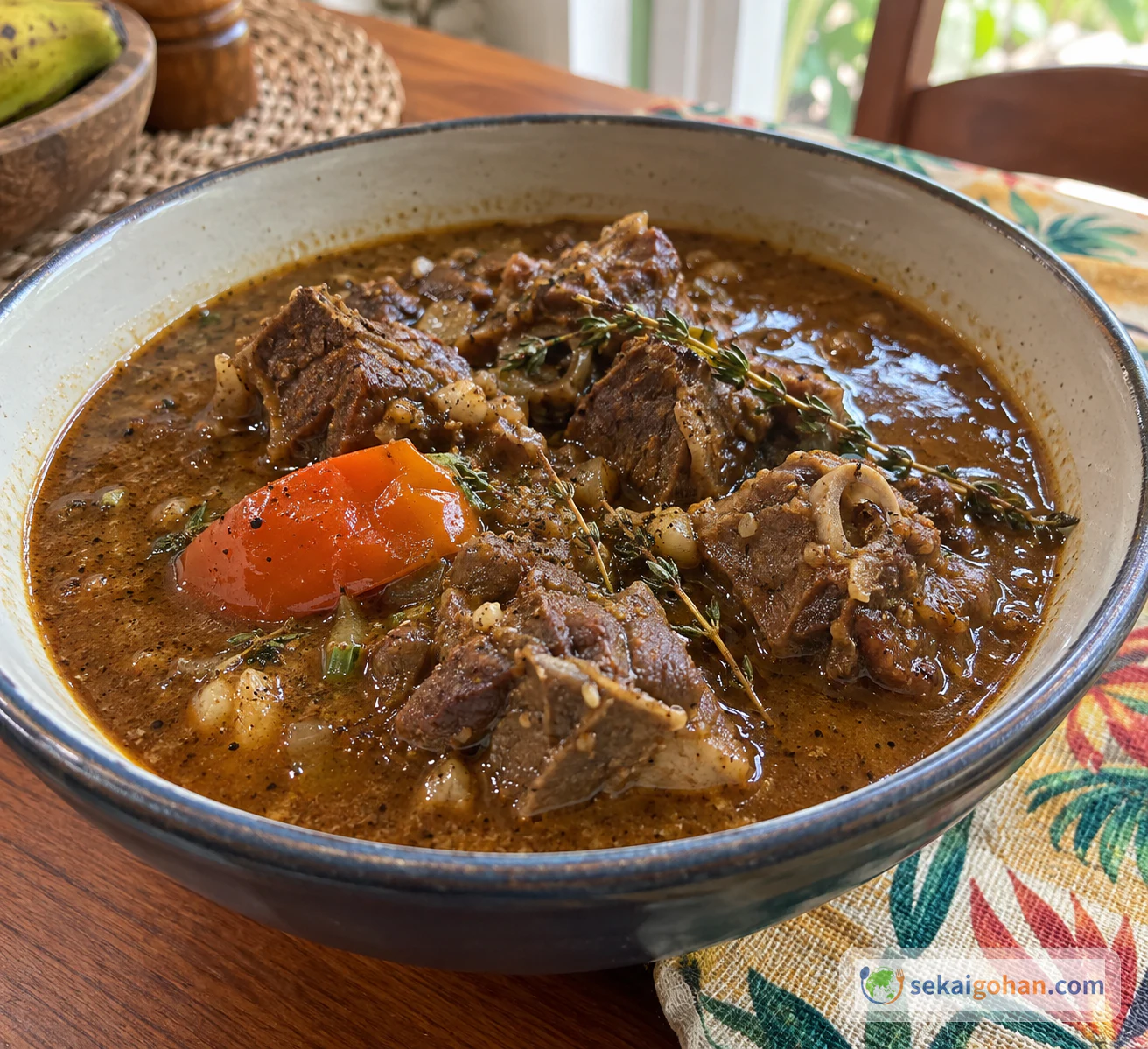
The ink-black broth comes as a surprise when you lift the lid. Then you cut into the pork stuffing, and a yellow yolk shows against the dark liquid, while a slow aroma of spices rises from the bowl. Relleno negro comes from the Yucatán Peninsula in Mexico. It is chicken stewed with tomato and onion in black recado, served with a large egg-filled pork meatball. It tastes of smoke, gentle bitterness and earth more than heat.
About relleno negro
Locally, relleno negro is often made with turkey. At home, bone-in chicken thighs or drumettes are easier to handle and easier to check for doneness. The black color comes from recado negro, also called chilmole, a seasoning paste of charred chilies, achiote, pepper, cumin, oregano, garlic and more. That mix of smoke, bitterness and earthiness is why the dish is not simply hot.
At a Yucatán table it arrives in a deep bowl, and you eat the turkey or chicken, the but, the egg and the black broth together. A tortilla picks up the filling and scoops the broth, and some people pour it over white rice. Break the yolk a little into the black soup. It looks bold, but the way of eating is homely.
In Spanish it is Relleno Negro. In the Yucatec Maya context it is sometimes called boox but', meaning a black stuffing or black meatball. The stuffing itself is called but.
Relleno negro and chimole
Dishes made with black recado share names and forms across Yucatán, Belize and Guatemala, so chilmole, chimole, Relleno Negro and Black Dinna sometimes appear side by side. Belize's chimole (in Japanese) is a home dish, close to a black chicken soup. Relleno negro adds the pork-and-egg stuffing, which makes it denser and more festive.
| What to look at | Relleno negro | Chimole |
|---|---|---|
| Main region | Yucatán Peninsula, Mexico | Belize and the Caribbean side |
| Local names | Relleno Negro, boox but', close to chilmole | Chimole, Chirmole, Black Dinna |
| Center of the dish | Chicken or turkey stewed in black recado, with an egg-filled but | A chicken soup stewed in black recado |
| Meat stuffing | Ground pork, egg and aromatics bound together | Added in some homes; often left out of the soup type |
| Hard part at home | The internal temperature of the but, and not scorching the black recado | Getting black recado, and not scorching the black broth |
Relleno negro layers chicken, black recado, pork stuffing and egg on one plate, with the black broth holding the meats together. Once you see that, the order of work is clear. For the contrast with central Mexico's sauce cultures, try mole poblano, which layers chilies and seeds, and tamales (in Japanese), wrapped in corn husks.
Ingredients (serves 4)

Turkey is closer to the local version, but it is hard to cook through in a home pot and hard to find. This recipe uses bone-in chicken thighs or drumettes. Shape the ground pork but separately, then simmer it in the same pot. On days without black recado, make the black base with the substitute paste. Don't try to char chilies black.
This dish contains chicken, pork, eggs and soy. Cook the ground pork but through to the center. With a thermometer, confirm 160°F (71°C) or above at the center. Chicken needs 165°F (74°C) at the center. Don't leave the stuffing mixed with raw egg at room temperature for long. Shape it, then move on to simmering right away.
Choosing black recado and other ingredients

The chicken, ground pork, eggs, onion and tomatoes are easy to find nearby. Black recado is the one to hunt for, since its supply outside Mexico is inconsistent. Buy it whenever you can. Its charred chili and spice aroma can't be fully replaced, but a home paste of achiote, allspice, cumin, oregano and a little unsweetened cocoa steers the flavor in the same direction.
Don't char chilies black in your own kitchen. It makes harsh smoke quickly, and a range hood alone won't protect you. Use store-bought paste or the substitute paste, and add extra heat and bitterness at the table.
Achiote doesn't make the dish black, but it gives the aroma at the base of recado-style dishes from Yucatán and Central America. For the substitute paste, crush achiote seeds, black pepper and oregano coarsely in a mortar to bring out their aroma. It takes more work than mixing powders, but the paste is less gritty and dissolves into the soup more easily. You'll reach for the jar again in tamales (in Japanese) and tacos al pastor, so it gets used up quickly.
Chicken and ground pork cook in the same pot, so a thermometer earns its place. Check the center of the stuffing and the chicken near the bone.
Method: layer the black aroma without scorching it
The steps look like a lot, but the order is simple. Season the chicken. Make the pork but. Dissolve the black recado. Brown the chicken and aromatics, then stew slowly in the black broth. Slice the stuffing and serve. Going slowly keeps the black sauce from turning rough.
Where relleno negro goes wrong

The dark color hides the warning signs: the broth looks black whether it is cooked or scorched. Judge instead by aroma, how the bubbles rise, temperature and the cut cross-section. A light bitterness belongs in the dish; a scorched one that comes to the front does not. To prevent it, dissolve the black recado in lukewarm water, don't boil it hard, and work from low to medium-low heat.
| Problem | Cause | How to fix |
|---|---|---|
| Strong bitterness | The black recado scorched on the bottom of the pot | Don't scrape the scorch; move the broth to another pot and thin with ½ cup (100 ml) water and 1 tsp lime juice |
| The but broke | Boiled over high heat, or the meat mixture was watery | Next time keep low heat at 85 to 95°C. This time return the crumbled meat to the broth and thicken it slightly |
| The center is red | The but is thick, or not simmered long enough | Return it in the cloth, cook 5 to 8 more minutes over low heat, and check the center temperature again |
| The chicken is tough | Boiled long, or boneless meat was cooked for the same time | With boneless, check step 6 at 20 minutes. This time, eat with plenty of broth spooned over |
| The color is pale | Too little black recado, or the substitute paste's color is weak | Dissolve 2 tsp more black recado, or 1/2 tsp achiote, in a separate dish before adding |
| Too hot | The habanero broke, or the black recado is a hot type | Remove the habanero and add ½ cup (100 ml) water, 1/2 tomato and 1 boiled egg, and simmer 10 minutes over low heat |
Serving and storing relleno negro
What to serve with it
| Menu | A day it suits | How to pair |
|---|---|---|
| Relleno negro, corn tortillas, lime | A holiday Yucatecan menu | Take up a little of the but and chicken at a time with tortillas |
| Relleno negro, white rice, cucumber dressed with lime | A dinner easy to make at home | Spoon the black broth over rice and cut it with a sour side |
| Relleno negro, tamales (in Japanese), tomato salad | A day to line up Mexican dishes | Compare the corn dough with the black broth |
| Relleno negro, a little chimole (in Japanese), lime | A day to compare black recados | Compare the same black stews with and without the stuffing |
For a home dinner, white rice is the staple. The broth is strong, so rather than piling the rice up like a donburi, tuck a little at the edge of the bowl to soak up the broth. If you buy tortillas, choose corn over wheat; corn ties in with the charred aroma of the black recado.
Skip rich cheese dishes on the side. Small, cooling things work better: cucumber squeezed with lime, thinly sliced onion, tomato and chopped cilantro keep the meal from feeling heavy to the end. And if you want to keep exploring how corn, chilies and meat connect, try a big-pot soup like pozole rojo (in Japanese) or tlayuda (in Japanese), where a toasted tortilla holds the toppings.
Storage and reheating

Relleno negro contains chicken, ground pork and eggs, so cool it quickly once the heat is off. Put the chicken and broth in separate shallow containers and store the but uncut in another. Eggs harden on reheating, so combine them with broth only for what you'll eat the next day, and finish them the same day or the next.
Refrigerate for up to 2 days. To freeze, portion only the chicken, broth and but, without eggs; they keep 3 weeks in the freezer. To reheat, put 1 portion and 2 tbsp water in a small pot and warm over low heat for 6 to 8 minutes, until the edge of the broth bubbles and the chicken is hot through to the center. Boiling hard toughens both the chicken and the but. In the microwave, heat at 600 W for 2 minutes, stir once, then add 1 more minute. Warm the eggs briefly, then cut in half.
The next day, the black recado aroma has soaked into the meat and the edges are softer than on the first day. If the broth has thickened too much, add 3.5 tbsp (50 ml) water and cook 5 minutes over low heat. If it tastes too salty, a few drops of lime cut the heaviness.
Frequently asked questions
Can I make it without black recado?
You can, though it will be relleno negro style rather than the real thing. The substitute paste points the flavor in the same direction with achiote, allspice, cumin, oregano, and a little bitterness and acidity. If you like the result, look for black recado next.
Is chicken instead of turkey fine?
At home, chicken works well. Turkey is closer to the local version, but outside Mexico it is hard to find and hard to fit in a home pot. Bone-in thighs or drumettes bring savoriness to the broth. If you use boneless thighs, check once at about 20 minutes into the simmer in step 6.
Can I make it with just chicken, without the but?
You can, but then it becomes a black chicken stew close to chimole. If the full version feels like too much work the first time, divide the but into 4 small meatballs and serve the boiled eggs separately.
How hot is it?
Heat depends on the black recado. It is not as fiery as it looks, but a hot paste or a habanero makes it strong fast. When the whole family eats, leave the habanero out of the pot and add pepper sauce at the table, so each bowl can be adjusted.
- Yucatán Today: Recipe for Relleno Negro: Consulted for boox but', recado negro, the makeup of the but, and how turkey, chicken and pork are used.
- Yucatán Today: The best types of Recado in Yucatán: Consulted for the ingredients of recado negro, charred chilies, spices and uses in Yucatán.
- En Yucatán: Receta del Relleno Negro: Consulted for how to make the but, the egg, ground pork and the flow of wrapping in cloth.
- Wikipedia: Relleno negro: Consulted for basic information such as the dish's region, turkey, pork, chilmole and egg.
- FoodSafety.gov: Safe Minimum Internal Temperatures: Consulted for safe internal temperatures of 165°F (74°C) for chicken and 160°F (71°C) for ground meat.