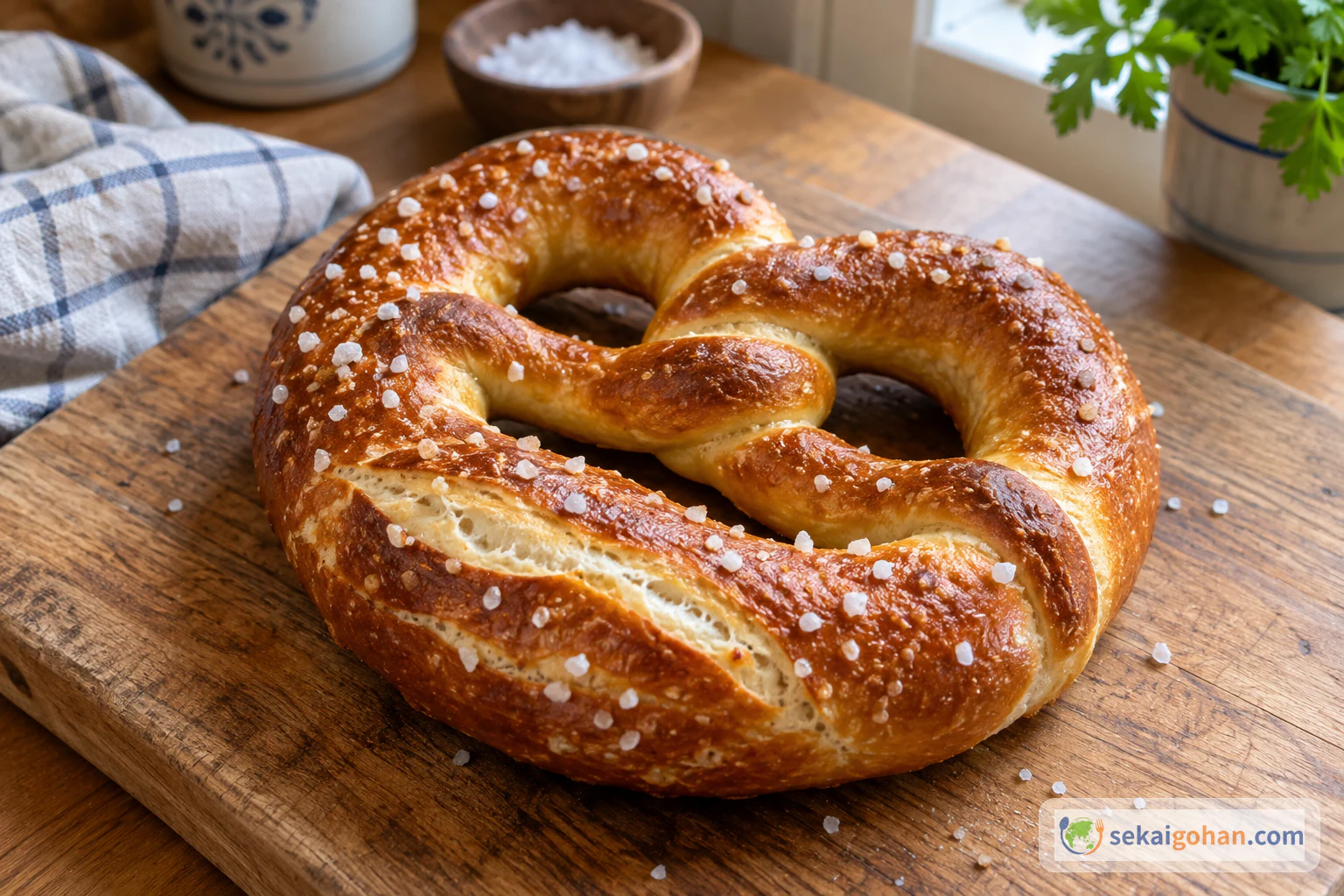
Baked knot-shaped pretzels with a deep amber crust and coarse salt on a wooden board, showing a plump belly, thin arms and variations in browning
Serves10 pretzels
CuisineGerman

German-Style Pretzels: A Laugenbrezel-Style Knot Baked After a Baking Soda Bath

How to make German-style pretzels at home: a bread-flour dough shaped into knots, chilled, dipped in a boiling baking soda bath and baked at 450°F until deeply browned. Covers kneading, folding, shaping, the difference between a baking soda bath and the lye used for true Laugenbrezel, the Bavarian and Swabian shapes, and eating them warm with butter and chives.

Cooking flow

Cooking steps

STEP 11 / 8

Mix and knead the dough

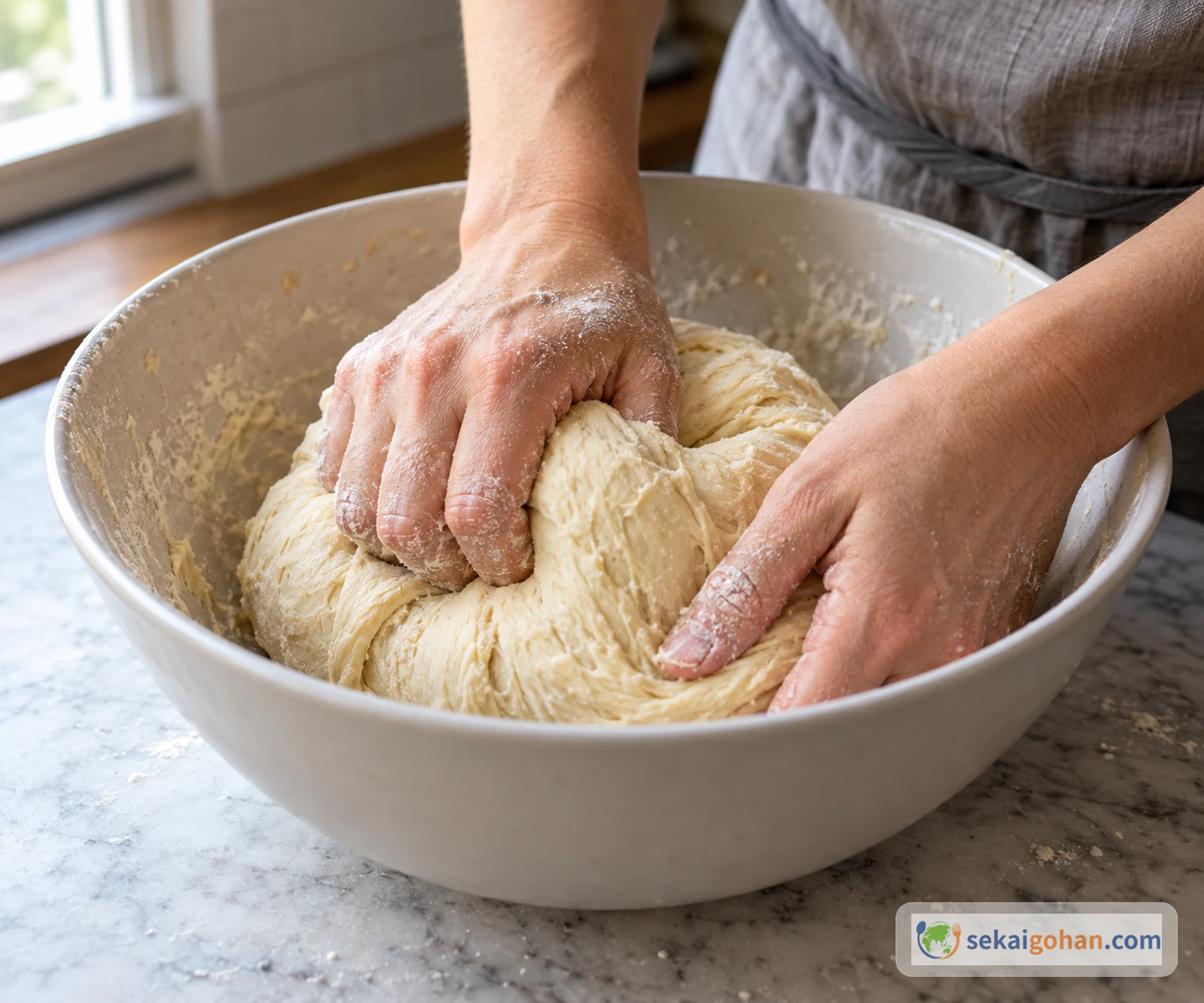
Hands kneading flour, water, salt, instant yeast, softened butter and optional malt powder into a smooth, elastic dough
Knead until the dough is even and springs back

Combine the flour, water, salt, instant yeast, softened butter and the optional malt powder, and knead into an elastic dough. In a stand mixer, mix for 3 minutes on low speed, then knead for about 5 minutes on medium speed. By hand, don't hold yourself to a fixed time; knead until the dough is even and stretches without tearing.

STEP 22 / 8

Let it rise for 45 minutes

STEP 2

Cover the dough and let it rise for 45 minutes. In the container, the dough relaxes and becomes ready for the fold that follows.

STEP 33 / 8

Fold from four sides and rise for another 45 minutes

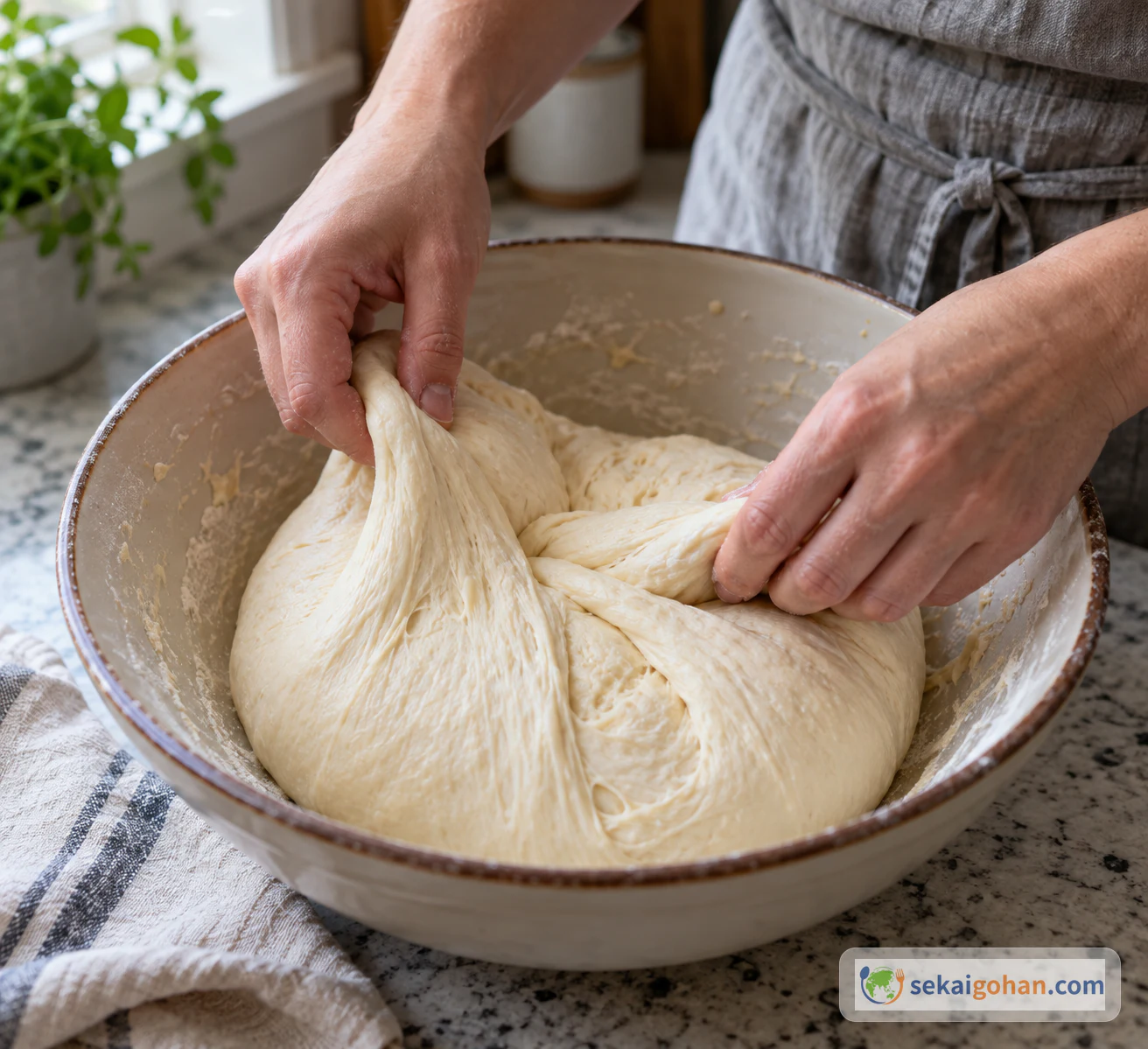
Folding the rested dough in the bowl from four sides after its 45-minute rise
Fold the dough in from all four sides, then cover it again

Fold the dough in from each of its four sides, four folds in all. Cover it again and let it rise for another 45 minutes. The folding helps build the dough's structure.

STEP 44 / 8

Divide into 10 and rest for 20 minutes

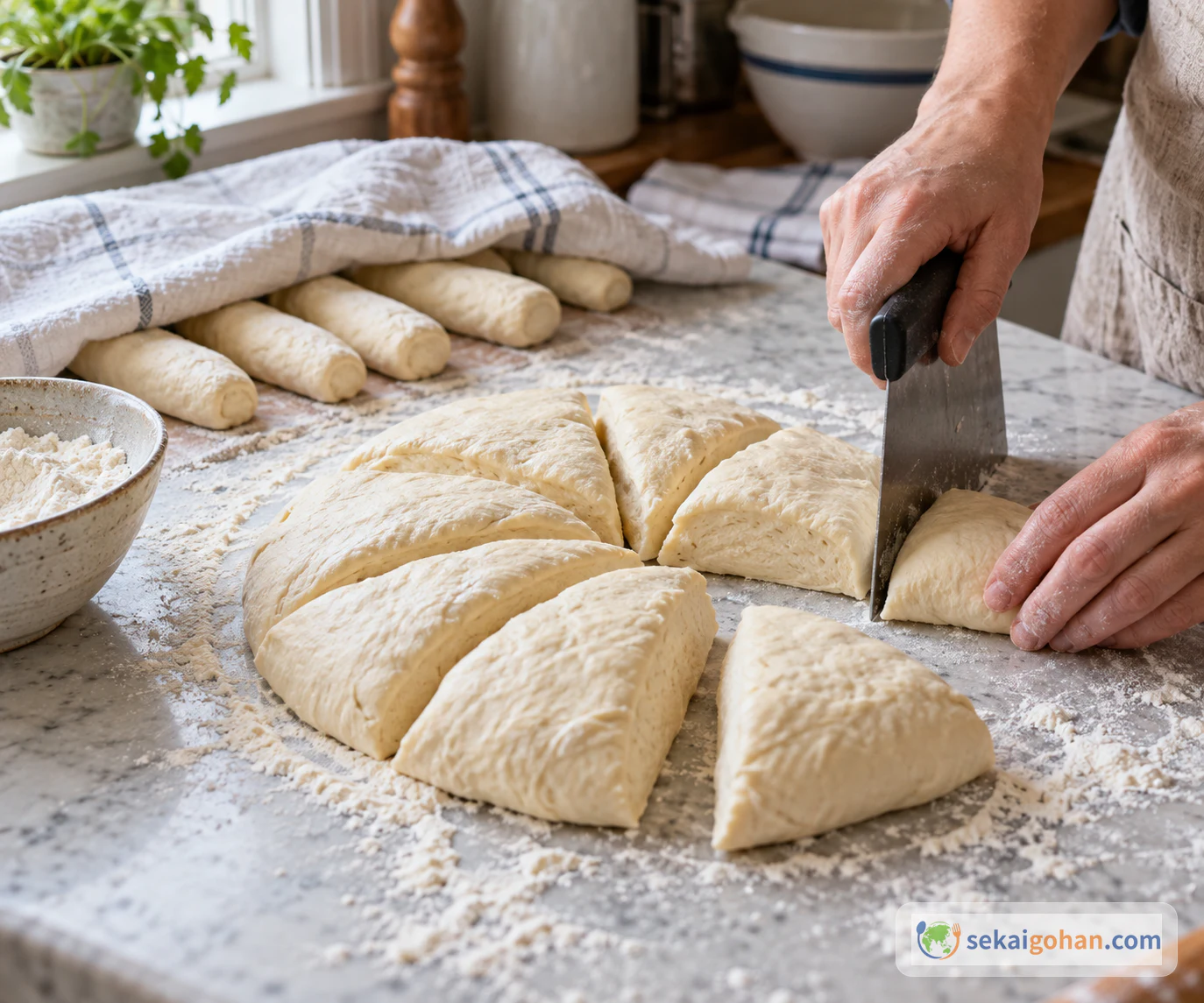
Dough divided into 10 pieces after its second rise, shaped into short logs and resting
Divide into pieces of about 100g and let the short logs rest under a cover

Gently deflate the dough and divide it into 10 pieces of about 3.5 oz (100g) each. Shape each piece into a short log, cover, and rest for 20 minutes. Resting makes the logs easier to roll into long ropes.

STEP 55 / 8

Roll long ropes and tie the knots

A rope of dough, thick in the middle and thin at the ends, bent into a U and crossed, with the ends being pressed onto the belly
A thicker center becomes the belly; the thin ends become the arms

Roll each piece into a rope about 18–22 inches (about 46–56 cm) long, keeping the center slightly thicker. Bend it into a U, cross the ends, and press them onto the lower part of the belly. This is the basic shape.

STEP 66 / 8

Chill the shaped pretzels, covered

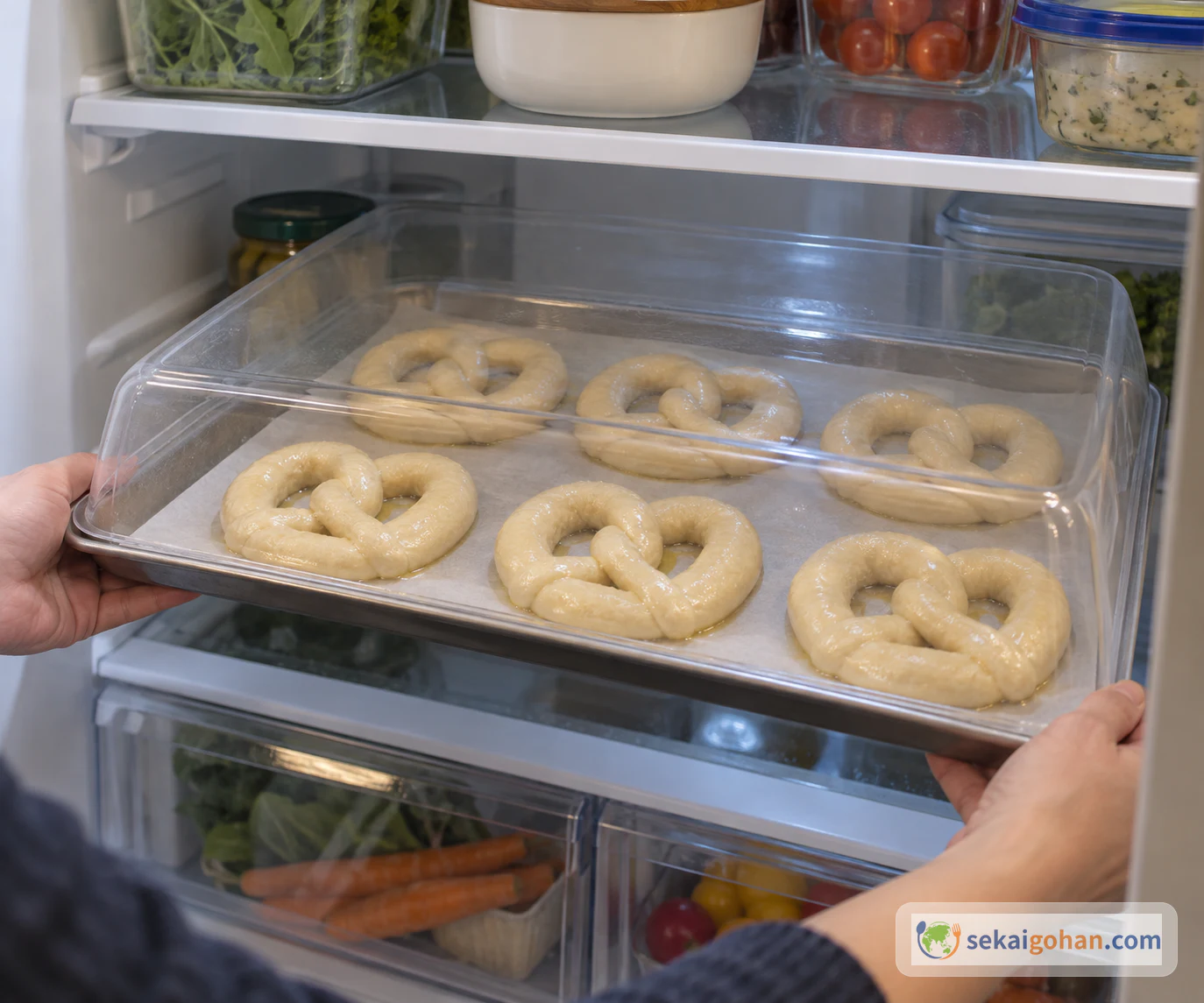
Shaped pretzel dough on a covered baking sheet going into the refrigerator to chill thoroughly
Keep the cover on while the shaped dough chills

Place the shaped pretzels on the parchment-lined baking sheet. If your kitchen is especially warm, refrigerate them right away. Otherwise, let them rest covered at room temperature for about 30 minutes, then refrigerate them for about 60 minutes until thoroughly chilled. Keep them covered with the lightly oiled cover while they chill.

STEP 77 / 8

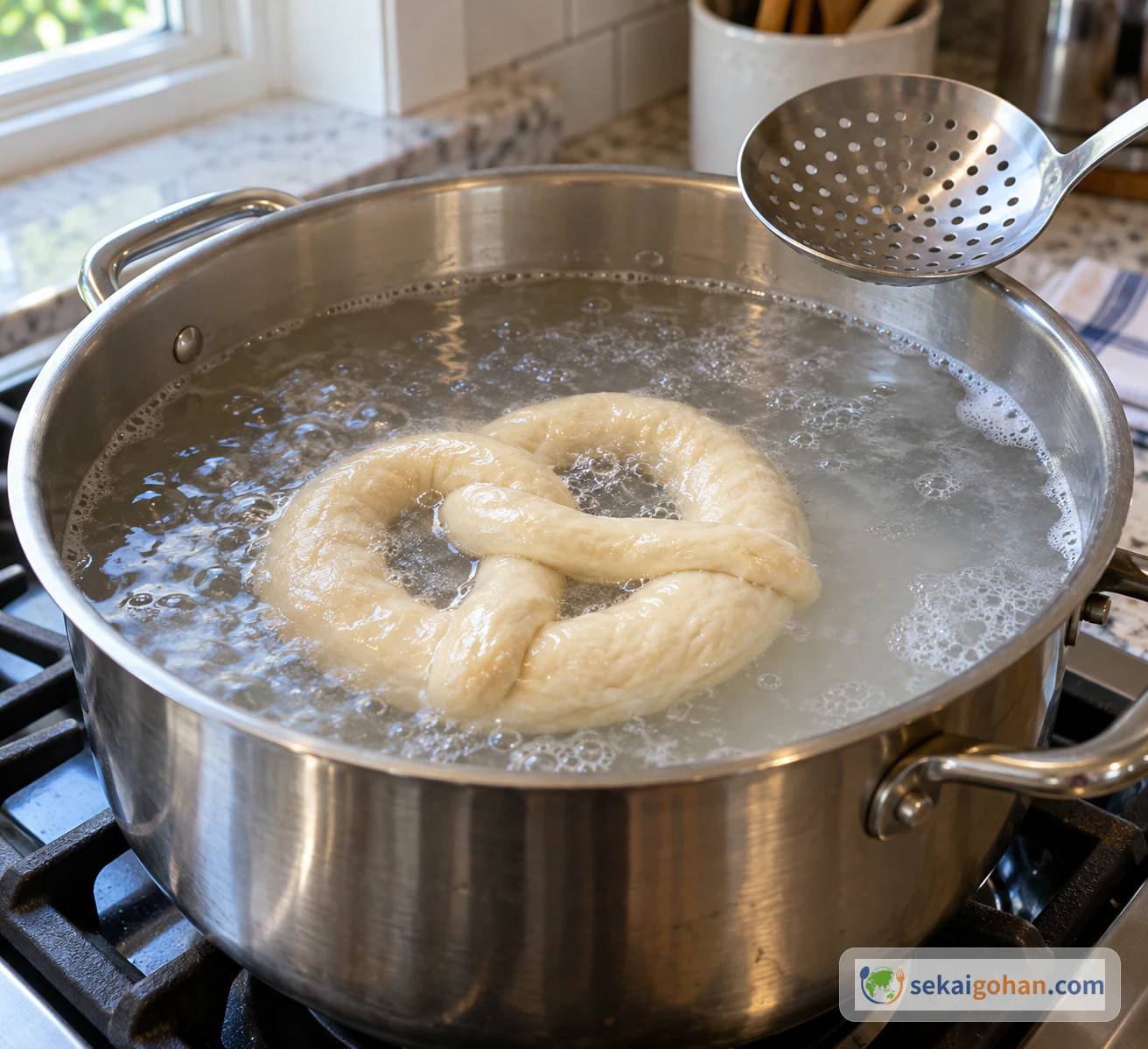
Boil the baking soda bath and dip the chilled dough

Chilled shaped dough in food-grade baking soda water in a wide pot, left for 1 minute in total without turning
A few at a time, 1 minute in total, without turning

Preheat the oven to 450°F (about 232°C). Bring the 1361g water and 36g baking soda to a boil in a wide pot. Lower the chilled pretzels into the bath 3 or 4 at a time and leave them in for 1 minute in total, without turning them over. Do not give each side its own minute. Lift them out and return them to the baking sheet. The liquid in the pot is a baking soda solution, not lye.

STEP 88 / 8

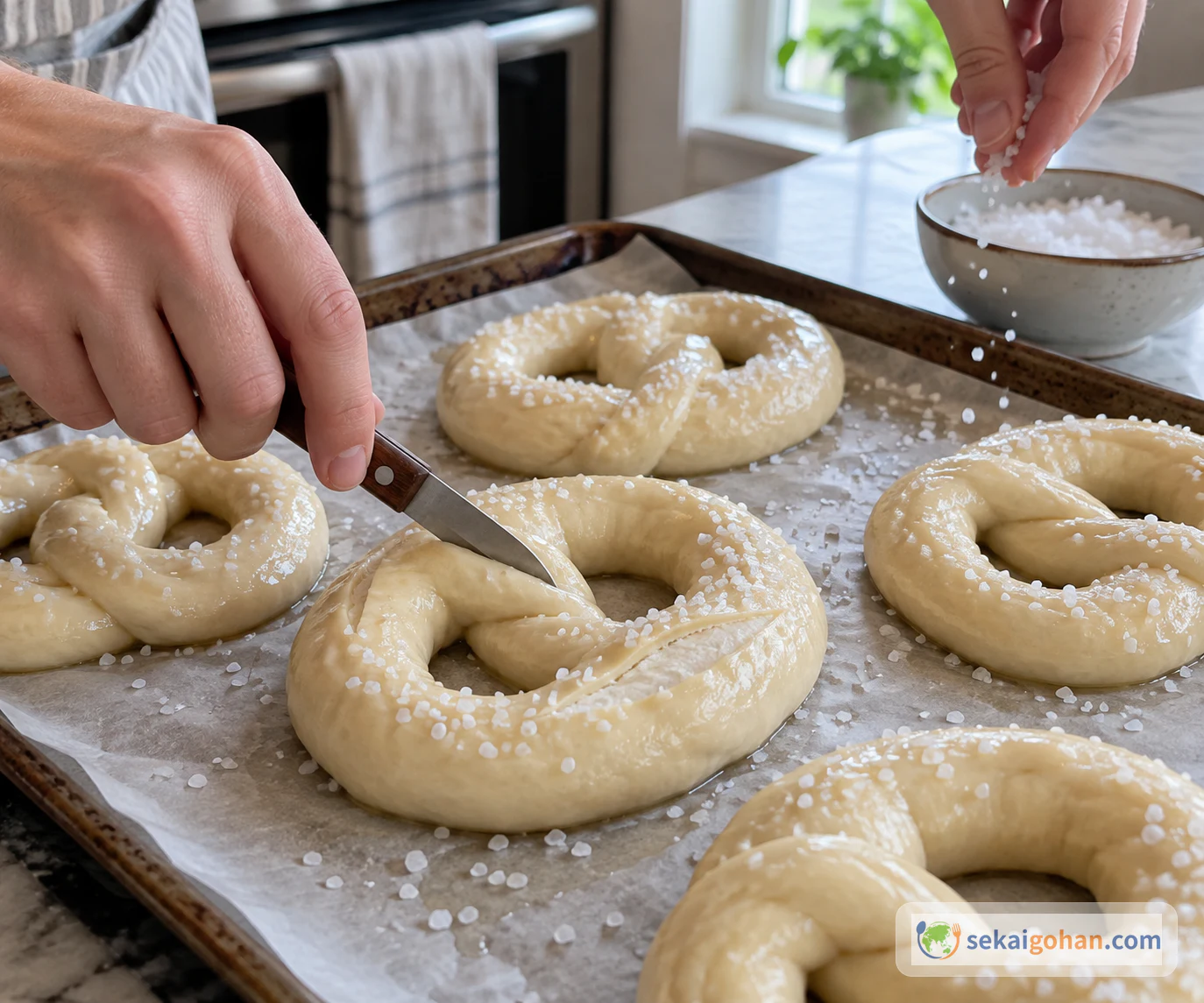
Slash, salt and bake for 14–16 minutes

Dough lifted from the baking soda bath, with a shallow slash in the belly and coarse salt scattered on top, arranged on a baking sheet before baking
Slash the belly and salt the damp surface before baking

Cut a horizontal slash across the belly of each pretzel and sprinkle with coarse salt, if using. Bake in the preheated oven for 14–16 minutes, until well browned all over. Cool on a rack.

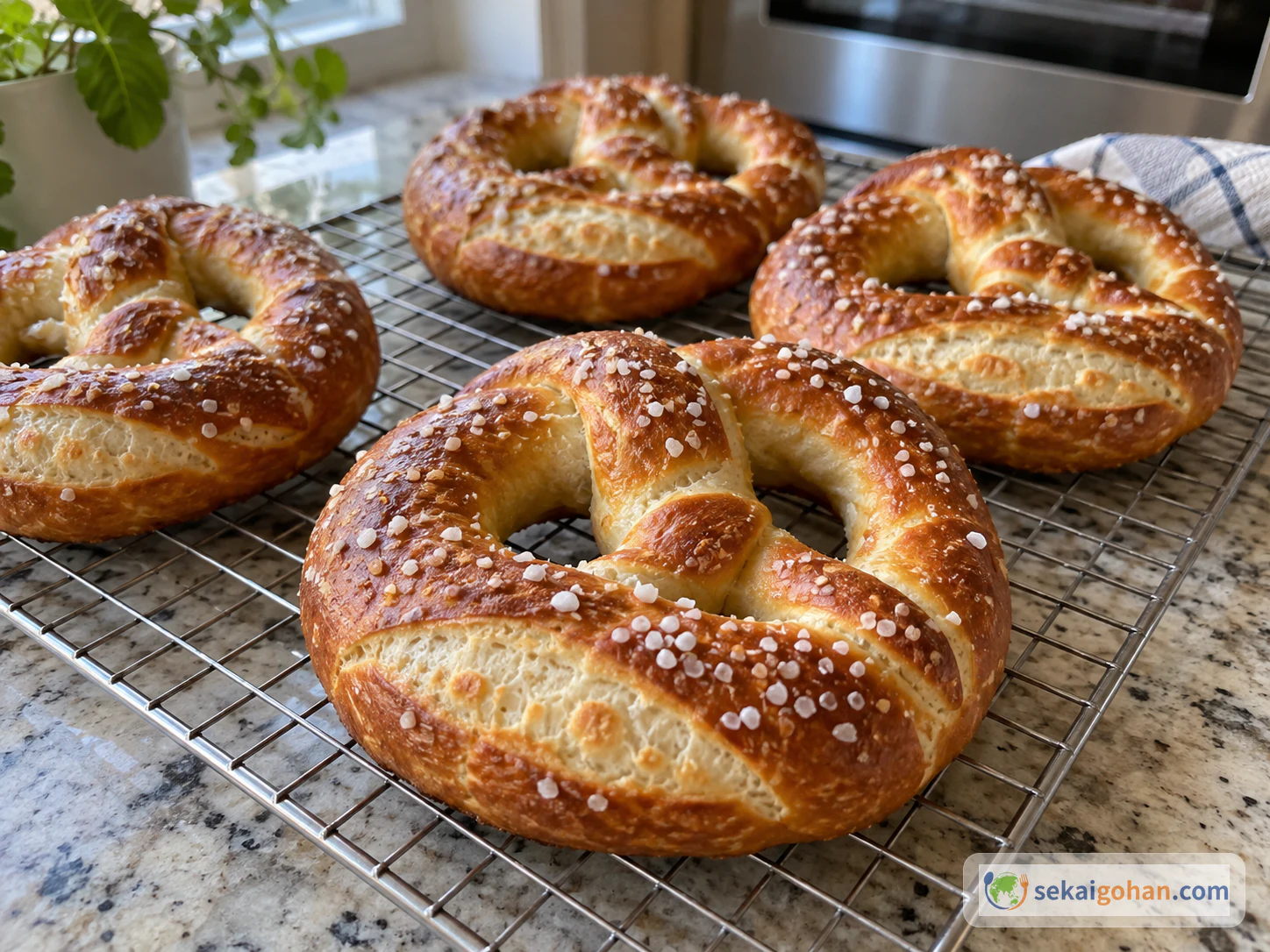
Deeply browned pretzels cooling on a rack after baking for 14–16 minutes at around 230°C (450°F)
Bake until browned all over, then cool on a rack
0 / 0
Ingredients

Ingredients

1 / 1

Ingredients

Ingredient Amount Role
Bread flour (unbleached) 1.25 lb (614g) The dough. Weigh it rather than measuring by volume
Water 11.5 oz (333g) The dough
Table salt 12g Seasons the dough
Instant yeast 1 1/4 tsp Rises the dough
Butter, softened, unsalted 1 oz (28g) Fat in the dough, for a tender bite
Diastatic malt powder 1/4 tsp, optional Can be left out
Water (for the bath) 3 lb (1361g) The bath for the shaped dough
Baking soda (sodium bicarbonate), food grade 1.25 oz (36g) The home alternative to a lye bath. It does not give the same color or flavor
Coarse salt (pretzel salt or other coarse salt) Optional, as desired Topping
Oil A little, as needed To brush lightly on the cover so it does not stick to the dough
Butter (for serving) Optional, as desired Served alongside, separate from the 1 oz (28g) in the dough
Chives (for serving) Optional, as desired Served with butter on warm pretzels
0 / 0

A pretzel comes out of the oven deeply browned, its salt crystals catching the light. Tear it open while it's still warm, spread it with butter and scatter chives on top. This is a home take on the German Laugenbrezel: a salted knot with chewy arms and a soft belly. Instead of the traditional lye dip, it is boiled in a baking soda bath, which gives a lighter color and a gentler flavor than a bakery pretzel.

German Pretzels: Names, Shapes and Origin

In German the bread is called Brezel, or Brezn in Bavaria, and the lye-dipped version is Laugenbrezel. Before baking, its surface is treated with an alkaline bath, traditionally lye (food-grade sodium hydroxide), and that bath is what gives a Laugenbrezel its dark color and distinctive surface. A baking soda bath gets you close at home, though the color, aroma and surface will differ from a lye-dipped pretzel.
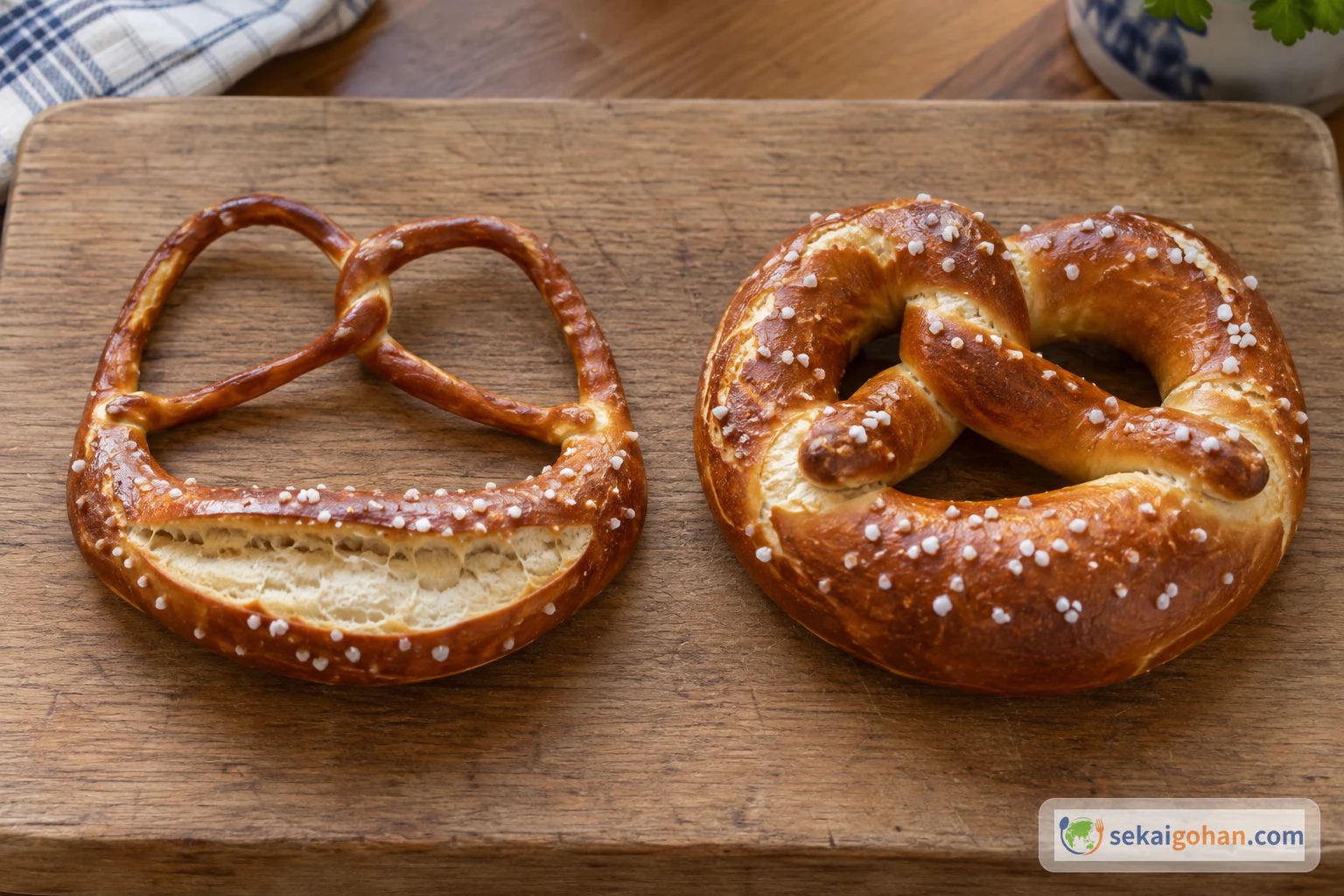
A Swabian-style pretzel with thin arms and a slashed thick belly beside a Bavarian-style pretzel with thicker arms and no slash, on the same board
Left: thin arms and a slashed belly. Right: thicker arms and an unslashed belly

The two southern shapes are easy to tell apart:

Shape Arms Belly
Swabian Thin Thick, with a cut that stays pale
Bavarian Thicker Usually not cut; the surface cracks open as it bakes

Pretzels belong to more than one region. Northern Bavaria also has a salted pretzel made without Lauge. Nobody knows where the knot shape comes from, though there are several legends, including that it imitates arms crossed in prayer and the story of a baker named Frieder.
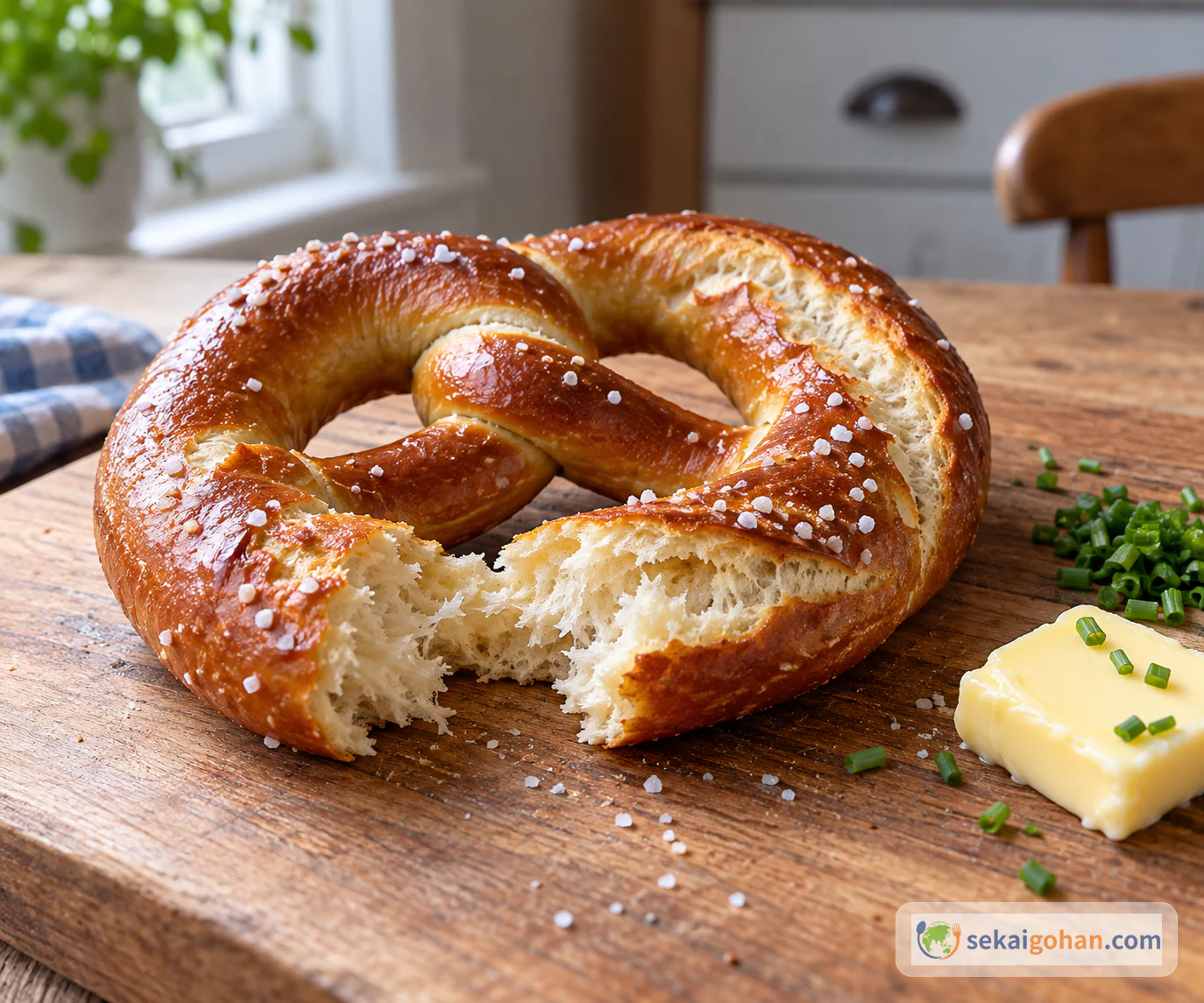
A breakfast table with a warm pretzel torn open, with butter and chives alongside
Warm pretzel with butter and chives, one way of eating it described in the Goethe-Institut feature

In Germany, pretzels are an everyday snack. Children take them home, and they show up at weekend breakfast, freshly baked and spread with butter, sometimes with chives on top.

Ingredients: 10 Pretzels from One Dough and One Baking Soda Bath
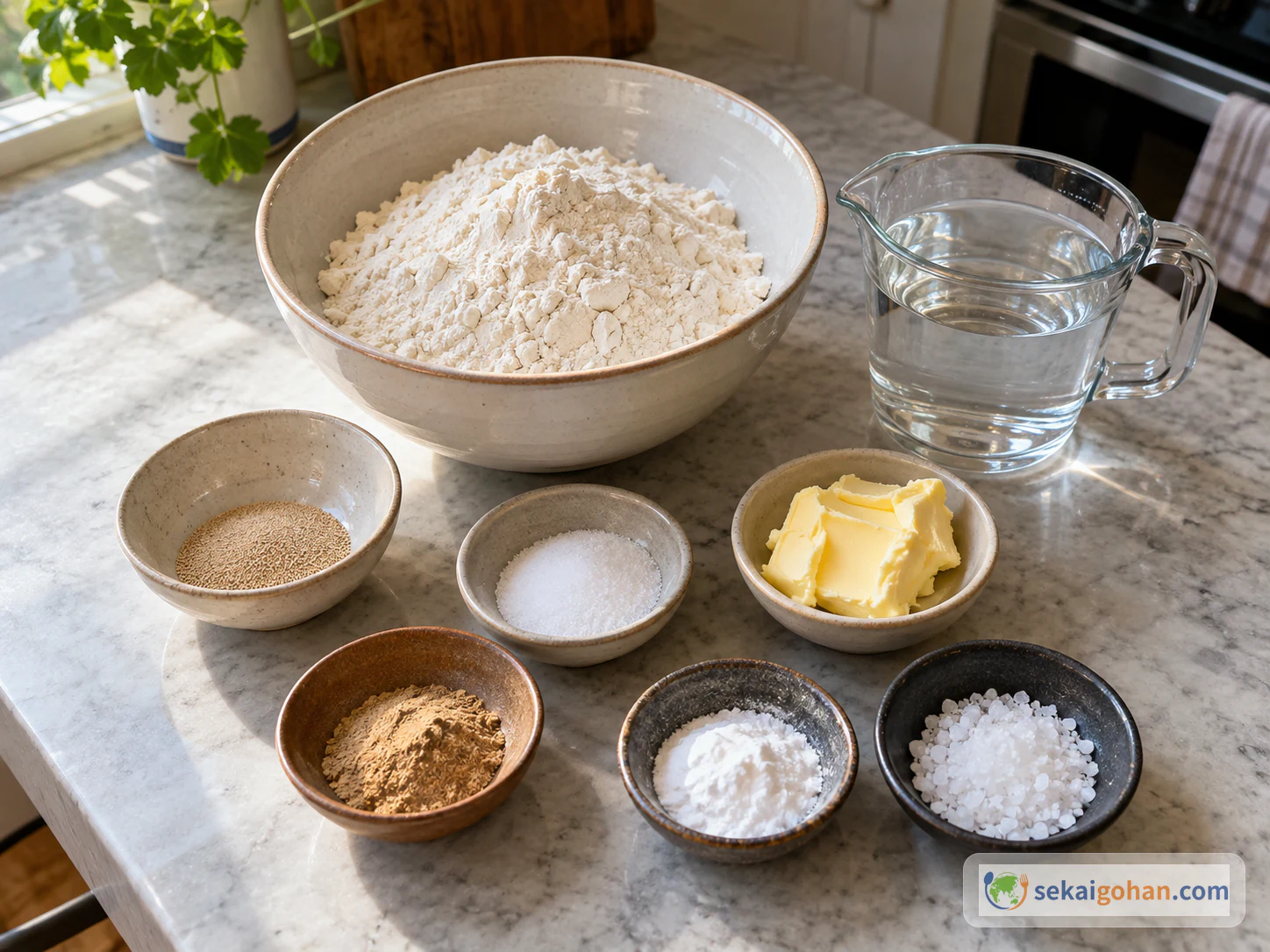
Bread flour, water, instant yeast, salt, unsalted butter, optional malt powder, baking soda and coarse salt divided into small dishes and bowls by stage
Keep the dough ingredients, the bath and the topping separate

Add all the dough ingredients at the mixing step. The water and baking soda go into the pot for the bath, and coarse salt goes on top just before baking.

Allergens and baking soda

This recipe contains wheat (gluten) and milk (butter). Cross-contact depends on your own kitchen, so check every ingredient label if someone has an allergy. Use baking soda sold for food, not baking soda or other products sold for cleaning.

Choosing Flour, Butter, Malt and Baking Soda

  • Flour: Use unbleached bread flour. Brands absorb water differently, so keep the amounts as written and watch how the dough looks and feels when you start kneading.
  • Butter: Use unsalted butter.
  • Malt powder: Optional. The pretzels are fine without it.
  • Baking soda versus lye: The baking soda bath is the home method here. Food-grade lye also works, but it requires protective equipment and gives a different result.

Equipment

  • Stand mixer (optional; the dough can also be kneaded by hand)
  • Bowl for rising the dough
  • Cover for the dough (such as plastic wrap), lightly oiled
  • Baking sheet lined with parchment paper (check the parchment's heat-resistance limit for a 450°F oven)
  • Wide pot for the baking soda bath
  • Sharp knife or blade for slashing the belly
  • Oven
  • Cooling rack

Method: Mix, Fold, Shape, Chill, Bathe and Bake

Read the temperature carefully

Bake at 450°F (about 232°C). If your oven uses Celsius, 230°C is a rounded setting. The baking time of 14–16 minutes is for one sheet; if all 10 do not fit without crowding, bake in batches, and there will be waiting time and extra baking.

Common Pretzel Problems and Fixes

Home kitchens vary, so judge the rises by the state of the dough as well as by the clock. If something goes wrong, check here:

Problem What to check What to do
The rope shrinks back as you roll it The dough is resisting Don't pull hard. Cover it and let it rest a few minutes before rolling again
The knot comes undone The ends were not pressed on firmly Press the ends firmly onto the belly, and chill so the surface settles before the bath
The color is pale A baking soda bath was used Baking soda gives a lighter finish than a lye bath
The dough feels dry or stiff A different flour was used Brands absorb water differently. Observe the dough before changing the water amount

Serving, Storing and Varying Pretzels

Serve pretzels with white sausage and sweet mustard, or simply warm with butter. If you prefer them milder, sprinkle on less coarse salt and serve with unsalted butter. The same dough also works for either regional shape: thicker arms and an unslashed belly for Bavarian, or thin arms and a slashed thick belly for Swabian. For more German dishes, see our Germany page.

Storage: Wrap the pretzels and keep them at room temperature for up to 3 days. For longer storage, freeze them.

Frequently Asked Questions

Can I make pretzels without lye?

Yes. This recipe uses a baking soda bath instead. Use baking soda labeled for food, and never substitute cleaning products. If you use lye, wear protective equipment.

Why slash the surface?

This recipe calls for a horizontal slash across the belly, as on a Swabian pretzel. Bavarian pretzels are usually left uncut.

Can I make the dough without butter?

Leaving out the butter makes this a different recipe; the texture and flavor would change.
Sources

  • King Arthur Baking, "German-Style Pretzels." The formula introduced as Jeffrey Hamelman's German-style pretzel, including all ingredients and amounts, the yield of 10, mixing, rising, folding, dividing, shaping, chilling, the baking soda bath, the 450°F baking temperature and 14–16 minute time, storage, and the note that food-grade lye requires protective equipment and gives a different result from baking soda. https://www.kingarthurbaking.com/recipes/german-style-pretzels-recipe
  • Goethe-Institut / The Big Ponder, "THE BIG POND Folge 22: The Story of the Brezn." Legends about the pretzel's origin and the uncertainty of its shape's history, the Swabian and Bavarian shapes as described by interviewees, eating pretzels warm with butter and chives, as a children's snack and at weekend breakfast, and regional differences including salted pretzels made without Lauge. https://www.goethe.de/prj/tbp/de/bpa/sto.html
  • SBS Food, "Pretzels (laugenbrezeln) recipe." A separate home recipe using a baking soda solution, and its suggestion of serving pretzels with white sausage and sweet mustard. Used only as supplementary reference; its formula is not mixed into this recipe. https://www.sbs.com.au/food/recipe/pretzels-laugenbrezeln/as8uuf63b