Lift the lid of the pot and the garlic reaches you before the vinegar. It has soaked up the braising liquid, and its scent comes up mixed with black pepper and chicken-skin fat, with the sharpness of the vinegar underneath. Chicken adobo, one of the Philippines' best-known dishes, braises chicken in vinegar, soy sauce, garlic and black pepper until it tastes sour, salty and rich at once. Equal parts vinegar and soy sauce are only the starting point. How long you boil the vinegar, how long the meat cooks over low heat and how much liquid you leave at the end decide the flavor. If the chicken is going over white rice, leave the sauce loose. If you want a deep glaze on the meat, take the lid off and cook it down a little more.
Chicken Adobo in the Philippines
How adobo is eaten
Adobo changes from household to household and from region to region. The best-known form braises chicken or pork in vinegar, garlic and black pepper. There is also adobo puti, made without soy sauce, and adobo sa gata, made with coconut milk, as well as versions with beef or water spinach (kangkong).
At a Filipino table, adobo is usually the main dish, eaten with white rice and served with vinegar or a dipping sauce. How much braising liquid you leave decides how it gets eaten. Some cooks leave enough to spoon over the rice, and others reduce it until it coats the meat, with the amount of meat changed to suit the table. These differences between households aren't mistakes in the formula. They show how each family uses the dish.
Adobo also has plenty of relatives. Coconut milk and heat lead to Bicol Express (in Japanese). Pinakbet and laing show how vinegar and fermented seasonings work with vegetables, and monggo makes beans the star. Embutido is a baked pork roll, and it shows what happens when meat is bound with vegetables and egg instead of braised in vinegar.
Origin of the name
There's more than one explanation for the name. Some people link it to a foreign word, but the name alone doesn't explain why the dish is built on vinegar and garlic. In 2021, there was a move to standardize several representative dishes, adobo among them. It didn't force home cooks into one formula. Instead it took regional differences into account, including bay leaves, black pepper, soy sauce, vinegar, coconut milk and atsuete (annatto).
Regional styles of adobo
| Style | How flavor and ingredients move | How to approach it at home |
|---|---|---|
| Basic chicken or pork | Vinegar, garlic, black pepper and bay leaf, with the saltiness of toyo or soy sauce layered on | Make it with rice vinegar and regular soy sauce, and adjust the final reduction |
| Adobo puti | No soy sauce; the meat finishes pale | Leave out the soy sauce and taste starting from 1/2 tsp salt. A pale color doesn't have to mean a weak flavor |
| Adobo sa gata | Coconut milk softens the edges of the acidity and fat | After making the basic version, combine ½ cup (150 ml) of the braising liquid with ¾ cup (200 ml) coconut milk |
| Versions with vegetables | Water spinach or banana blossom combined with the meat | Add water spinach in the last 3 minutes to keep the texture of the leaves |

Adobo sits on the table with rice and a sour condiment.
At home, decide on a starting point instead of hunting for one original form. Think about how much sourness, saltiness and fat you want, and how much sauce you'd like for the rice. Once you know that, substitutions become much easier to make.
Ingredients (serves 4)
This amount is a starting point, with soy sauce and vinegar at close to 1 to 1. Filipino cane vinegar is often rounder in aroma than rice vinegar. If you cannot find it, use rice vinegar. Only with distilled grain vinegar, increase the water to ¾ cup (200 ml) and check the acidity after reducing. Sugar is not in the basic version. To add sweetness, add just 1 tsp right before finishing; this keeps the aroma of the vinegar.
Some soy sauces contain soy and wheat. If you have an allergy, check the label and switch to a wheat-free tamari or similar. Tamari can be strong in saltiness and color, so start with 3.5 tbsp (50 ml) and add after tasting the braising liquid.
Buy cane vinegar once you have made adobo a few times and want a rounder acidity than rice vinegar gives. If you can only get rice vinegar, the basic version still works, so you don't need to hunt for a special vinegar.
If you pile fried lumpia Shanghai or the noodle dishes pancit bihon and pancit canton onto a main dish served with sauce over white rice, strongly flavored dishes follow one after another. On the day adobo is the center, serving a vegetable or a soup rather than lining up such dishes all at once keeps the acidity of the braising liquid easier to preserve.
Choosing Vinegar, Soy Sauce and Coconut Milk
For a first batch, use regular soy sauce and rice vinegar. Rice vinegar is milder than Filipino cane vinegar. Cane vinegar keeps the vinegar's aroma clearer, so it's a good choice for your next pot, once you know the basic flavor.
In the first pot, you'll notice the effect of heat more clearly than the effect of the vinegar you chose. Save cane vinegar or coconut milk for the next batch.
Soy sauce varies by region too. Filipino toyo is one of the sauces added at the table, mixed with vinegar, calamansi and garlic, and some brands taste darker and saltier than Japanese soy sauce. Regular dark soy sauce won't taste like a Filipino product, so start with 3.5 tbsp (50 ml) and taste the braising liquid before adding more. Many soy sauces, toyo included, list soybeans and wheat among their ingredients, so read the ingredients and allergen labels every time you switch brands.
Coconut milk is only worth buying if you want to try the Bicol style. If this is your first adobo, or you don't like the scent of coconut, start with the basic version. When you do buy it, look for a 1¾ cup (400 ml) can of a cooking product whose ingredients are coconut milk, water and citric acid.
Whole black pepper releases its aroma slowly. Crush it coarsely with the flat of a knife or in a mortar so the aroma rises with the garlic. A mortar works if it comes with a pestle and is deep enough to crush the peppercorns and large enough to hold the garlic. If a knife does the job, or you'd rather not store another tool, skip it.
Fixing the Balance of Chicken Adobo
The last few minutes change the character of adobo. With the lid on, the sour braising liquid stays around the meat. With the lid off, the liquid reduces and the saltiness of the soy sauce and the fat of the chicken come forward. For plenty of sauce over rice, stop while the liquid still flows loosely. For a sauce that coats the meat, reduce until the bottom of the pot shows for a moment when you draw a spatula through it.
Leave a little of the vinegar's sharpness. Even after the sharp smell has gone from the steam, a brief sourness in the mouth keeps the fat from the chicken skin from feeling heavy. That's the difference from sinigang, which puts its acidity in the soup, while adobo works it into the meat. Humba braises pork in vinegar and soy sauce down to a glaze, and comparing the two shows why adobo keeps some of its liquid.
If the liquid tastes too salty, take out the chicken and then add water. If the acidity is too sharp, adjust with a little sugar and water. Don't reduce for a long time with the chicken still in the pot, because the meat will dry out.
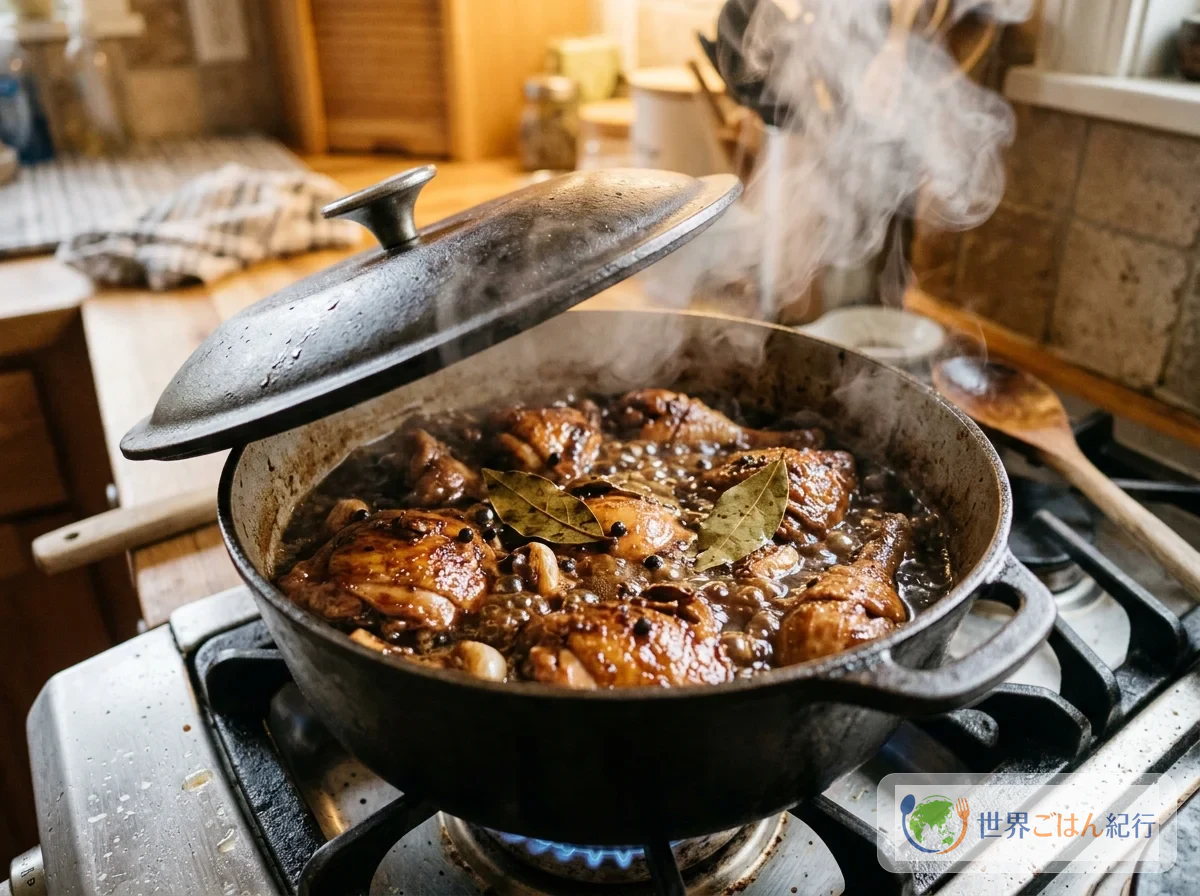
Next time, change only one thing: either the kind of vinegar or the amount of braising liquid you leave. That's the quickest way to find the adobo you like.
Serving, Variations and Storage
Serving adobo
White rice is the centerpiece, because it soaks up the acidity and saltiness. For a side, pick something watery, like leafy greens or cucumber, and the braising liquid will stand out. Lighter partners work well too: tortang talong for a vegetable side, or chicken tinola or sinigang for soup, since they don't repeat the sour braise.
Avoid stacking another fatty meat next to it. Skip a second chicken dish like the smoky grilled chicken inasal, and leave out longganisa or dinuguan so adobo stays the main dish. If you want the punch of pork fat and garlic, add just a small amount of sisig.
Adobo puti and adobo sa gata
Adobo puti braises mainly with vinegar, garlic, black pepper and bay leaves. Without soy sauce to give it saltiness and shape, don't over-reduce the liquid. Keep the aroma of the vinegar and the fat of the chicken, and taste for salt at the end.
Adobo sa gata comes from the Bicol region, where coconut milk softens the edges of the vinegar and the chicken fat. Make basic adobo first, then combine the braising liquid and coconut milk in a separate pot. Return the chicken and simmer over low heat for 8–10 minutes. If you add the full 1¾ cups (400 ml) from the start, the acidity gets hard to judge.
Pork, beef and vegetables
For pork, cut 1.5 lb (700 g) of pork shoulder into 2 inches (5 cm) cubes and braise 10–15 minutes longer than chicken. If it's fatty, skim off a little of the fat that rises at the end. Pochero and lechon are good comparisons for pork. Beef needs more time for the braising liquid to reach the meat, so it won't fit into this 60-minute recipe as written. Kare-kare and bulalo show how broth and beef work together. Offal uses a different method altogether, as in bopis (in Japanese), so don't carry over the chicken amounts and times.
Some regions add water spinach or banana blossom. Put the water spinach in only for the last 3 minutes. If it braises from the start, the leaves fall apart and lose their bright color and bite.

Storing leftovers
Adobo often tastes better the next day, but the vinegar doesn't make it safe at room temperature. When you've finished eating, move it to a shallow container, don't leave it sitting out to cool, and refrigerate it within 2 hours of cooking. Eat it within 3–4 days. Reheat only what you'll eat, and heat it through to the center.
Cold braising liquid sets with white fat and tastes saltier. Warm it slowly over low heat, and the fat melts and the aroma of the vinegar comes back. If the liquid has reduced overnight, add just 1–2 tablespoons of water before warming. If you plan to shred leftover chicken for arroz caldo, a soft rice porridge, or for sopas, a soup, save a little braising liquid with it. It carries adobo's richness into the next dish.

Washing raw chicken can spread splashed water around the surroundings. Do not wash the chicken; wipe off the moisture and use it. Use separate cutting boards and knives for raw meat and for food eaten as is, and wash your hands with soap before and after cooking. Check the internal temperature of the chicken, with 74°C (165°F) as the guide.
Frequently Asked Questions
Does it still count as Filipino food with rice vinegar?
Yes. Changing the vinegar doesn't turn adobo into a different dish; it's a way to set the acidity for your table. Rice vinegar is milder than cane vinegar, so start from ¼ cup (60 ml) in the basic formula. If you use distilled grain vinegar, increase the water by 1.5 tbsp (20 ml) and check the acidity at the end.
Can I make it with chicken breast?
You can, but braise it for less time than bone-in thighs. Use about 1.5 lb (600–700 g), and check the internal temperature after 18–22 minutes over low heat. Keep the reduction short too. Taking the meat out and reducing only the sauce helps keep it from drying out.
Is it a spicy dish?
The basic version has no chili. For heat, add just one red chili to the braising liquid, even if you're also adding coconut milk. Anyone who wants more can add it at the table.