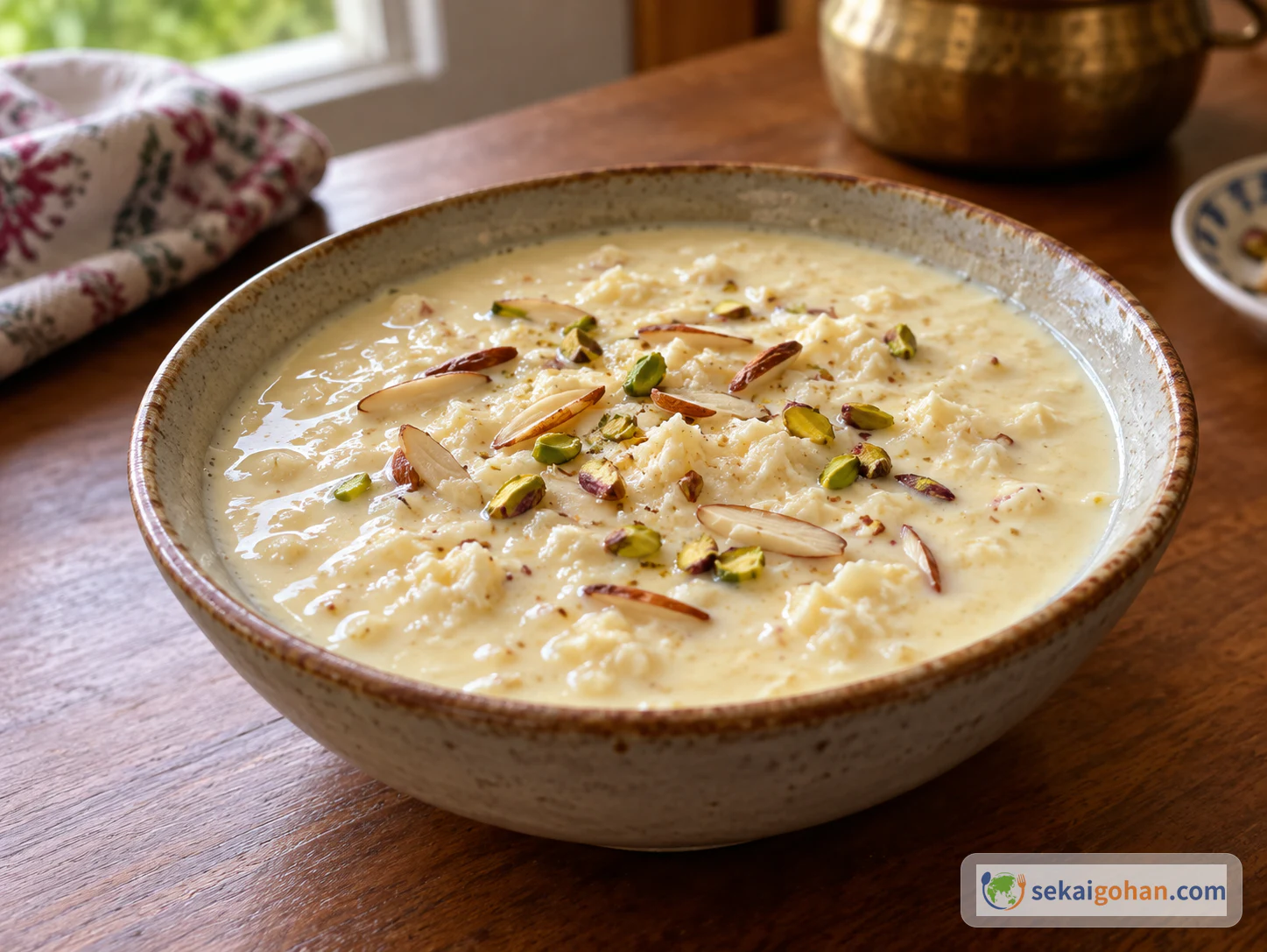
Warm milk in a pot, and the air in the kitchen starts to change. At first it is only white steam. Then the washed basmati goes in, the pot settles into a weak simmer, and you keep stroking the bottom with a wooden spoon until the grains swell, the yellow of the saffron loosens, and the green aroma of cardamom mixes with the sweetness of the milk. This is doodhpak (Doodh Pak), a sweet dish of milk and rice from western India, especially around Gujarat. "Rice milk pudding" gets you close in English, but not all the way: the milk is cooked down, yet the finish stays light enough to flow off the spoon. That lightness is where cooks outside India most often hesitate.
Doodhpak at the Gujarati table
The name combines doodh, meaning milk, with pak, which carries the sense of boiling or cooking. Alongside the milk and rice go sugar, saffron, cardamom and nuts. By name it is a dessert, but at the Gujarati table it moves between "a little sweet served after the meal" and "a sweet dish eaten together with fried puri."
That makes more sense once you know that Gujarati cooking doesn't confine sweetness to the end of the meal. A Gujarati thali lines up farsan, vegetable shaak, lentil dishes, yogurt-based dishes, rice or khichdi, dal and sweets, and many of those dishes are sweet, salty and spicy at once. Doodhpak fits into that flow, rounding out the whole table with the sweetness of milk, beside salty side dishes and fried bread.
It is made for special days and to welcome guests, and served with hot puri. Many Gujarati households finish it with a whitish color and keep the saffron mild.
Doodhpak, kheer and basundi
Doodhpak is often confused with kheer, payasam and basundi. All of them turn milk into a sweet, but the amount of rice, how far the milk is reduced and where the dish sits in a meal differ.
| Dish | Main region | Finish | Guide for a home kitchen |
|---|---|---|---|
| Doodhpak | Gujarat, western India | Milk is the star with relatively little rice. Not drinkable but light | About 1.5 oz (45 g) rice to 6¼ cups (1500 ml) milk |
| Kheer | Northern India and widely | Many kinds of rice, semolina, noodles and so on; thickness ranges widely | More rice moves it toward kheer |
| Payasam | Southern India | Wide range of rice, lentils, semolina, jaggery and so on | Coconut or jaggery changes the direction |
| Basundi | Western India | Milk reduced strongly, a rich sweet that works even without rice | Reduce milk to nearly half, with no rice |
Doodhpak's strength is its lightness, whether it closes a meal or sits beside puri. On a day you want something closer to kheer, add more rice; for doodhpak, leave room for milk that flows from the ladle.
Ingredients (serves 6)

Serves 6 as a small bowl after a meal, or 4 when it is the sweet eaten with puri.
This recipe uses dairy and tree nuts. You can make it without the almonds or pistachios, but watch for cross-contact on tools and storage containers that have handled nuts. Because the milk is heated for a long time, it is a dish where boil-overs and scorching happen easily. Stay by the pot and scrape the bottom often.
Ingredients that are hard to choose at the shop
Milk, sugar and almonds are fine from a nearby supermarket. The basmati, saffron and cardamom define the character of doodhpak. You use only small amounts of each, and they also go into other Indian dishes and Middle Eastern rice dishes, so they do not go to waste for anyone who keeps cooking.
Buy in this order: rice, cardamom, then saffron. Basmati gives the finished dish its grain texture. Cardamom moves the sweetness of the milk toward a "sweet-shop aroma." Saffron is the final flourish, used for aroma rather than to deepen the color. If you want to save money, buy the rice and cardamom first and leave the saffron for next time. The dish still works.
| Priority | Ingredient | Why buy it | What changes if you substitute |
|---|---|---|---|
| High | Basmati rice | Slender grains that stay light in the milk | Short-grain rice turns sticky and moves toward milk porridge |
| High | Whole cardamom | Adds a green aroma to the milk's sweetness | Ground is convenient but tastes floury if overused |
| Medium | Saffron | Adds a festive feel and a pale fragrance | Leave it out if needed. Do not substitute turmeric |
| Low | Charoli | Gives a local nutty character | If hard to find, almonds are fine |
Basmati keeps the grains looking light. Short-grain rice turns sticky when cool and moves toward milk porridge. Doodhpak uses only 1.5 oz (45 g), so a 2.25 lb (1 kg) bag is an easy buy.
Use saffron for aroma, not color. Doodhpak needs only 0.05–0.1 g, so softening a small amount of whole threads is more reliable than buying a cheap colored powder. Saffron also works in risotto and fideuà.
Cardamom can be used ground, but cracking whole pods and crushing the seeds brings a green aroma into the milk. Leftover pods can go into chana masala and Kabuli palaw.
Choosing ingredients for doodhpak
Whole milk, basmati rice, saffron and cardamom in these proportions keep the pot from scorching on a home stove. Extra rice may feel like a safer bet, but it overpowers the milk, so start with 1.5 oz (45 g), check the thickness once it cools, and adjust the next batch to the way you like to eat it.
Saffron is where you set the mood. A little more gives the look of a showy festival sweet, while a modest pinch suits an everyday bowl of sweet milk and rice. This recipe keeps it to the amount that adds aroma rather than color, aiming for a pale yellow in which the white of the milk still shows. The light, spoon-flowing finish also suits a meal better than the strong sweetness of shop-bought versions in India.
Method
For doodhpak, what matters more than the order of ingredients is not scorching the milk, not breaking the rice and not reducing too far. Use a heavy pot about 9.5 inches (24 cm) across with a wide bottom; it lets moisture escape and makes it easier to scrape the bottom with a wooden spoon.
Common doodhpak problems and fixes
Most doodhpak trouble comes down to four things: scorching, heaviness, an aroma that's too strong, and a sweetness that tastes blurry.
| Failure | Why it happens | How to fix |
|---|---|---|
| Bottom of the pot scorches | Keeping it at a hard boil. Not scraping the bottom | Keep the heat at medium-low or below and stroke the bottom with a wooden spoon every 2–3 minutes |
| Hard when cold | Too much rice, or reduced too far | Stir in 2–4 tbsp milk. Next time reduce the rice by 5 g |
| Saffron tastes medicinal | Too much, or steeped long in hot liquid | Start from 0.05 g. Soften it in milk and stir it in briefly in the pot |
| Cardamom is floury | Too much powder | Use 4 cracked whole pods. If powder, up to slightly under 1/2 tsp |
| Sweet but not tight | No salt, or thin milk | Add a pinch of salt and use whole milk |

The hardest call isn't an ingredient at all, it's knowing where to stop the heat. A thickness that looks just right in the warm pot will firm up in the refrigerator as the rice absorbs moisture. So stop at step 5 while it is still slightly loose. Think of it in three stages: a little loose when warm, firmer when cold, revived with milk just before eating. That way it stays good into the next day.
Serving and storing doodhpak

At Gujarati tables, doodhpak is often served with puri. Sweet milk rice with fried bread can sound heavy, but with a salty side or something fried next to it, the sweetness settles into the meal. Serve it in small bowls beside salty dishes rather than as one large dessert: a little lentil curry, cucumber raita, fried puri and a sour pickle keep the sweetness from turning monotonous.
At home, quickly fried puri, a mildly spiced raita and the lentil dal tadka suit it better than a fermented-batter dish such as dosa. For a Gujarati flatbread, thepla also works. And a chilled small bowl after a hot tandoori chicken is plenty; the milk rounds off the lingering spice and cools the table.
Store it for up to 2 days in the refrigerator, in a clean container, once the heat has gone out of it. Chilled, the rice absorbs moisture, so stir in some milk before eating. To reheat, use a pot over low heat, or a microwave at 600 W in 30-second bursts. Heat it too fast either way and a skin forms and the bottom can set.
Frequently asked questions
Can I make it with short-grain rice?
Yes. Short-grain rice is very sticky, though, so the same 1.5 oz (45 g) turns heavy once cooled. If you use only short-grain rice, start from 1.25 oz (35 g) and stop loose at step 5. The grains feel different, but it's still a delicious sweet milk rice.
Can I make it with low-fat milk?
You can, but the roundness you get from reducing milk is weaker, and more sugar or saffron won't bring it back. Use plain whole milk for your first batch; if you want it lighter, swapping in low-fat milk for half is safe.
Is it fine without saffron?
Yes. Cardamom and nutmeg alone make a good home version. Skip turmeric as a way to turn it yellow: even a small amount gives an earthy smell and pushes it toward curry rather than a sweet.
Is warm or cold more authentic?
Both are eaten. Warm, the aroma of milk and cardamom stands up; cold, the sweetness settles. A simple rule at home: serve it warm with puri, and chilled as a dessert after a meal.
Does it become something else without nuts?
The aroma and texture are a little weaker, but it still works. If you have a nut allergy, leave them out and crush the cardamom a bit more carefully to make up the aroma. If it looks plain, a few drops of the saffron-softened milk over the surface are enough.