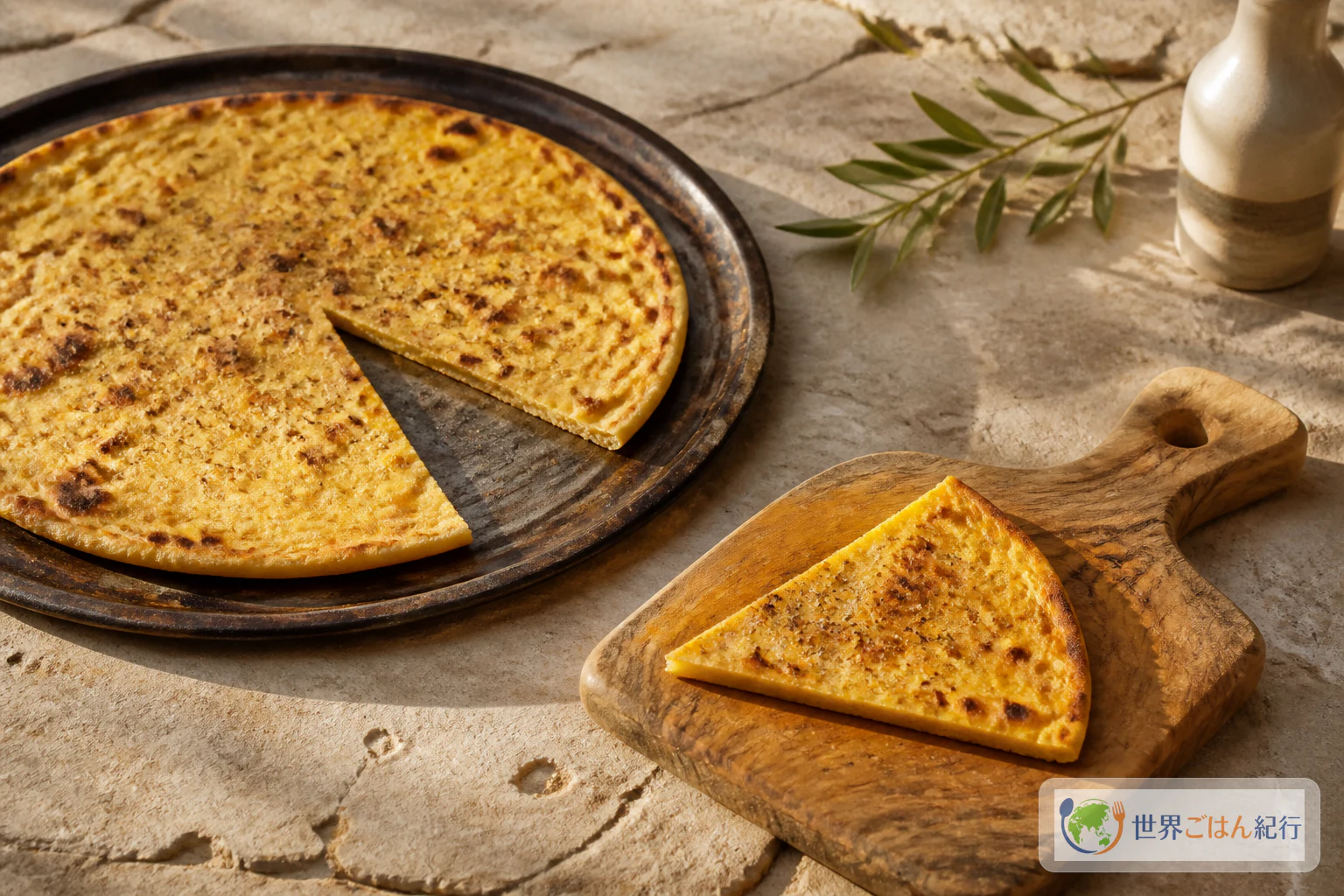
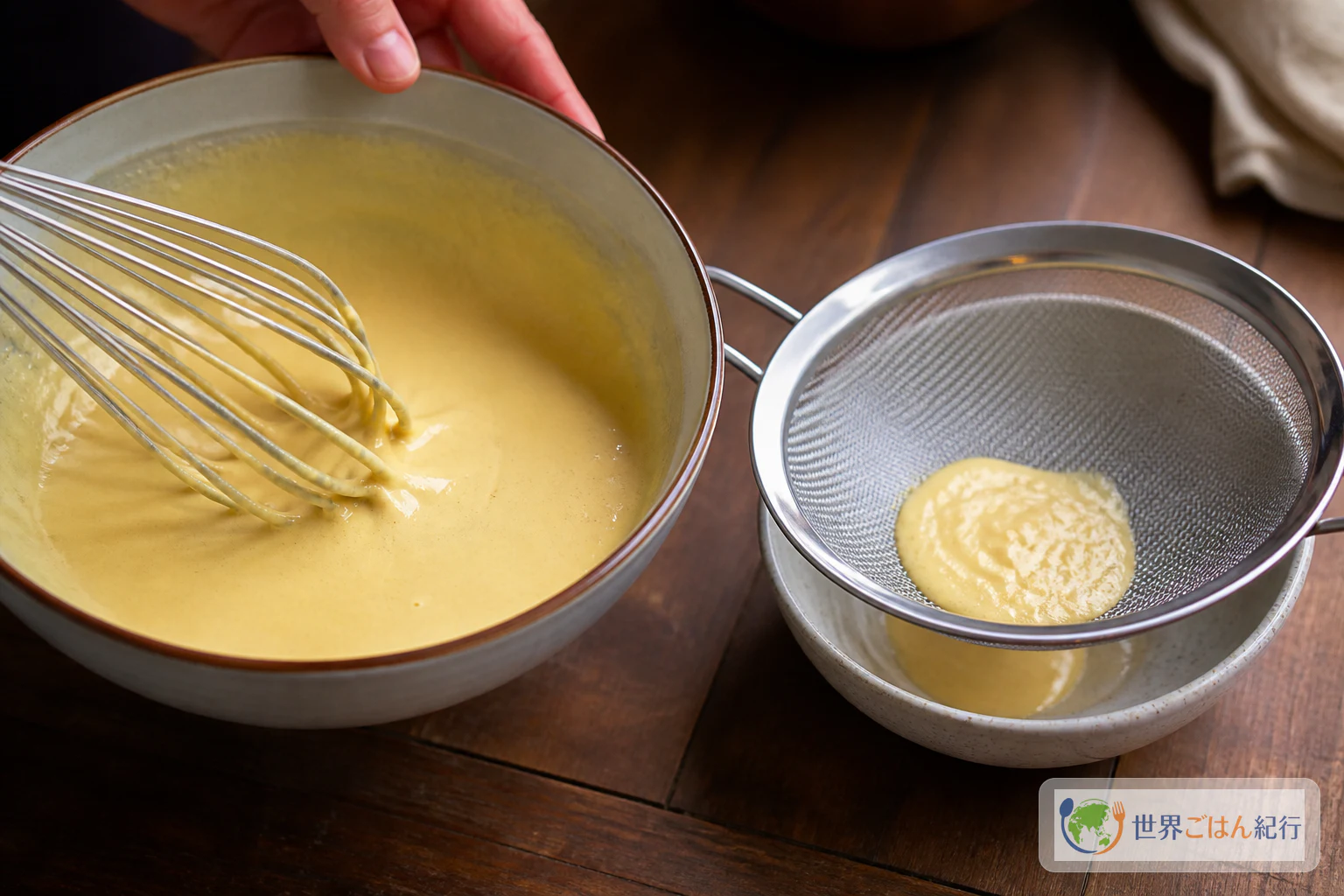
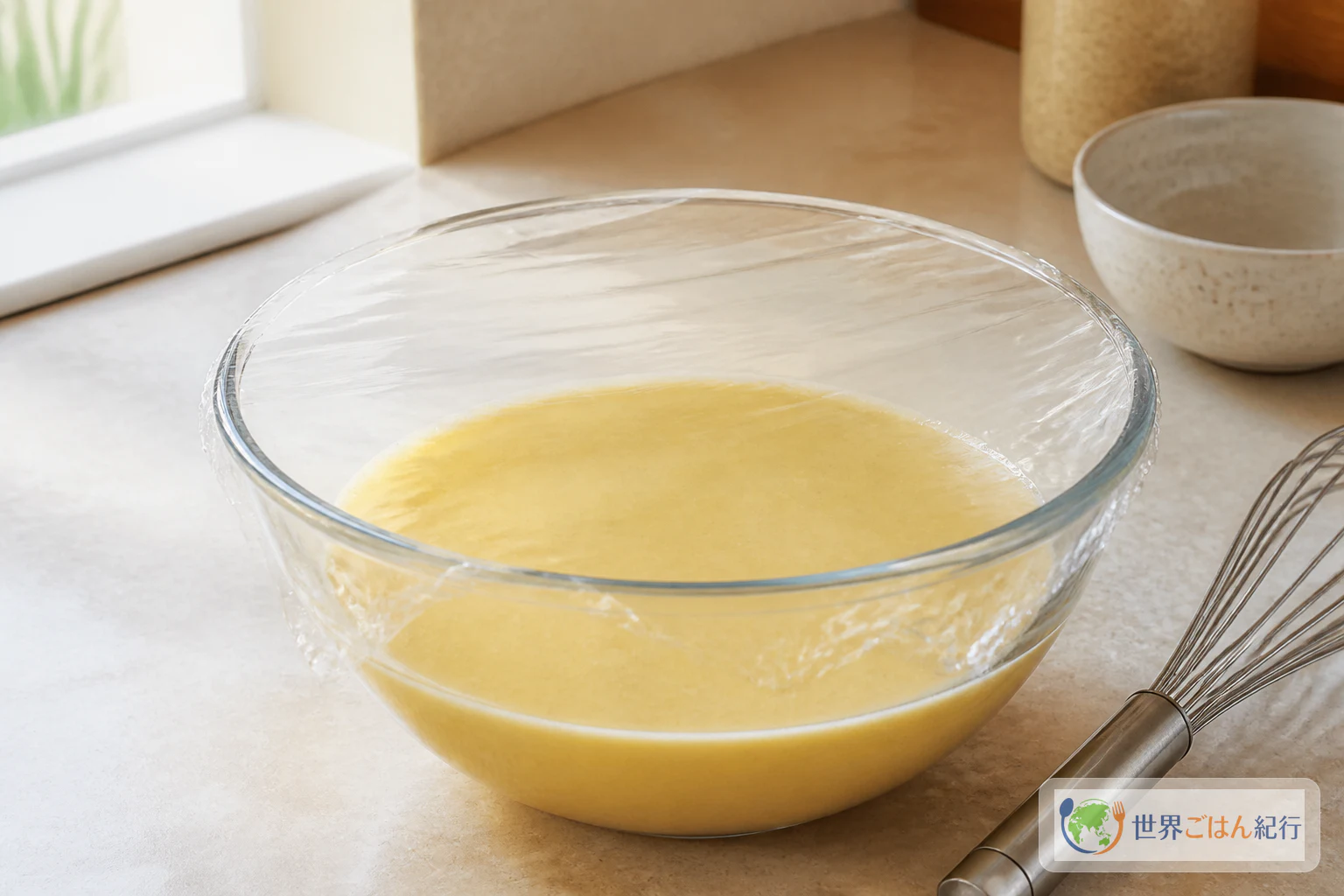
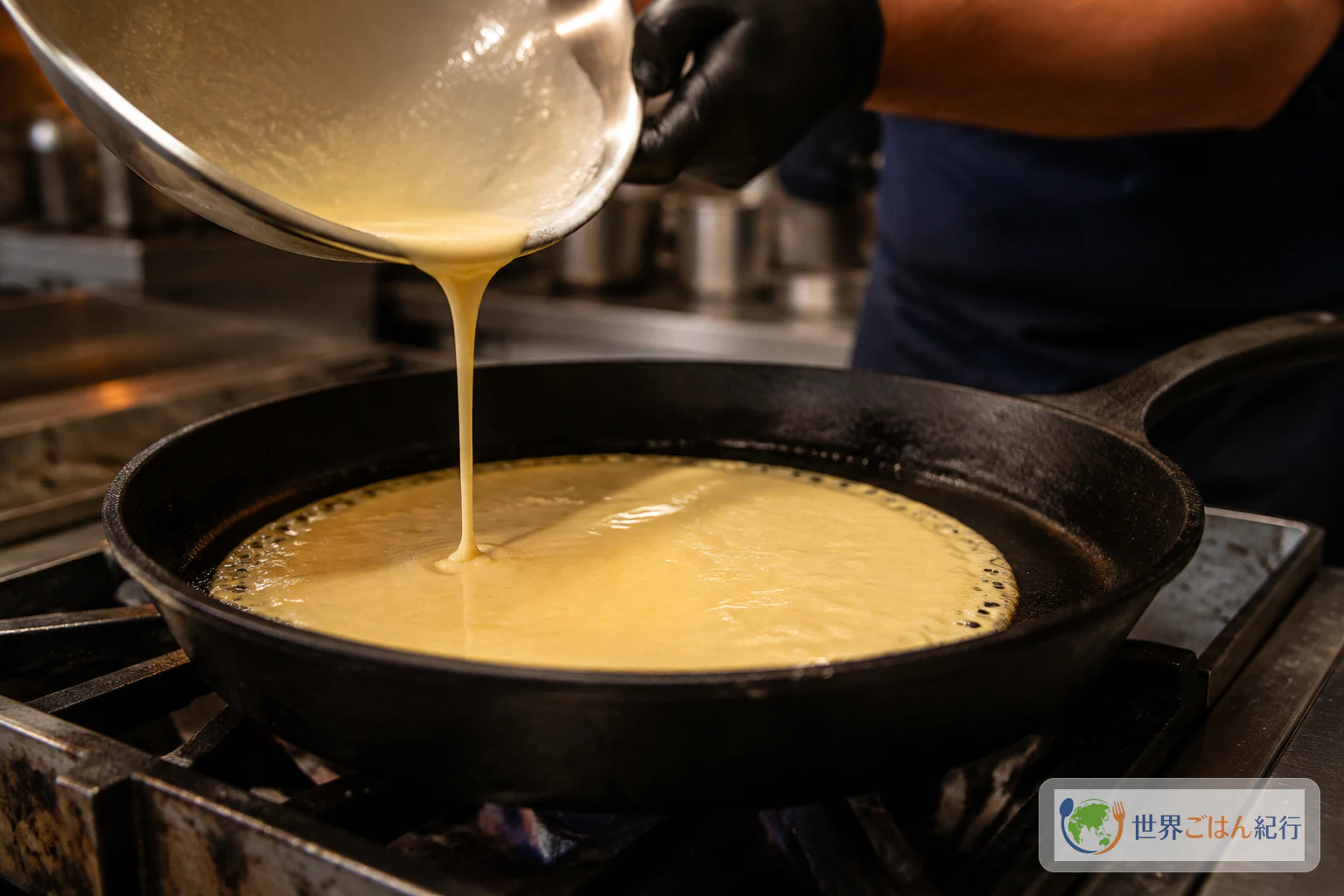
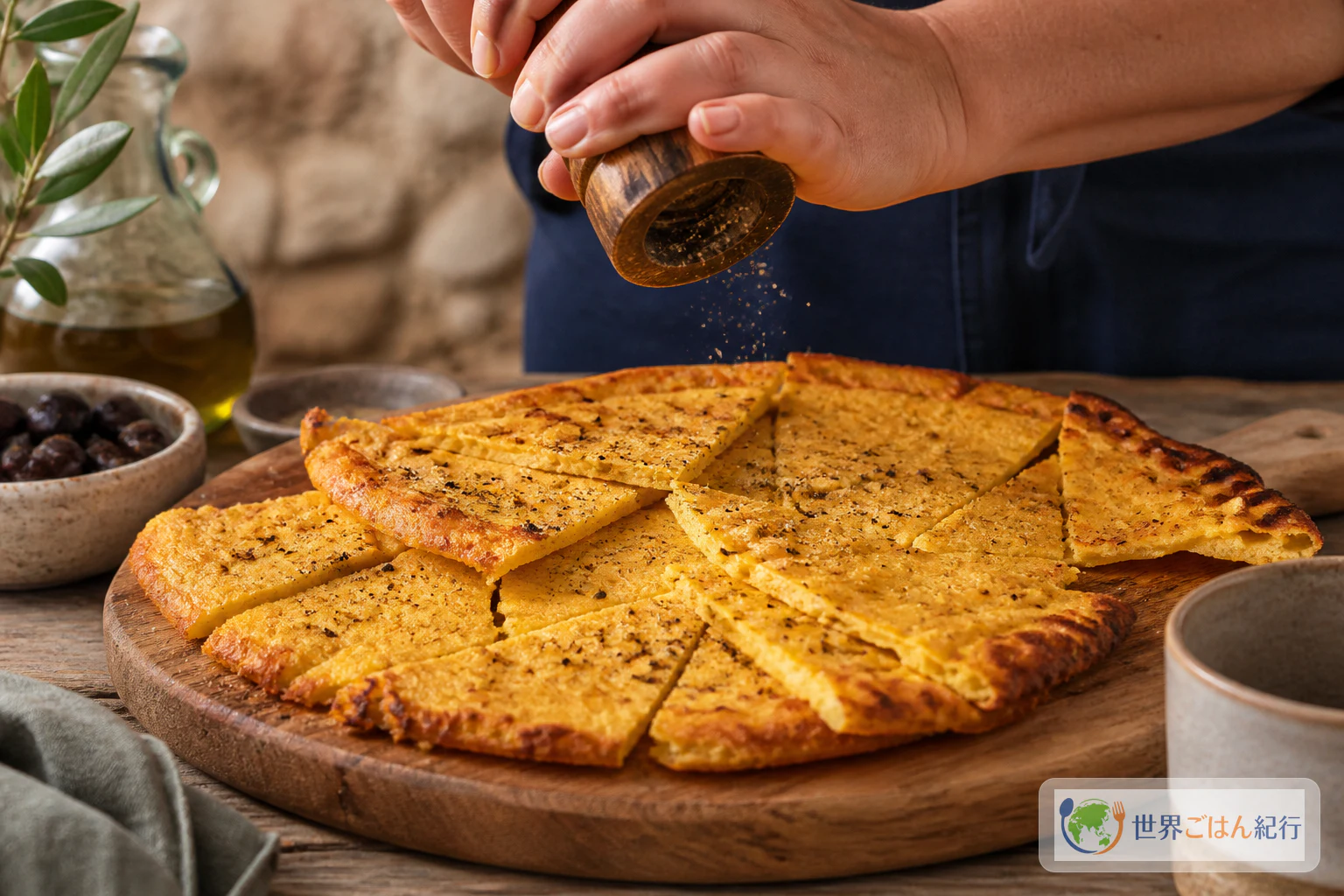
Pull socca from a hot pan and brown spots of char rise along the edge, while the center slowly sags from the corner you lift. It's less a firm-baked crêpe than a thin bread, dried crisp only on the surface, with the sweet aroma of chickpeas left inside. In Nice it's made from chickpea flour, water, olive oil, and salt, poured as loose as liquid cream, baked in a very hot oven, and cut while hot. Don't add more flour to thicken the batter, and grind black pepper over it as soon as it comes out of the oven. Mixing takes about 15 minutes, but the flour needs 2 hours to absorb the water and settle, so make the batter at lunchtime and bake before dinner.
Socca in Nice, Liguria, and Toulon
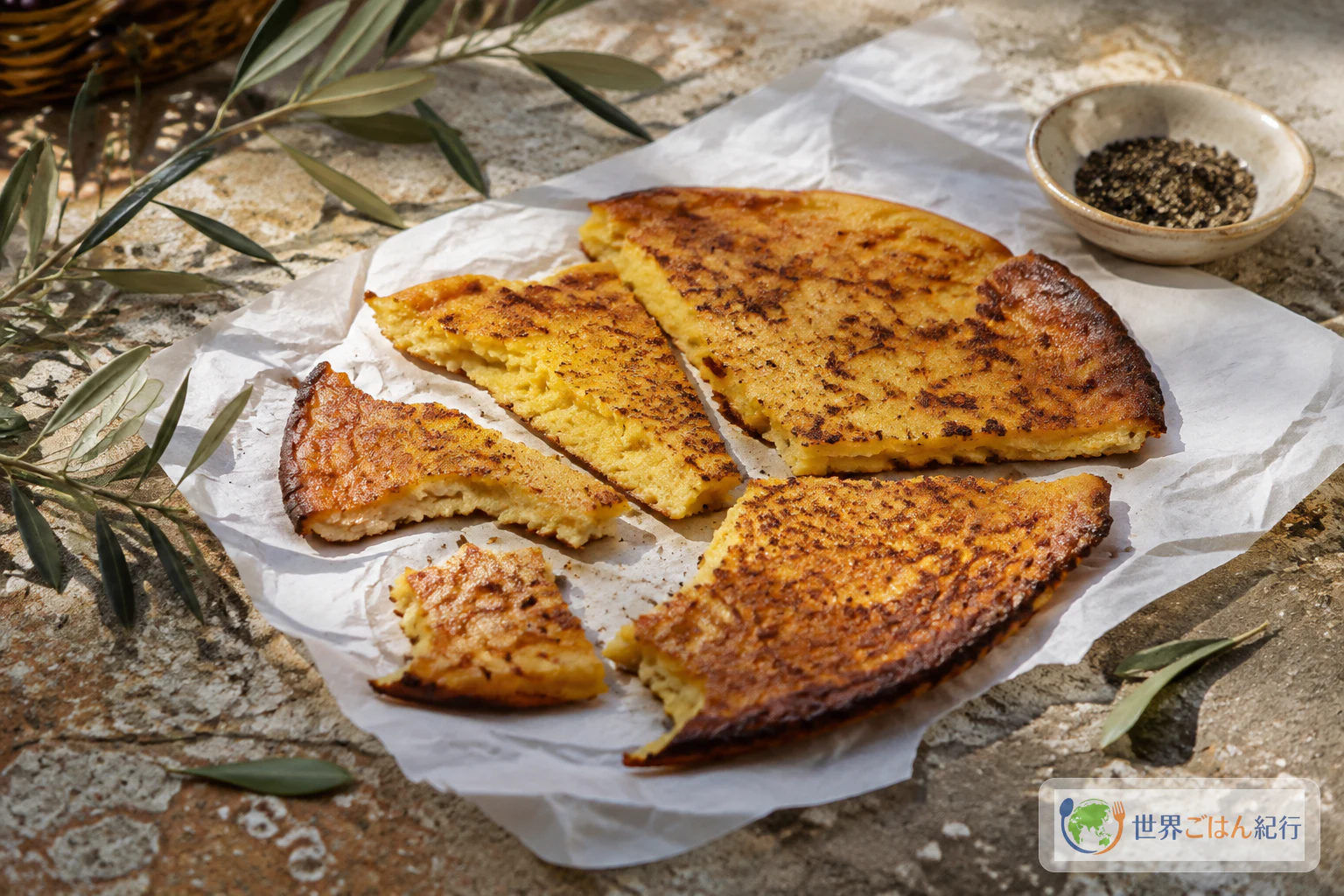
Before any sauce or topping, socca tastes of flour and fire. It's an affordable Niçoise dish meant for sharing. Picture a big baked sheet cut into generous pieces, set on paper, and eaten hot, rather than neatly plated servings.
The same chickpea flour batter is called farinata in Liguria, in northwestern Italy. In Toulon, in southern France, there is a close relative called cade. Socca and cade differ mainly in thickness, not ingredients: socca is thin, and cade is thick, about 1 inch (2 cm). Recipes for socca itself range from 0.125 inch (3 mm) to about 0.25 inch (5 mm), depending on the pan, the heat, and how much batter you pour.
There is no single origin story. Chickpeas, which grow even in dry land, have been eaten since ancient times, spread to Italy in the Middle Ages, and came to southern France through the people of Genoa. Socca's name and way of baking took shape with the street vendors of Nice, in its markets, and on the tables of the old town, which is why the neighboring versions still differ.
Ingredients (two 10-inch (26 cm) sheets, serves 2)
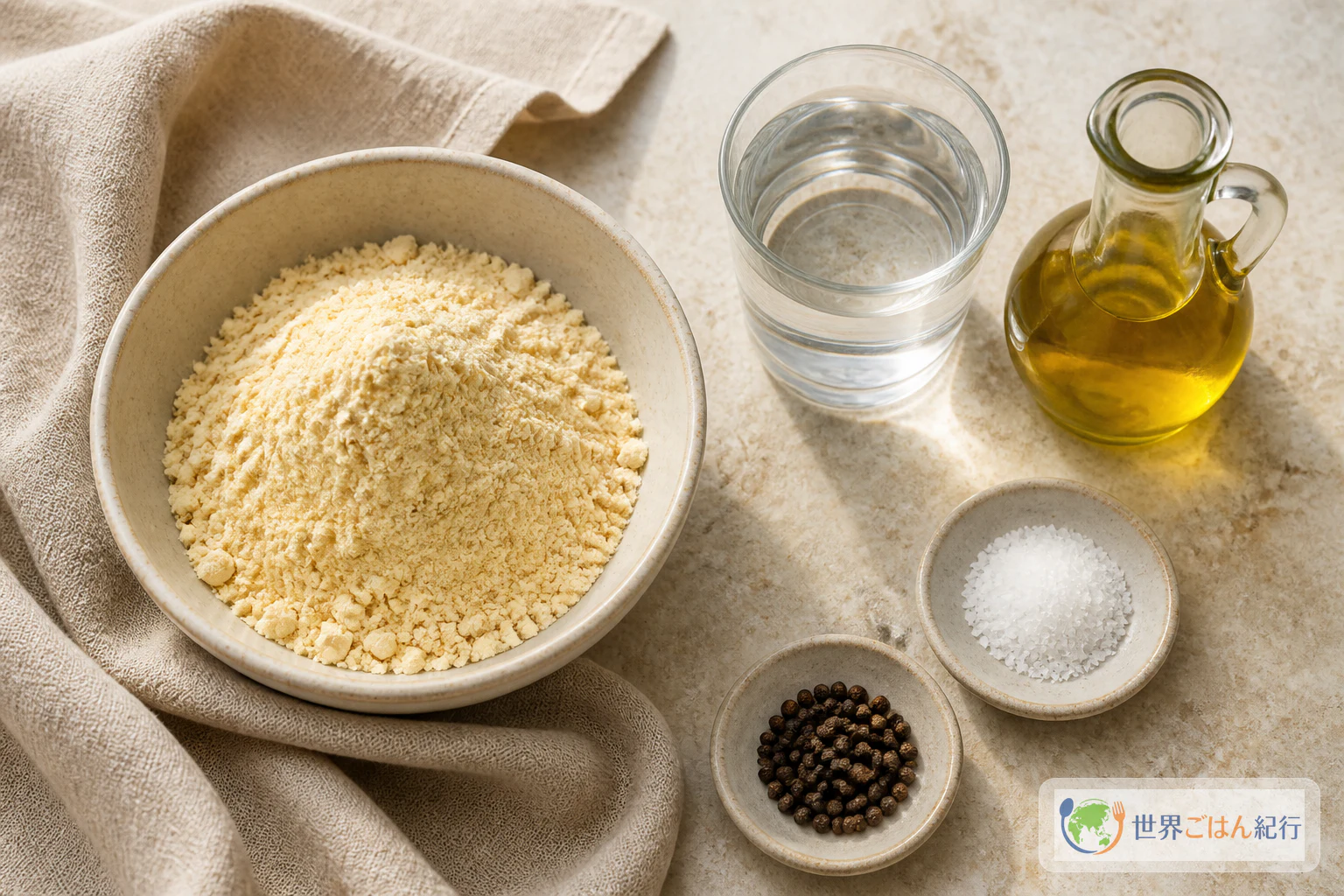
This recipe is scaled down from a blend of 9 oz (250 g) flour and 2 cups (500 ml) water to two sheets in a home 10-inch (26 cm) pan. You can add all the water at once, but flour grind changes how it absorbs, so mix with ¾ cup (190 ml) first and keep the remaining 2 tsp (10 ml) for adjusting thickness.
| Ingredient | Amount | Substitutes & notes |
|---|---|---|
| Chickpea flour | 3.5 oz (100 g) | Also called besan or garbanzo flour. Choose an unsalted product whose only ingredient is chickpeas |
| Cold water | ¾ cup (200 ml) | Mix ¾ cup (190 ml) first and add the rest only if thick. Water only slightly cooler than room temperature is fine |
| Olive oil | 1.5 tbsp (25 ml) | For the batter. Extra-virgin that isn't too strongly flavored is less likely to compete with the flour's flavor |
| Fine salt | 2 g | About 1/3 tsp. Don't use mixes that already contain salt |
Baking and finishing
| Ingredient | Amount | Substitutes & notes |
|---|---|---|
| Olive oil | 2 tsp (10 ml) | 1 tsp (5 ml) per 10-inch (26 cm) pan. Too little oil makes the edge hard to release |
| Black pepper | 1–2 g | Grind coarsely over the baked socca. Ground pepper works but the aroma comes up differently |
Don't replace chickpea flour with all-purpose or rice flour. Wheat flour makes the batter sticky, and rice flour changes how the baked surface cracks. If you can't find it nearby, look for "chickpea flour," "besan," or "gram flour" at import or South Asian grocery stores. Grinding dried chickpeas in a home mill gives uneven grains and uneven cooking, so it isn't suited to a first sheet.
Chickpea flour is the star of the batter, so buy a small amount nearby if you can. Order online when a store is out of stock, when you also make falafel, pakoras, or bean crêpes, or when you want to check that the only ingredient is chickpeas. A kilogram makes about 10 batches of socca, so if you're making it once, a small package is easier to store. After opening, keep it sealed in a cool, dark place.
Ground black pepper from a bag will make the dish. For a stronger aroma, or if you will also grind other whole spices like salt or Sichuan pepper, get a small mill for finishing. When choosing, check that it handles whole peppercorns, has adjustable coarseness, and can sit on the table as is. If you already own a mill, or will use up pepper as powder, you don't need to buy another. Two sheets use only a little pepper, so a large or electric mill isn't necessary.
Chickpea Flour, Pans, and Ovens for Socca
Chickpea flour
Nutritional values are for 3.5 oz (100 g) chickpea flour, 2.5 tbsp (35 ml) olive oil, and 2 g salt divided between 2 people, and they change with the product and the amount of oil. If you have a legume allergy, or need to check production-line labels, read the ingredients and allergy notes before you open the bag of flour.
Pan and oven
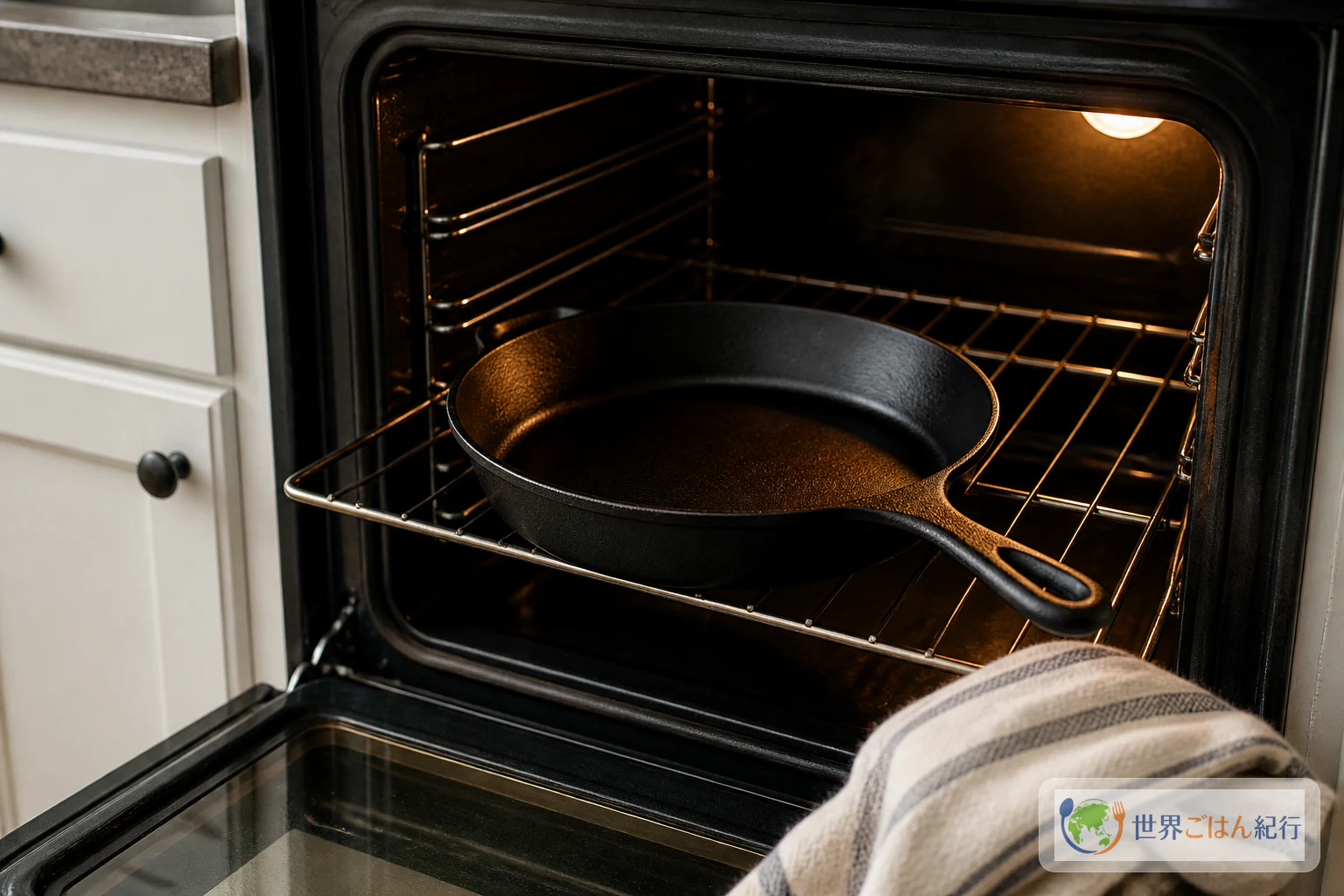
Traditionally, socca is baked on a 19.5-inch (50 cm) copper sheet at a minimum of 525°F (280°C), ideally in a wood-fired oven. Heating a sheet that size at home isn't realistic, so use a flat-bottomed cast-iron pan that goes in the oven and build the browning with preheating, thinness, and top heat. What carries over is the method: rest the batter, let oil settle on hot metal, spread it thin, and eat right after spots of char appear. A small pan also has a short distance from center to edge, which makes it easier to measure the batter for each sheet.
| Condition | Nice's standard | Practical solution at home | Effect on flavor and texture |
|---|---|---|---|
| Baking sheet | An oiled copper sheet about 19.5 inches (50 cm) across | A 10-inch (26 cm) ovenproof cast-iron pan | Instead of dividing one large sheet, you enjoy fresh-baked twice |
| Temperature | Minimum 525°F (280°C), wood-fired oven preferred | Preheat to 525°F (275°C) and add top-heat broiler | No wood smoke, but you can still get charred spots on the edge |
| Thickness | 0.125 inch (3 mm) | About ¾ cup (160 ml) of batter into a 10-inch (26 cm) pan | Easy to make a thin edge without weighing the center down |
| Eating speed | Cut right after baking and eat hot | Bake one sheet at a time and serve in the order they finish | Reduces sagging from cooling |
An oven that only reaches 475°F (250°C) won't give the color of wood-fired socca, and thickening the batter just makes the center heavy. Reduce the batter to ½ cup (150 ml), pour it onto a heavy baking sheet preheated for about 45 minutes, and bake 8 to 12 minutes on the top rack. If your oven has a broiler, use it only for the last 1 to 2 minutes and stop before the surface blackens; judge doneness by the brown of the edge and the sheen at the center.
Without an oven
On the stovetop, cook it in the style of the crêpe griddles also seen in Nice. Heat the pan over medium for 3 minutes, let 1 tsp (5 ml) oil settle, pour in about ¾ cup (160 ml) batter, keeping it 0.125 inch (3 mm) thick, and cover with a lid. Cook over medium-low for 5 to 7 minutes, until the wet sheen on the surface is gone, then flip when the edge starts to release and cook 1 minute. You'll get fewer charred spots than in the oven, and the center comes out a little thicker.
Method: Pour a Liquid-Cream Batter Thinly into Hot Oil
Checking the thickness of the batter and the heat of the pan separately makes it easy to correct even the first time. Right after mixing the flour it looks watery, but after 2 hours it thickens just slightly. If the batter poured into the pan goes beyond 0.125 inch (3 mm), only the surface scorches first and the center turns heavy.
Socca Problems and Fixes
With so few ingredients, nothing hides a mistake. Work out whether the batter's thickness, the pan's temperature, or the thickness of the sheet went off, and correct the next one. For a first sheet, 0.125 inch (3 mm) is the safest target, since thin batter cooks through before it scorches; compare the edge and the center as you eat, and adjust from there.
| What happened | Main cause | How to fix it then, how to adjust next time |
|---|---|---|
| Center stayed liquid | Batter is thick, pan was cold, or the surface was broiled too suddenly with the broiler alone | Return the pan to 525°F (275°C) for 2 to 3 minutes. Next time reduce the batter to ½ cup (150 ml) and preheat the pan 15 minutes or more |
| Only the edge is black and the center is white | Top heat is too strong, or the pan didn't hold enough heat | Stop the broiler 1 to 2 minutes earlier and return to normal 525°F (275°C) heating. Next time preheat the pan longer on the middle rack |
| Won't release from the pan | Too little oil, pan not hot enough, or too long between pouring and baking | Insert a wooden spatula from the edge and release a little at a time. Eat torn parts as bite-size pieces, and next time spread 1 tsp (5 ml) of oil over the whole pan |
| Batter is gritty | Rested too briefly, or lumps weren't strained | If you haven't baked yet, mix in 1 tsp (5 ml) water and extend the rest by 30 minutes. It can't be fixed after baking, so next time rest 2 hours |
| Batter is heavy before baking | Flour is coarse, flour was packed when measuring, or too little water | Add water 1 tsp (5 ml) at a time until it falls from the whisk in a thin line. Level the flour off when measuring rather than pressing it down |
| Salty and the flour's aroma is lost | Salt was added by eye, or finishing pepper and salt were confused | Add a few drops of lemon rather than more salt. Next time measure 2 g salt in the batter and increase only the black pepper at the end |
A scorched sheet is usually salvageable: scrape away only the bitter black chunks and keep the aromatic brown edge. A center that hasn't set isn't "moist," so keep heating until the liquid sheen is gone. And if the chickpea aroma comes across too strong, bake thinner and brown the surface well rather than raising the heat.
Toppings and Pairings for Socca
The classic is hot socca with black pepper, eaten as is. Toppings go on the finished sheet in small amounts, never into the batter, where their moisture would weigh it down. Bake the first two sheets plain and try variations from the third on, so you get to know the taste of flour and fire first.
Black pepper
Sprinkle 0.5 to 1 g coarsely ground black pepper on fresh-baked socca. A coarse grind keeps the aroma there when you bite. If it lacks saltiness, adjust with a few drops of olive oil and pepper rather than reaching for salt first.
Rosemary oil
Chop the leaves of 1 sprig rosemary finely, mix with 1 tsp (5 ml) olive oil, and brush on the baked socca. Mixed into the batter, the leaves scorch, so the aroma goes on at the end.
Caramelized onion
Slice 1/2 onion thin, cook it in 1 tsp oil over low heat for 15 minutes, and cool. Put up to 2 tbsp on one sheet of socca and sprinkle with black pepper. Always cook the onion first, since raw onion weighs the center down with its moisture. It gets quite sweet, so it suits a later sheet better than the first.
Tomatoes and olives
For lunch, halve 6 cherry tomatoes and blot the surface water with paper towels. Pile them with 20 g black olives on the baked socca and drizzle with 1 tsp olive oil, and the thin bean base picks up a Mediterranean saltiness.
Goat cheese
Tear 1 oz (30 g) goat cheese or cream cheese thin and scatter it on the socca right after baking. When the surface softens slightly from the residual heat, sprinkle with black pepper. More cheese than that hides the aroma of the batter and turns it heavy and oily.
Drinks and dishes from Nice
Water, a dry white wine, or unsweetened sparkling water suits socca better than sweet sauces. If it's the center of the meal, put tomatoes and leafy vegetables on a separate plate so the socca doesn't absorb their moisture. It goes well alongside Nice's Pissaladière or Pan bagnat, which layers the same city's vegetables and fish on bread, and you'll taste the difference between a thin batter baked crisp and bread that soaks up juices. Next to Neapolitan pizza, socca is a thin bean-flour sheet rather than a puffed fermented dough.
Storing and Reheating Socca
Eat it immediately. The longer socca sits, the more steam from the center softens the edge, and a warm plate is no substitute for fresh-baked. If you're serving it on paper to tear by hand, bake one sheet at a time, when the person eating is ready.
Once leftover socca has cooled, put each sheet in a clean shallow container and refrigerate; shallow containers let food cool quickly. Throw out any that sat at room temperature for a long time, or that has a sour smell or a slimy surface, and reheat thoroughly, with 167°F (75°C) or higher as the guide.
The next day, warm the refrigerated socca in a skillet over medium-low, 2 to 3 minutes per side. A lid brings back the center but steams the edge, so take it off for the last 30 seconds; a microwave alone makes the whole thing too pliable. To freeze, wrap each sheet in plastic wrap, put them in a bag, use within about 2 weeks, and heat from frozen in a toaster oven or skillet until hot in the center.
FAQ
Can I replace chickpea flour with wheat flour?
No. Wheat flour makes a different crêpe with gluten, and you lose socca's bean aroma and its texture of a cracking edge and soft center. If you need to avoid wheat, choose 100% chickpea flour rather than imitating it with rice flour or cornstarch.
Can I leave the batter overnight?
Yes. After the 2-hour rest at room temperature, refrigerate it, and check the thickness the next day before baking. Cold batter lets the flour absorb more water, so add 1 to 2 tsp (5 to 10 ml) water to bring it back to liquid-cream thickness. If it smells sour or off, or looks discolored, throw it out, even if you were planning to cook it.
What if I don't have a cast-iron pan?
An oven-safe shallow stainless steel pan or a baking sheet works. A thin aluminum sheet loses heat easily, so preheat it well and reduce the batter to about ½ cup (150 ml). Avoid pans with plastic or wooden handles or non-oven-safe coatings, and check the heat tolerance and instructions on the product label.
Is a soft center underbaking?
If the liquid sheen is gone and the batter doesn't run when lifted, a soft center is fine for socca. If there's still liquid you could scoop with a spoon, or batter runs from the cut edge, it's underbaked: bake 2 to 3 more minutes at 525°F (275°C), and pour less at once next time.
How many days can baked socca be kept?
Fresh-baked is best. Refrigerate it, eat it by the next day, and reheat it thoroughly to the center. Leaving it out to dry won't extend its life, and tasting is no way to check whether it's still good.