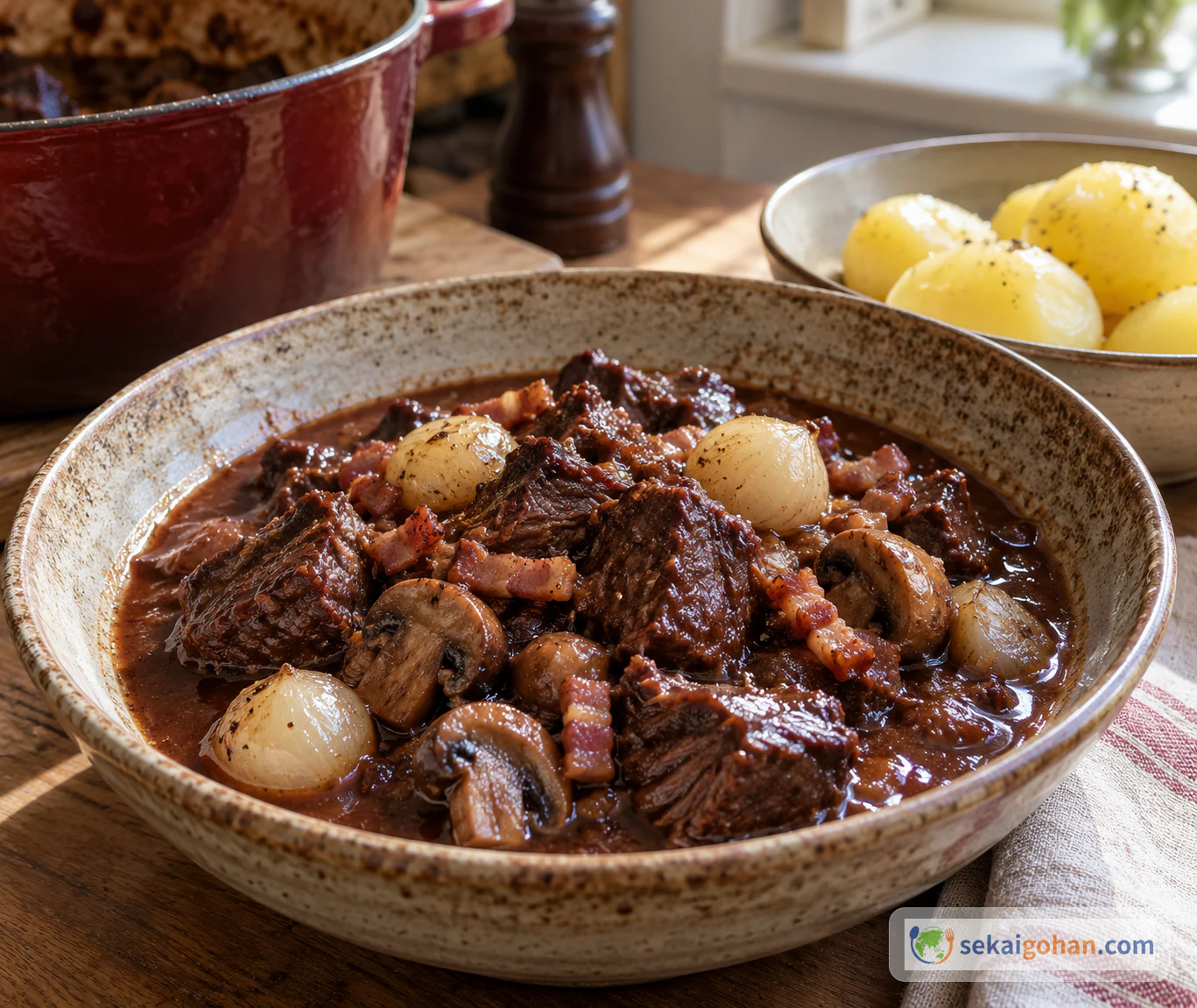
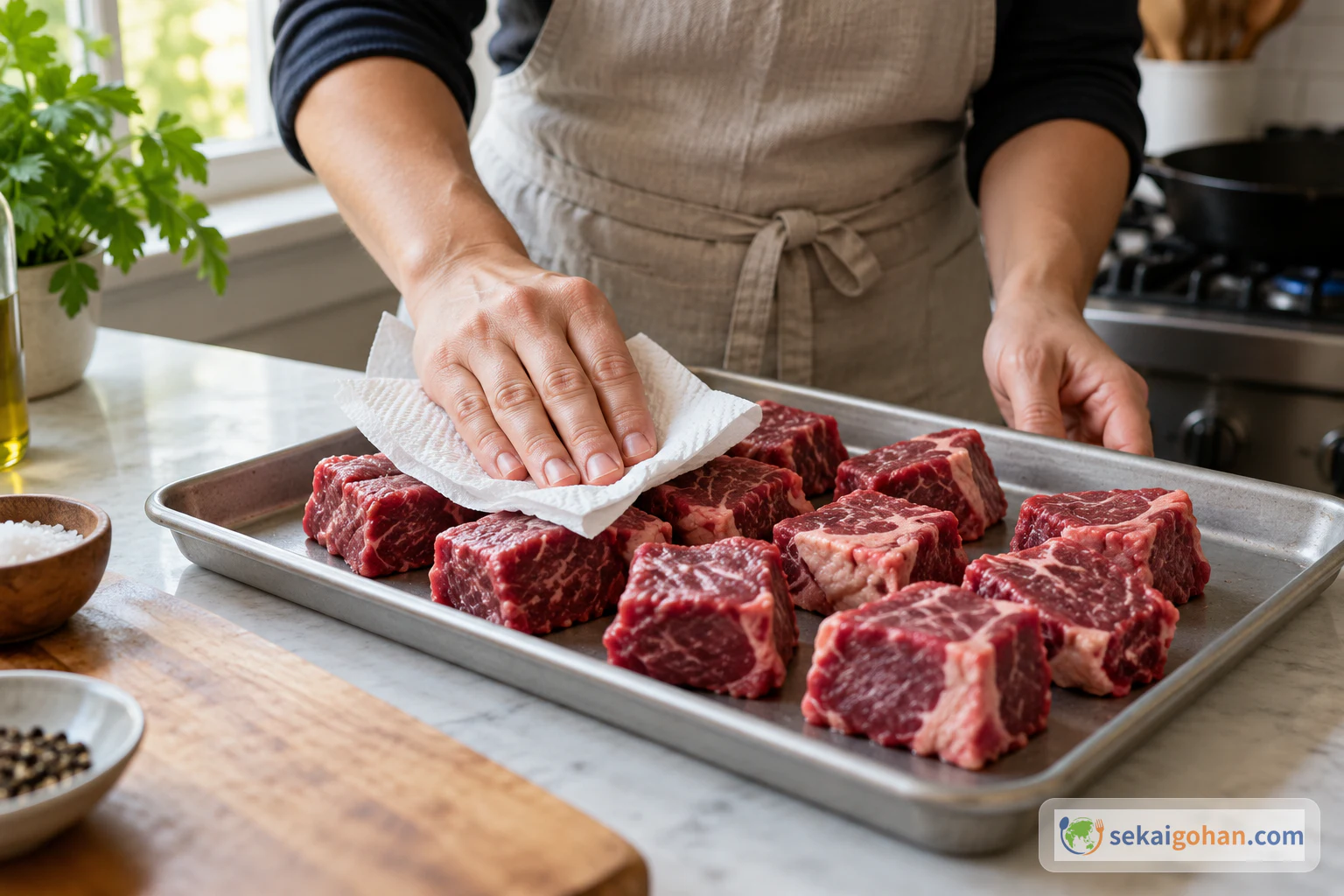
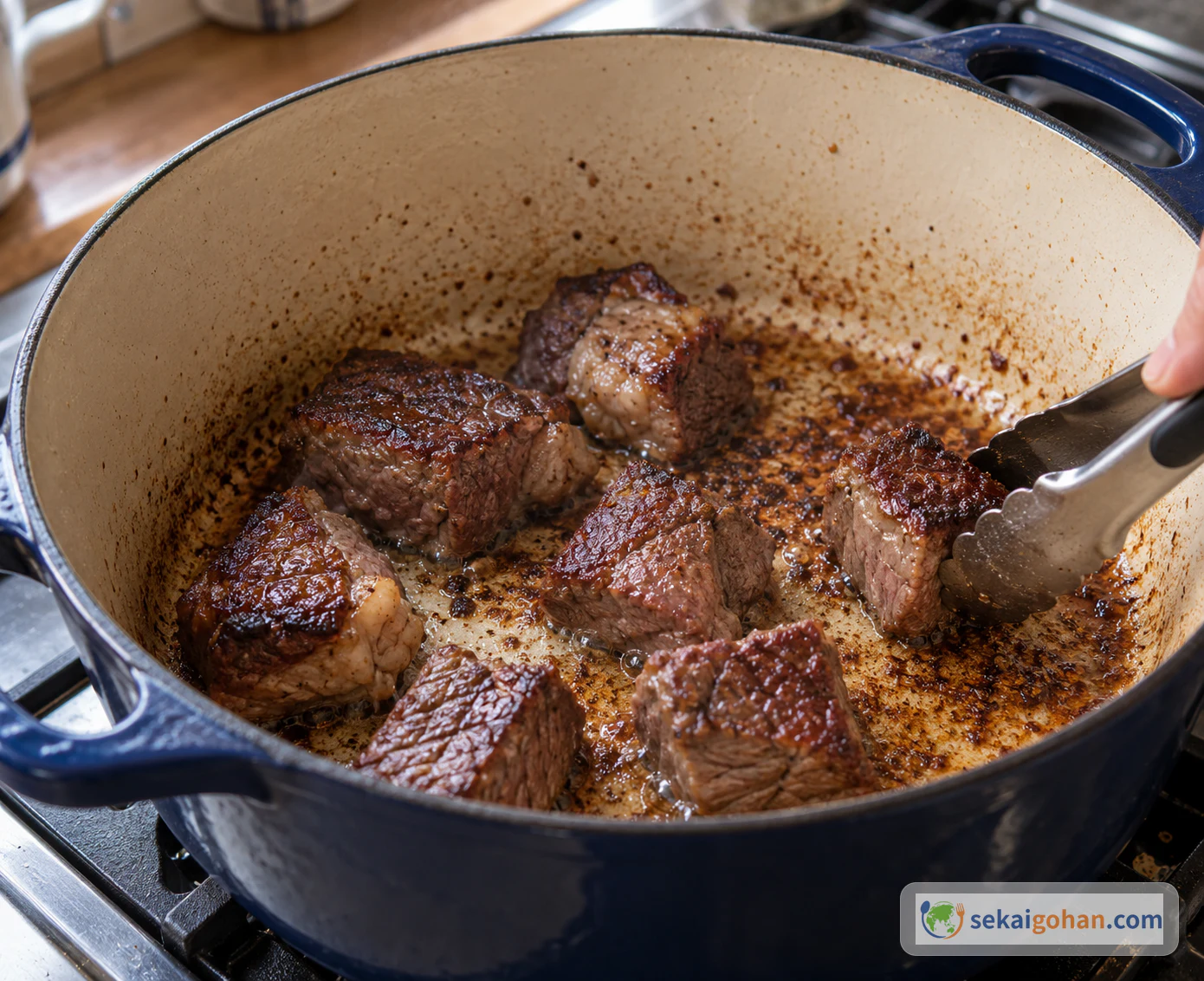
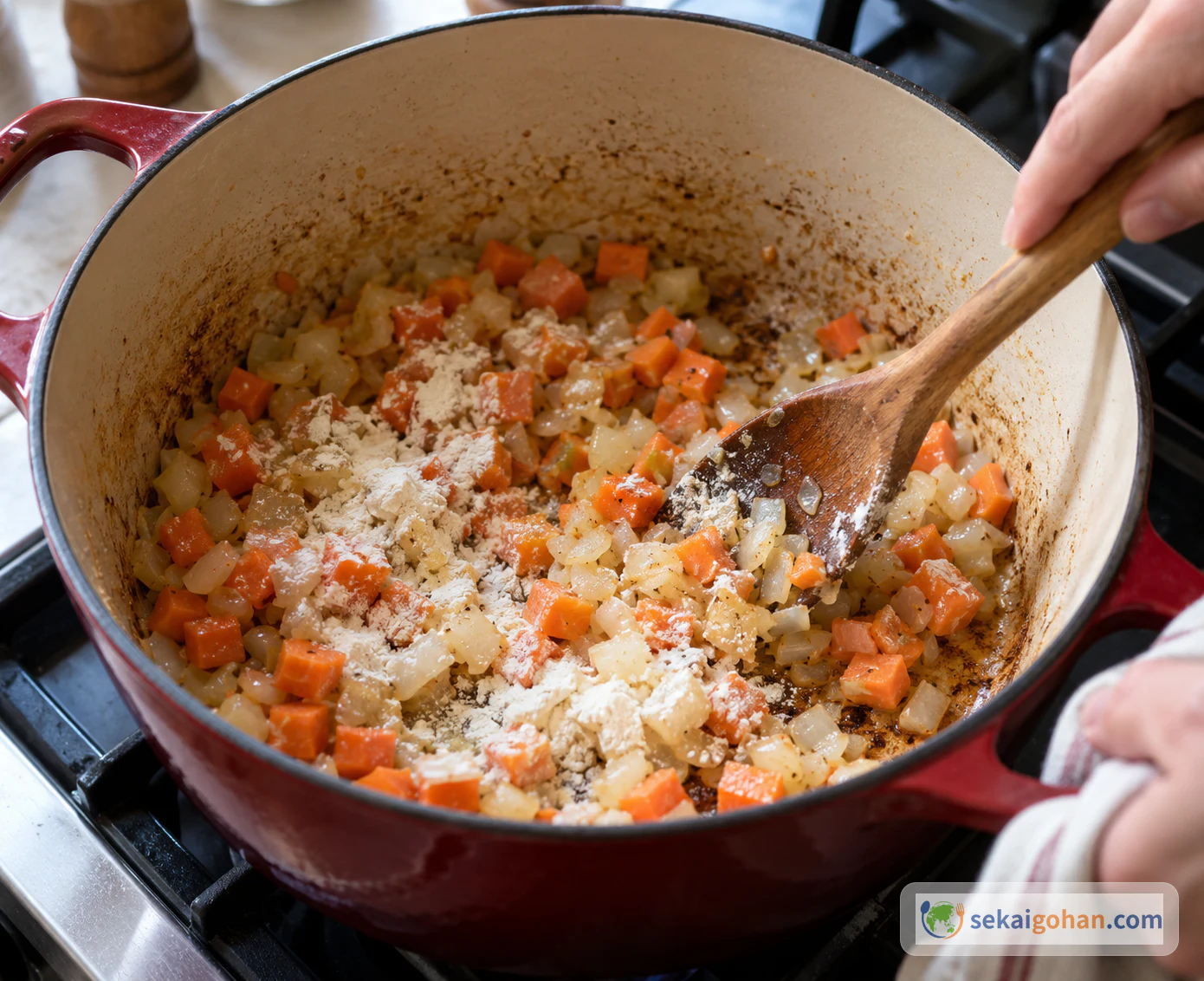
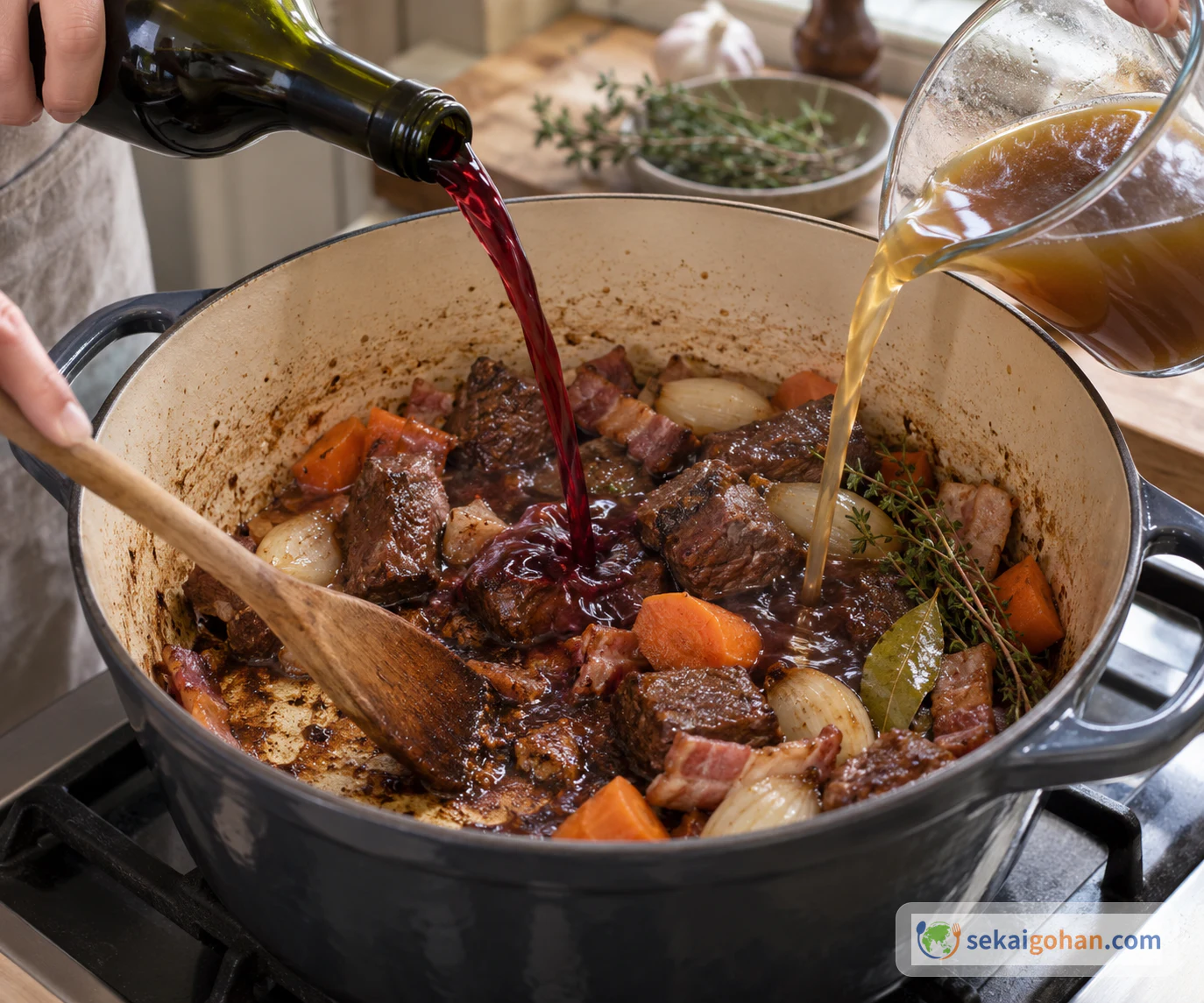

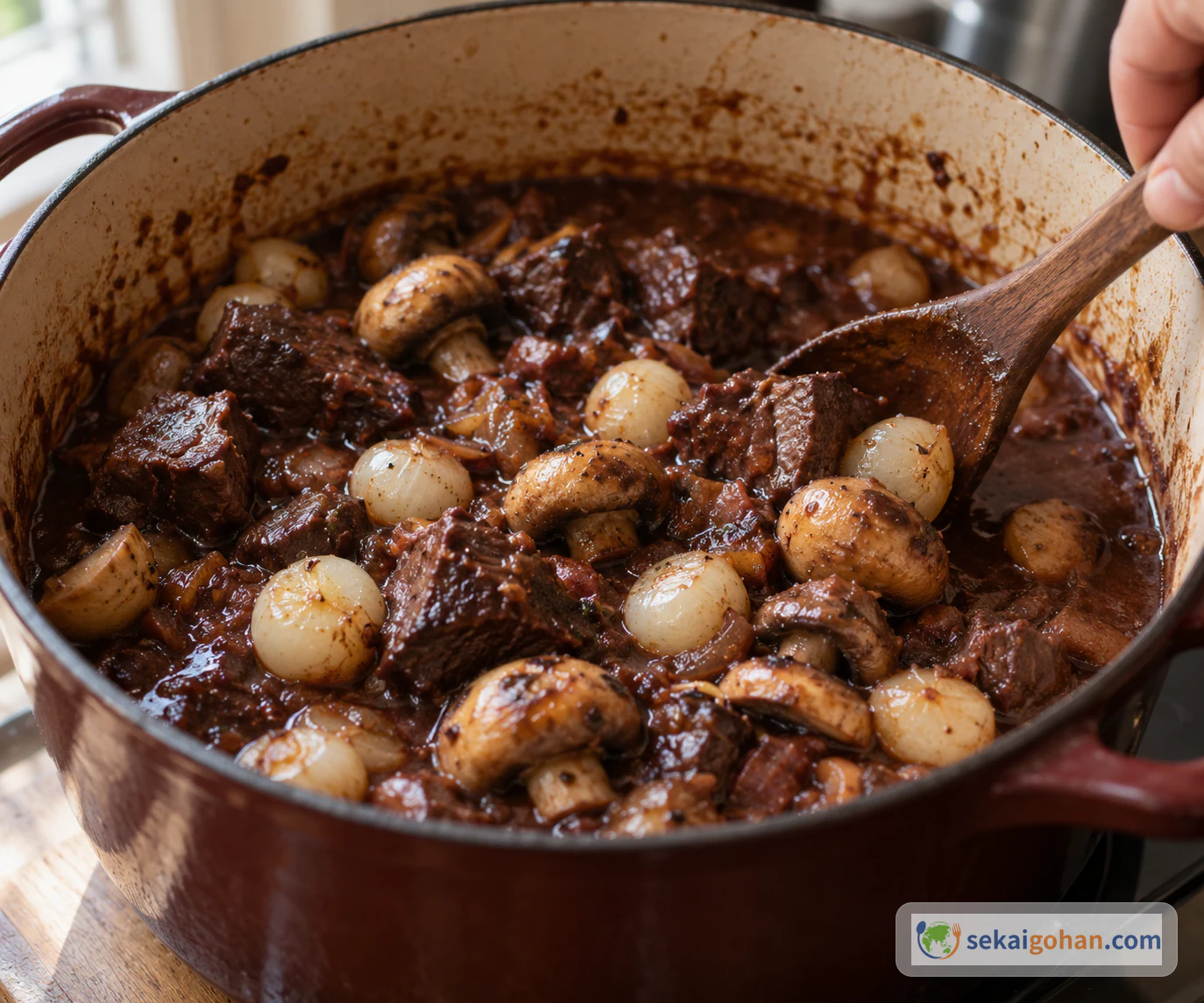
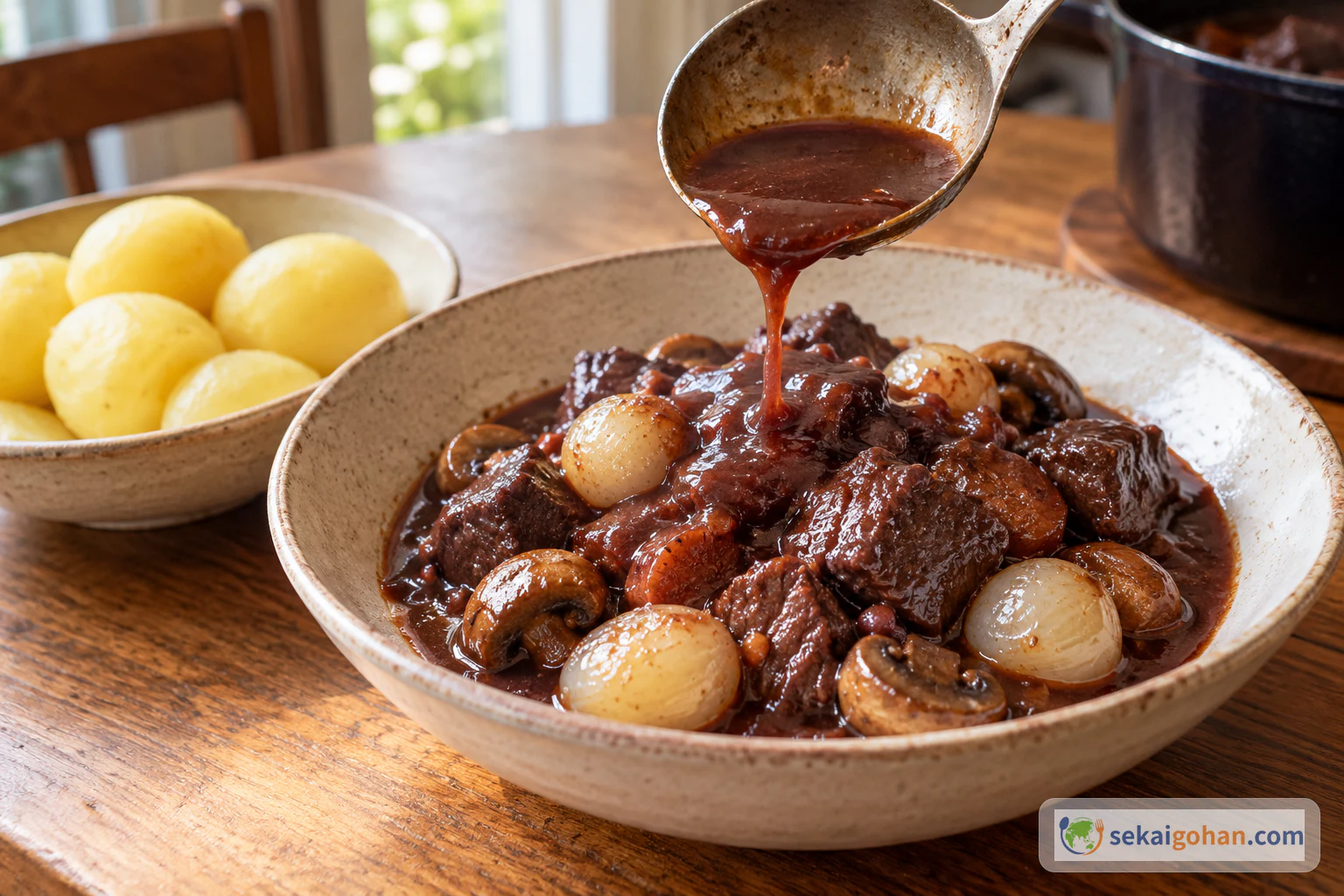
Bacon renders in a heavy pot, cubes of beef brown in batches, and red wine loosens the brown layer stuck to the bottom. Then the lid goes on, the heat drops as low as it will go, and small bubbles rise quietly at the edge of the pot while the kitchen fills with the smell of wine and bacon. Beef bourguignon is Burgundy's red wine braise, and what comes out after that slow simmer is deeply browned beef that pulls apart in a dark, aromatic sauce, with pearl onions and mushrooms that still hold their shape. The keys are simple: dry the meat and brown it well, keep the pot at a gentle simmer rather than a boil, and judge doneness by whether the beef pulls apart with a fork, not by the clock.
Beef Bourguignon in Burgundy
Red wine runs through Burgundian cooking, and bœuf bourguignon is one of the region's signature dishes, pairing local Charolais beef with wine. It belongs to autumn and winter cooking in France. In Dijon, it is a traditional Sunday dish, a regional specialty that brings together Charolais beef, Burgundy red wine, mushrooms, small onions and lardons. At home, any good braising beef and a dry red will do.
In French the dish is bœuf bourguignon, also written boeuf bourguignon; in English it is sometimes called Beef Burgundy. Bourguignon simply describes something "in the Burgundy style."
Recipes under this name differ considerably, depending on serving sizes, pots and individual cooks. One version for 4 uses 1kg of beef chuck, 400ml of red wine and 400ml of veal stock, with 150g each of bacon, mushrooms and small onions, cooked covered in the oven at 180°C (350°F) for about 2 hours. Another marinates 1kg of beef in a whole bottle of wine for at least 3 hours or overnight, uses 150g of lardons and 200g of mushrooms, and simmers for 2 hours 30 minutes. A restaurant version from Autun uses 1.5kg of beef and 1.5L of wine, simmered over low heat for 2 to 2½ hours.
France has other slow braises worth knowing alongside this one: pot-au-feu with its clear beef broth, cassoulet from southwestern France with beans and meat, and garbure, a stew of vegetables and meat. Just over the border, carbonnade is a beef stew made with beer rather than red wine.
Ingredients for 4 Servings
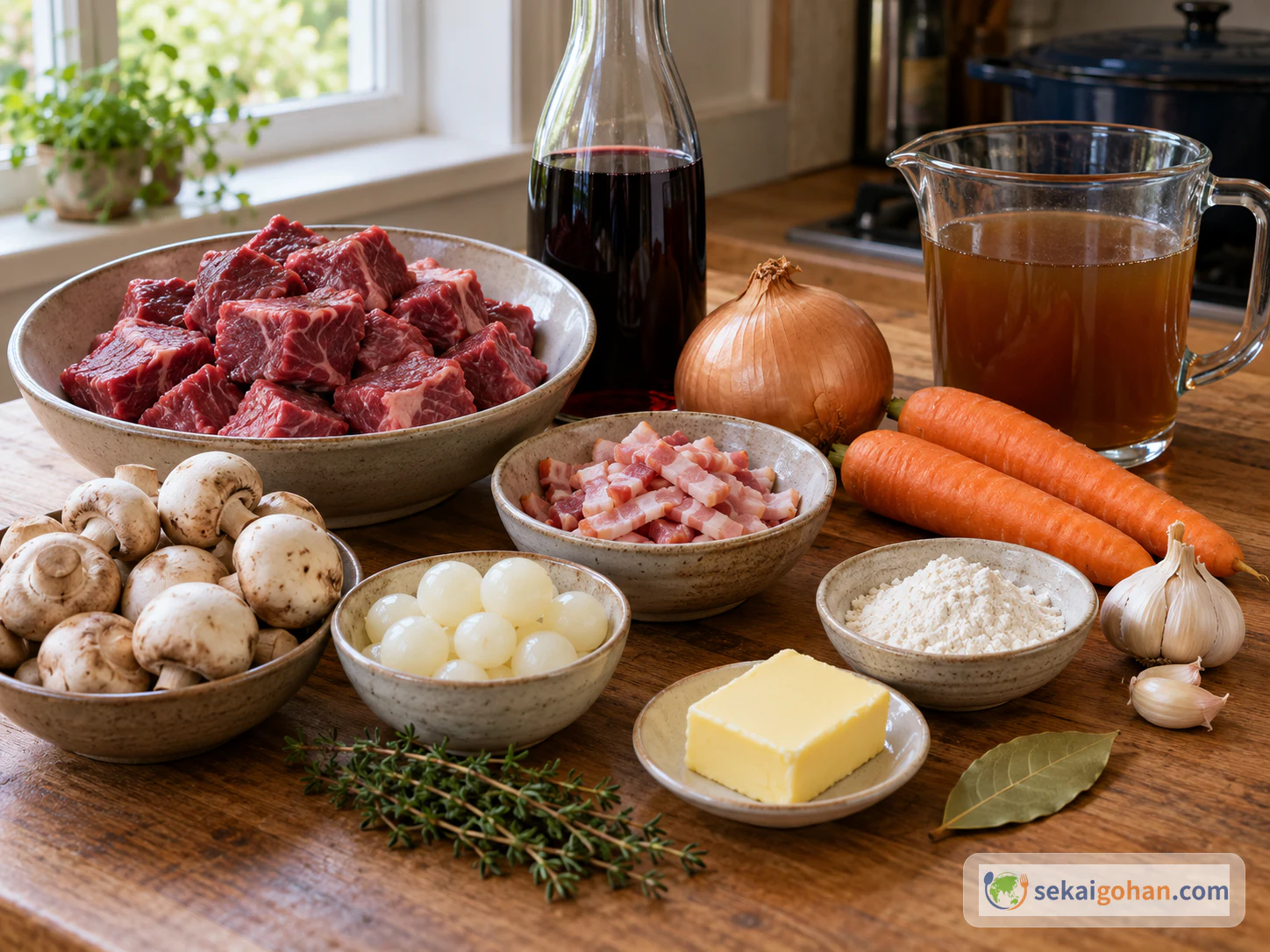
The weights for onion and carrot are a shopping guide, not something you need to measure exactly.
This dish contains beef and pork, and the flour contains wheat. Check the label on store-bought stock for wheat, milk, soy and other allergens. Long simmering does not remove all the alcohol from the wine. For children, anyone who is pregnant, or anyone who avoids alcohol, don't serve this version.
Equipment
- Heavy pot with a lid, such as an enameled cast-iron casserole
- Separate frying pan for the garnish
- Wooden spatula
- Paper towels
- Skewer, for testing the pearl onions
- Fork, for testing the beef
- Warmed deep plates for serving
The beef is done when it pulls apart with a fork. That tells you it is tender, not that it has reached a safe temperature. If you already own a heavy lidded pot, you don't need another. A thick pot helps hold a steady low simmer over a long cook.
Choosing Ingredients for Beef Bourguignon
Beef. Choose a cut meant for braising from the shoulder or shank: chuck, shoulder sold for stewing, or shank. Fat and connective tissue vary between cuts, so the time to tenderness will vary too. Lean steak cuts are not a good fit here.
Red wine. A Burgundy red is the natural choice if you can get one; otherwise, use a dry red you would happily drink, and an inexpensive bottle is fine. Sweet wine or seasoned cooking wine will change the flavor. Keep the stock and salt in check.
Stock. If you don't have veal stock, use unsalted or low-sodium beef stock; the savory character shifts slightly. Bouillon granules or cubes made with water are saltier and more strongly flavored, so adjust the salt at the end according to the product label.
Bacon. Slab bacon cut into strips works well. A heavily smoked product can compete with the aroma of the wine.
Pearl onions. If you can't find them, cut small regular onions into large pieces. They fall apart more easily, so cook them separately and add them late.
Mushrooms. Cremini (brown) mushrooms work. Shiitake have a strong aroma that pulls the dish somewhere else, so they are not a like-for-like substitute.
Flour. To avoid gluten, skip the flour and reduce the sauce at the end instead. Potato starch or cornstarch gives a different viscosity and a glossier, more translucent sauce, so it can't be swapped in at the same amount.
Butter. Vegetable oil works for the garnish, though you lose the dairy aroma.
Thyme. If using dried thyme, use a small amount.
Salt. Bacon and stock vary widely in saltiness. Start with the 3g in the ingredients and settle the final seasoning at the end.
Method: Braising Beef in Red Wine
Heat levels and minutes are guides for a home stove. Adjust medium and low heat to how tightly your lid fits and how the meat behaves. For safety, don't flambé in the pot.
Fixing Beef Bourguignon Mistakes
| Problem | What to check | How to fix it |
|---|---|---|
| The beef is tough | Too little liquid, or the pot boiling too hard | Keep a little liquid in the pot and simmer longer over low heat |
| The sauce is greasy | Fat collected on the surface | Skim the fat off the top |
| The sauce tastes sharp | Not simmered long enough | Simmer longer, check the salt, then round it out with a little butter |
| The sauce tastes floury | Flour not cooked through | Skip adding more flour; lift out the solids and let the sauce bubble until the flour is fully cooked |
| The sauce is too thin | Too much liquid left | Lift out the solids and reduce the sauce for a few minutes |
| The sauce is too thick | Reduced too far | Add hot water or unsalted stock a little at a time |
Serving, Storing and Variations
Serving
Boiled or steamed potatoes, fresh pasta, wide noodles or bread all work for catching the sauce. The long simmer suits a winter weekend or a table where people are gathering, any time of year. In Autun, leftover sauce goes into œufs en meurette, eggs served in a red wine sauce.
Making It Ahead and Storing
Beef bourguignon is good made the day before and reheated; keep the meat submerged in the sauce so it doesn't dry out. Cool it quickly rather than leaving it out at room temperature: divide it into shallow containers and refrigerate promptly. Overnight, the fat sets on the surface, where it is easy to lift off.
Reheat in a pot until the whole thing is thoroughly hot, and reheat only as much as you plan to eat. Refrigerate any leftovers promptly in a clean container.
Soups and stews keep about 3–4 days in the refrigerator and 2–3 months in the freezer. Cool it quickly, refrigerate it in portions, and eat it soon.
Variations
Oven braise. Use a lidded ovenproof pot and follow the oven version above, checking the tenderness of the meat as you go.
Marinated version. Marinate the beef in wine with aromatics for at least 3 hours or overnight. Pat the meat dry before browning, and bring the marinade to a boil before adding it. You will need to adjust the amount of liquid.
Beef cheek. Cheek gives a richer result. Depending on its connective tissue, it can take longer.
Frequently Asked Questions
When do the mushrooms go in?
They are cooked separately and added at the end, so they keep their shape and texture.
What if I want to avoid red wine?
No substitute makes the same dish. Red grape juice with a little acidity can make a separate dish in the same spirit, with a different flavor. Long cooking does not remove all the alcohol from the wine version.