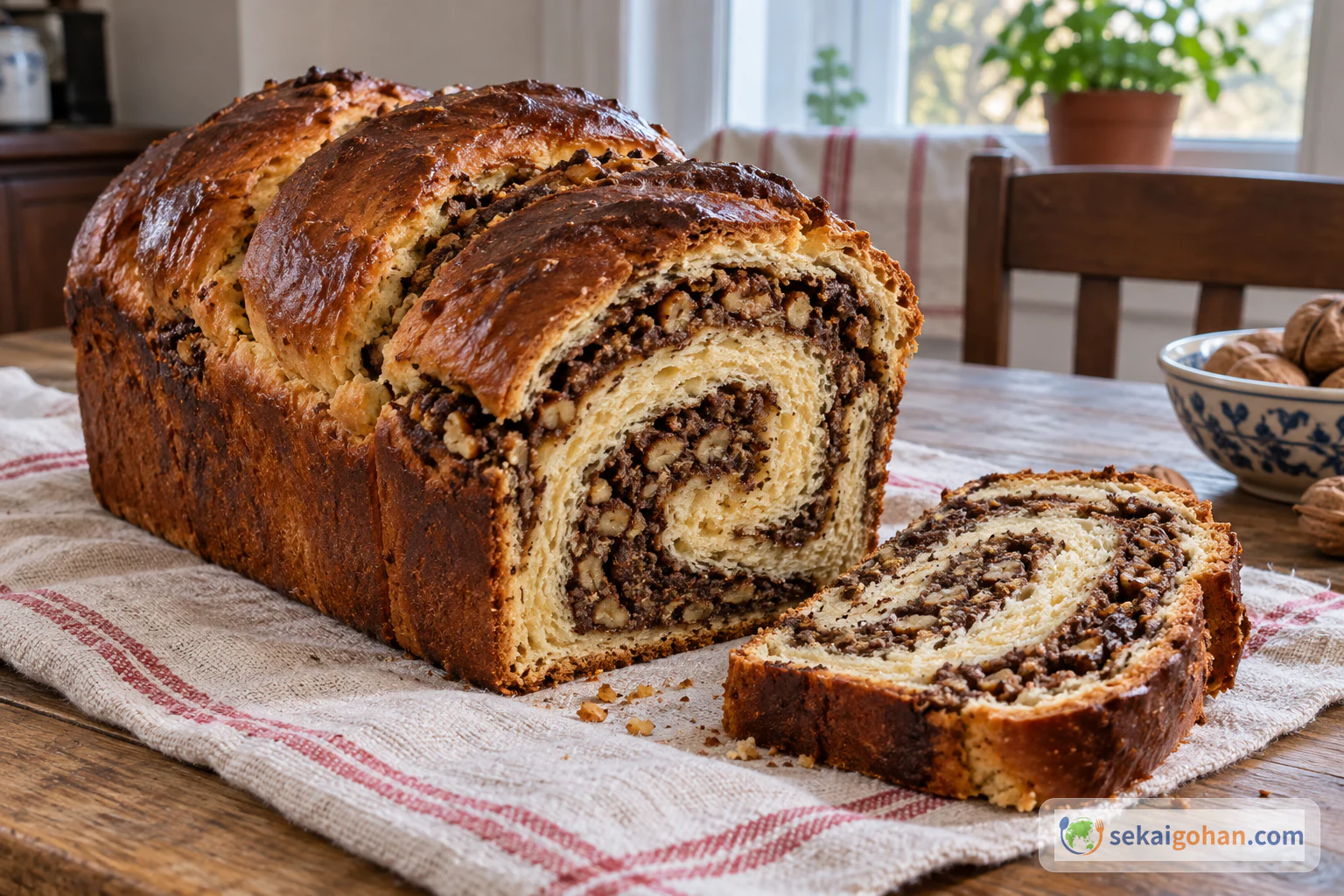
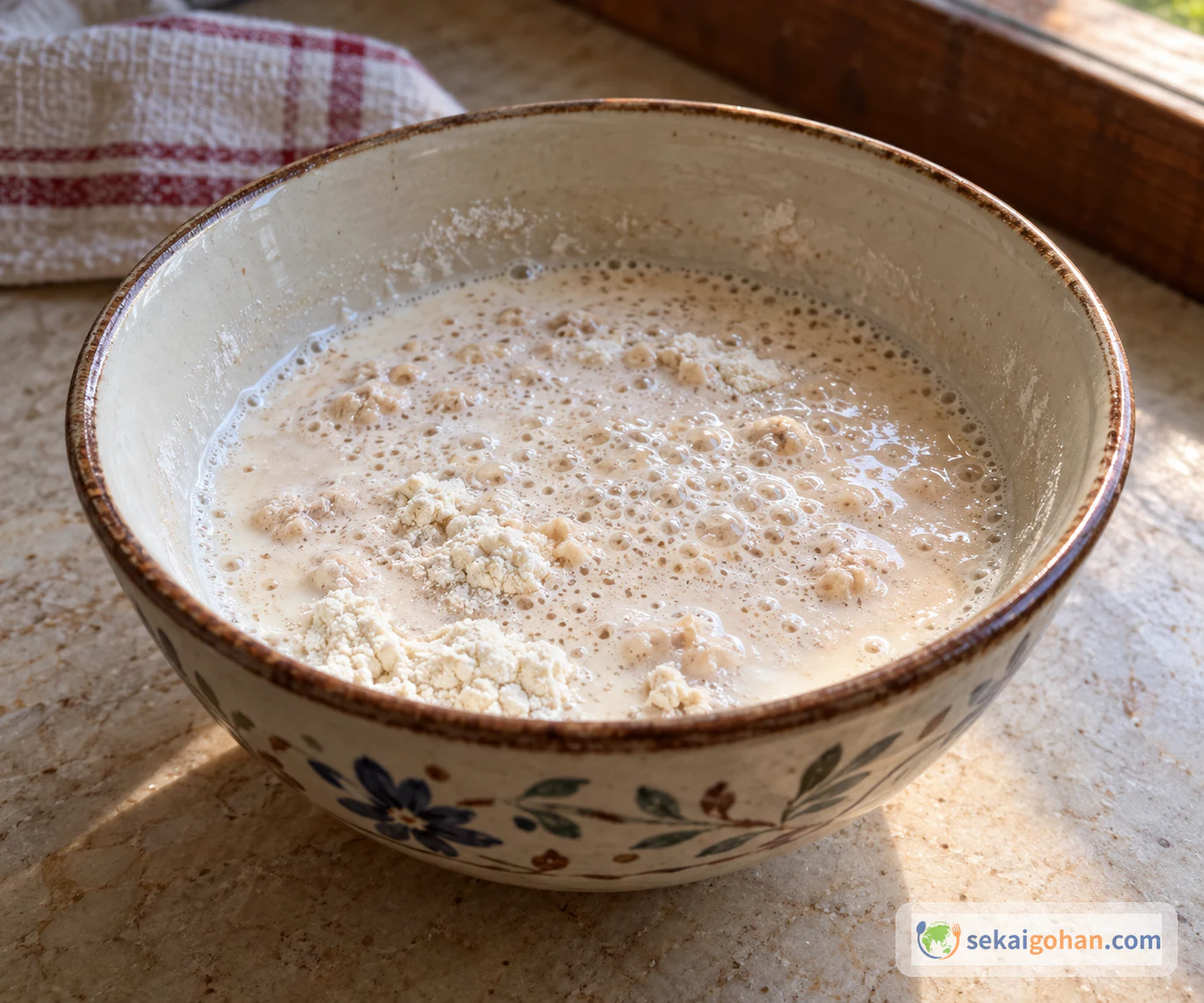
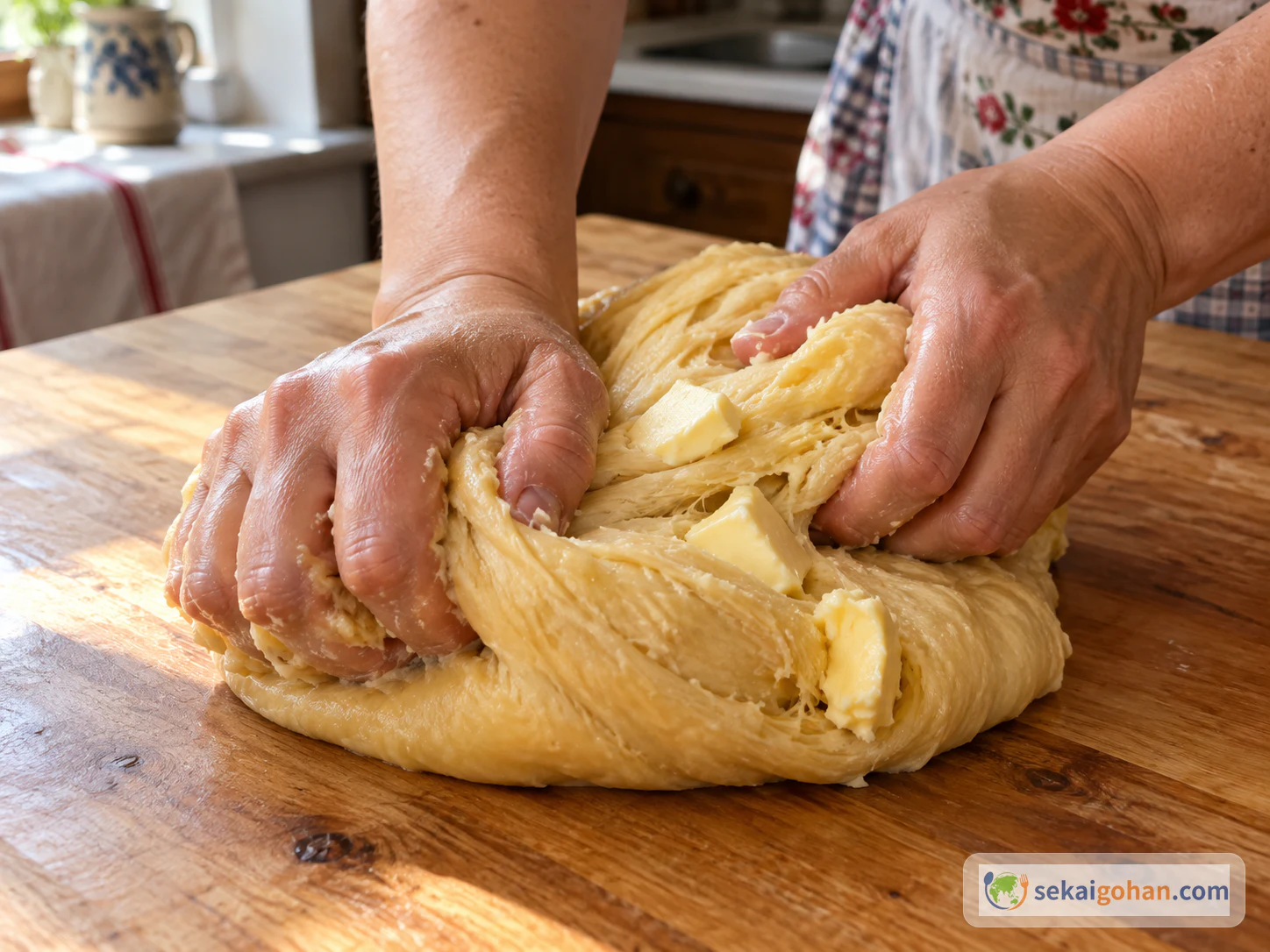
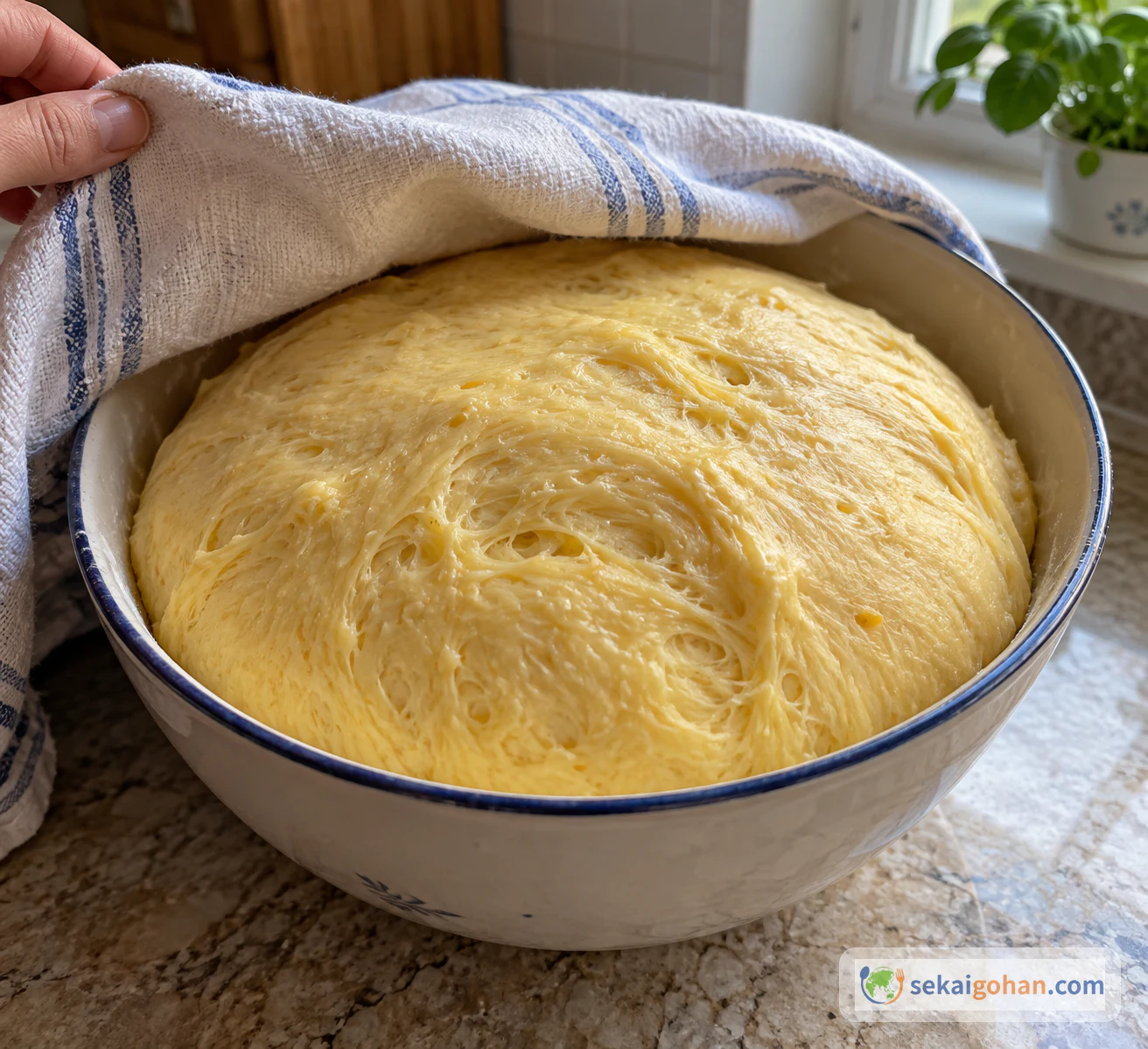
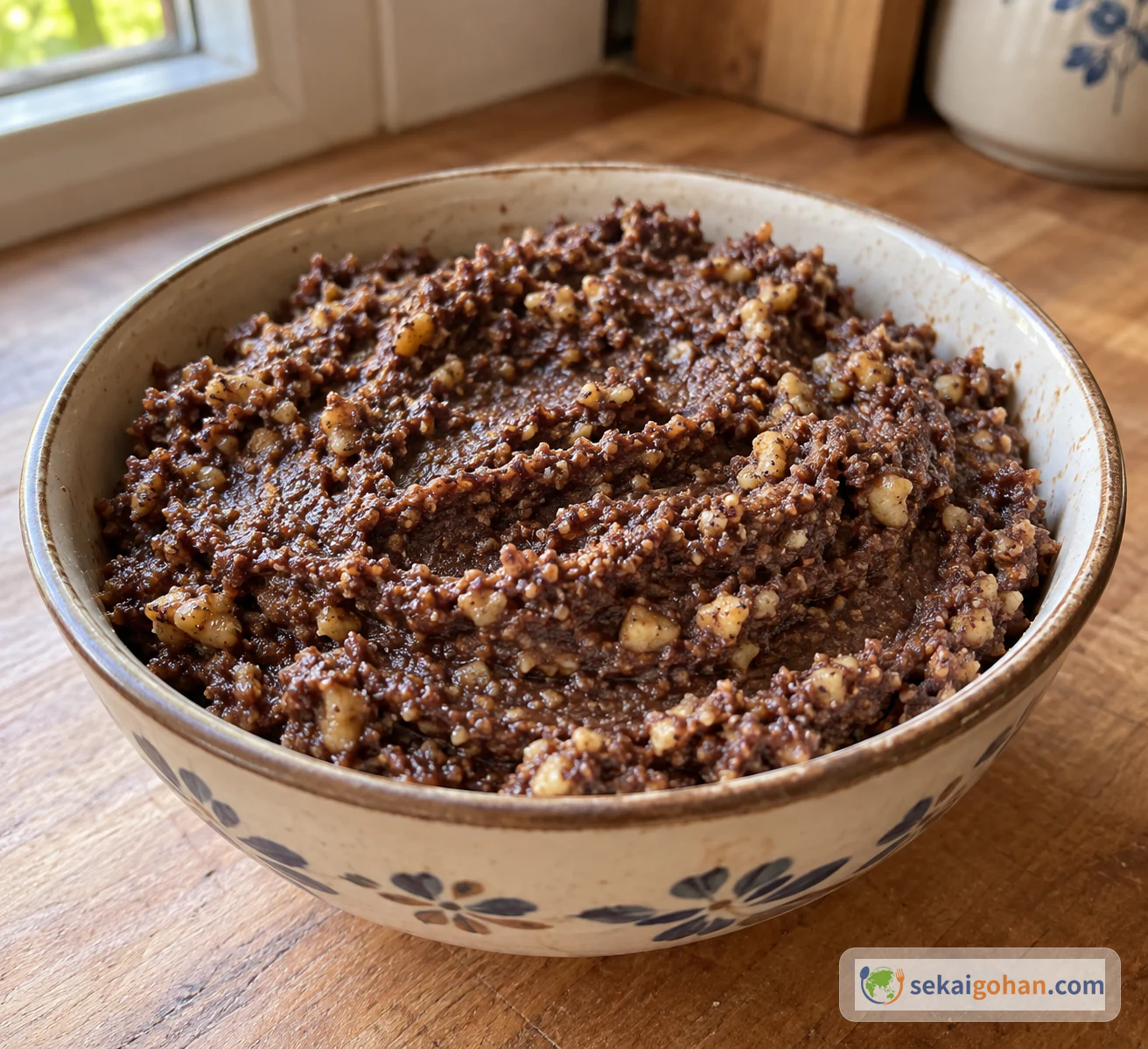
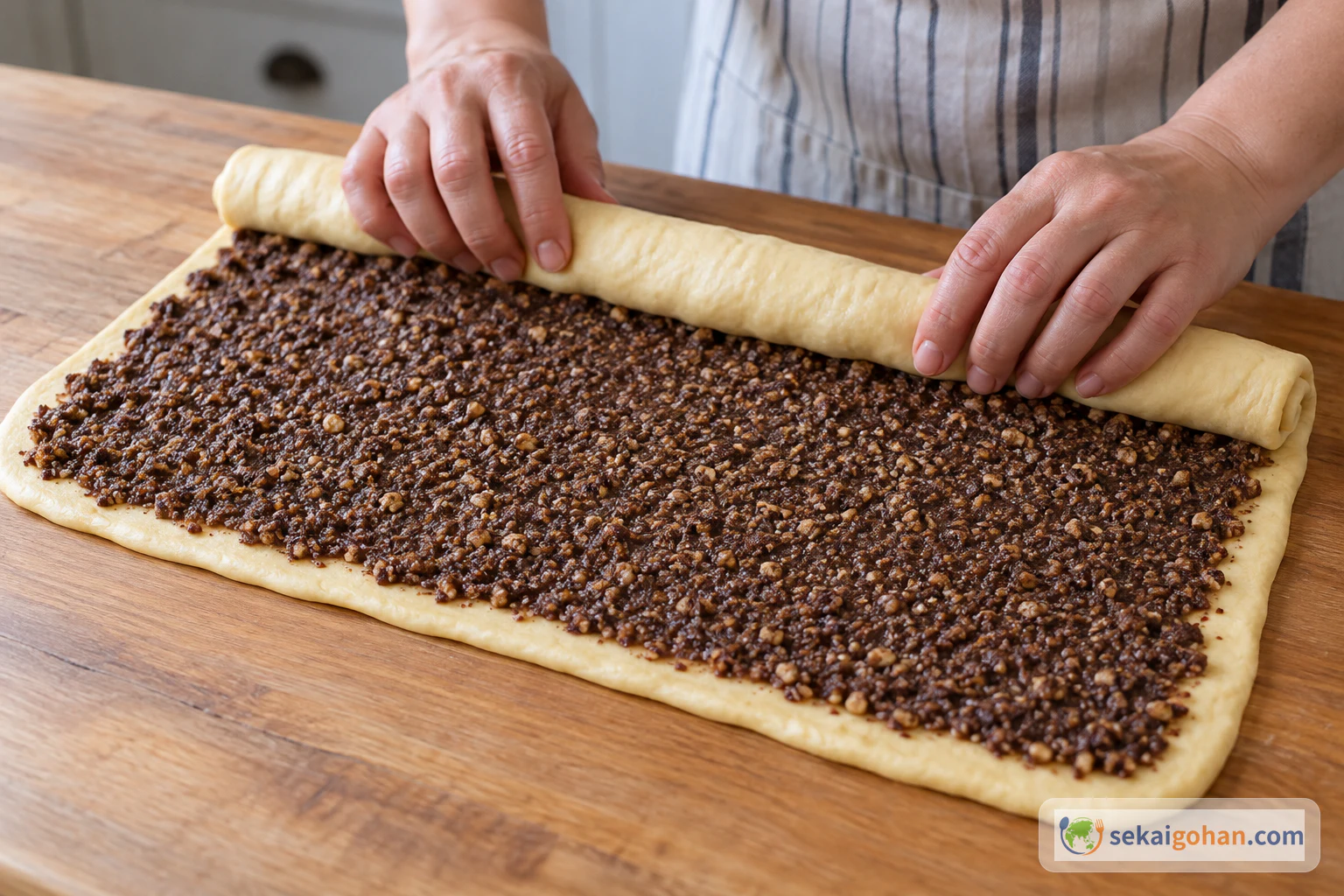
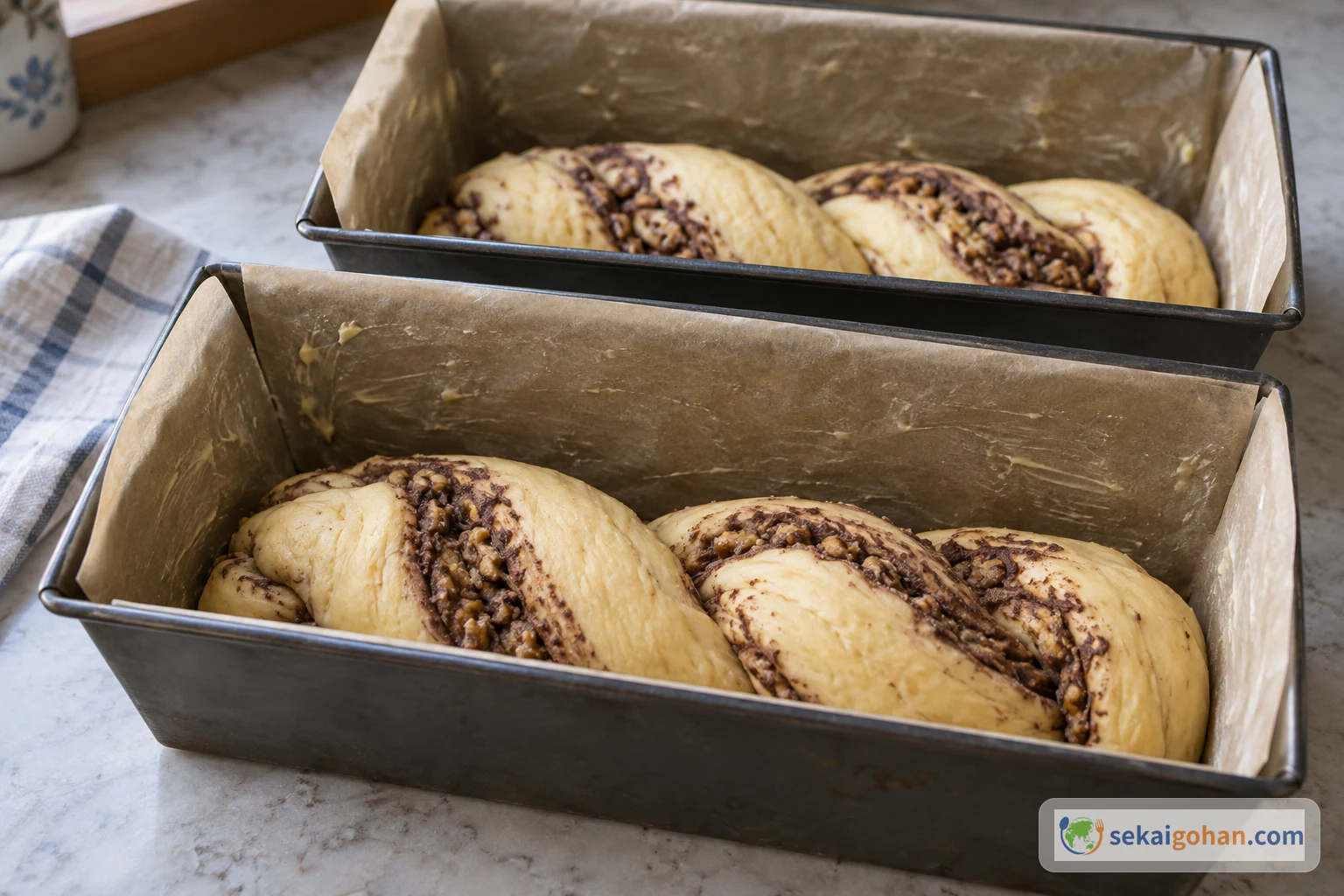
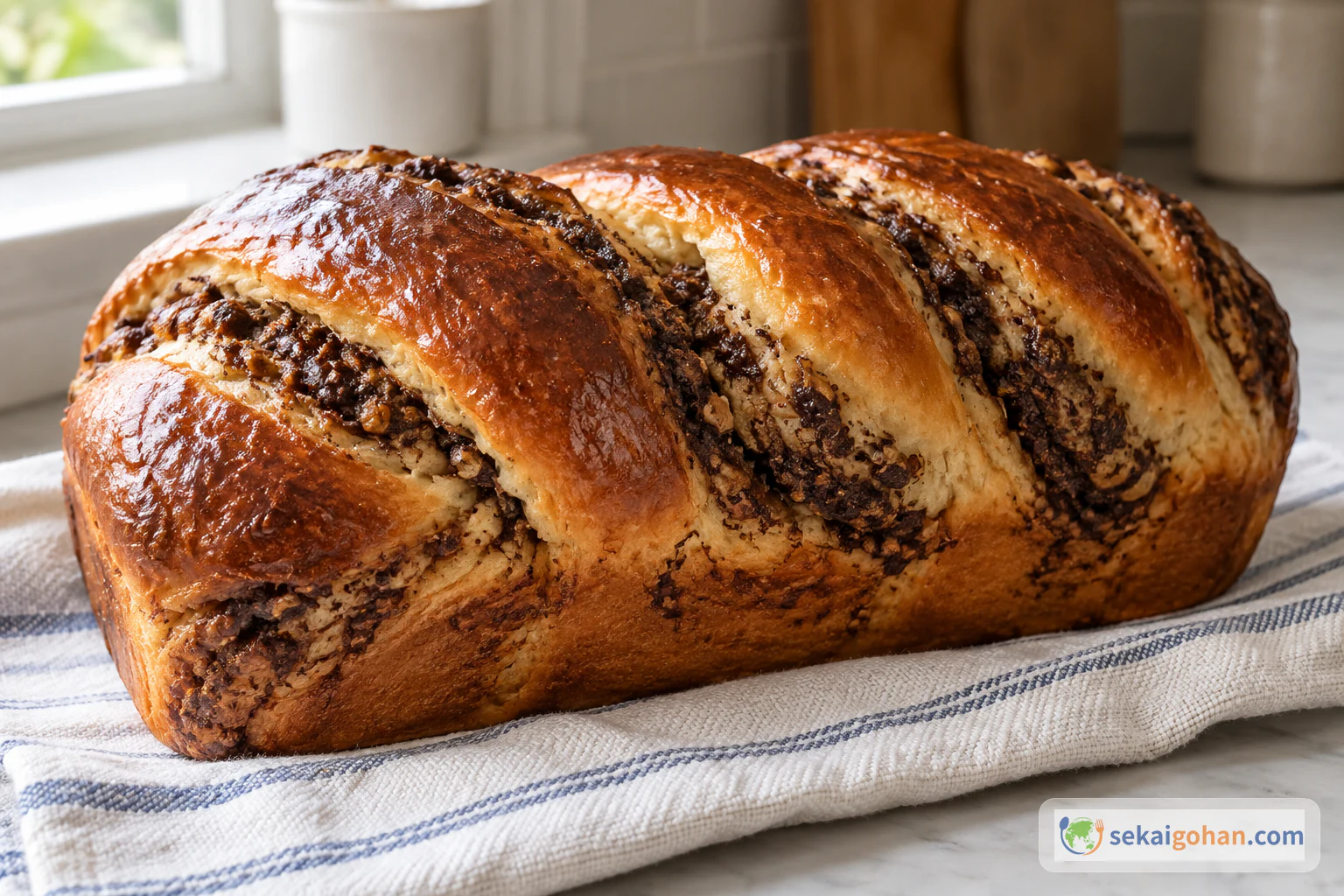
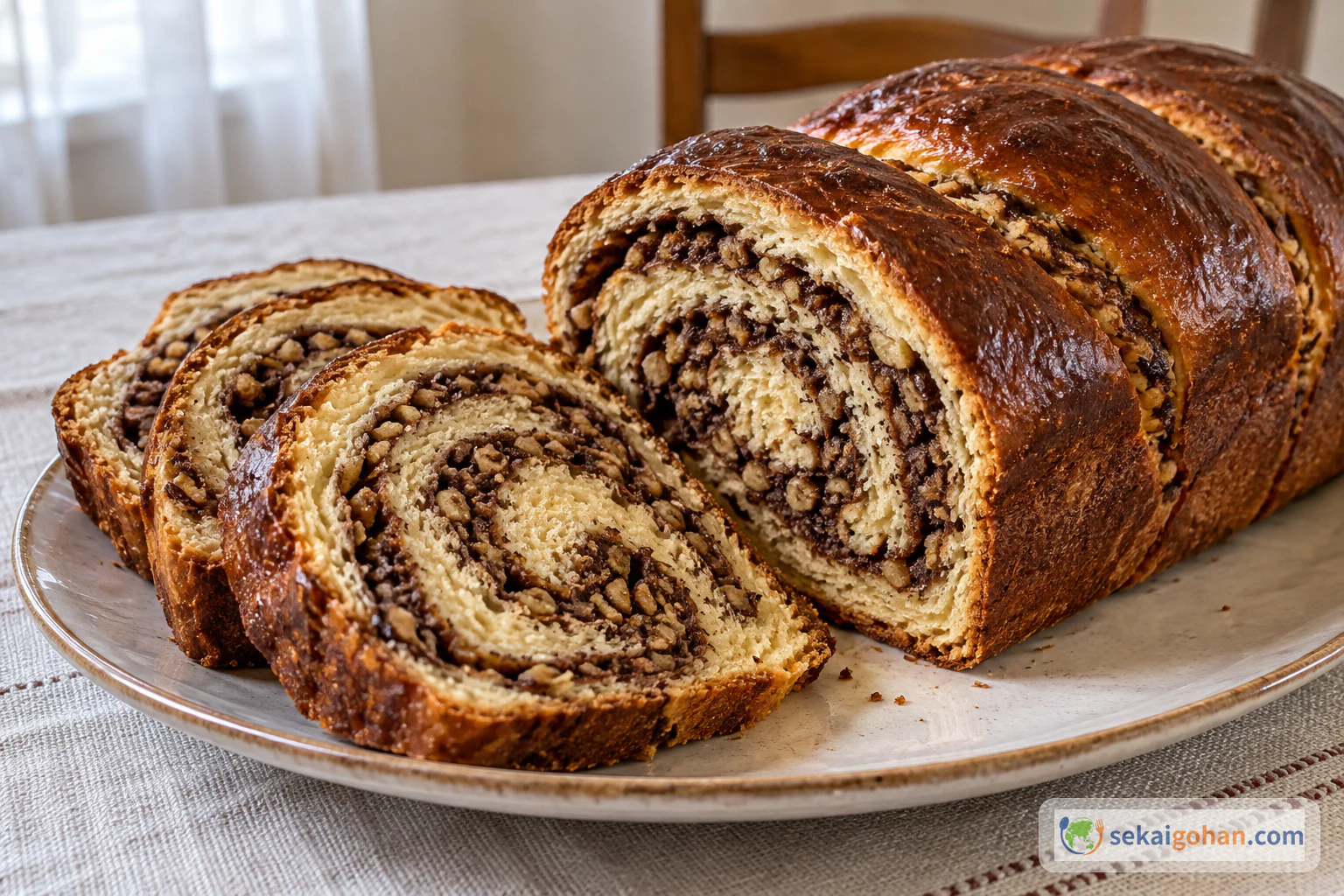
From the outside, a cozonac is a tall, golden, glossy loaf with a twisted top. The real reveal comes with the first slice, when ribbons of ground walnut and cocoa curl through the soft crumb. This Romanian sweet bread, pronounced koh-zoh-NAHK, is baked for festive days, above all Christmas and Easter. The dough is sweet and rich with yolks and butter, perfumed with vanilla and citrus zest, while the filling brings toasty walnut, bitter cocoa and a note of rum. This is cozonac cu nucă, the walnut cozonac with cocoa, and it makes two loaves. For more dishes from the same country, see the Romania country page.
Cozonac at the Romanian Holiday Table
Cozonac belongs to the festive table at Christmas and Easter, and each household has its own way with it. The dough is built from flour, milk, eggs, sugar, butter and yeast. Walnuts are the most common filling, but poppy seeds, raisins and rahat (Turkish delight) turn up too.
The method itself is simple, even if it takes patience. You knead an enriched dough for a long time and let it rise, then roll it around a filling, twist or braid it, and bake it in a pan. Neighboring countries bake closely related breads; Bulgarian kozunak is the same bread under a different spelling and pronunciation.
Ingredients: Two Loaves, Each Item With Its Own Job
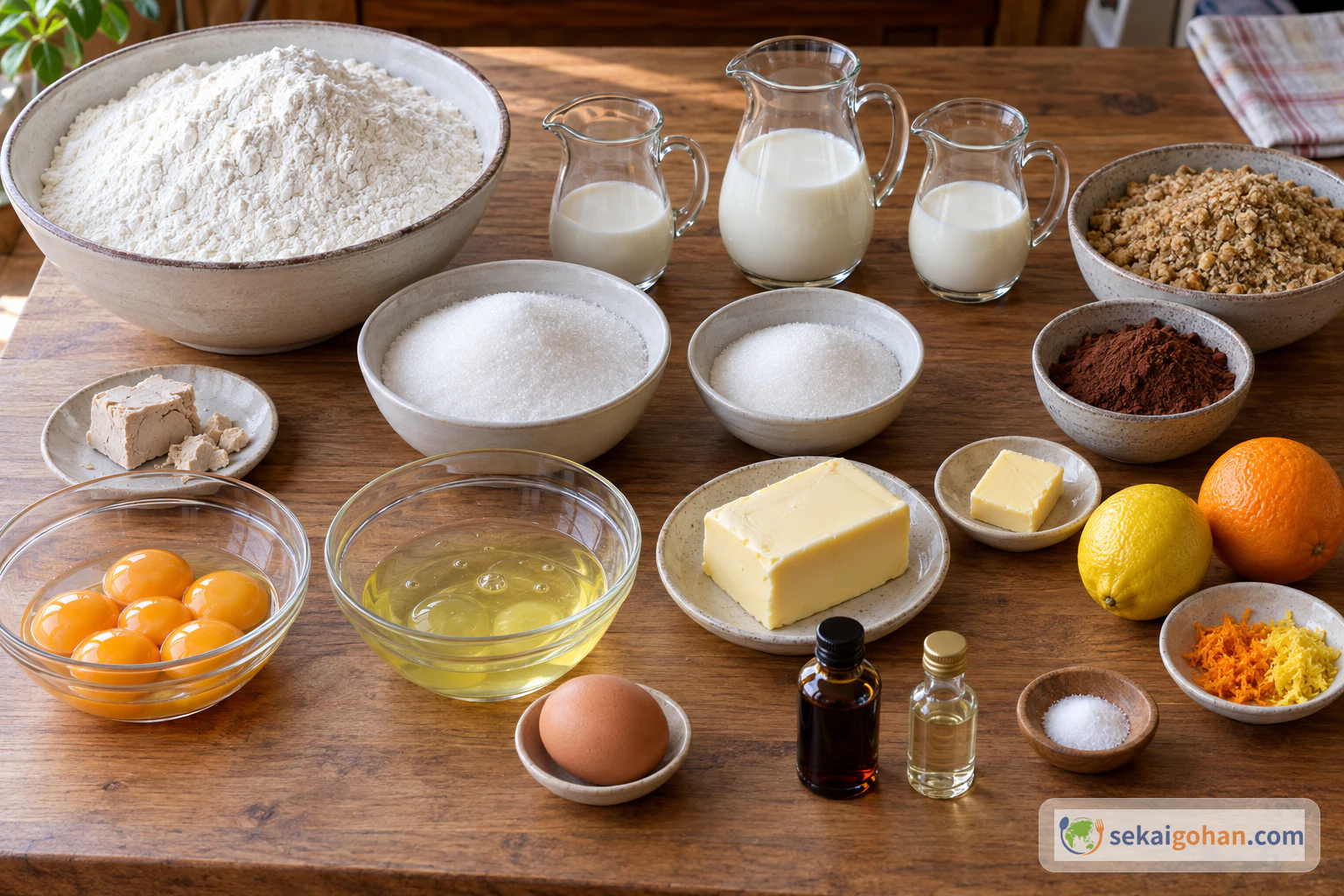
Milk, sugar, eggs and butter appear in more than one place. Before you start, measure each portion for its own use into its own container. Weigh the items given in grams. For the tablespoons and teaspoons, use 1 tbsp (15 ml) and 1 tsp (5 ml). The spoonfuls for starting the yeast come out of the flour and sugar amounts.
This bread contains wheat, eggs, milk and walnuts. If you swap ingredients, check the labels of your extracts and other processed ingredients as well.
Choosing Ingredients for Cozonac
- Flour: Use strong white flour. Bread flour is the practical equivalent in most supermarkets.
- Yeast: Use fresh yeast, 25 g. If you can't find it, use instant yeast, 7 g. Use one or the other, never both, and follow your yeast package's directions.
- Rum: Use rum extract, 1 tsp, or dark rum, 2 tbsp. Use only one.
- Butter: Use unsalted butter.
- Egg whites: Six yolks go into the dough, which leaves six whites. Only 3 go into the filling, so set the other three aside for another use. The glaze uses a separate whole egg.
- Spoonfuls for the yeast: The flour and sugar for starting the yeast come out of the 2.25 lb (1 kg) flour and 7 oz (200 g) sugar. They are not extra.
Equipment
- A large mixing bowl for the dough
- A small bowl for starting the yeast
- A bowl for the filling
- Two loaf pans, each 12 inches (30 cm) long
- Parchment paper for lining the pans
- A clean cloth for covering the dough
- A pastry brush for the egg glaze
- Oven-safe paper for covering the tops if they brown early
- A wooden skewer for testing doneness
- A thermometer (optional)
- A soft, clean towel for cooling the loaves
Method: Patience With the Dough, Care With the Swirl
The listed total time is 1 hour 50 minutes, but the rising takes longer. Plan stage by stage, and move on when the dough shows the signs described in each step.
Cozonac Troubleshooting
Treat the stage times as guides and judge each stage by how the dough looks and feels. If something seems off, this table shows where to look.
| What you see | What to check | What to do |
|---|---|---|
| The dough hasn't doubled after 1.5–2 hours | Was the milk lukewarm? Did the yeast foam in step 1? Is the spot warm? | Keep it covered in a warm place and judge by volume, not time |
| The dough feels sticky or uneven during kneading | Was the butter added all at once? | Add butter gradually and keep kneading for the full 20–30 minutes |
| The filling is hard to spread | Was each filling ingredient fully mixed in? | Mix until it forms a thick, spreadable paste, as in step 4 |
| The swirls look uneven in the slices | Were the dough and filling divided into 4 equal parts? Is there a border at the edges? | Next time, divide both evenly and spread the filling to an even layer with a clean edge |
| The dough fills more than half the pan right after shaping | Pan size | Check that your 12 inches (30 cm) pans can hold the dough at half depth or less |
| The top browns well before the time is up | Oven heat | Cover with oven-safe paper, keeping it away from the heating elements |
| The skewer comes out with dough on it | Doneness in the center | Keep baking, and check again between the swirls. About 198°F (92°C) inside means the bread is done |
Frequently Asked Questions
What does "two loaves" mean for pan size?
Two loaves, two pans, each 12 inches (30 cm) long. The recipe doesn't give width or height, so go by fill level: no more than half full right after shaping, and up to the rim after the second rise.
Why are there three separate milk amounts?
Each one has a different job. From the 1¾ cups (400 ml) dough milk, ½ cup (100 ml) is used to start the yeast and 1¼ cups (300 ml) goes into the dough. The filling takes its own ½ cup (100 ml) of warm milk. Measuring them separately keeps the dough and filling in balance.
Why cool the loaves on their sides?
Unmold after 10 minutes, lay the loaves on their sides on a soft, clean towel, and turn them now and then until completely cool. Slice only after cooling.