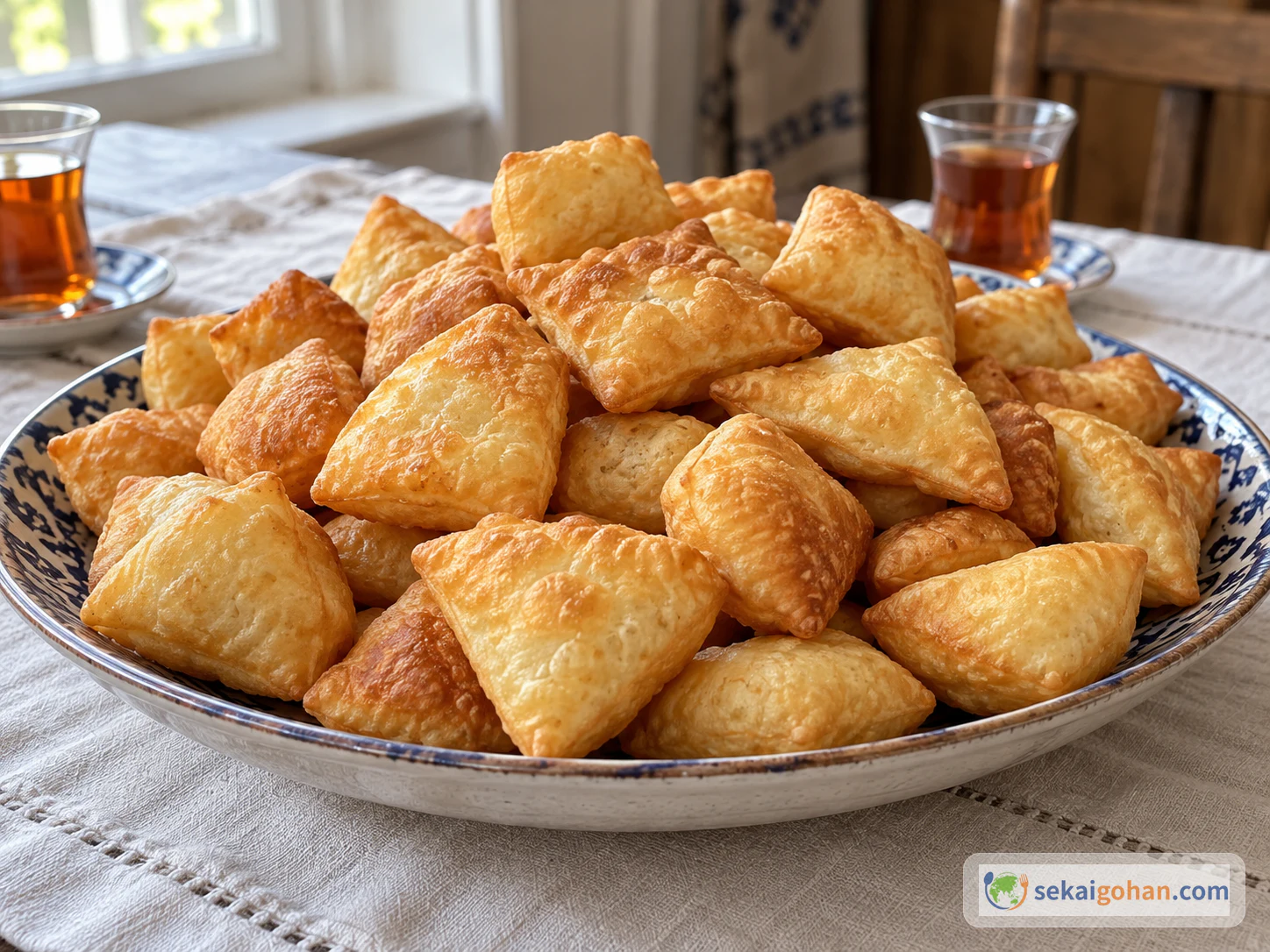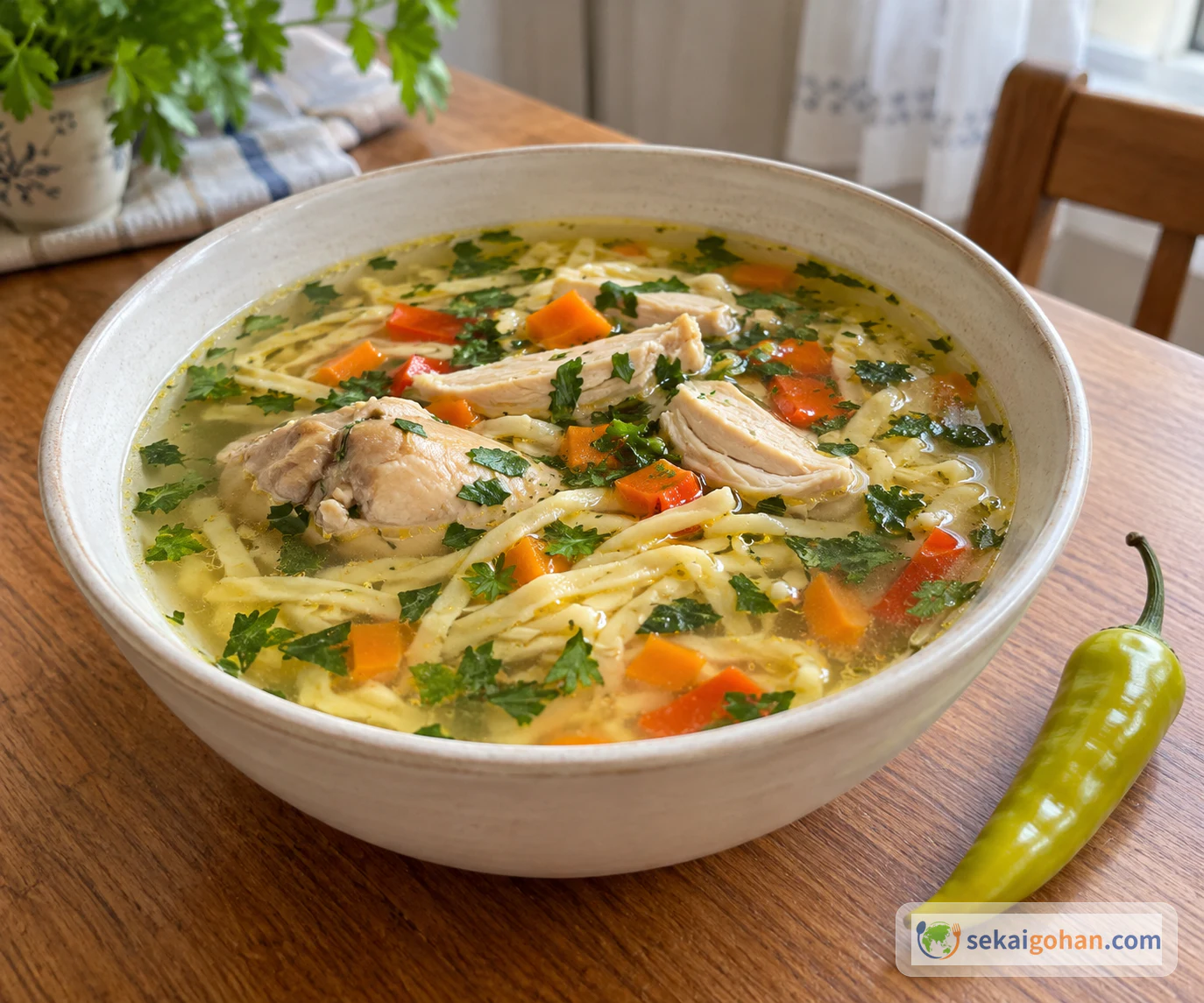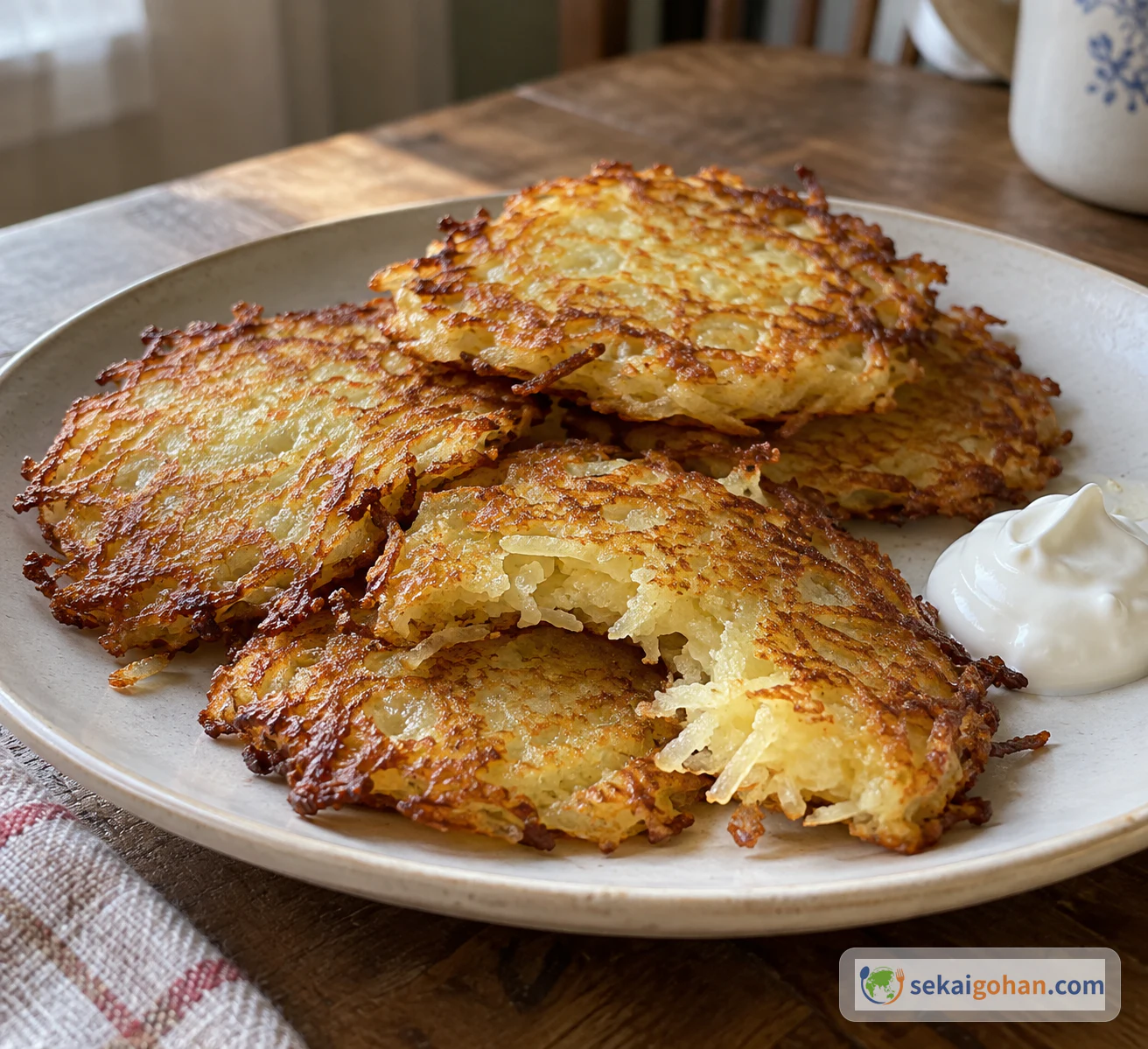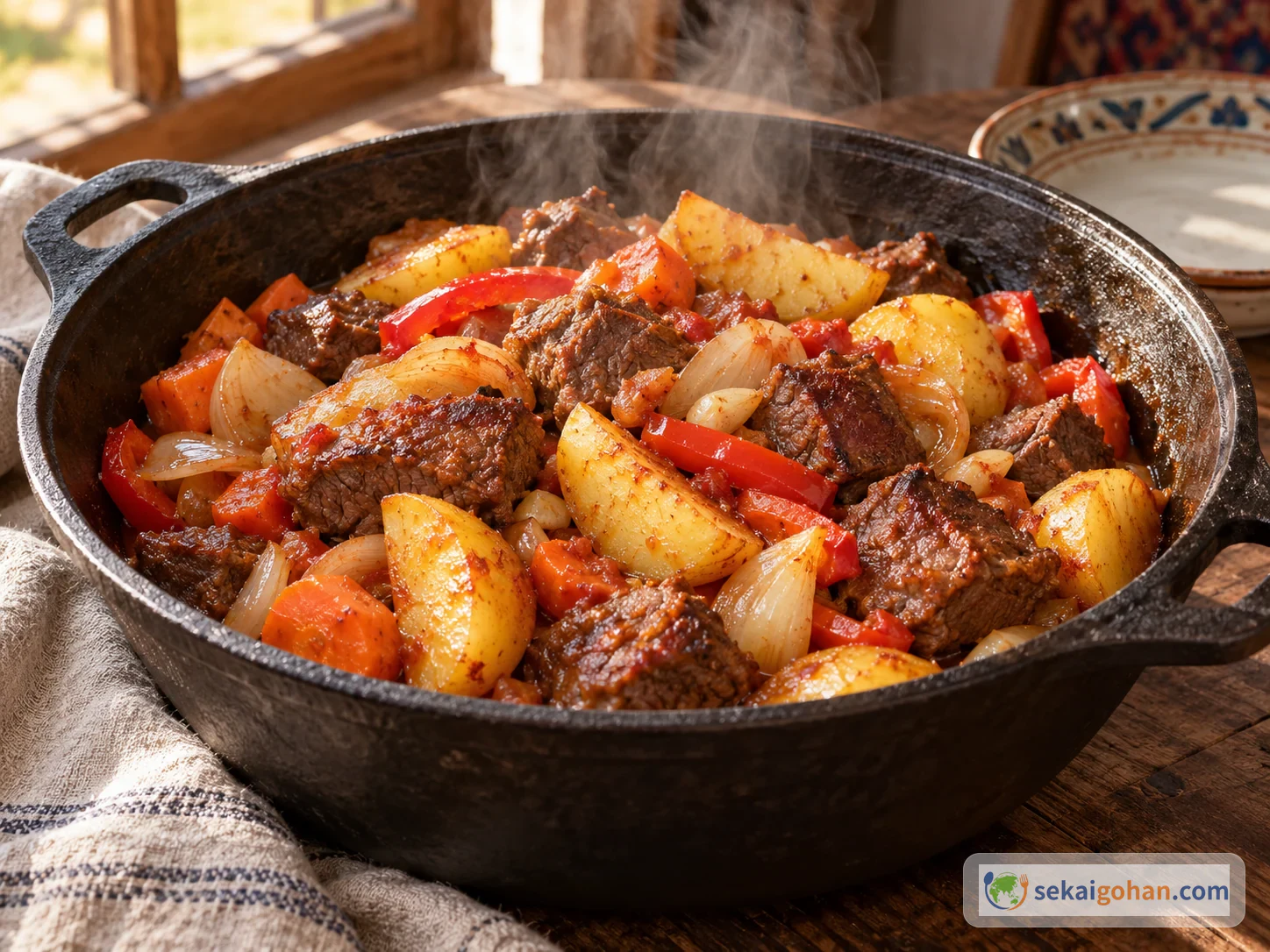
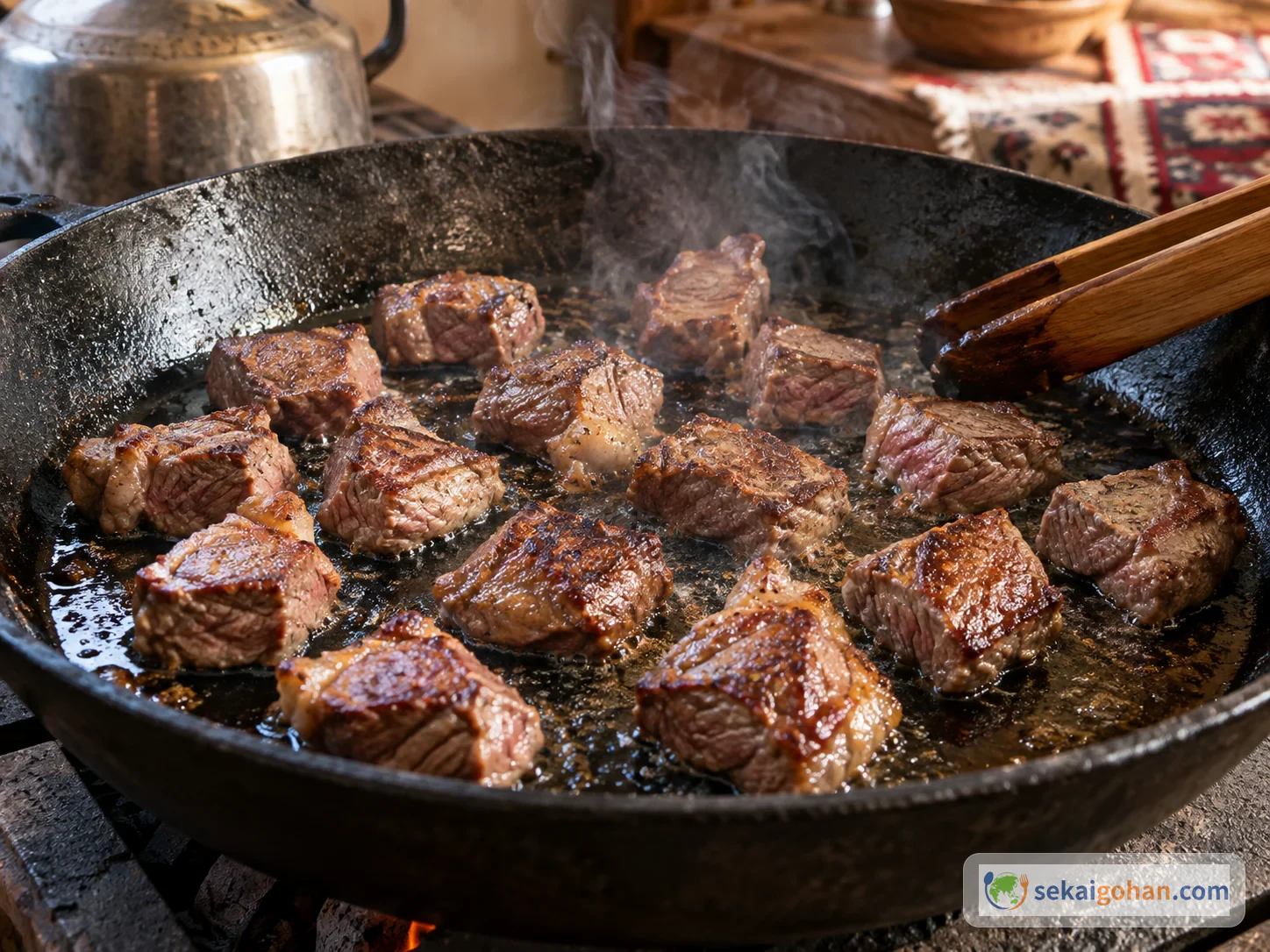
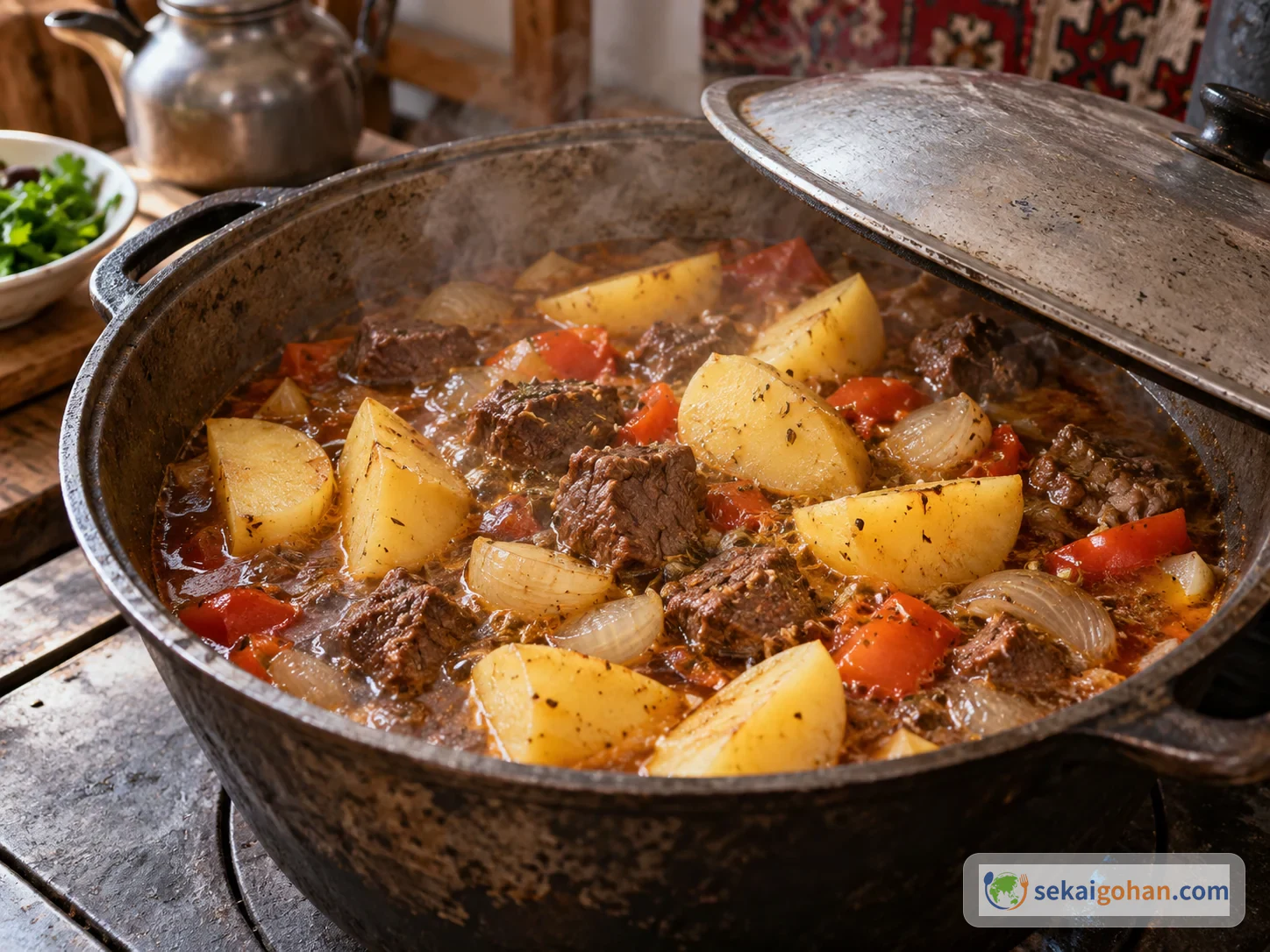
Bread is stacked high at the morning market, and from a guesthouse kitchen comes the sound of onions frying. On the table sits a heavy pot of fried meat, potatoes and onions, and family and guests gather around it, serving themselves straight from the middle. This is kuurdak (Куурдак in Kyrgyz), a Kyrgyz dish of meat and potatoes browned in fat that come together in the steam. Its name is introduced as meaning "fried meat," and that first browning is where all the flavor starts. Lamb and horse meat are common locally; this version uses beef, which is easy to find, and needs no special equipment or rare ingredients.
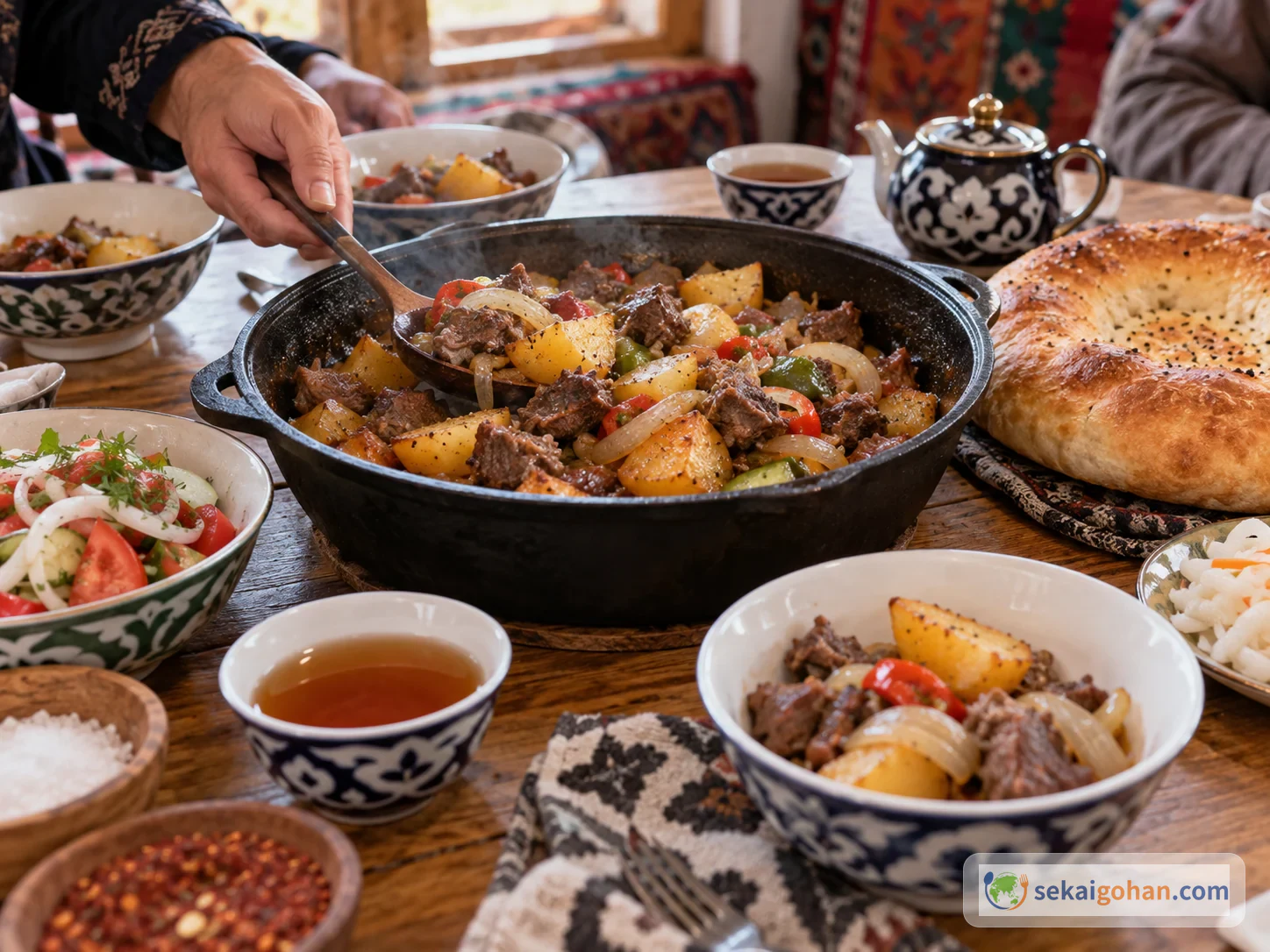
Kuurdak in Kyrgyz food culture
Kyrgyz cooking grew out of nomadic life and livestock raising, so meat and dairy sit at the center of the table. Cattle and sheep raised on the mountain pastures (jailoo) become the dishes used to welcome family and guests.
Kuurdak began as food for herders and nomads. Meat was preserved by soaking or covering it in fat, then packed with garlic and onion into a dried stomach (kutyr) to carry on long journeys and migrations. The smell of fried meat in today's pot is an echo of that past. That preservation method is history, though: modern kuurdak is a hot main course, meat fried in a pot with vegetables and potatoes, and at home it goes into the refrigerator after cooking. Don't keep it at room temperature covered in fat; that is not a safe home method.
The dish changes from table to table. In the north, the south and around Naryn, horse meat stands out, and kuurdak is made with lamb or horse meat fried with potatoes and onions in homes and casual eateries alike. Around Karakol, other food cultures such as Dungan cuisine overlap, a reminder that Kyrgyz food can't be reduced to one taste. At homestays, kuurdak arrives with bread and tea, and everyone shares the portions served out. Under the same name, the meat, the fat and what comes alongside all shift.
Ingredients (serves 4)
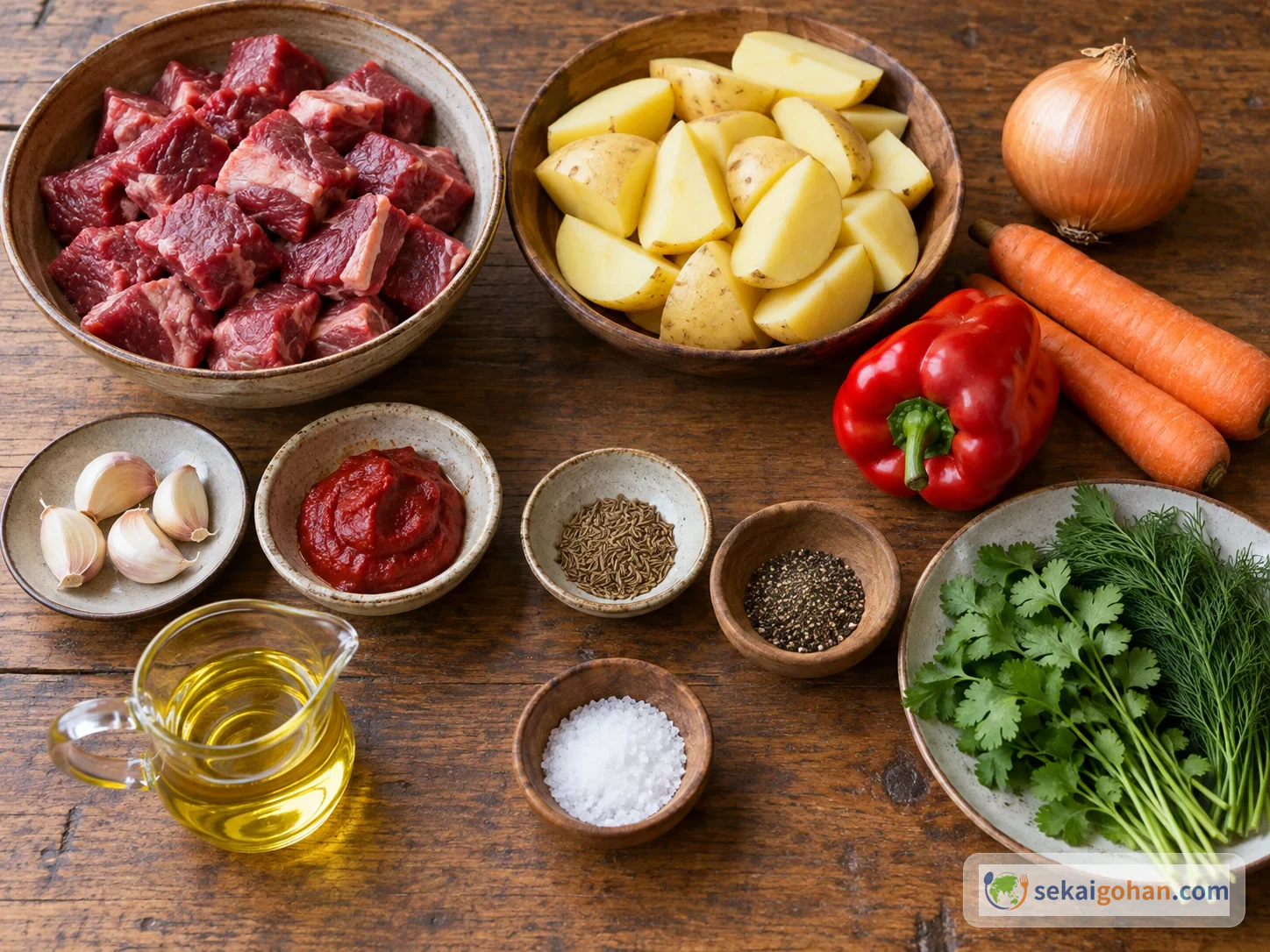
The full recipe makes 7 servings: 1.25 lb (600 g) beef, 5.5 oz (160 g) onion, 5.5 oz (160 g) carrot, 7 oz (200 g) bell pepper, 1 oz (30 g) tomato paste, ¼ cup (60 ml) oil, 20 g herbs, 10 g garlic, 1 lb (500 g) potatoes and 5 g cumin. The table below scales these to 4 servings, rounded to easy-to-weigh amounts. Use the 4-serving amounts as a guide. Adjust the salt, black pepper and water to suit your pot and taste. Take 3 g cumin as the baseline and adjust the aroma. Cut the meat and vegetables evenly so they cook at the same rate.
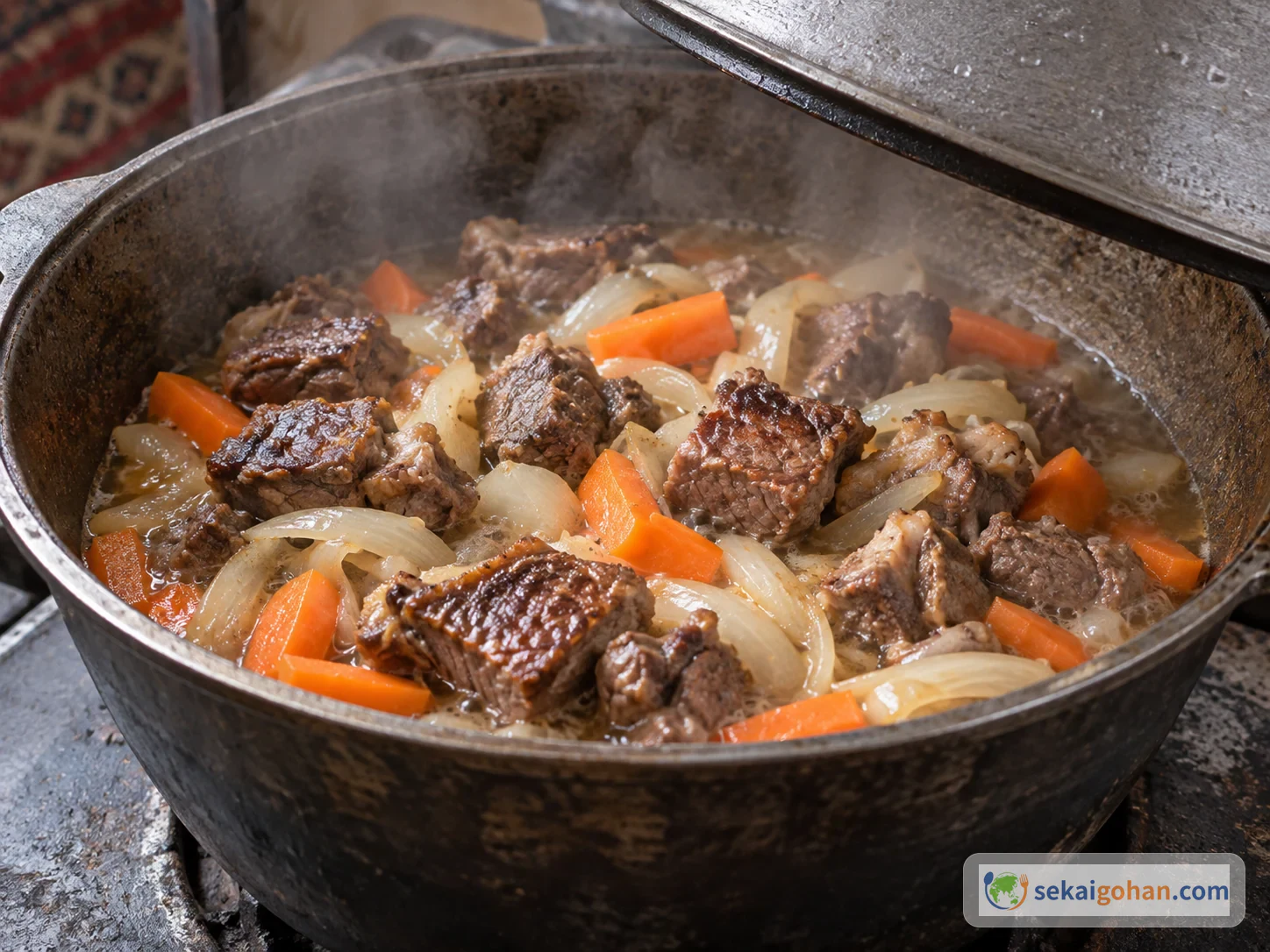
Use ½ cup (120 ml) water in the first half to briefly braise the meat and aromatics. Keep the boiling water for the second half for cooking the potatoes through. Pour in a lot of water at the start and the browning of the meat is buried in the liquid, and the result moves toward a soup. Splitting the water between the first and second halves is the trick. For the second half, choose the amount from the range in the table, depending on the size of your pot and the height of the potatoes. Keep the liquid from hiding the ingredients.
Keep the cutting board and knife for raw meat separate from those for vegetables. If you do not, wash the tools that cut the meat with detergent before using them on vegetables. Beef does not become safe just by browning the surface; it is a dish where you cook it thoroughly through the center. When measuring dry spices such as cumin, do not put back a measuring spoon that has touched raw meat.
Ingredients and substitutes for kuurdak
Beef round or shoulder works well, cut into 1 inches (3 cm) cubes. If your meat is lean, the oil used for browning makes up the savor. Lamb can replace it in the same amount and brings a stronger aroma of fat, while beef gives a milder sweetness. Horse meat needs a longer braise, so check doneness and tenderness as you go.
Fry in vegetable oil rather than lamb or horse fat kept at room temperature; you borrow the aroma without storing the fat. Building the browned surface matters more to this dish than the kind of meat. Potatoes and onions give kuurdak its shape, so keep them. The bell pepper and tomato paste add sweetness and color; leave them out and you get a plainer dish of meat, onion and potatoes, with less color and acidity.
| Ingredient | Local range | At home | Effect on the result |
|---|---|---|---|
| Meat | Lamb, horse meat, beef and so on | 12.5 oz (350 g) beef round or shoulder | The aroma changes, but the browning and braise stay the same |
| Fat | Fat from the meat, lamb fat, horse fat | 2.5 tbsp (35 ml) vegetable oil | Lighter aroma; builds browning on the bottom of the pot |
| Vegetables | Onions and potatoes at the core | Carrot, bell pepper and tomato paste too | Adds sweetness, color and body to the liquid |
| Aroma | Cumin and other spices | 3 g cumin, a little black pepper | Ties the meat and potatoes together |
| Pot | A large pot or a heavy pot close to a kazan | A heavy pot of about 9.5 inches (24 cm), or a deep skillet | Room to brown the meat without overlapping and hold the liquid later |
Cumin gives this dish its aroma. Look for it under the general name "cumin" at a spice shop. Whole seeds bloom in the pot, while ground cumin spreads evenly through everything, so choose whichever form you like. Check the form, ingredients and storage condition on the label. Without cumin you can still make it with black pepper alone, though the aroma will be weaker; another spice in its place will change the taste.
Method
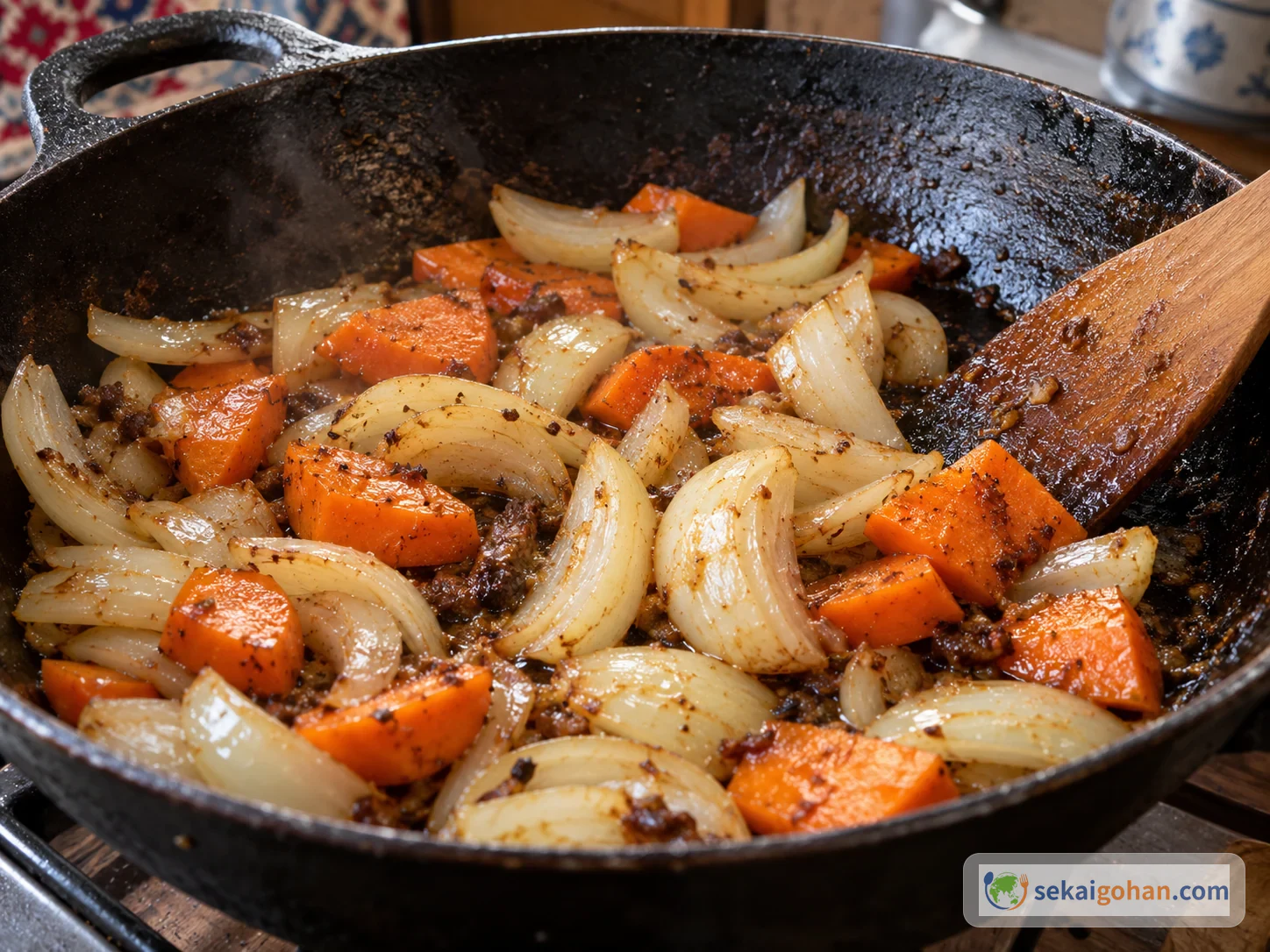
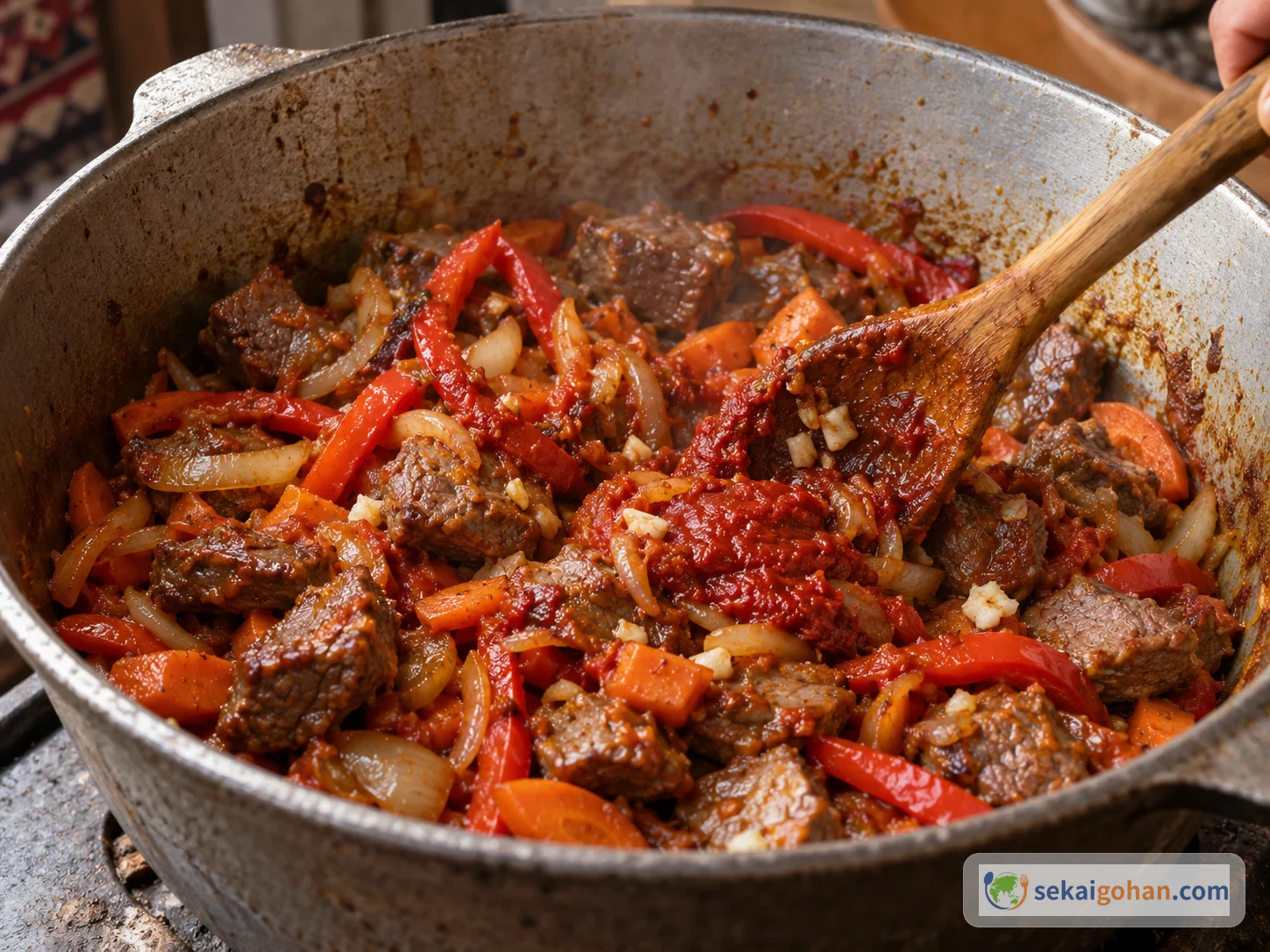
The work goes from browning the meat, to braising in a small amount of water, to finishing with the potatoes. Prep takes 25 minutes and cooking 50 minutes, 75 minutes in all. The steps are the same as in the 7-serving recipe. Work in this order: meat, onion and carrot, a little water, bell pepper with garlic and tomato paste, then potatoes. Go by the pot, not the clock. Watch the color of the meat's surface, the moisture at the bottom of the pot, and how a skewer goes into the potatoes. Adding water after the color has come and potatoes that keep their shape even when a skewer goes through are the two peaks of this dish.
Keep the browning to a deep brown. Remove any black scorch that makes smoke. There is no need to change pots; it is fine to go on avoiding the scorched part. The rule is to avoid the scorch rather than scrape it in. If the meat is tough, add a little boiling water before putting in the potatoes, cover, and extend in 10-minute steps. Judging the meat and potatoes separately keeps either from being left half done.
If the potatoes seem about to break, do not stir; shake the pot. Shaking the pot instead of stirring with a spatula keeps the shape. Only remove the lid if there is a lot of liquid.
Fixing scorching, wateriness and tough meat in kuurdak
Most failures can be rescued if you can read what's happening in the pot. A brown, fragrant bottom is good: loosen it with a little boiling water. Black scorch is different. Never return black scorch to the flavor. Checking the doneness of meat and potatoes separately saves time: hard potatoes just need a longer simmer at the end, and if the liquid runs low, add boiling water a little at a time.
| State | Main cause | How to recover |
|---|---|---|
| The bottom is black and smells bitter | Heat too strong, paste fried too long | Move the ingredients to another pot without scraping the scorched part and continue with a little boiling water. If bitterness has spread through, don't try to cover it up |
| Meat is tough | Not enough liquid in the first half, a tough cut | Before the potatoes, extend in 10-minute steps with 3.5 tbsp (50 ml) boiling water and the lid. After the potatoes, extend briefly over low heat without breaking them |
| Too much liquid | Too much boiling water in the second half | Once the ingredients are cooked, remove the lid and cook a few minutes over medium heat. Don't over-stir; leave a little liquid at the bottom of the plate |
| Potatoes break | Cut too small, stirred too much, cooked too long | Stir by shaking the pot. Next time cut into quarters or larger and turn off the heat as soon as a skewer goes in |
Turn off the heat by the state of the food, not only by the clock: the meat is cooked, a skewer slides into the potatoes, and a little liquid remains at the bottom. Turning off the heat while the corners of the potatoes remain also makes the dish look good on a large plate.
Taste to the end and decide salt and liquid just before plating; herbs can be adjusted then too. Do not hide bitterness or undercooking with spices or water. For a stronger flavor, cook off more moisture rather than piling in extra cumin.
Serving and storing kuurdak
Serving
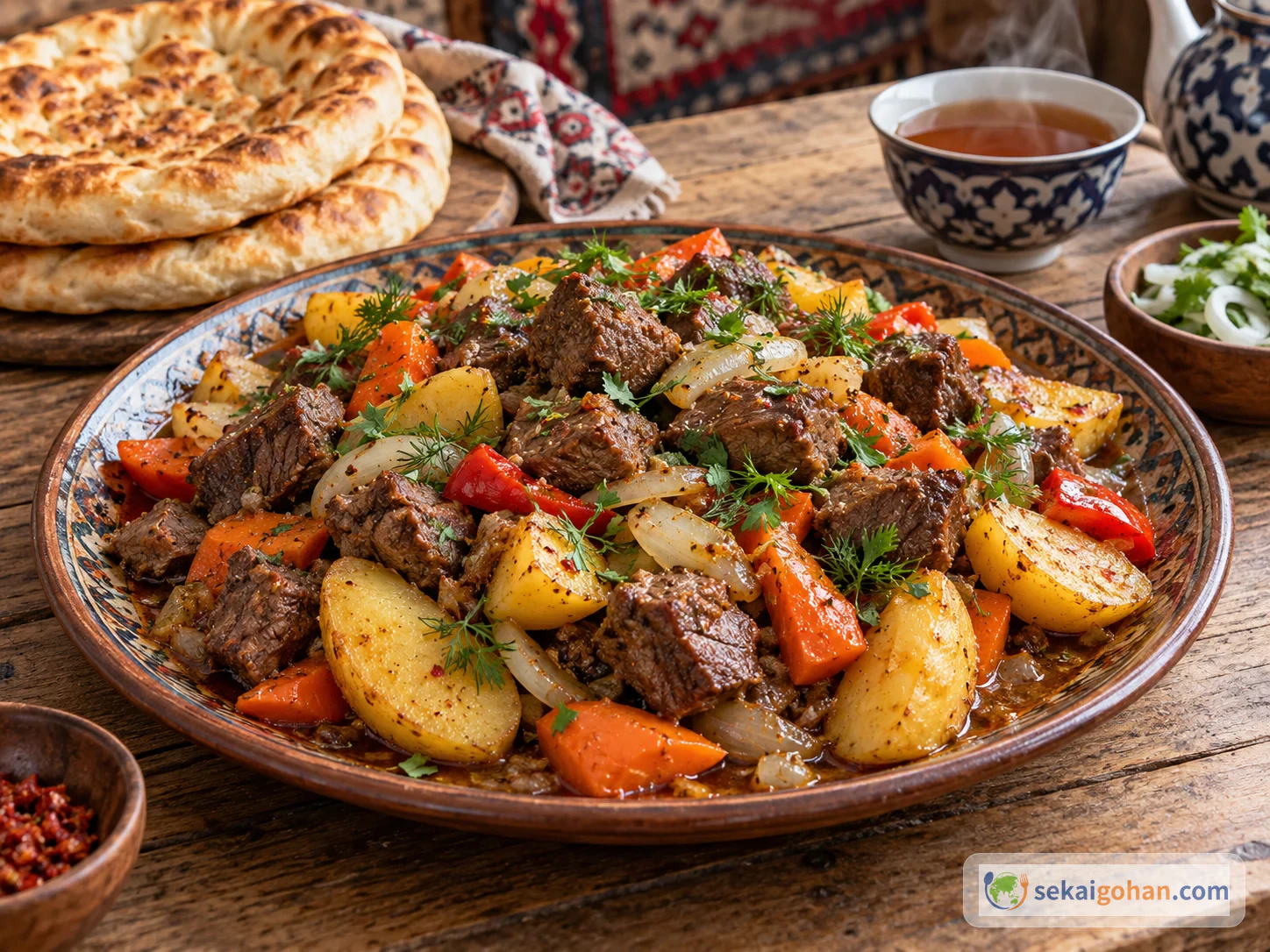
Bring kuurdak to the table hot on a large plate as a second course, with the meat and potatoes divided evenly, and set out bread and hot tea to lighten all that meat. In a life of nomadism and herding, meat was the dish for welcoming family and guests, and gathering around one plate to share is part of the meal's manners. At home, a sour raw vegetable or unsweetened yogurt makes a nice optional side to take up the fat.
For another meat dish served on a large plate from the same nomadic world, try beshbarmak. For rice, there's plov, and for dairy with bread, qurutob. Even within Central Asia, the way the table comes together changes from dish to dish.
Storage and reheating
After cooking, do not leave it in the pot at room temperature. Refrigerate or freeze it within 2 hours. Above 90°F (32°C), do it within 1 hour. Divide it into shallow containers; cooling quickly in shallow containers brings the center down faster. Keep the refrigerator at 39°F (4°C) or below, and keep meat juices from touching other food.
Check the time it was cooled and the condition of your refrigerator, and eat it early. If there is an off smell, sliminess or a bulging container, do not eat it. When reheating, heat it hot through the center. Reheat by bringing the liquid to a boil; heat any part with sauce or liquid until it boils. In a microwave, stir partway so no cold part remains. Do not keep it at room temperature covered in fat for make-ahead cooking.
Solidified fat after a night in the refrigerator is normal; check the look and smell of the surface before warming. Take out only the portion you will warm, add a little boiling water to the pot, and heat it over gentle medium-low heat without scraping the bottom. The potatoes are fragile by now, so shaking the potatoes instead of stirring keeps their shape. Plate as soon as it's warm, and don't store what you've reheated.
Frequently asked questions
What about making it with lamb or horse meat?
Lamb can replace beef in the same 12.5 oz (350 g). If it's fatty, reduce the vegetable oil a little to keep the bottom of the pot from scorching. With horse meat, toughness depends on the cut, the aging and where the meat comes from, so judge tenderness by pressing rather than by the clock. Even when changing the meat, the order is the same: brown without overlapping, braise in a little water, and add the potatoes last.
Can I leave out the bell pepper and tomato paste?
You can. If you omit only one, don't make up the flavor with extra water; adjust while watching the liquid at the end. Fresh tomatoes add moisture, so cut back on the boiling water in the second half to keep the ingredients from breaking down.
Can I make it in an ordinary deep skillet?
Yes, as long as it has a lid and lets you spread the meat in one layer. In a shallow pan where liquid might spill, use a little less boiling water in the second half and don't pile the potatoes too high. If the pan is thin, lower the heat one step and brown the meat in batches.