Oromo, the Kyrgyz steamed roll, served on a plate with yogurt sauce
Prep55 min
Cook45 min
Serves4 servings
CuisineKyrgyz

Oromo Recipe: Kyrgyzstan's Steamed Meat and Potato Roll

Oromo is a Kyrgyz steamed roll of thin dough spread with meat, potato, onion and cumin. See how to make it with an ordinary steamer and avoid failure.

Total: 1 hr 40 minLevel: Intermediate

Cooking flow

Cooking steps

STEP 11 / 8

Knead the dough

20 min + 30 min rest

Oromo dough being kneaded on the counter
It is fine if it's firm at first. Resting makes it easier to roll, so don't add so much water that it gets sticky

Put 11.5 oz (320 g) bread flour and 1/2 tsp salt in a bowl, add 1 egg and ½ cup (145 ml) water and stir with chopsticks until crumbly. Turn it out onto the counter and knead for 12 minutes, until the surface changes from rough to smooth and the dough springs back slowly when pressed with a finger. Shape it into a ball, rub it thinly with 1 tsp oil, wrap it in plastic and rest it at room temperature for 30 minutes. Don't add extra water from the start; only if floury spots remain after 5 minutes of kneading, add 2 tsp.

STEP 22 / 8

Roll it thin

10 min

Oromo dough rolled out to about 2 mm
About 2 mm thick. Roll it evenly rather than making it so thin it nearly tears

Put the dough on a floured surface and roll it with a rolling pin into a rectangle of about 17.5 inches × 14 inches (45 cm × 35 cm). Roll it to about 0.125 inch (2 mm), thin enough that it doesn't tear when lifted and light shows faintly through. A thick edge stays hard after rolling, so make the four corners a little thinner than the center. Brush 2 tsp oil thinly over the surface to prevent drying.

STEP 33 / 8

Mix the filling

15 min

Meat and vegetable filling for oromo being mixed in a bowl
Cut the potato small. If it's large, the center is slow to cook within the steaming time

Cut the potato into 0.25 inch (5 mm) dice, the onion into 0.25 inch (5 mm) dice and the pumpkin into 0.25 inch (7 mm) dice. Coarsely grate the carrot and chop the beef fat into 0.125 inch (2 mm) pieces. In a bowl, put the ground beef, vegetables, cumin seeds, black pepper, salt, 2 tbsp water, 1 tbsp oil and the chopped dill, and mix by hand for 2 minutes. The meat should be lightly sticky, the fat of the meat should coat the corners of the potato thinly, and no liquid should collect at the bottom.

STEP 44 / 8

Spread the filling

8 min

Meat and vegetable filling being spread thinly over oromo dough
Spread the filling thin. Leaving a 2 cm border makes the end of the roll easier to seal

Put the filling on the rolled dough and spread it thinly with the back of a spoon. Keep it under 0.5 inches (1 cm) thick and leave a 1 inches (2 cm) border. If only the center is a thick mound, the juices run when you slice at the end and only the outer dough softens first. Even if it looks like too little filling, the layers pile up when rolled, so thin and even is correct.

STEP 55 / 8

Roll and seal

7 min

Oromo dough being rolled into a tube with the meat and vegetable filling
Roll while pushing out the air. Even thickness matters more than squeezing it tight

Lift the dough from the near edge and roll it into a long tube, tightening gently as if pushing out the air. Pressing hard lets the juices escape, so keep the diameter at about 3 inches (7 cm). Pinch the end of the roll closed with your fingers so the surface dough lies smooth and no floury patches or large cracks remain. Fold in both ends too to block the exit for the juices, and if it won't fit in the steamer, cut it into 2 pieces here and re-seal the ends.

STEP 66 / 8

Put it in the steamer and steam

40 min

Oromo steamed in a ring inside a stainless steel steamer
Weak steam makes the dough heavy. Fill the pot with steam on high at first, then drop to medium

Line the steamer with parchment punched with holes and rub 1 tsp oil on the surface. Lay the roll in a loose ring, bring the water in the pot to a full boil over high heat, then set the steamer on top. For the first 5 minutes keep the heat high to circulate steam, then steam for 35 minutes over medium. Keep the water at a steady simmer with thin steam coming out of the gap at the lid. You are on track if the dough turns glossy and translucent and springs back when pressed.

STEP 77 / 8

Check that it is cooked through

5 min

Steamed oromo lifted with a spatula to check that it is cooked
Leaving it for 2 minutes before taking it out lets the dough settle so it doesn't crumble when sliced

Turn off the heat, slide the lid slightly ajar and leave it for 2 minutes. Lifting it suddenly tends to tear the surface dough, so slide a wide spatula underneath to take it out. If you use an instant-read thermometer, insert it from the side into the thickest part and confirm 167°F (75°C) or above. Without a thermometer, cut off just 0.5 inches (1 cm) from an end: it is done if the meat has no pink and the potato is soft enough to crush with a finger.

STEP 88 / 8

Slice and plate

5 min

Steamed oromo being cut into 3 cm slices
3 cm slices balance ease of eating and the look of the whorl

Move it to a cutting board, lightly wet a knife and cut into 1 inches (3 cm) slices. Pressing straight down flattens the whorl, so slice by drawing the blade back and forth. Arrange the slices on a plate with the swirl visible and serve with the yogurt sauce. For the sauce, just mix yogurt, garlic, salt, vinegar and chopped dill; the acidity cuts the heaviness of meat and flour.

0 / 0
Ingredients

Ingredients

1 / 3

Dough

Ingredient Amount Substitutes & notes
Bread flour (strong flour) 11.5 oz (320 g) All-purpose flour also works. Cake flour alone tears easily
Egg 1 Some traditional versions skip it. Include it for a dough that resists tearing
Water ½ cup (145 ml) Adjust by just 2 tsp (10 ml) at the end, depending on firmness
Salt 1/2 tsp Gives the dough flavor and strength
Neutral oil 1 tbsp For the dough surface and the steamer
2 / 3

Filling

Ingredient Amount Substitutes & notes
Ground beef 10.5 oz (300 g) If you have ground lamb, replace 5.5 oz (150 g)
Beef fat 10 g Chop finely. Add if the meat is lean
Potatoes 9 oz (250 g) (2 medium) 0.25 inch dice. Use without soaking in water
Onion 8 oz (220 g) (1 large) 0.25 inch dice. As important as the meat
Carrot 2.75 oz (80 g) Coarsely grated
Pumpkin (kabocha) 4 oz (120 g) 0.25 inch dice. Sweet, so don't overdo it
Cumin seeds 1 tsp Lightly crush with your fingers
Black pepper 1/2 tsp Coarsely ground suits it
Salt 1 tsp Draws moisture out of the filling
Water 2 tbsp Makes the juices when steamed
Neutral oil 1 tbsp Keeps the filling moist
Dill or parsley 5 g Chop finely, for aroma
3 / 3

Yogurt sauce

Ingredient Amount Notes
Plain yogurt 5.5 oz (150 g) Unsweetened
Garlic 1/2 clove Grated
Salt 1/4 tsp Tightens the sourness
Rice vinegar or lemon juice 1 tsp Sourness in place of sour cream
Dill or parsley 3 g Chop finely
0 / 0

The moment you lift the lid off the steamer, the sweet smell of flour rises with onion, meat and cumin. Slice the roll thickly and you see potato soaked in meat juices inside a whorl of thin dough, and the kitchen suddenly feels like a Central Asian canteen. Oromo (Oromo / Оромо) is a steamed roll from Kyrgyzstan: thin wheat dough spread with meat, potato and onion, rolled into a long tube and steamed. It has no browned crust like a pan-fried dumpling and no rich broth like a stew, and it eats like something between manti and lagman.

About Oromo

Oromo is one of Kyrgyzstan's representative meat-and-dough dishes. It looks like a giant rolled dumpling, but because you don't wrap pieces one by one the way you do for manti, it is much easier to make at home. The usual local filling is lamb, beef, potato and onion, and some households add carrot or pumpkin in season. Some cooks favor potato, some meat, and some both.

If you want to explore the family further, the wrapped manti is a close relative, and Kyrgyz lagman takes the same meat and flour into hand-pulled noodles. Set beside Kazakhstan's beshbarmak, it shows how differently "boiling," "steaming" and "making noodles" treat the same ingredients.

Ingredients (serves 4)

All the ingredients

Ingredients for oromo: flour, egg, ground beef, potato, onion, carrot, pumpkin, cumin and yogurt laid out
The ingredients are familiar, but cumin and the aroma of steaming give it a Kyrgyz character
About allergens

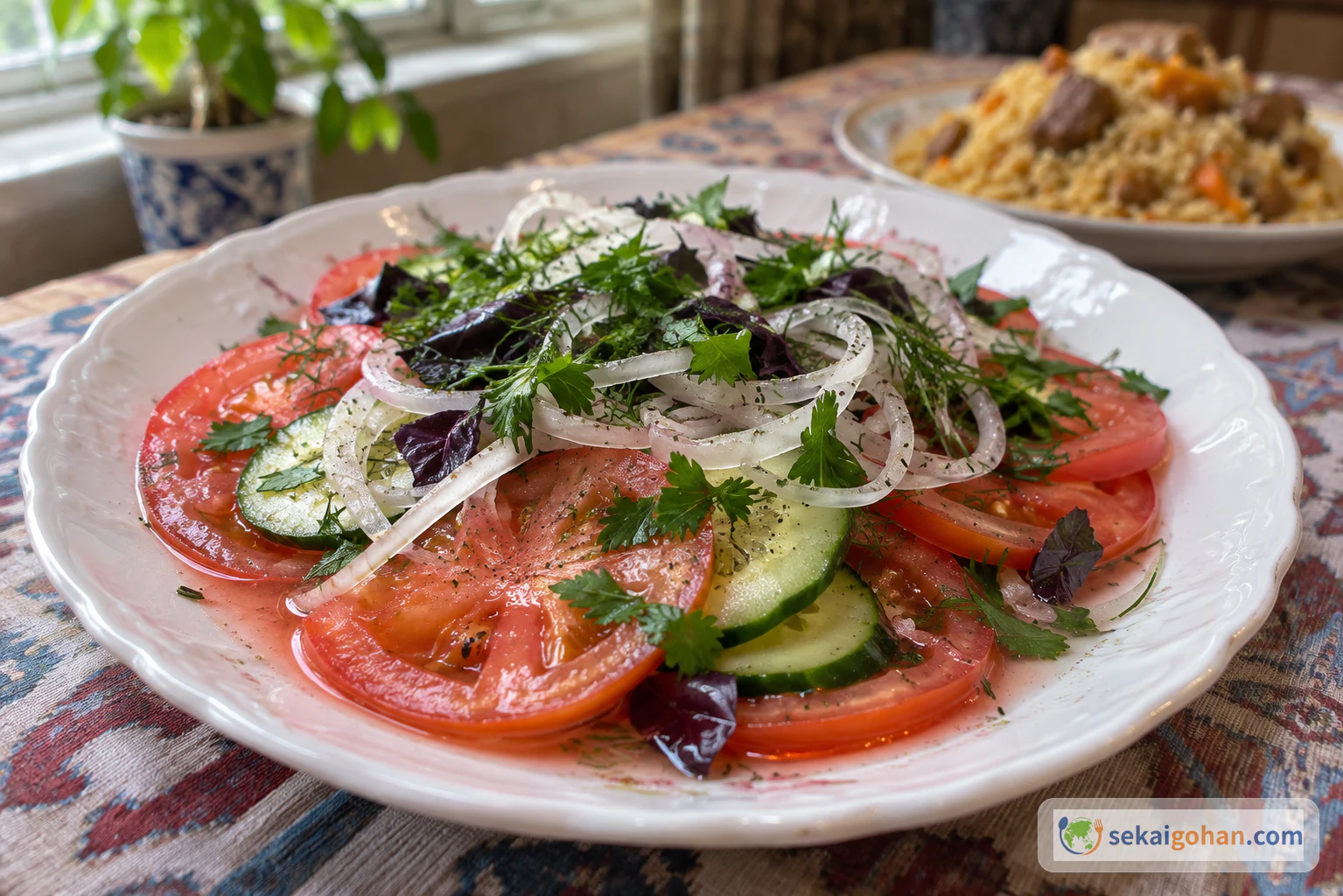
This recipe contains wheat, egg and dairy. If you leave out the egg, add 1.5 tbsp (20 ml) more water and knead 2 minutes longer. If you don't make the yogurt sauce, serve a tomato and cucumber salad with a little vinegar so the fat of the meat doesn't feel heavy.

Choosing Ingredients for Oromo

How oromo turns out depends less on the meat and vegetables than on the aroma, the size of your steamer, and cooking it through. Ordinary ground beef and potatoes from any grocery are fine, so only a few things need thought before you shop.

Meat, potatoes, onion, pumpkin, cumin and a steamer laid out in a kitchen for shopping for oromo
Ordinary meat and vegetables are fine. The things to decide on are the form of the cumin and the length your steamer can take

Ground lamb isn't always easy to find, so this recipe uses ground beef with a little beef fat for aroma and juiciness. If you can get ground lamb, replace half of the beef with it and you'll be much closer to the local version. Keep the meat in proportion, too. Packing the roll with meat alone makes the center slow to cook and lets the fat run when you slice it, while the potato catches the meat juices and the sweetness of the onion as it steams.

Whole cumin suits oromo better than ground. Over a long steaming time ground cumin loses its edge, but whole seeds, lightly crushed between your fingers and mixed into the filling, keep their fragrance and release it when you slice the roll. Too much feels heavy, so 1 tsp is enough.

For equipment, a steamer roughly 12 inches (30 cm) across holds the long roll without forcing it to bend. A small steamer works too; see the FAQ below.

Instructions

Roll the dough thin, but don't go paper-thin or it will tear. Stop at about 0.125 inch (2 mm), spread the filling thinly and keep the steam steady.

Common Oromo Problems and Fixes

Because the filling goes into the roll raw, use an instant-read thermometer. A thick meat roll is hard to judge from the outside, so aim for 167°F (75°C) or above in the center.

Problem Cause Fix
Dough tears Too much water, not rested enough, filling too thick Knead the dough firm, rest 30 minutes, spread the filling under 0.5 inches (1 cm)
Raw in the center Roll too thick, weak steam, large potato Diameter 3 inches (7 cm) or less, high heat at first, potato in 0.25 inch (5 mm) dice
Juices run when cut Cut right after steaming Slide the lid ajar for 2 minutes, then wait 2 more minutes on the board
Weak aroma Only ground cumin, too little fat Lightly crush whole cumin, add 10 g beef fat or a little lamb
Gets boring to eat No sauce or acidity Serve with yogurt sauce, cucumber and tomato salad, and hot tea

Serving, Storing and Varying Oromo

Serving oromo

Oromo is a dish of flour and meat, so serve it with something sour and something warm: yogurt sauce, a cucumber and tomato salad, and hot black tea keep it from getting heavy all the way to the last bite.

Oromo on the table with yogurt sauce, a cucumber and tomato salad and hot tea
With hot tea and a sour salad, even a meat-and-flour dish doesn't feel heavy

Adding pumpkin

Carrot and seasonal pumpkin both work in the filling. Japanese kabocha is very sweet, though, and if you make it the star the dish drifts toward a sweet steamed bun. About 4 oz (120 g) in small pieces adds just a touch of sweetness between the meat and potato.

Storage and reheating

Steamed oromo, left uncut, keeps for 2 days in the refrigerator. Once it has cooled slightly, wrap it in plastic and put it in a container so it doesn't dry out. Cut surfaces dry quickly, so keep whatever you plan to eat the next day as a whole roll.

Re-steaming beats the microwave: 8 minutes over medium heat for a whole roll, or 5 minutes for slices. If you do use a microwave, arrange the oromo on a plate, sprinkle on 2 tsp water, cover loosely with plastic and heat at 600 W for 1 minute 30 seconds to 2 minutes. Overheating hardens the dough, so stop as soon as the center is warm.

To freeze, let the roll cool uncut and wrap each one separately in plastic; it keeps for about 3 weeks. Steam it straight from frozen over medium heat for 15–18 minutes, and the chewy texture of the dough comes back nicely.

Frequently Asked Questions

Is it not authentic without lamb?

Lamb brings the aroma closer to the local version, but ground beef still makes a fine oromo. What matters most is cutting the onion and potato small, building fragrance with cumin and cooking the roll through in the steamer. If you can chop thinly sliced lamb with a knife, using 5.5 oz (150 g) ground beef and 5.5 oz (150 g) chopped lamb changes the character a lot.

Can I make it with store-bought dumpling wrappers?

It won't taste the same. Dumpling wrappers are small and can't make the rolled layers, so you end up with something closer to a steamed dumpling. If you want to save time, divide the dough in two and make two smaller rolls instead.

What if my steamer is small?

Divide the dough into two rolls, each a little shorter than the inner diameter of the steamer, seal the ends firmly and set them side by side. Steam the full 40 minutes without lifting the lid, since opening it lets the steam drop. For the same reason, don't swap tiers midway in a two-tier steamer.