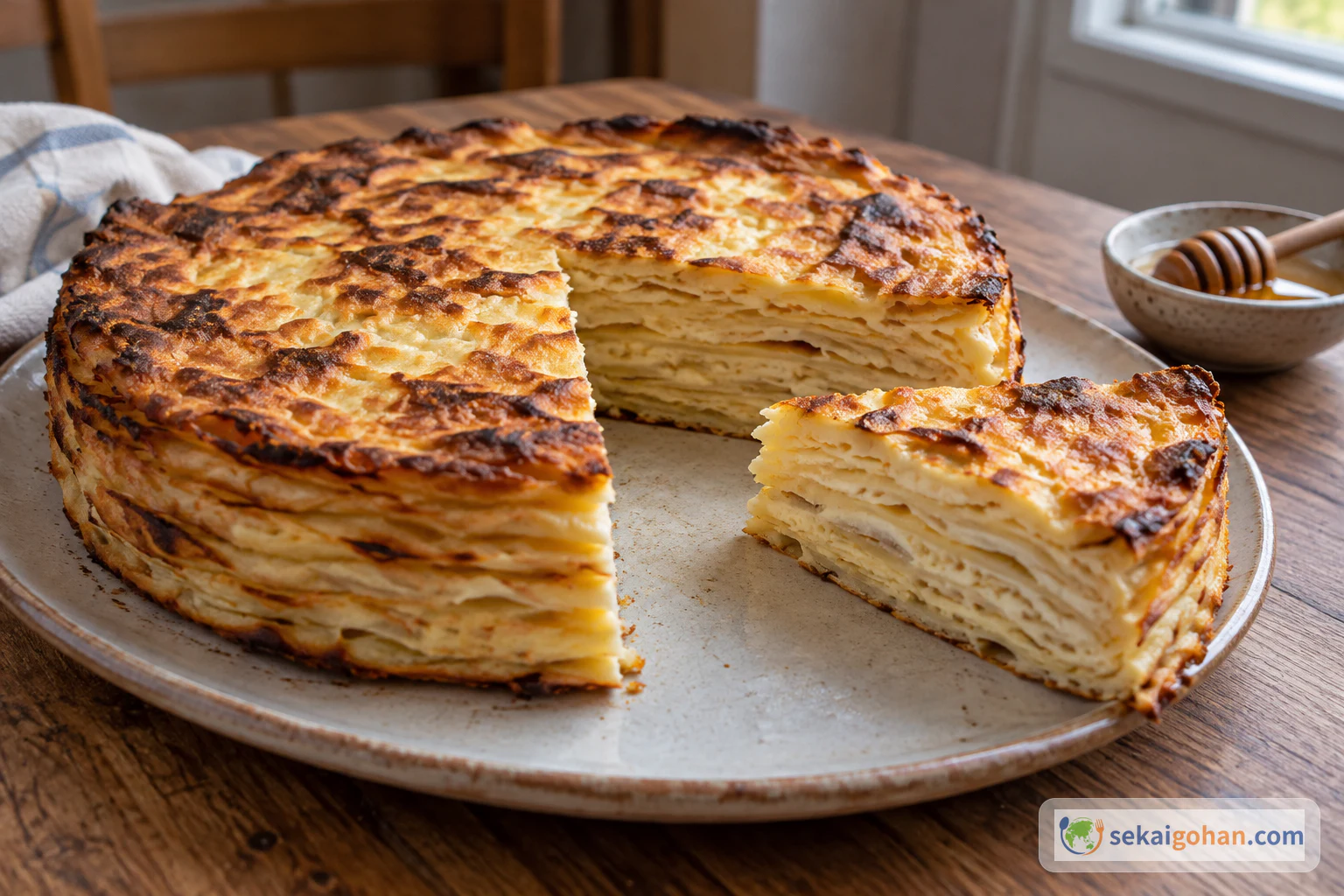
When you work butter in a March kitchen, a little of the smell of spring mixes into the still-cold air. There's the scrape of sugar being ground in with a wooden spoon, a quiet pause each time an egg goes in, and then the moment the dough suddenly turns heavy as the cornmeal is added. Ballokume, the signature baked sweet of Elbasan in central Albania, looks like a plain yellow cookie, but it leaves a distinct feel in your hands as you make it. The toasty scent of cornmeal and the richness of butter, lifted by eggs, are what it tastes of.

Ballokume and Elbasan's spring festival
Ballokume (Ballokume / Ballokumja) is the symbol of Dita e Verës, the spring festival Elbasan celebrates on 14 March. On that day flowers, family gatherings, sweets, and strolls make up a single scene in the city, and this yellow sweet is part of it.
In Albanian it is ballokume or ballokumja, and depending on the region and spelling it is also written ballakume. This article uses "ballokume" for readability.
Ballokume texture
It doesn't snap thin and crisp like a wheat-flour cookie. The outside cracks lightly and the inside crumbles, so it sits somewhere between a moist cake and a hard biscuit. The ideal is a bite where a little grain of the meal remains while the butter and sugar dissolve in your mouth.
Among Albanian dishes, the roasted pepper and cheese fërgesë is a dish for a meal; ballokume is a sweet that brings spring home. If you're curious about Balkan sweets, set it beside layered burek and Georgian achma to see how differently wheat flour, dairy, and cornmeal get used.
Ash lye and the home kitchen
Local accounts often mention finj, an ash lye. Older methods use a small amount of an alkaline liquid made by boiling wood-stove ash in water, which is where the alternate name "kulaç me finj" comes from. I don't recommend using ash of unknown origin in food at home: you can't tell what wood was burned, whether there were paints, charcoal, or metals in it, or how strong the ash is. Here, a small amount of milk and some resting time give the dough its cohesion instead.
With so few ingredients, the real skill lies in reading the dough rather than in flavoring: how far to work the butter and sugar, whether the eggs went in too fast and split it, whether you overworked it after the cornmeal. Albanian households are known for their copper vessels and wooden spoons, and it's worth respecting that, while settling on proportions you can reproduce without strain. If you want to make it more local, put the flour choice and a good long working with the wooden spoon ahead of ash lye.
| What to look at | Closer to local | Settling point for a home kitchen |
|---|---|---|
| Flour | Finely ground cornmeal | Mainly fine corn flour, mixing in coarse meal only in part |
| Fat | Strongly scented butter | Use unsalted butter and add a little salt separately |
| Tools | Copper vessel, wooden spoon | A large metal or ceramic bowl and a sturdy wooden spoon |
| Ash lye | A little finj | Not used at home; make up the moisture with 1 tbsp (15 ml) milk |
| Bake color | Pale gold | Bake low at 350°F (170°C) and stop before the edges get too dark |

Ingredients (serves 4, 12 large cookies)

Baking them large gives the local presence, but a home oven cooks them slowly. For a first batch, divide into 12 and bake at about 5.5 to 6 cm across to avoid failure.
This recipe uses eggs and dairy. Cornmeal is a gluten-free ingredient, but some products are made in facilities that also handle wheat. Because the strength and safety of ash lye are hard to control at home, this article does not use it.
Choosing the flour
Cornstarch is starch only, so it won't do. What ballokume needs is the aroma of corn and the grain of the flour. Look for labels such as corn flour, fine cornmeal, or maize flour. Made with coarse polenta meal alone, hard grains remain in the center, so if you use it, limit it to 2.75 oz (80 g) of the total.
For a first time, mainly using fine corn flour is the safe choice. Rather than hunting for a flour that matches the local name exactly, choose a grind that doesn't catch on the teeth when baked. If a bag has many coarse, sandlike grains, sift it once through a fine sieve and keep the coarse grains that remain to 2.75 oz (80 g) or less.
Choosing cornmeal, butter, and tools for ballokume
Eggs and butter from a neighborhood supermarket are fine. The two things that are easy to get wrong are the grind of the cornmeal and keeping the butter from melting. A wooden spoon and a large bowl can be swapped for sturdy tools you already have, but get the flour wrong and the texture won't come back.
For a first batch, make fine corn flour the base, and add fine cornmeal in part only if you want a rustic grain. Made with coarse polenta meal alone, the grains tend to stay hard in the center while the outside is already baked. So settle the flour first, before anything else on the list.
Butter is easiest to handle at 20 to 23°C: it dents when pressed with a finger, but no oil seeps at the surface. In a winter kitchen, or on a day you soften it in the microwave, a thin kitchen thermometer makes it harder to misjudge the line between "soft" and "starting to melt."
| Priority | What to buy | What to look for | Substitute |
|---|---|---|---|
| High | Corn flour | A fine powder. Ingredients mostly corn | Mix in coarse cornmeal only in part |
| Medium | Fine cornmeal | Adds a slightly gritty rustic texture | Not the whole amount; up to 2.75 oz (80 g) |
| Medium | Kitchen thermometer | Keeps the butter from over-melting | Check by pressing: dents, no oil seeping |
| Medium | Sturdy wooden spoon | Lets you press and work the thick dough against the bowl | A thick wooden spatula |
| Low | Copper-colored or metal bowl | Wide, easy to work by hand, 10 inches (25 cm) or more across | A large stainless steel bowl |
How to make it: don't rush after the flour goes in
Ballokume is not a sweet to mix all at once with a whisk. Work the sugar and butter well, don't let the eggs split, and once the cornmeal goes in, press it together. The dough before baking is heavier than soft cookie dough and holds a finger mark when squeezed.
Ballokume bake color and common failures

Keep the color light. Bake ballokume to a toasty cookie brown and the bitterness of burnt butter crowds out the sweet aroma of the cornmeal. Aim for a pale yellow top with only the edges a slightly deeper gold, and a cross-section that isn't too dry and still has some grain.
| Symptom | Cause | Fix |
|---|---|---|
| Spreads flat | The butter was melted, or all the eggs went in at once | Bring butter to 20 to 23°C and mix eggs in one at a time |
| Powdery center | Underbaked, or shaped too large | Make each about 2.75 oz (80 g) and add 3 minutes at a time at 350°F (170°C) |
| Hard outside | Baked too hot | Drop to 350°F (170°C) and stop when the edges color |
| Very gritty | Too much coarse meal | Mainly corn flour, with coarse meal limited to 2.75 oz (80 g) |
| Greasy | Melted butter, or too little working | Use soft solid butter and work it 15 minutes at the start |
If your oven has hot spots, leave the sheet alone for the first 15 minutes and swap it front to back for the last 5. Opening the door often early on drops the temperature and makes it hard for the center to cook. If the tops crack too much, smooth the surface slightly when shaping, and next time add 1 tsp (5 ml) more milk.
Serving and storing ballokume

For the spring festival in Elbasan, eggs, nuts, dried figs, and fruit are prepared alongside ballokume. At home, it goes well with afternoon coffee, strong tea, or unsweetened yogurt. Skip the whipped cream and sweet sauces; a bitter drink or a tart fruit balances the sweetness of the cornmeal and butter far better.
On baking day the outside is light, and by the next day everything settles a little. Once they're completely cool, wrap each one in paper and put them in an airtight container: they keep 2 days at room temperature, 4 days refrigerated, or 3 weeks frozen. The fridge firms the butter, so take them out 20 minutes before eating. Thaw frozen ones naturally, then warm them 2 minutes in a 300°F (150°C) toaster oven to bring back the aroma.

If you're making them ahead, bake and store rather than leaving unbaked dough in the refrigerator overnight. Cornmeal dough keeps absorbing moisture as it sits, and when shaped the next day it cracks deeply. The day before, measure the flour, set out the butter and eggs, and get the sheets and paper ready, then do the working on the day.
For another sweet that reuses ingredients and aromas from the same region, try sheki halva.
FAQ
Can I make it with cornmeal alone?
You can, but coarse flour alone is quite gritty. For a first batch, use mainly corn flour and mix in at most 2.75 oz (80 g) of coarse cornmeal. If you do use coarse flour, add 1 tsp (5 ml) more milk and rest the dough 35 minutes so the grains settle a little.
Can I reduce the butter?
You can cut about 20 g, but the crumbly break typical of ballokume weakens. Below 5.5 oz (150 g) it tends to turn powdery, so if you reduce it, make each cookie smaller and start checking at 18 minutes. I don't recommend margarine, which changes the aroma and water content.
Can I substitute pancake mix?
It becomes a different sweet. Pancake mix contains wheat flour, leavening, and flavoring, and the crumbly cornmeal texture won't come through. If you must cut the cornmeal, go to 10.5 oz (300 g) corn flour and at most 4 oz (120 g) all-purpose flour, and think of the result as a ballokume-style cookie.
Can I bake small ones for children?
Yes. Divide the dough into 1.75 oz (50 g) pieces about 2 inches (4.5 cm) across and bake at 350°F (170°C) for 15 to 18 minutes. Small ones dry on the outside sooner, so stop when the edges color slightly. Served with milk or unsweetened yogurt instead of coffee, the sweetness feels calmer.