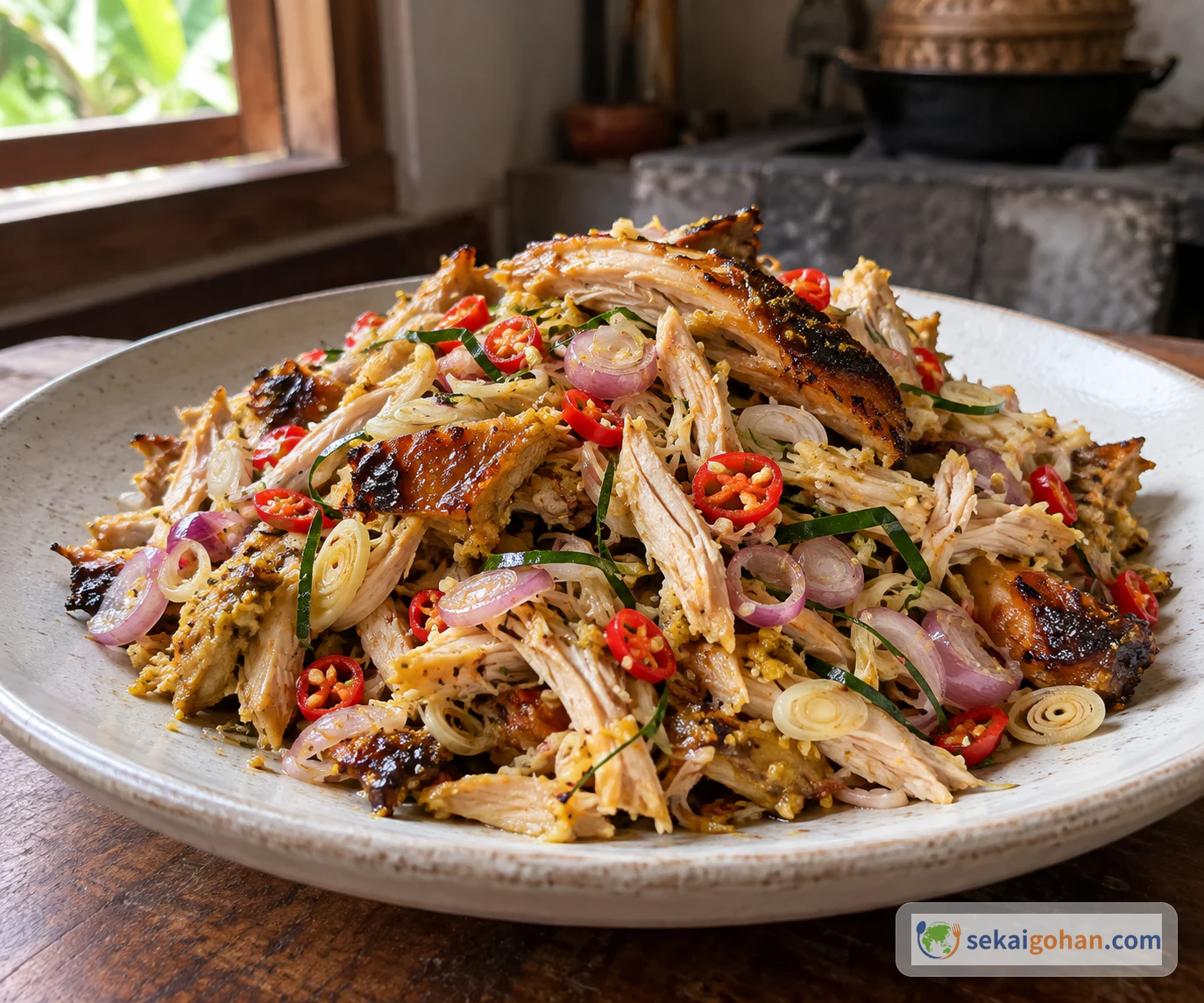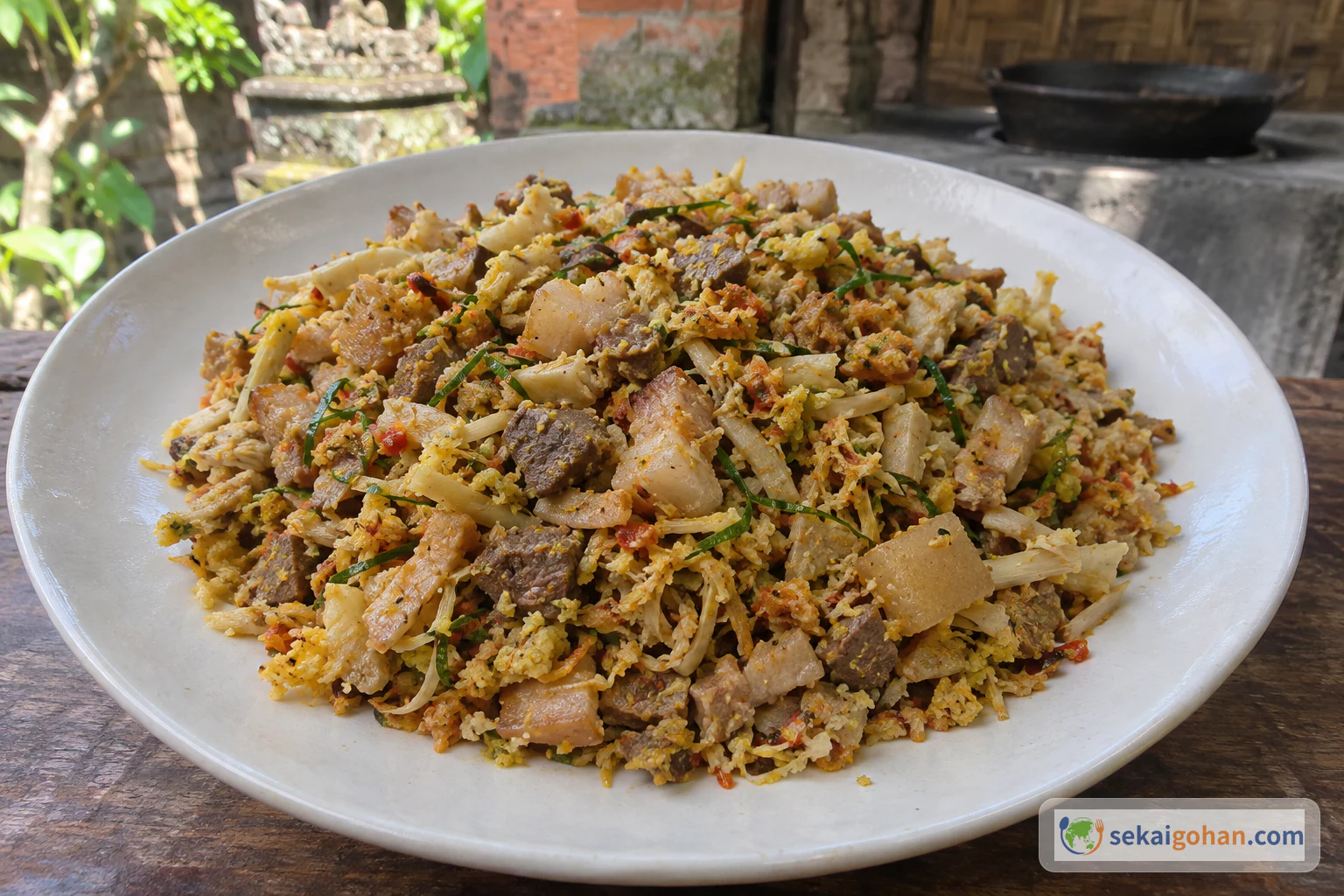
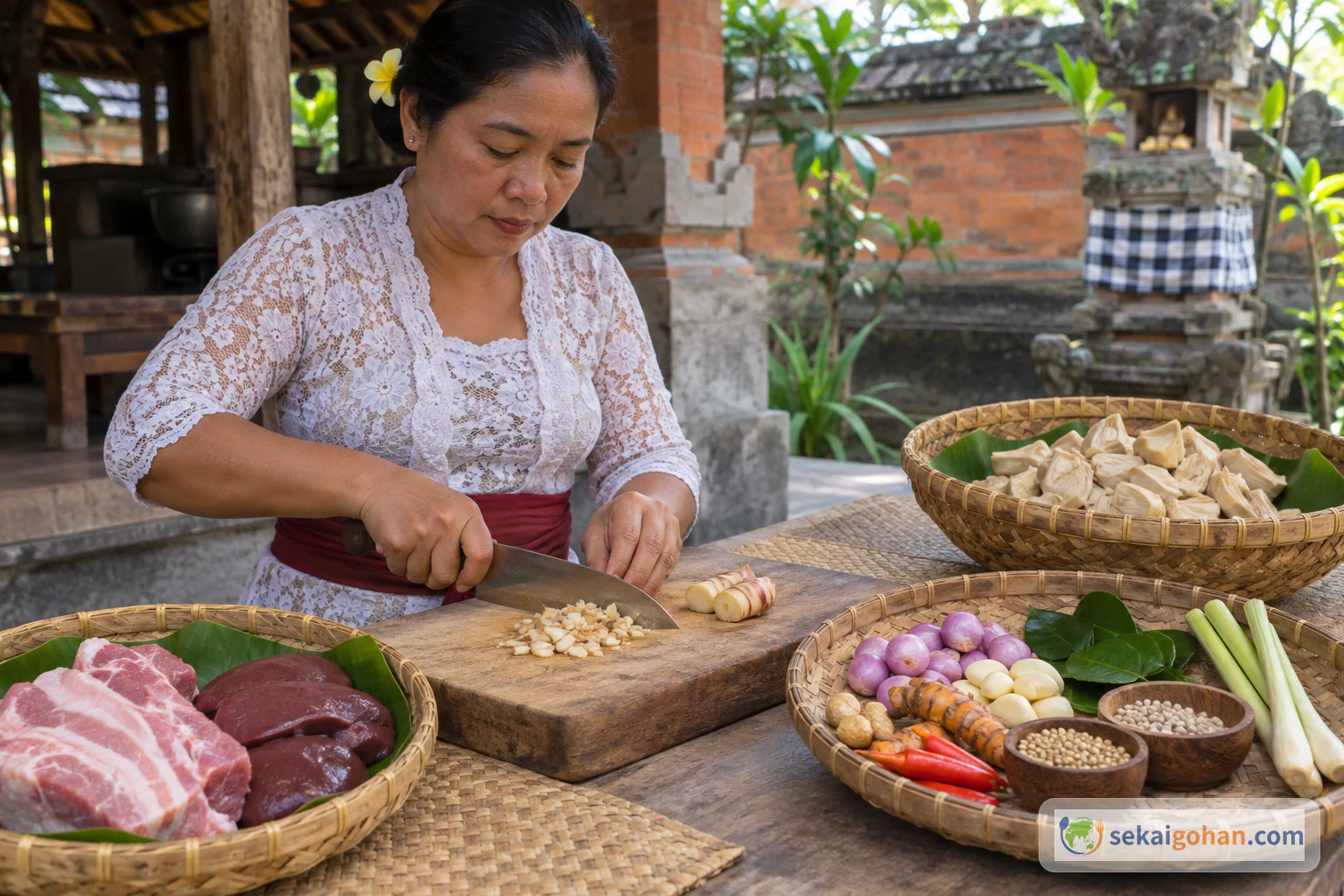
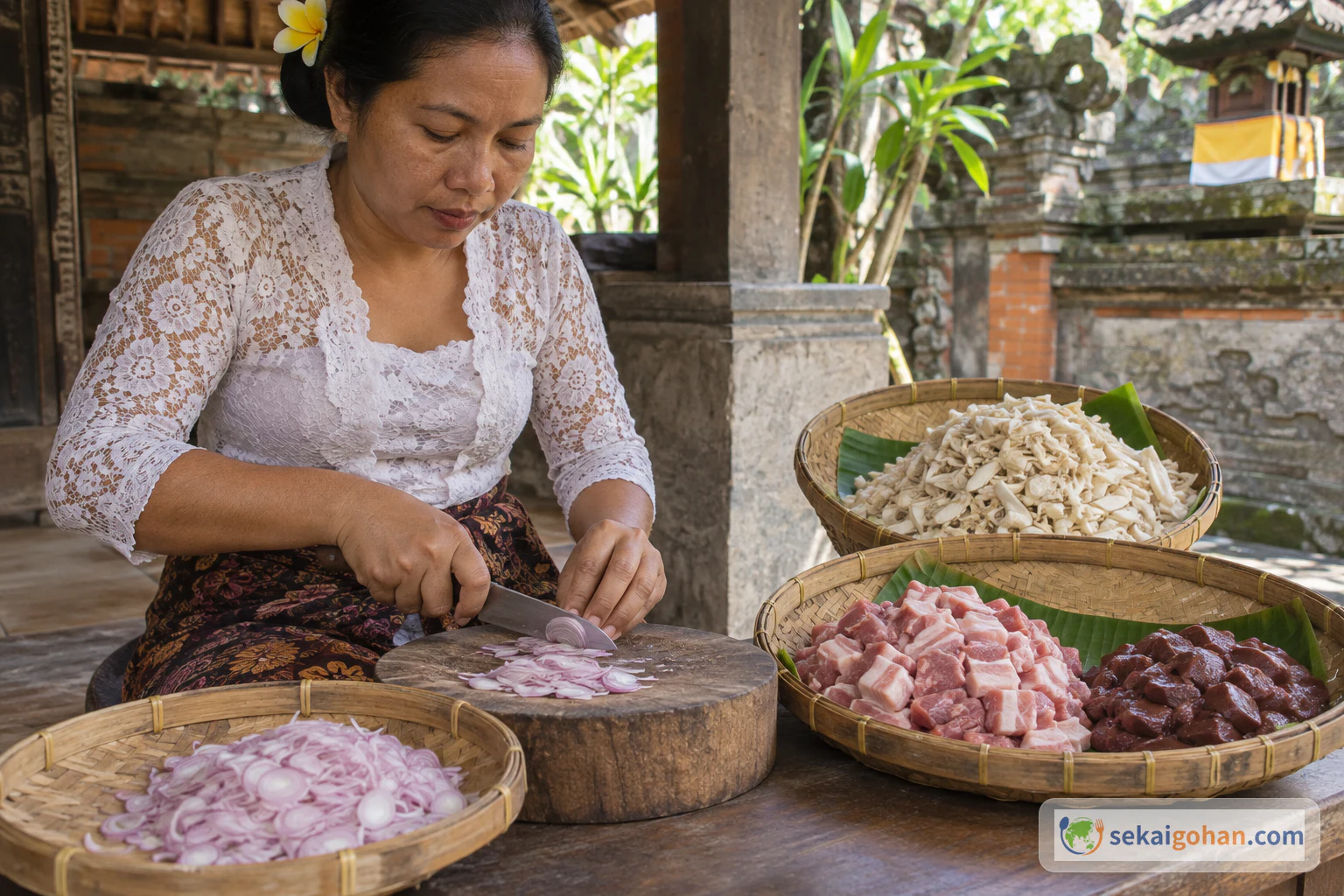
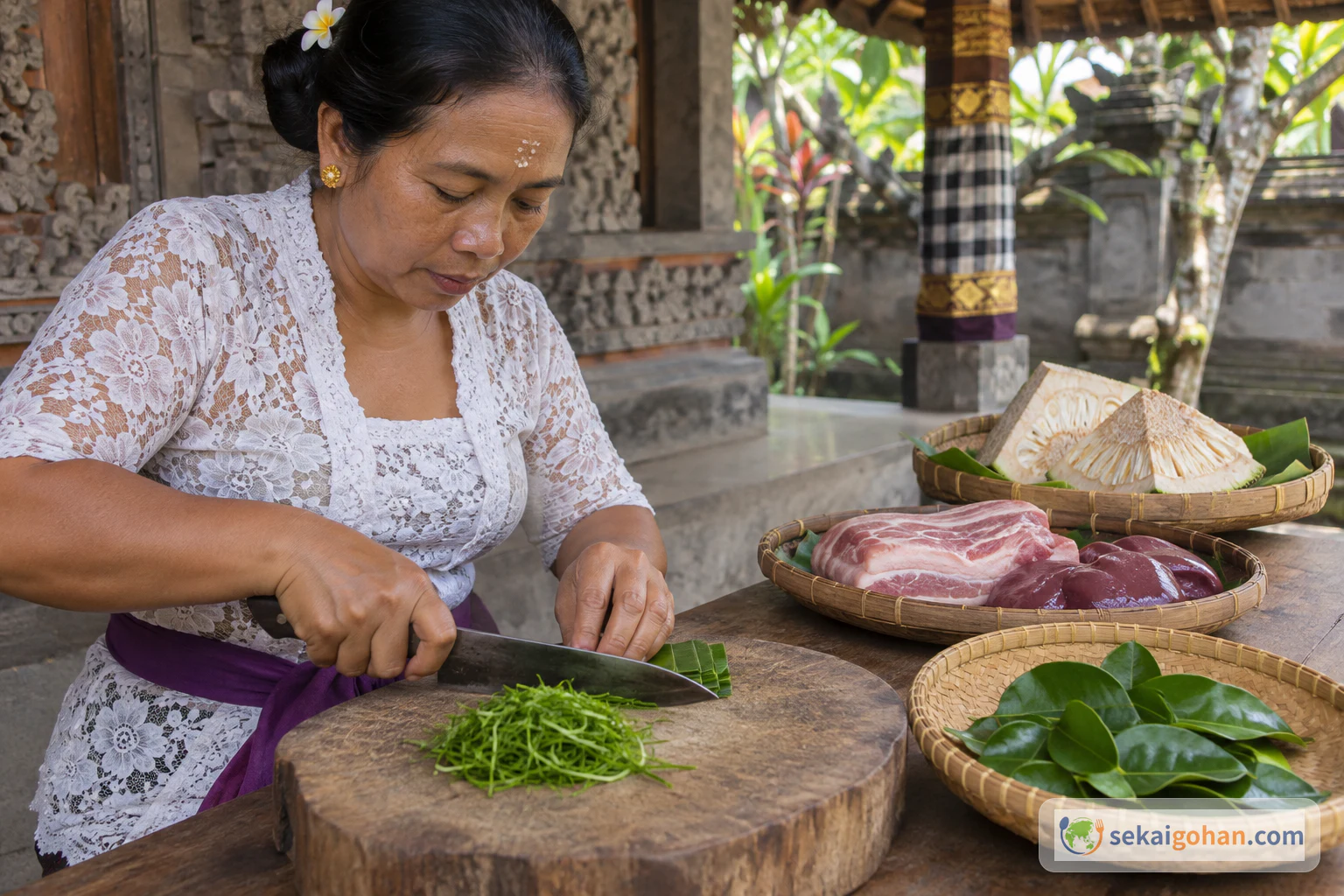
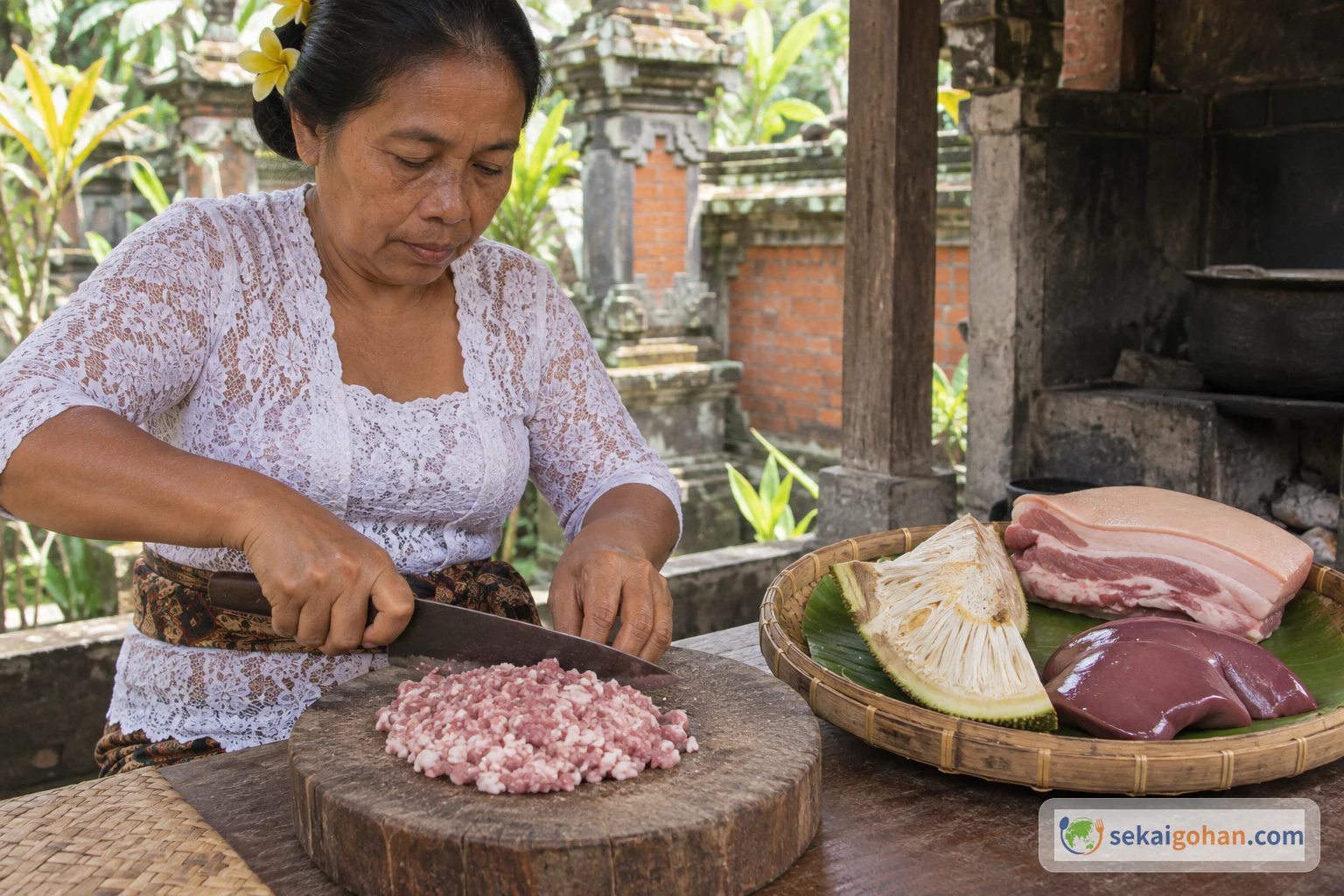
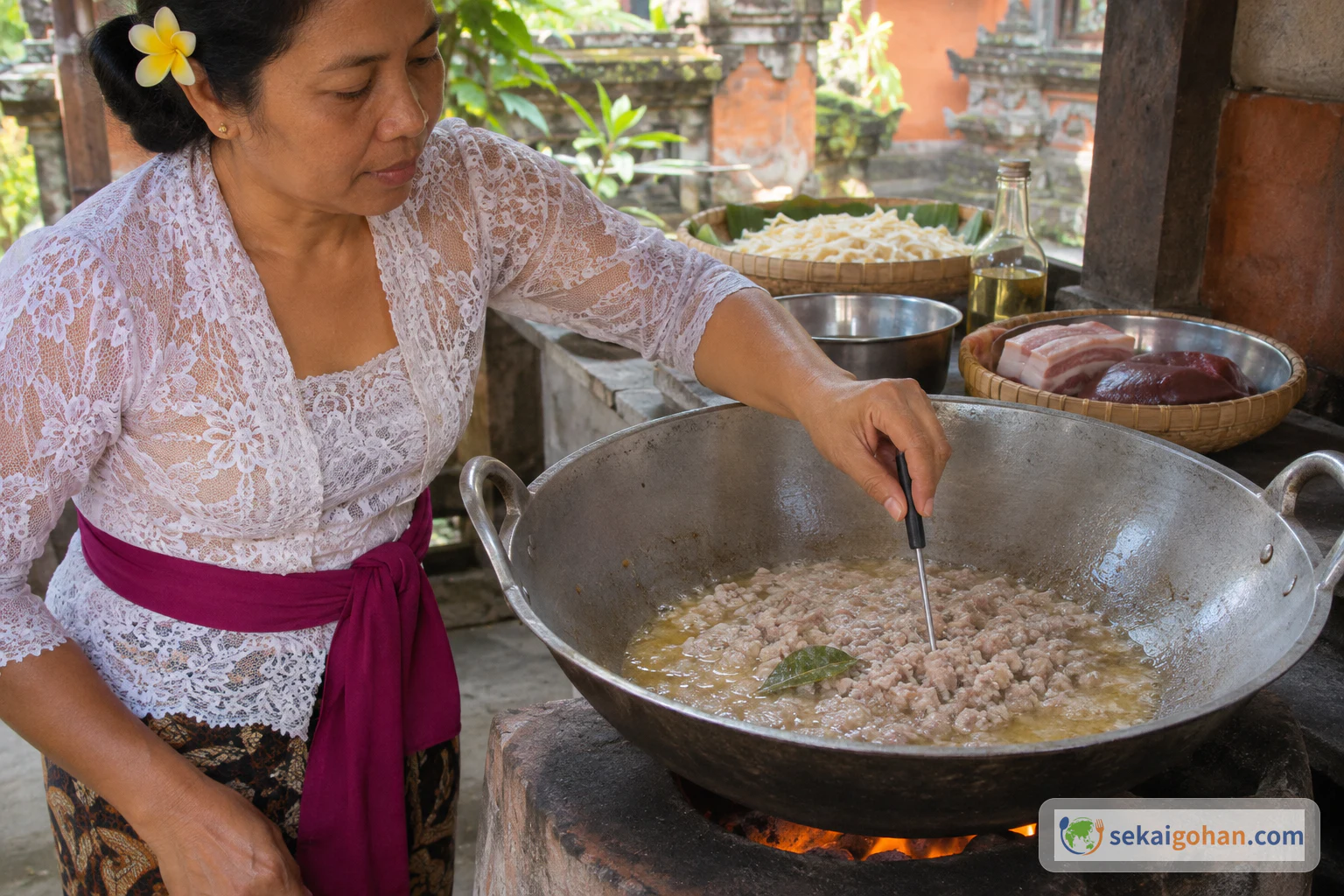
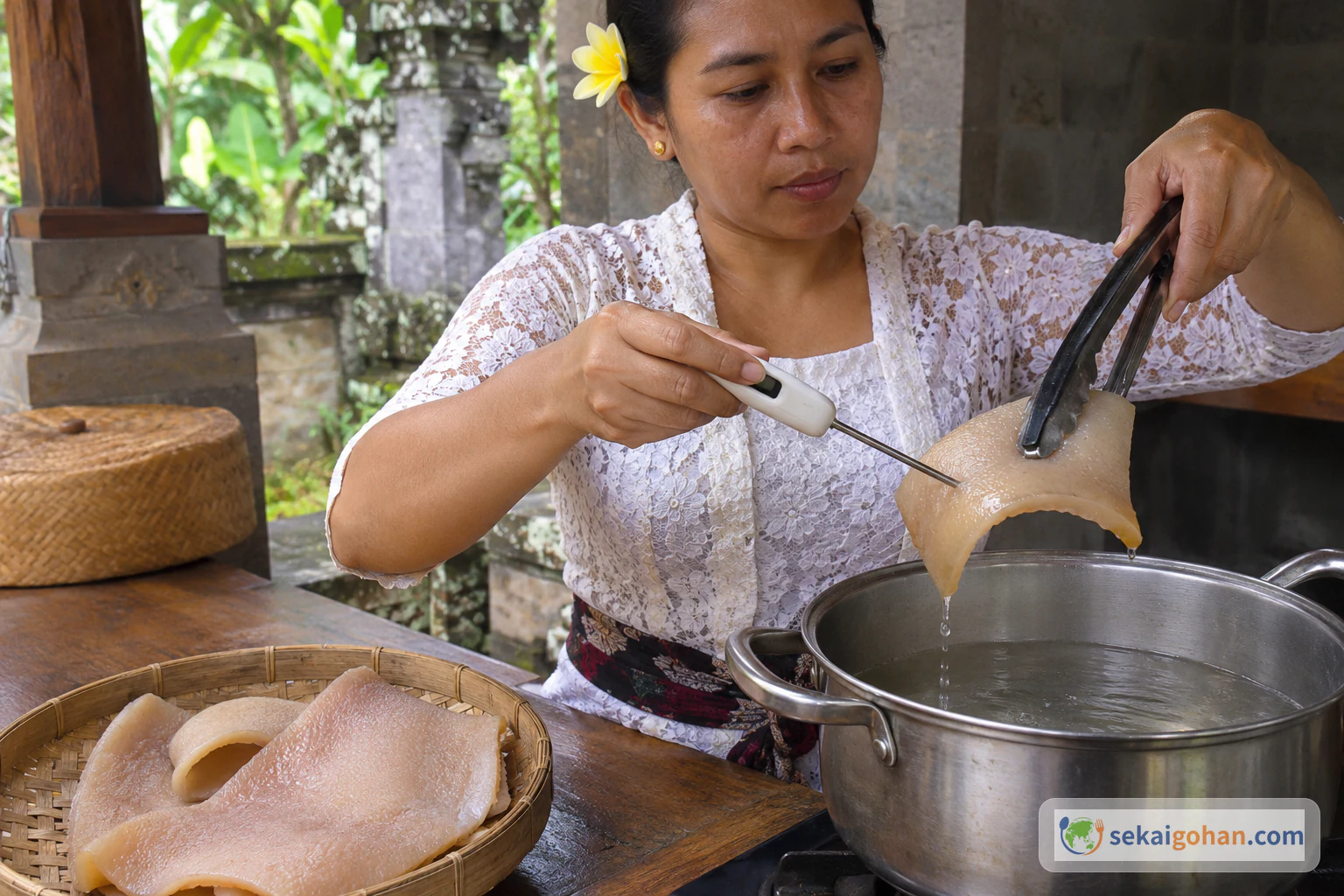
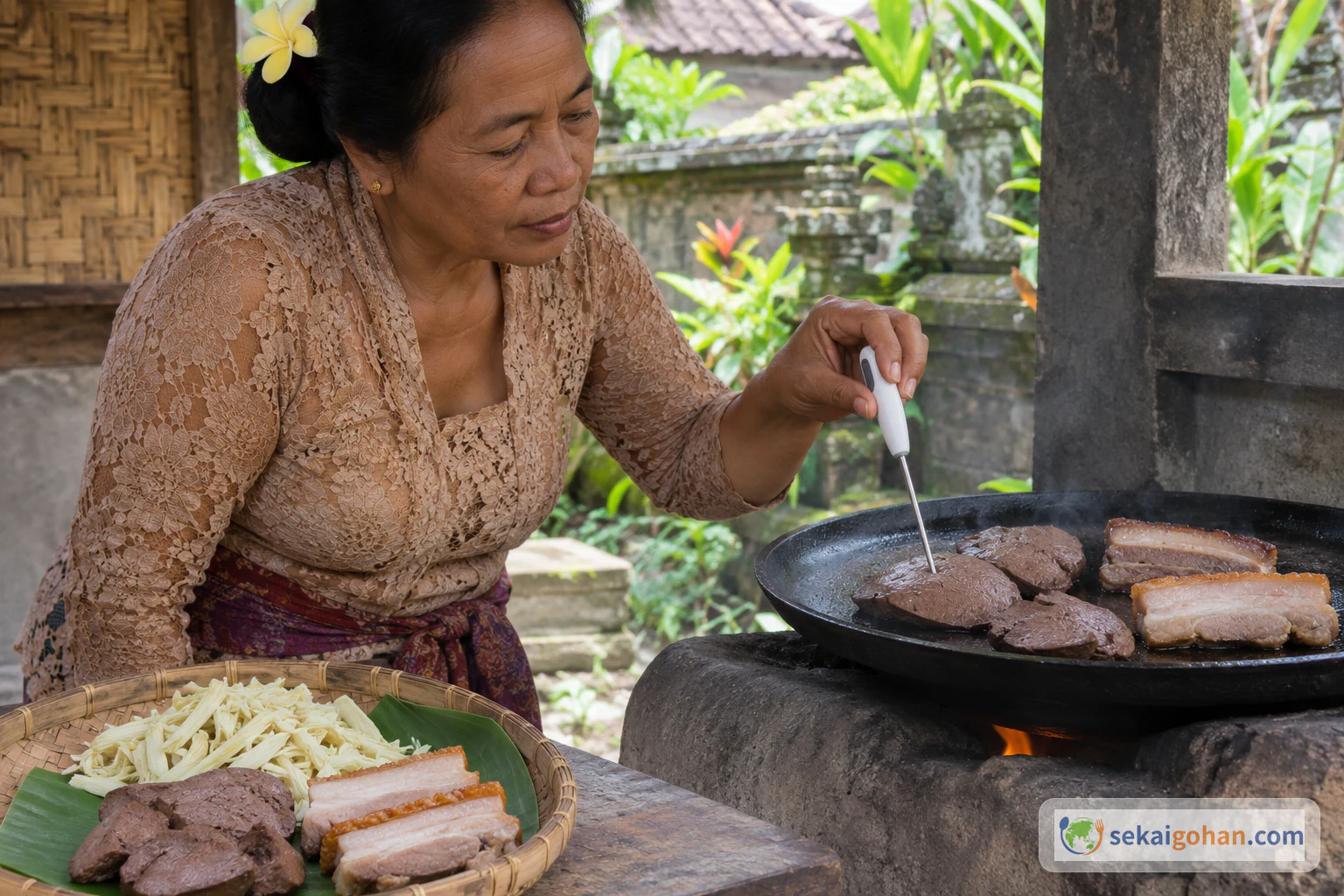
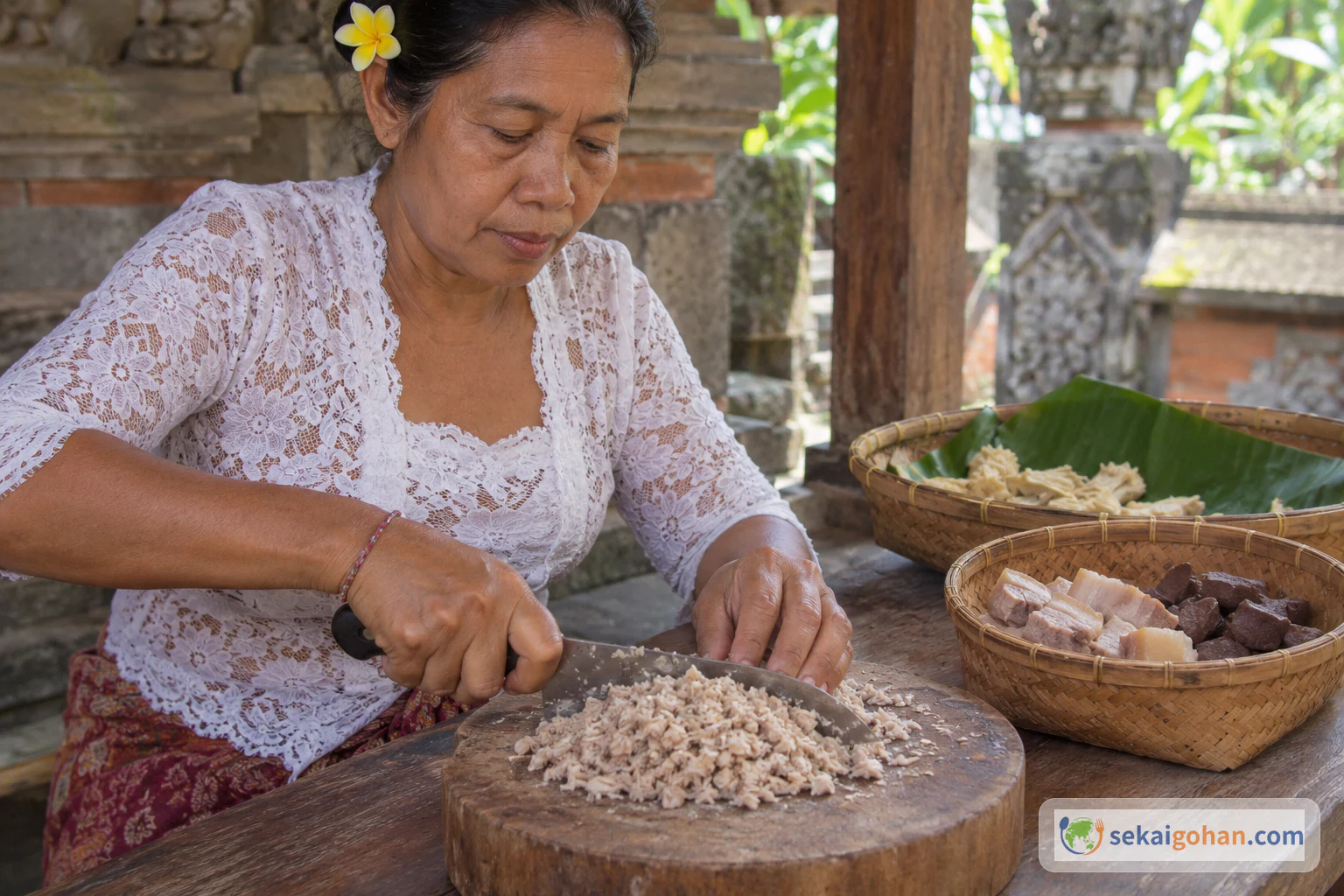
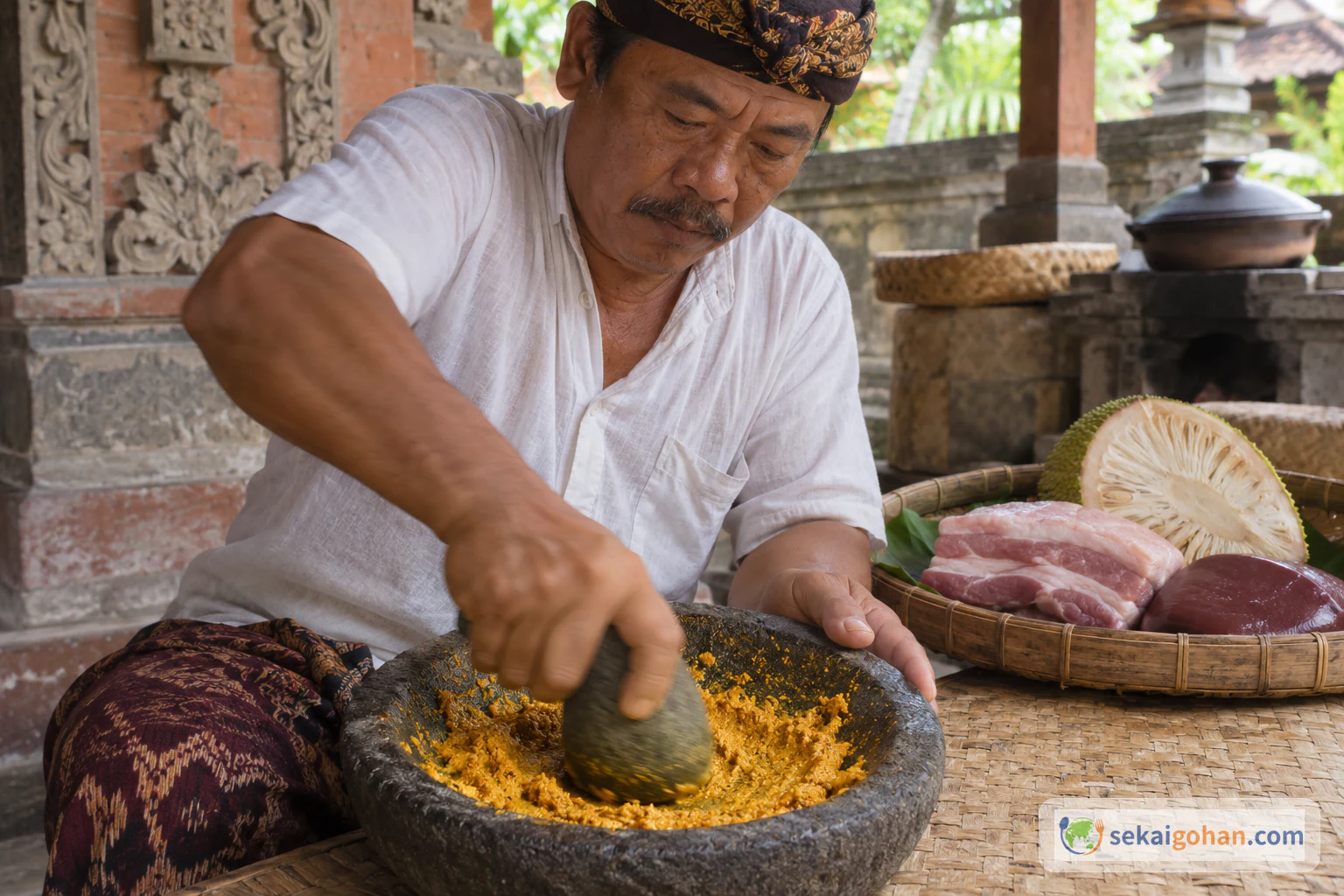
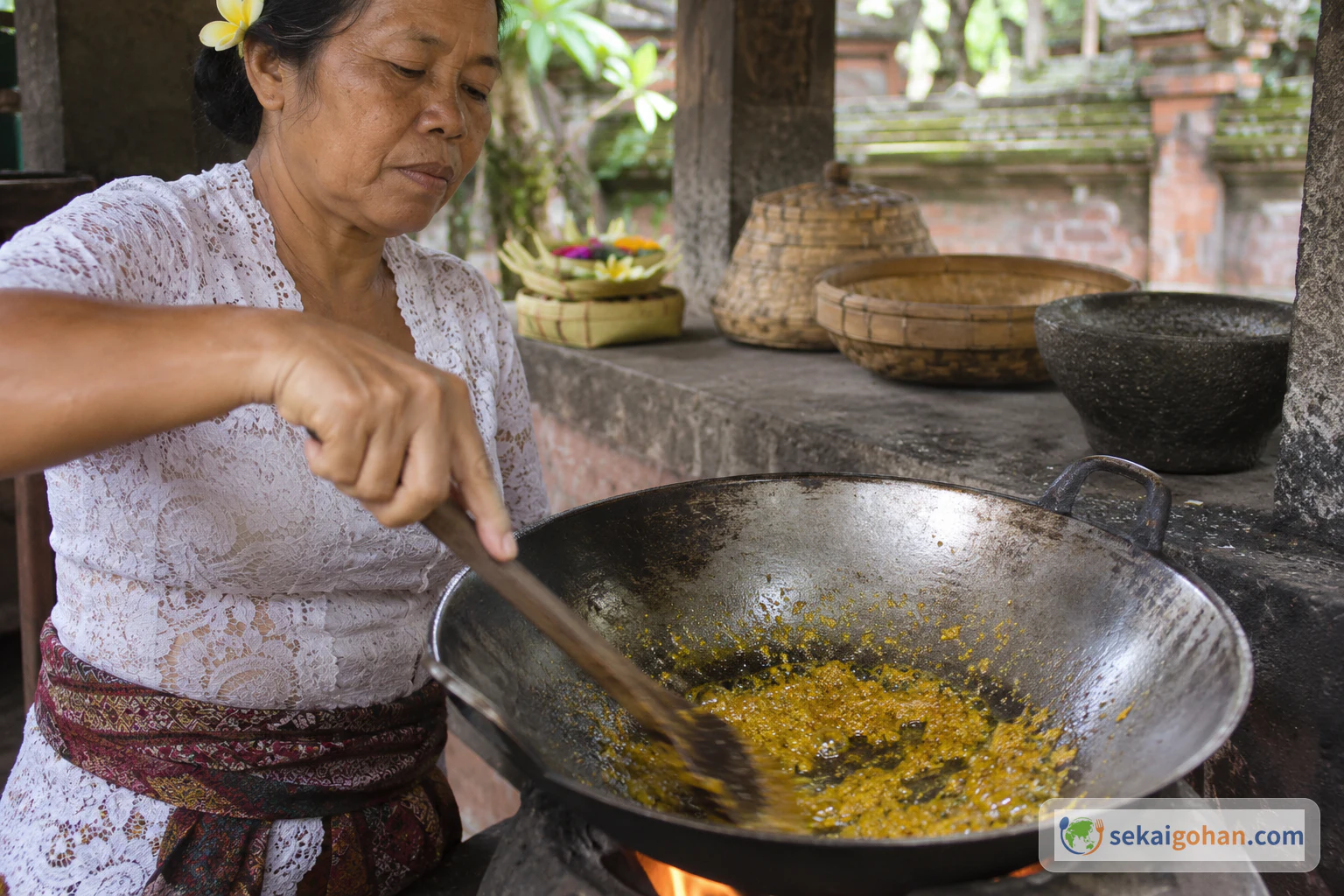
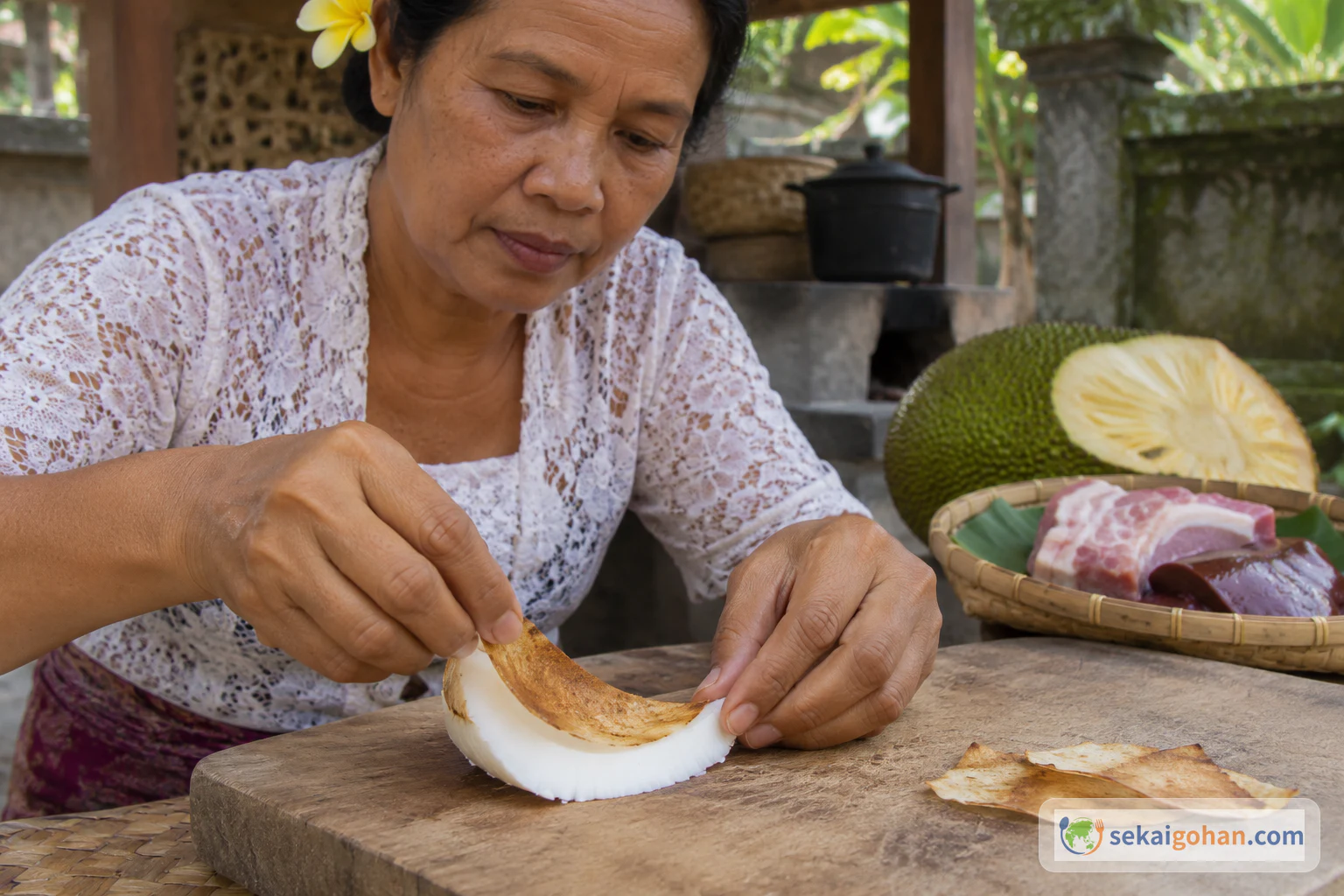
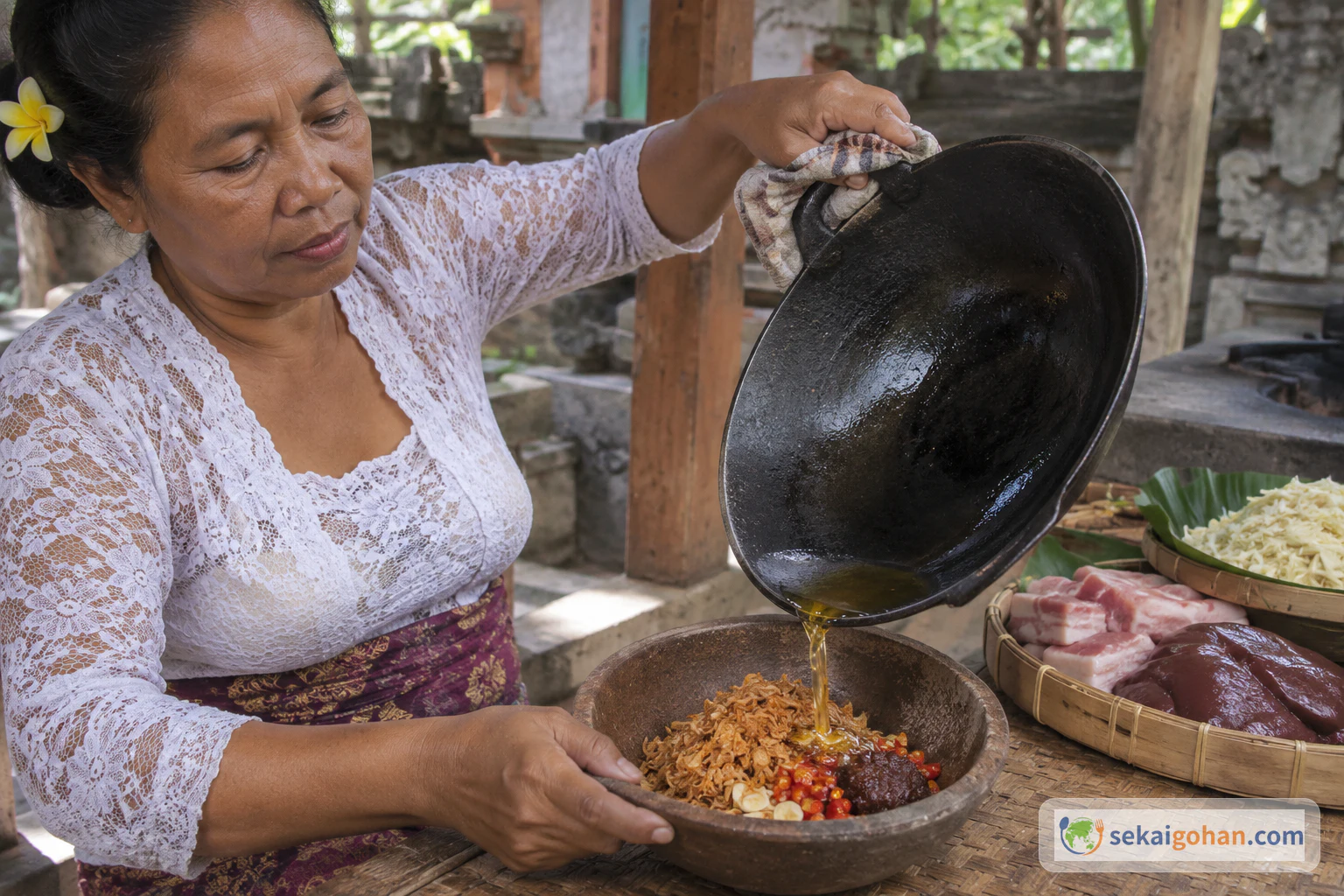
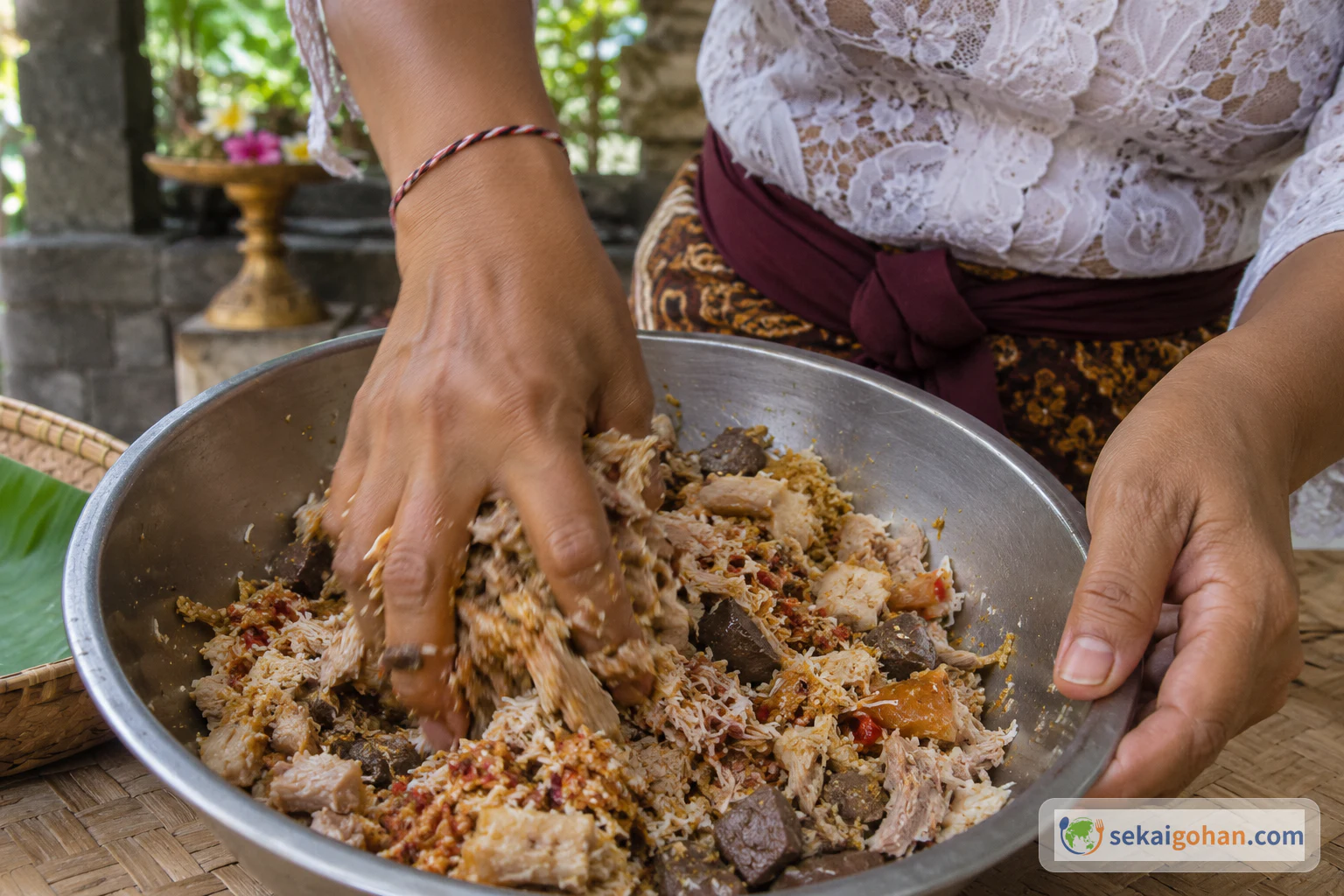
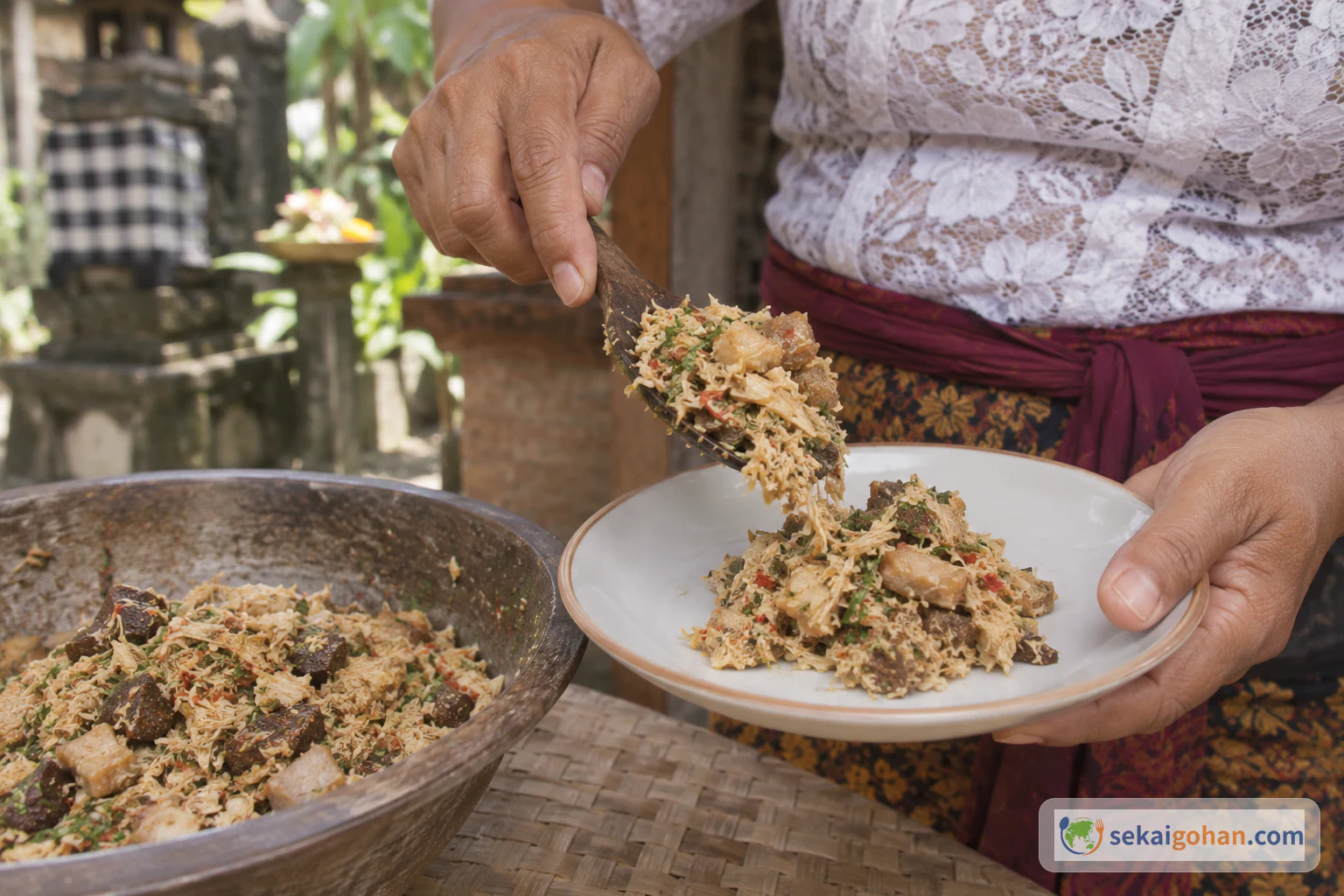
Lawar often starts with mebat, the shared job of chopping meat and spices fine while everyone talks. That's a good way into this Balinese dish, because most of the work here happens with a knife and a board. This version, for 6 servings, brings together skin-on pork belly, pork liver, canned green jackfruit and half a coconut, bound with a cooked spice paste called base genep and a fried sambal embe. You'll find more of the country's dishes on our Indonesia page.
About Balinese Lawar
Lawar is a Balinese dish with many forms, and it can be made with many kinds of meat. Its making is often shared work: nglawar is the communal preparation of the dish, and mebat is the chopping done together while talking.
Red and white lawar are distinguished from each other. Lawar merah is made with blood, while this recipe contains none. Lawar nangka is a separate dish built around jackfruit; here the jackfruit shares the mix with pork, skin and liver.
Serve lawar with rice and sayur urab on the side rather than mixed in.
Everything is prepared separately and only comes together in the last few steps. Use a food thermometer for the pork, skin and liver.
Ingredients for 6 Servings
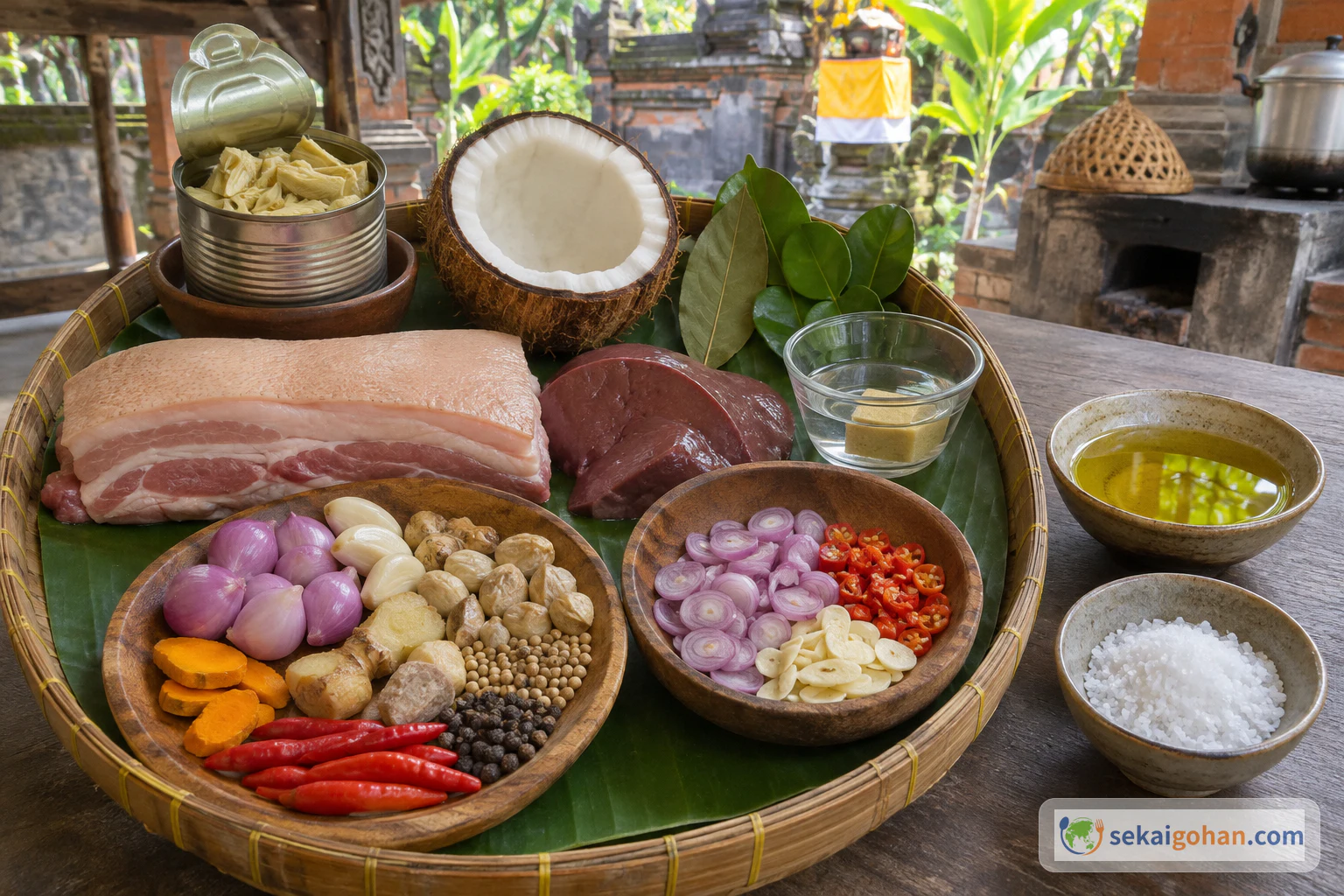
Equipment
- Heavy kitchen knife or cleaver for fine chopping
- Sturdy mortar and pestle, or a food processor
- Food thermometer with a clean, fine-tip probe
- Dedicated board, knife, tongs and plate for raw pork and liver
- Separate clean boards and knives for produce and cooked food
- Wok for the pork
- Griddle or grill for the liver and coconut
- Separate pots for the skin and the jackfruit
- Separate pans for the base genep, the coconut and the sambal
- Colander, jug and grater
- Clean bowls, plates and trays, plus one large mixing bowl
Choosing Ingredients for Lawar
Where to Shop
Canned green jackfruit, galangal, kencur, candlenuts, kaffir lime leaves and shrimp paste are the items most likely to send you to an Asian grocer or an online shop, so search by these common names. Ask for kencur by that name and check the product label.
The four rhizomes are prepared separately, and each one matters. Replace one and you're making a different version, with a different flavor.
The recipe contains shrimp paste and sesame seeds. If you're using a vegetable stock cube, check its label for ingredients and allergens too.
Coconut and Lime Leaves
The sliced kaffir lime leaves and the white coconut go into the finished lawar raw. Wash the leaves under running water and dry them completely, and give the white coconut flesh a light rinse before grating.
The method mentions the coconut's "brown skin." Take it to mean the thin brown seed coat, about 0.2 mm thick, covering the white flesh. The hard shell and husk are never food.
Method: Prepare Each Part Separately, Then Combine
Steps 1–17 prepare the produce. Steps 18–47 cook the pork, skin, liver and jackfruit. Steps 48–74 make the base genep, coconut and sambal. Steps 75–81 bring everything together.
Lawar Troubleshooting and Safe Heating
Heat pork (including offal) and pork liver through to the center. Pathogens are killed when the center reaches 167°F (75°C) or above for at least 1 minute. Check the pork, the separated skin and the liver with a clean thermometer. Judge doneness by the thermometer, not by color, cooking time or photographs.
Keep tools for raw meat and offal away from cooked food and raw produce. Wash your hands after touching raw meat or offal. If you refrigerate raw meat, keep its juices from dripping onto anything else.
The pork is stir-fried for "a few minutes" and the liver goes on a griddle or grill, so the thermometer has the final say: the pork, skin and liver should reach at least 75°C at the center and stay there for at least 1 minute.
| Problem | What to check | What to do |
|---|---|---|
| The pork, skin or liver doesn't hold 75°C for 1 minute | The center of the pork mound, the thickest part of the skin, or the thickest piece of liver | Keep cooking and measure again. Color and elapsed time can't replace this check |
| You are tempted to add more stock | The recipe uses one cup of water, with the half cube dissolved in it | Do not add a second measured cup |
| The base genep starts to catch | The heat under the pan | Lower the heat and keep stirring until the paste is cooked through without burning |
| You can't tell which coconut part to use | Hard shell and husk, or the thin brown surface on the white flesh | Use only the thin brown surface and the white flesh. Never crush or eat the hard shell or husk |
| A sambal ingredient is still in the oil when the next is ready | The pan should hold only one ingredient at a time | Lift the earlier ingredient into the bowl before adding the next |
| A raw-meat tool is the one closest to hand during assembly | The tools used for cooked food and raw produce | Use a clean tool. Keep raw-meat tools away from cooked food, lime leaves and coconut |
| The finished lawar needs more seasoning | The salt, which has no set amount | Add a little salt and toss again |
Frequently Asked Questions
How many grams are in the 2 cans of jackfruit?
The recipe gives no can size or weight. Use 2 cans of green jackfruit in whatever size you can find.
What can I use instead of kencur?
There's no equivalent we can recommend. Kencur is sometimes called white ginger or sand ginger, and it is also linked to "lesser galangal" and Kaempferia galanga, though that link is disputed. Ask for it by the name kencur in shops. If you use something else, treat the result as a different version.
How many minutes should I cook the liver?
There is no set time. Griddle or grill the liver until cooked, then measure the thickest piece and make sure it stays at 167°F (75°C) or above for at least 1 minute. Browning alone won't tell you the center is done.