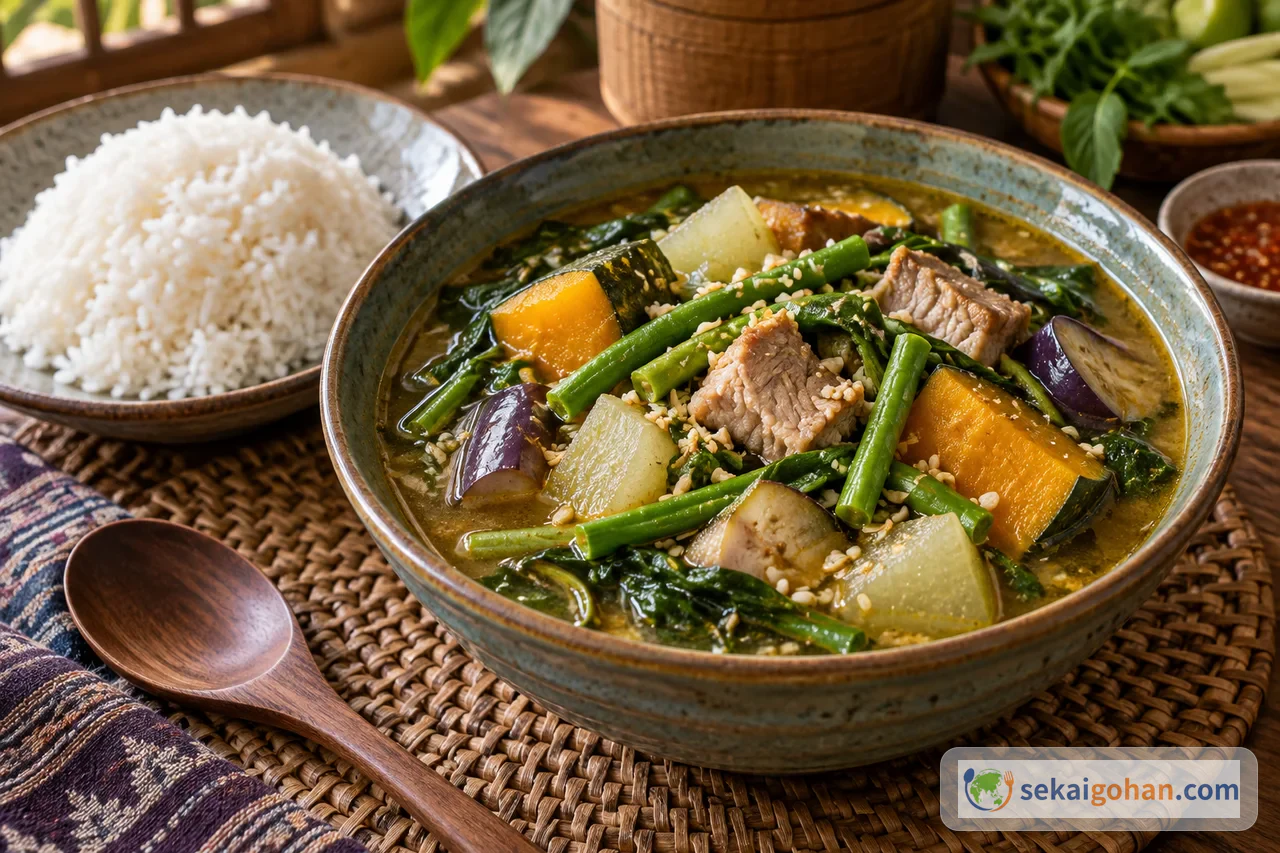
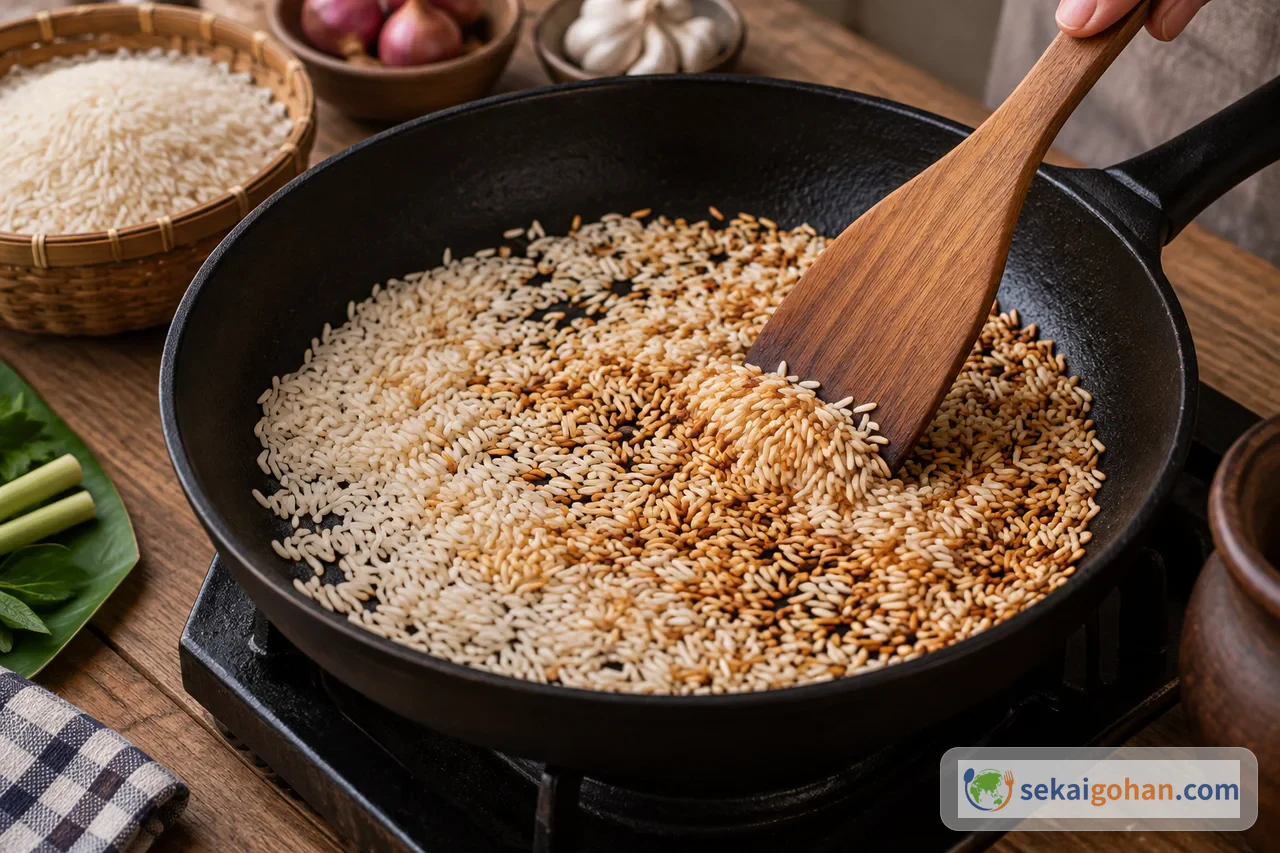
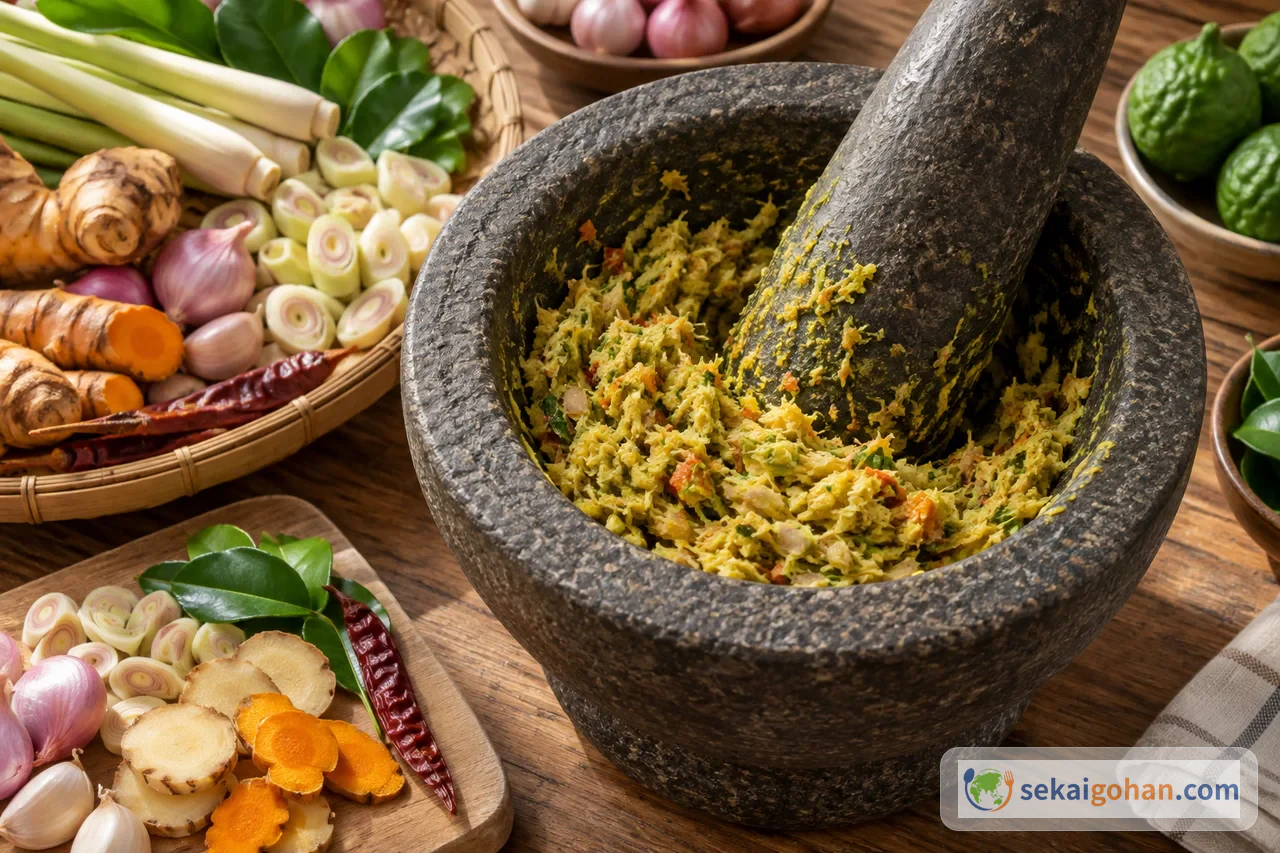
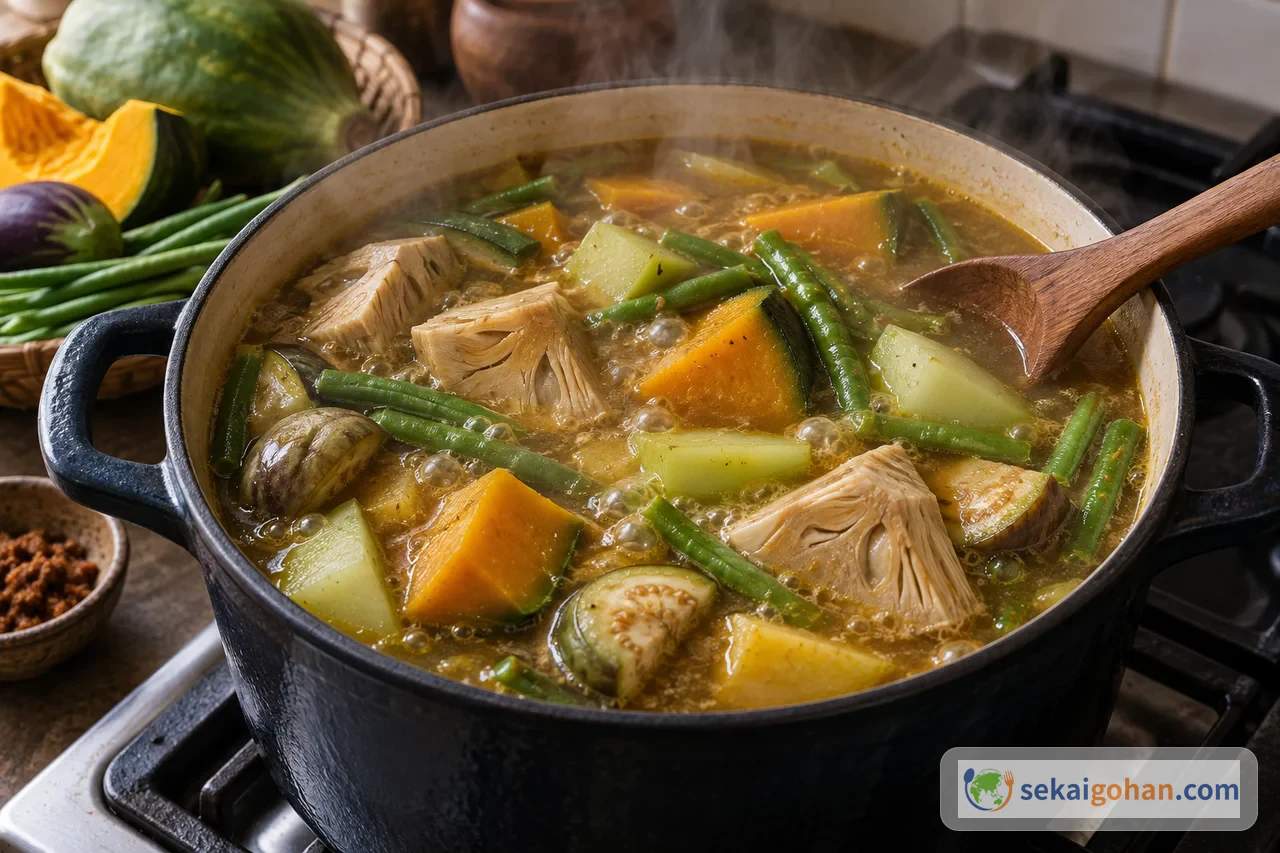
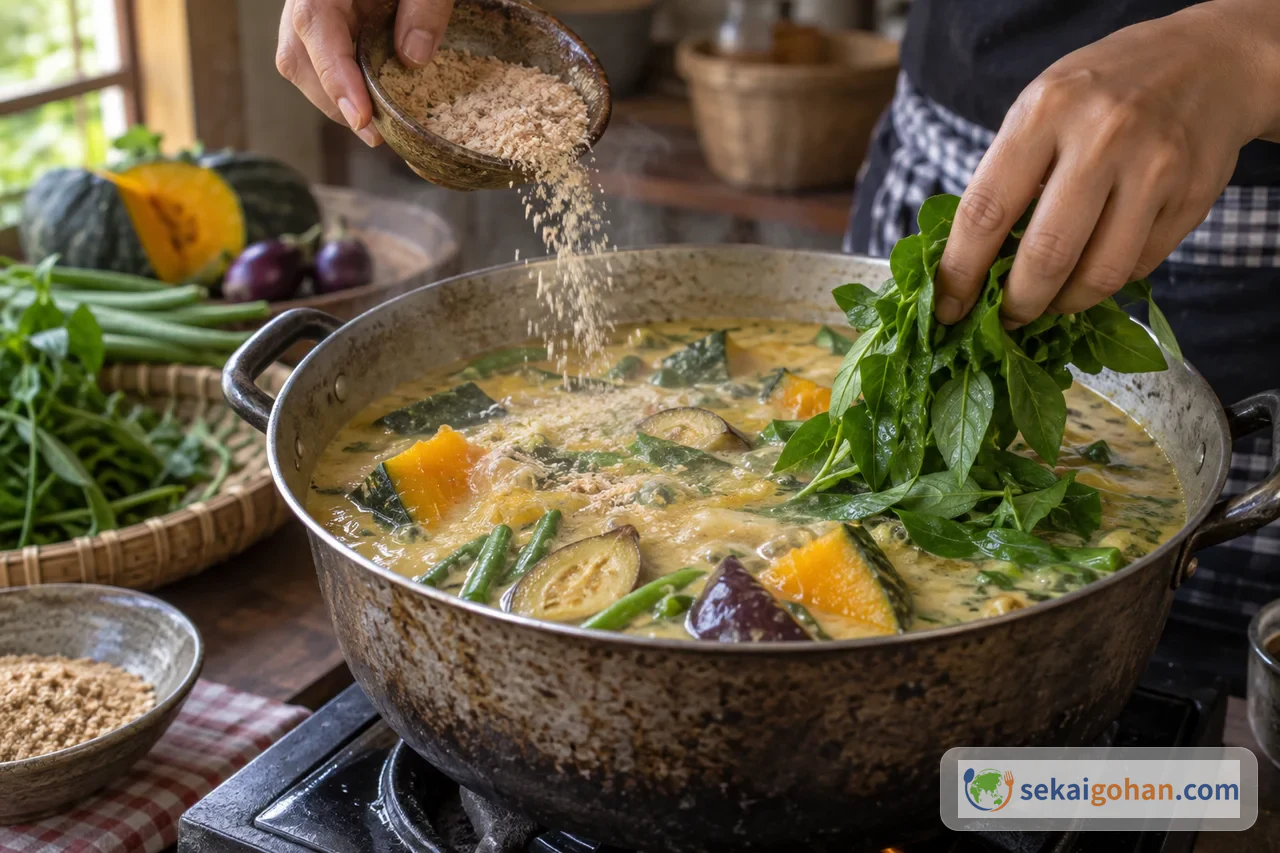
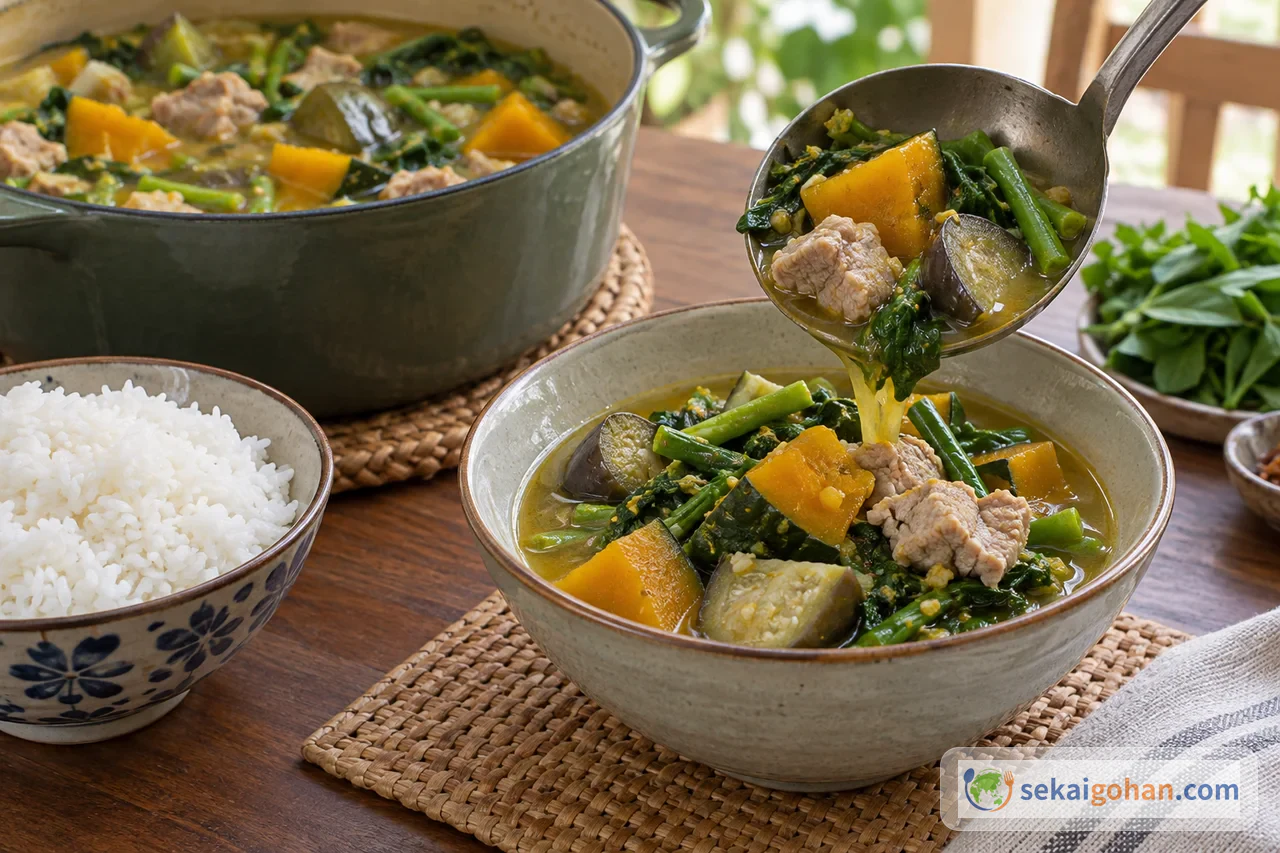
Stir rice in a dry pan and the white grains turn light golden bit by bit, giving off a scent like popcorn. Crush it coarsely once it cools and add it to a pot of vegetables. Flour would make the broth heavy; the rice thickens it just enough to cling thinly between the vegetables. That toasted rice is at the heart of samlor korko (Samlor Korko / សម្លរកកូរ), a Cambodian stew of pork, pumpkin, and vegetables. Its toastiness rests on kroeung, a pounded blend of lemongrass, galangal, and makrut lime leaves, and on prahok, a fermented fish paste.
Samlor korko at the Cambodian table
The name and how it is eaten
Samlor is the Khmer name for this kind of dish, also spelled samlaw, samlar, or samla. The word means soup or stew, and korko relates to stirring the pot. Meat, vegetables, and an aromatic paste are mixed together in the pot and eaten with rice, so this is more stew than a broth you sip.
Cambodian meals combine rice, samlor, and vegetable dishes, and the table leaves room to mix flavors and textures from one to the next. Korko is a traditional stew made with roasted and ground rice, pork, and pumpkin. The rice goes into the pot as well as alongside it, and its aroma and light body are what set korko apart from a plain soup of meat and vegetables.
Kroeung, prahok, and toasted rice
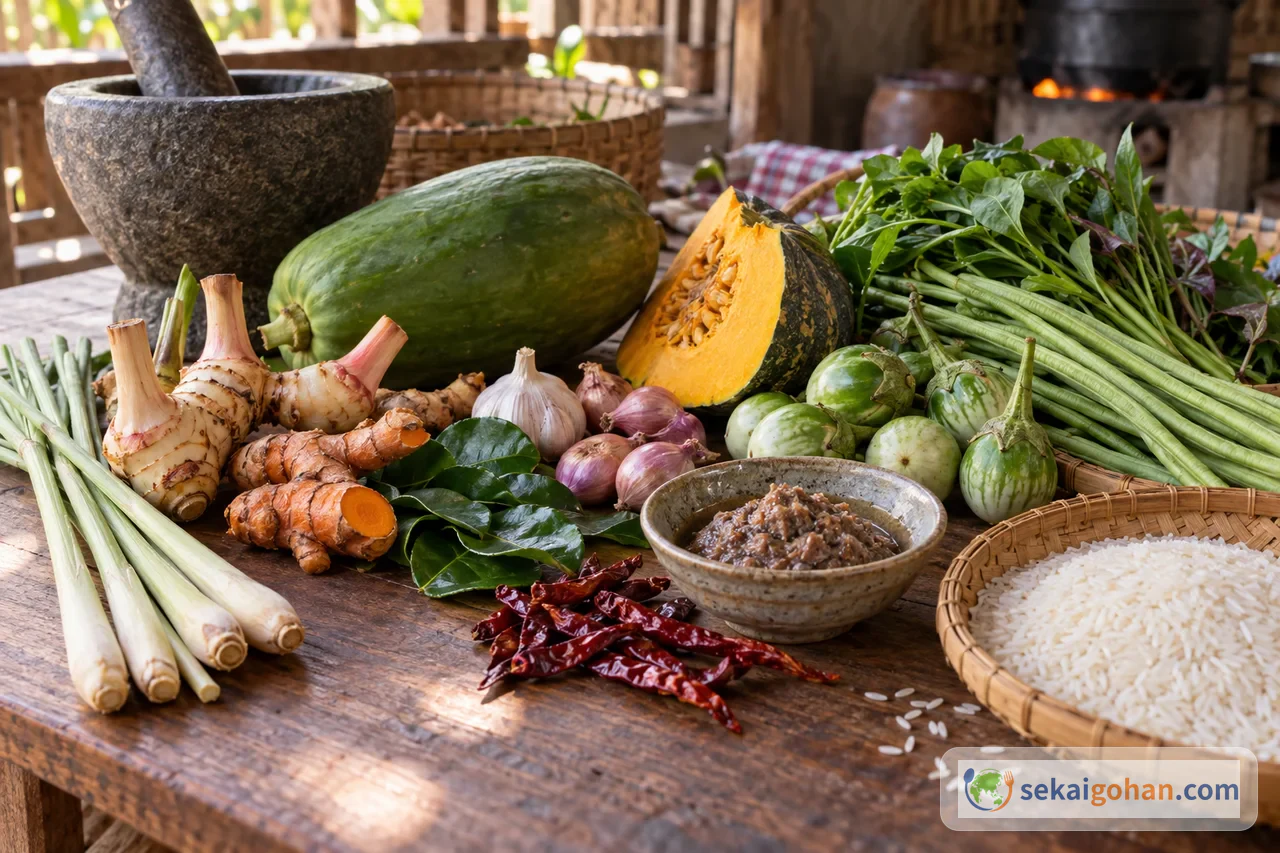
Kroeung is the core of the aromatics: a paste pounded from lemongrass, galangal, garlic, shallot, and makrut lime leaf, among others. Chopped fine and opened slowly in oil, it keeps the brightness of the lemongrass and the cooling quality of the galangal far better than curry powder does. A small amount of chili adds another layer of fragrance. If the table wants less heat, leave it out, and the pot still has its backbone.
Dry-roasted rice gives the broth a toasty aroma and a fine, slightly grainy body. Store-bought rice flour thickens evenly, but you miss the smell of roasted grain and the small grains that settle between the ingredients. So even in a home kitchen, give the rice those few minutes of dry roasting and a coarse grind.
Versions by season and household
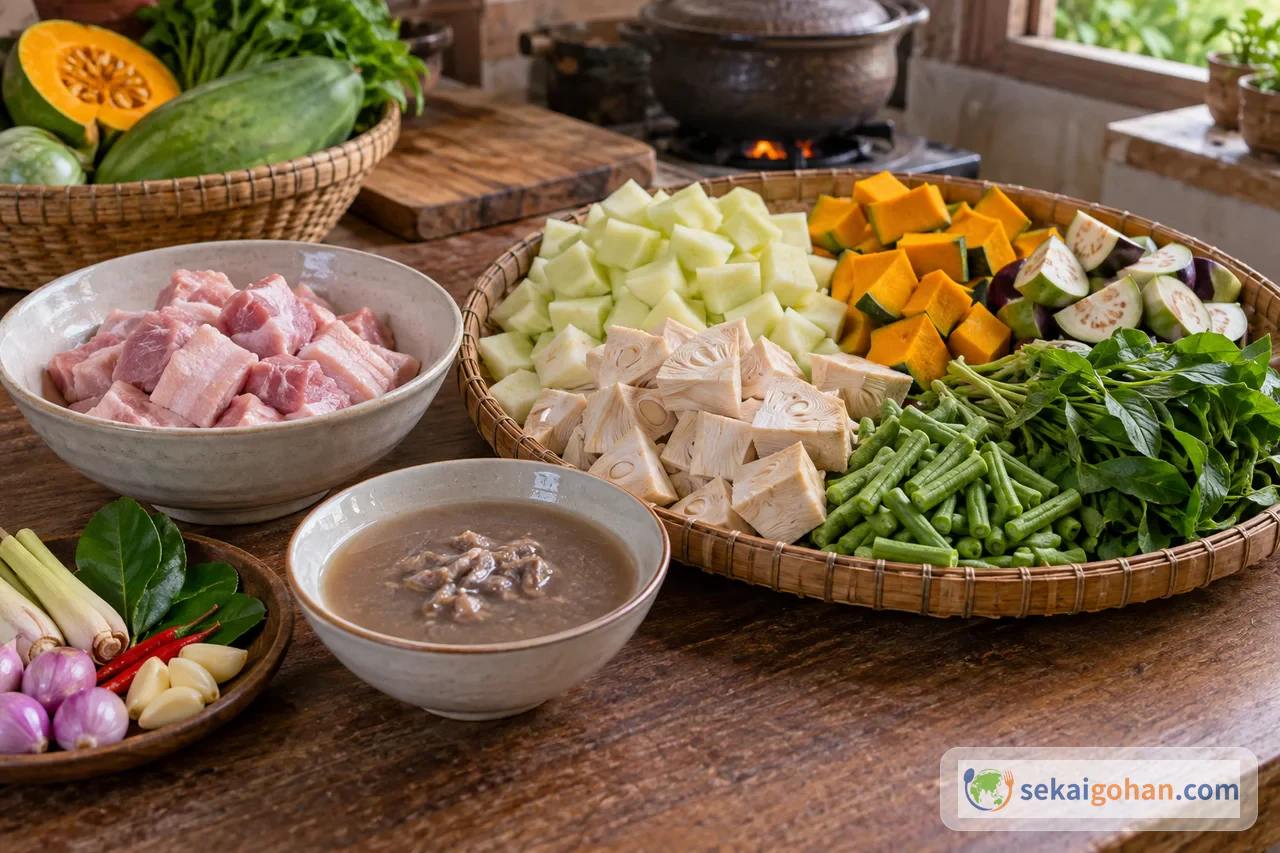
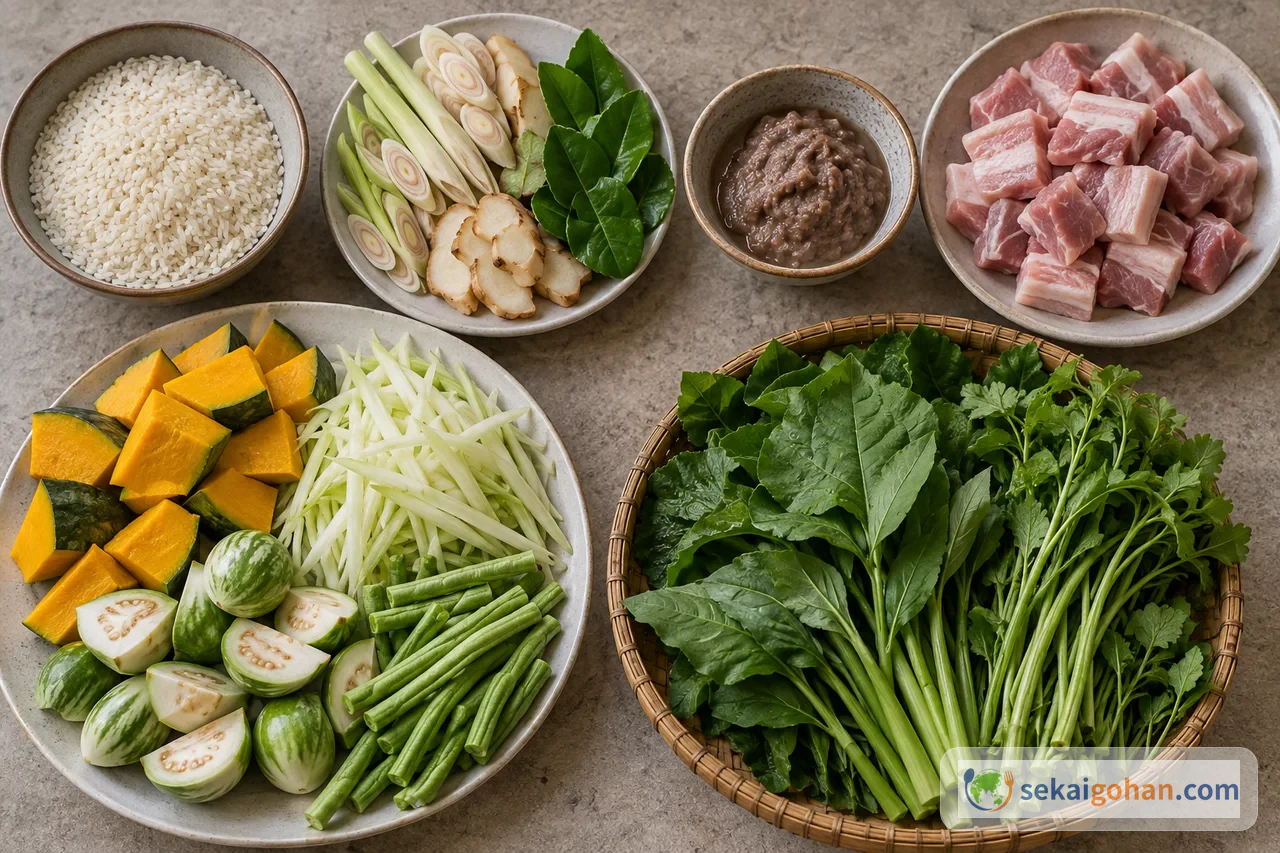
There is no single fixed list of ingredients. Some cooks add more water and lean toward a soup, while others add more toasted rice and lean toward a stew. Pork is common, but you will also find versions with chicken or fish. The vegetables change with the season: green papaya, young jackfruit, eggplant, pea eggplant, pumpkin, moringa.
Ingredients (serves 4)
You do not need to gather every vegetable the authentic way. Think separately about the ingredients that form the core of the flavor and those that create texture in the pot. Lemongrass, galangal, and makrut lime leaves overlap in the role of aroma, so do not make up for the absence of two by using a large amount of the third.
Prahok is different from fish sauce, shrimp paste, and chili paste. If you cannot find it nearby, order it online: just 15 g of fermented fish changes the base of the pot's savoriness and aroma. If you are trying it once, or dislike the smell of fermented fish, start with the fish sauce version. Check the label for a fermented fish paste made from fish and salt, and check the size and the storage conditions after opening.
If you want to keep the fermented aroma, dissolve 15 g in water and strain it. If you replace it with fish sauce alone, do not put in the full amount from the start; begin with 1.5 tbsp (20 ml) and taste. Salt content and solids differ by product, so check the ingredients and storage conditions.
If you choose frozen lemongrass, decide by whether you will use the aroma many times. A product from which you can use the white part for the kroeung and put the green part into the broth makes it harder to waste the rest. Check that it is edible, the net weight, and whether it is frozen or dried.
Choosing ingredients and substitutes for samlor korko
Outside Cambodia, it is easy to find stand-ins for the vegetables. Toasted rice, kroeung, and prahok are another matter. Each one does a separate job, so if you replace all three with a single substitute, the flavor loses its shape. When you have to cut back, decide which aroma you are going to keep.
Prahok and fish sauce
Abroad, the hard ingredient to find is prahok, not green papaya or young jackfruit. Leaving it out tones down the smell and makes the dish easier to eat, but you also lose the depth of fermented fish. Fish sauce works in its place, minus the grainy feel and aged aroma. Rather than pouring in all 2 tbsp (30 ml) at once, start with 1.5 tbsp (20 ml) and add 1 tsp (5 ml) at a time at the end. To get back a little of the fermented fish aroma, mash in a small amount of anchovy instead of adding more fish sauce. Anchovy has its own flavor, though, so check that the label lists fish and go lightly the first time. For more on prahok's aroma and uses, see the dip prahok ktis.
Green papaya, young jackfruit, and pea eggplant
Daikon stands in well for green papaya. It gives off more water, but it is easier to predict when it will break down. Cut it into 0.5 inches (1.5 cm) half-moons and add the next ingredient while the center is still a little firm. Sliced thin, it gives up its flavor before the toasted rice goes in, and the broth ends up tasting only of daikon.
Young jackfruit goes into the pot as a fibrous vegetable, not for fruit sweetness. If you cannot get it canned, use pumpkin or 2 oz (60 g) of mushrooms, and never ripe jackfruit, which is far too sweet. Mushrooms go in with the eggplant and soak up broth, so add 3.5 tbsp (50 ml) more water overall to keep the pot from getting tight. For pea eggplant, try shimeji mushrooms or bell pepper. Daikon and pumpkin change the water and sweetness of the pot, so stick to the cutting sizes and the order of adding.
Pork, chicken, or fish
With chicken thigh, fry the surface in the kroeung just as you would the pork, add the water, and cook it through to the center. White fish or catfish-type fish falls apart easily. Simmer the hard vegetables first, without the pork, and add the fish for the last 10 to 12 minutes. Fish doesn't call for more prahok: the fish broth and the fermented fish aroma overlap, so start the fish sauce low and taste.
Without meat or fish
Without prahok or fish sauce, you can build the flavor with 15 g of fermented soybean paste and salt, and it holds up as a vegetable stew. It will be missing the fermented fish aroma and the savoriness of the sea, though, so think of it as a different dish rather than samlor korko. If you have a fish allergy or eat vegetarian, check the seasoning labels first.
Mortar or food processor
A mortar crushes the lemongrass fibers and releases their aroma as you pound. Kroeung doesn't need to be as smooth as curry paste, so a food processor can do the job too. It just takes more work to keep small amounts of aromatics under the blade. A heavy mortar is worth buying if you make Cambodian or Thai aromatic pastes many times a month. For a single batch, whatever mortar or food processor you already have will do.
If you choose a granite mortar set, check the material, the inner diameter, whether it comes with a pestle, and how to wash it. Granite is heavy, so you'll need storage space and a place to wash and dry it.
Method: layer toasted rice, kroeung, and vegetables by how they cook
Do not use the cutting board or knife that touched raw meat for the leafy greens or the plated rice. Cut the vegetables first and the pork last; that makes it easier to keep track of washing and cooking.
Common samlor korko mistakes and fixes
Keeping the order of the pot
The vegetables should end up soft, but if everything goes in at once, the pumpkin falls apart, the eggplant gets waterlogged, and the greens lose their color. Cut the lemongrass and galangal fine and open the kroeung in oil. Strain the prahok with water and let the meat take it up. Simmer hard vegetables such as green papaya or daikon first, then add the eggplant and beans. Finish with the toasted rice and keep the leafy greens bright. Follow that flow and you can taste the aroma, the savoriness, and each layer of vegetables separately, even without pea eggplant or moringa.
If you replace the kroeung with curry powder, add the prahok only at the end as fish sauce, and grind the rice to powder, the pot drifts toward a spicy vegetable curry. That isn't wrong, but you lose all three things that make samlor korko what it is: the fermented fish, the pounded aromatics, and the toasted rice.
Grinding the toasted rice
Ground to a perfect powder, toasted rice thickens the broth faster, but you lose the little bursts of toastiness when you bite into a grain. Grains that are too large stay hard in the mouth and thicken only part of the broth. Aim for a mix of 1 to 2 mm grains and fine powder, and once it's in the broth, give it only 3 to 5 minutes on low heat.
Frying the prahok
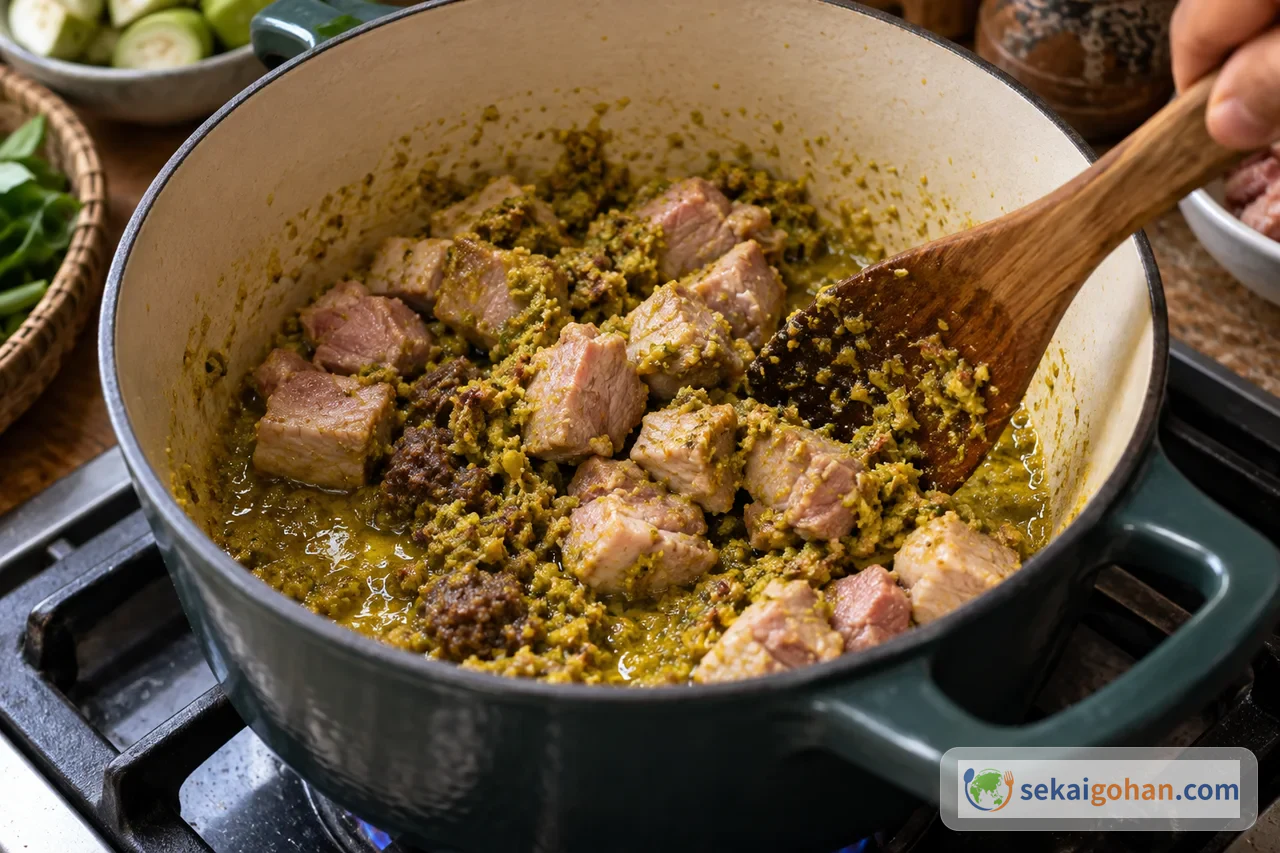
Fermented fish has a strong aroma. Stirred straight into the broth at the end, its salt and aroma feel separate from everything else. Instead, after frying the kroeung in oil, add the strained prahok and fry it for 1 minute so the pork picks up the aroma.
Soupier or more stew-like
Leaving the water at 3¾ cups (900 ml) gives a stew-like pot in which the toasted rice aroma and the ingredients cling to the rice. For more broth, add 3.5 tbsp (50 ml) to ½ cup (100 ml) from the start and keep the toasted rice at 1.5 oz (45 g). Water added only at the end dilutes the flavor, so put back fish sauce a little at a time until the broth tastes rich and aromatic rather than just salty.
Serving and storing samlor korko
Samlor korko is meant to be eaten with warm rice, a little broth, vegetable, and meat at a time, more than as a rich stew that stands on its own. If you'd like another kroeung fish dish, try amok, which shows how the same lemongrass-based aromatics change with coconut milk and steaming. Samlor korko keeps the shape of the vegetables and the grainy body of toasted rice, while amok gathers the aroma into the smoothness of fish and coconut.
To keep leftovers, separate the stew from the rice, move both to shallow containers, and cool them quickly. Reheat the whole pot until it is bubbling and hot through to the center, at 167°F (75°C) for at least 1 minute. The prahok aroma and the thickness of the toasted rice grow stronger by the next day, so finish the first day's pot a little loose. Eat it the same day if you can, and otherwise finish it within the next day. Throw out anything whose smell, look, or storage you are unsure of.
This dish uses pork, fish, fish sauce, and prahok. Use separate cutting boards, knives, and tongs so juices from raw meat and fish never reach salads or plated rice, and check the ingredient labels of each product.
Move the pot and the rice separately into shallow containers and cool them quickly, and when reheating, make sure they are hot all the way through. Because pork or fish is used, aim for 167°F (75°C) or above at the center for at least 1 minute, and throw out anything you are unsure about in storage condition or smell.
Frequently asked questions
How do I fix a broth that is too thin or too thick?
If it's thin, take off the lid and simmer on low for 5 minutes before you reach for more fish sauce. Taste once the toasted rice aroma comes out and the broth leaves a thin coating on the back of a spoon. If it's still thin, add fish sauce 1 tsp (5 ml) at a time. If it's too thick, add 2 tbsp (30 ml) of boiling water at a time, simmer 1 minute, and check. The toasted rice takes up more broth as it cools, so leave the pot a little loose just before eating.
Can I make the kroeung without a mortar?
Yes, in a food processor. Cut the ingredients to about 0.125 inch (2 mm) first, add no water, pulse 10 seconds at a time, and scrape down the sides. It doesn't need to be perfectly smooth. Stop when no long lemongrass fibers remain and the paste holds together when you press it with a finger.