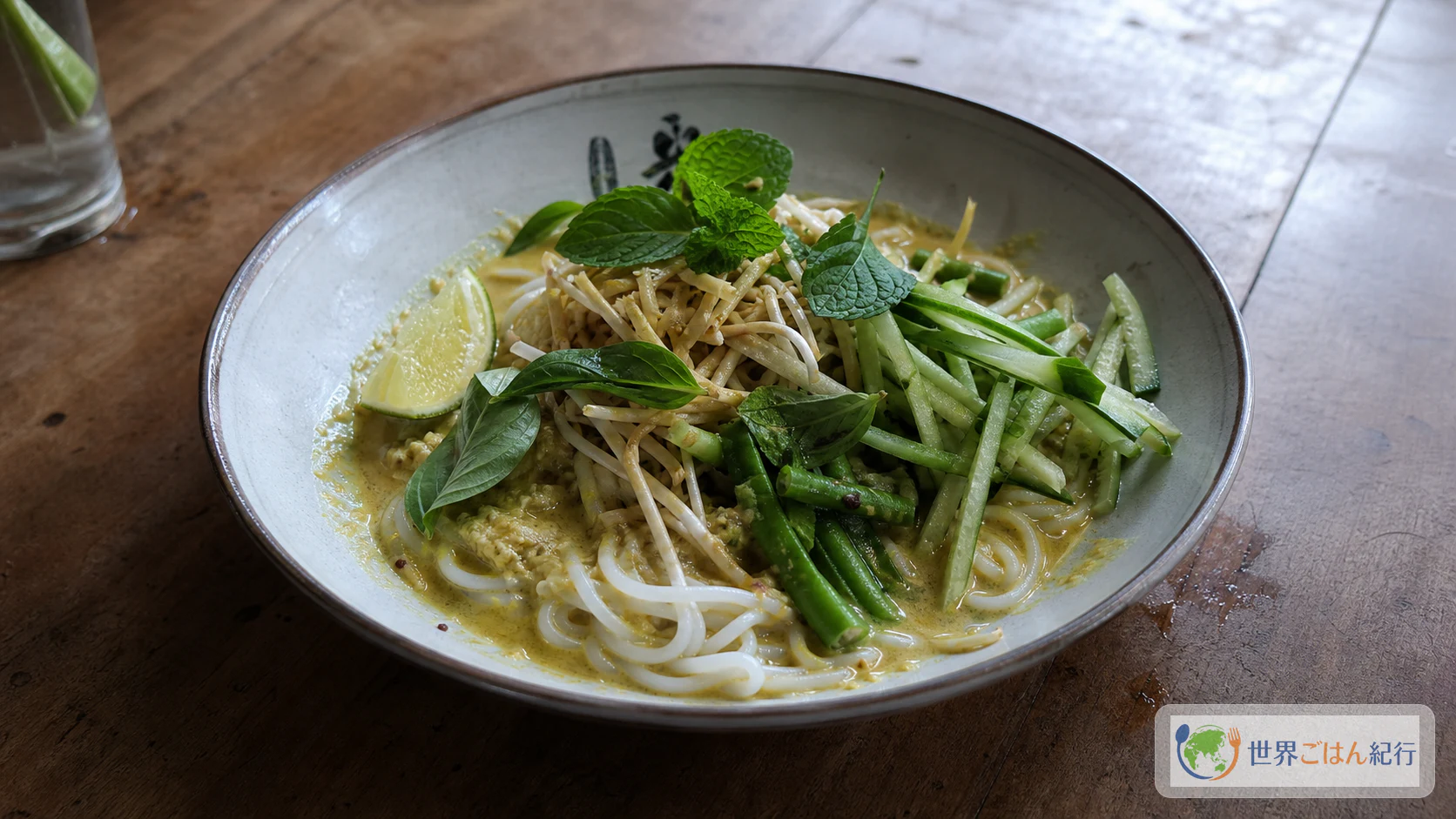
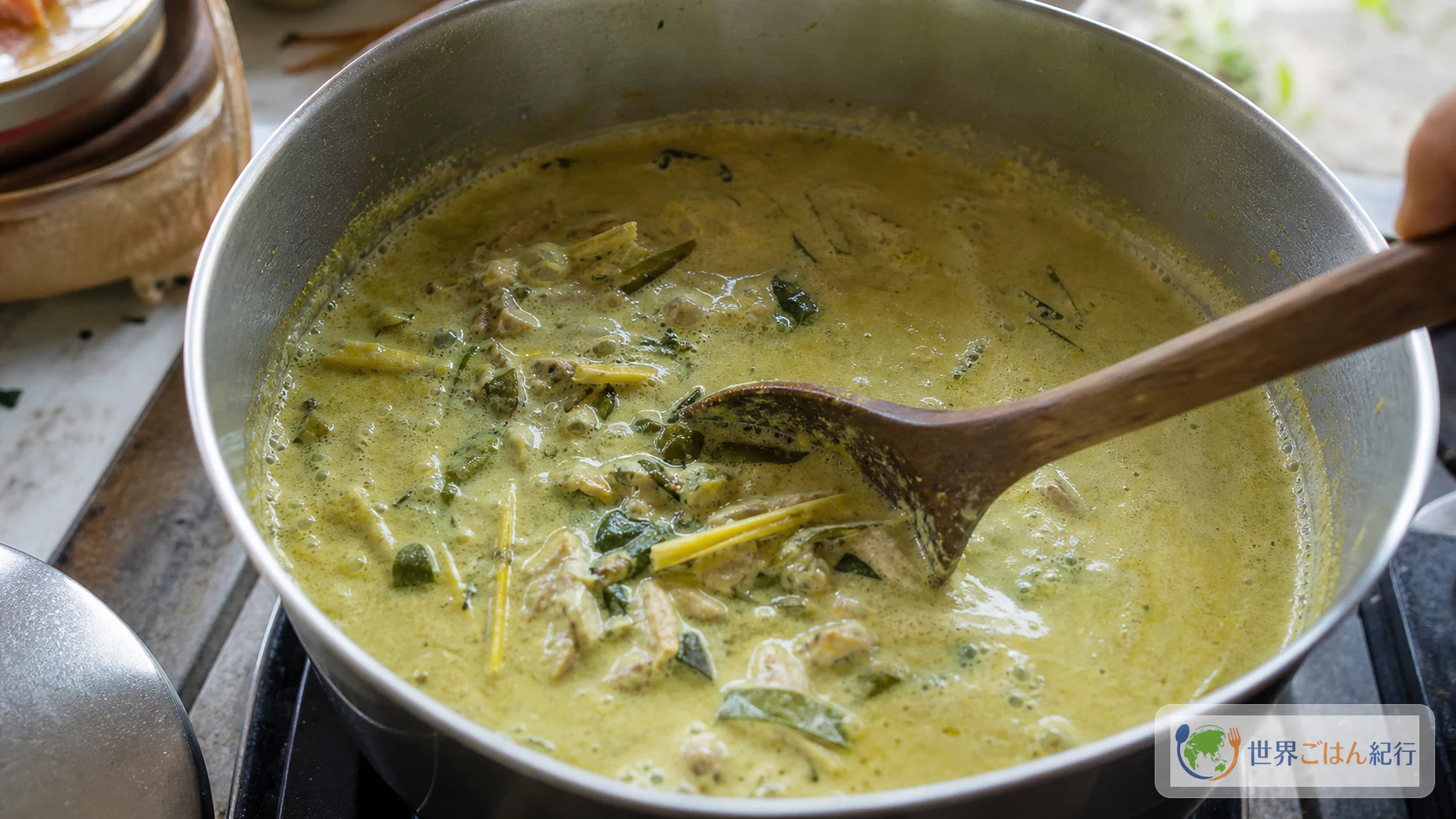
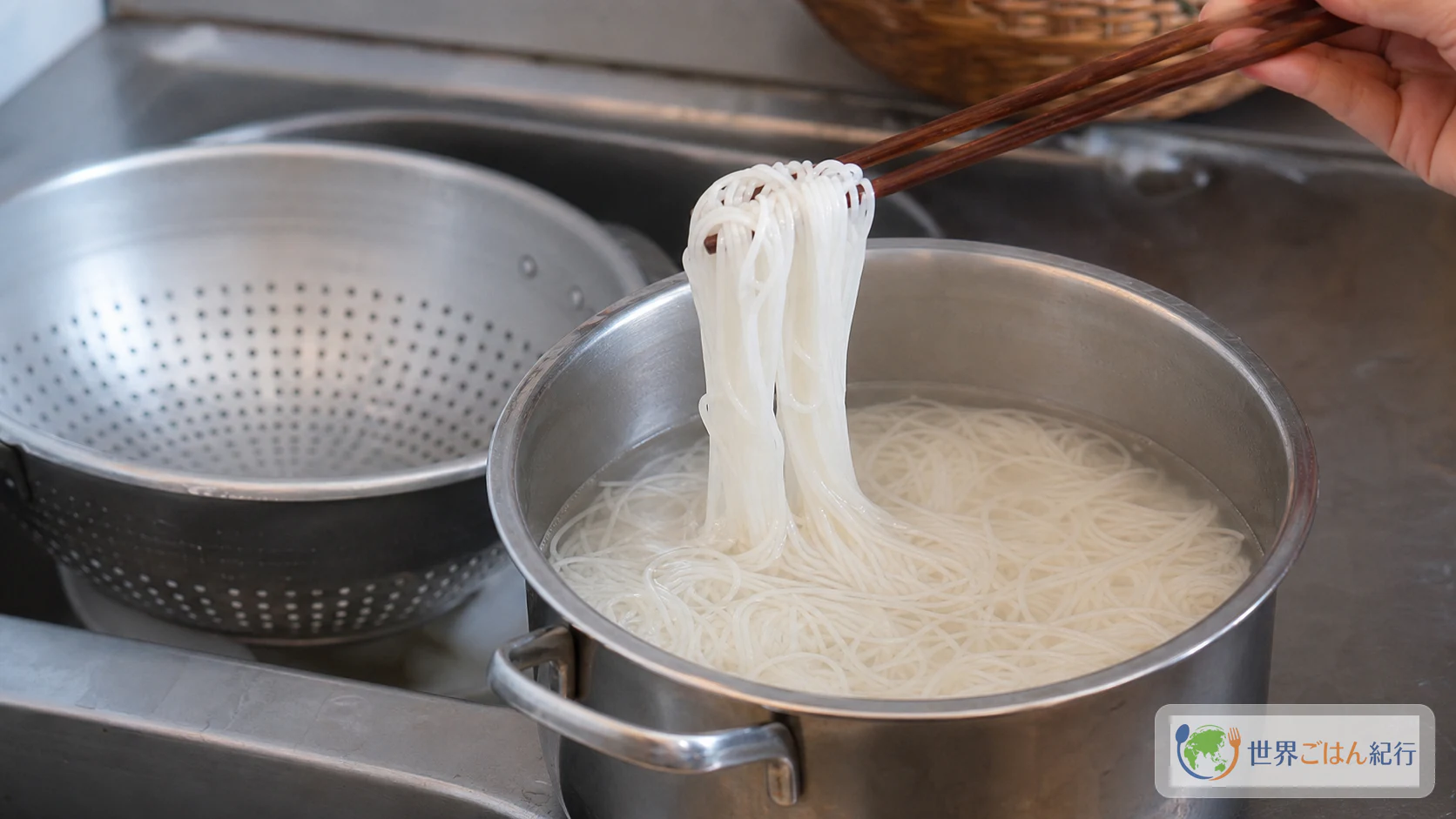
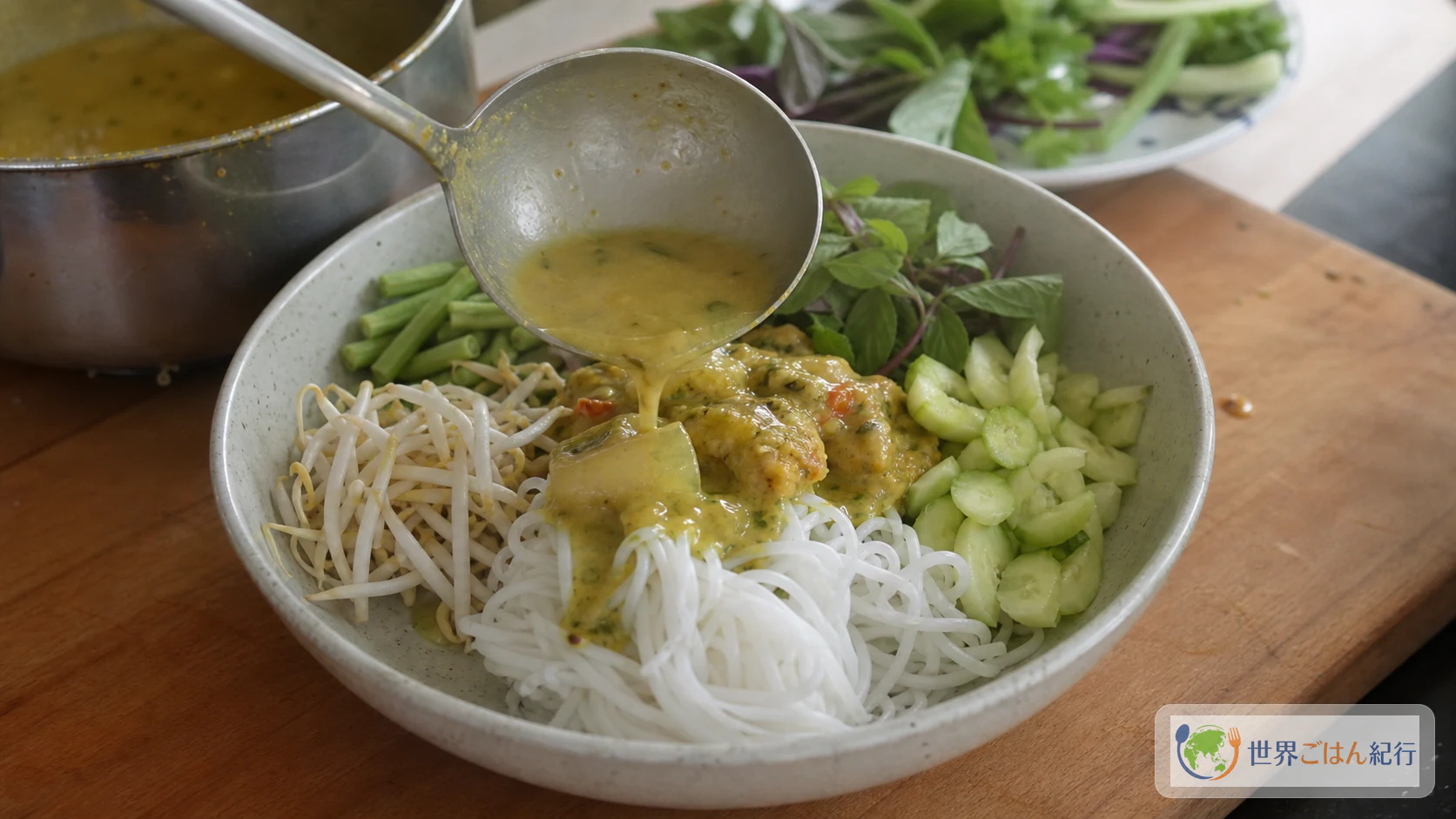
Loosen rice noodles into a bowl, pile cucumber, bean sprouts, green beans, and herbs alongside, then pour over a yellow soup scented with fish, and your kitchen suddenly smells of Southeast Asia. That bowl is num banhchok, the rice noodle dish Cambodians eat for breakfast and as a light meal. The soup gets its fragrance from lemongrass, galangal, and turmeric, and flaked fish gives it a light body. The raw vegetables go on last, still cold, and you fold them into the hot soup as you eat.
About Num Banhchok
In English the spelling varies: Num banhchok, Nom banh chok, Num banh chok. In Khmer it is written នំបញ្ចុក, and it is used for the rice noodles themselves or for the dish made with them.
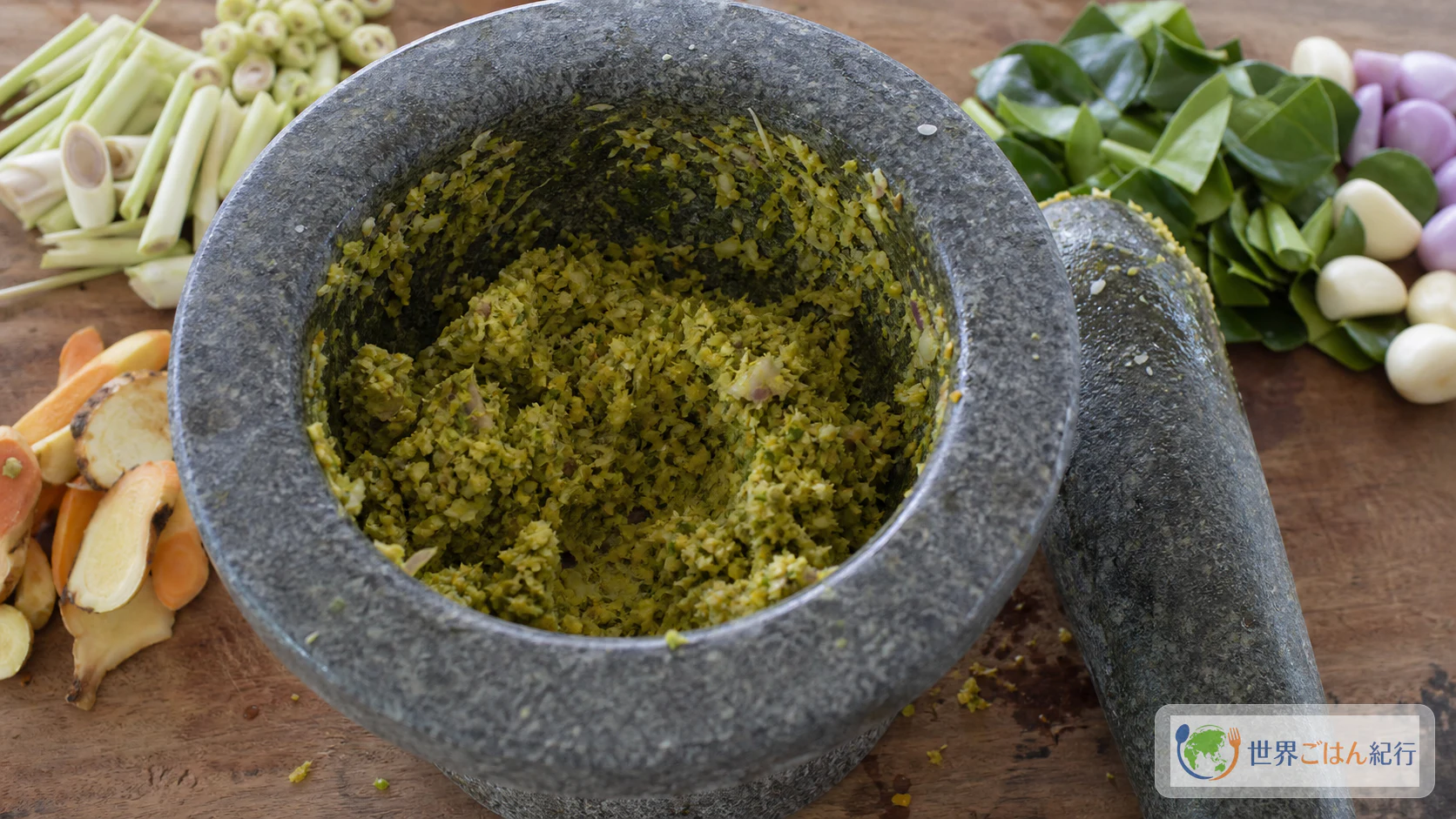
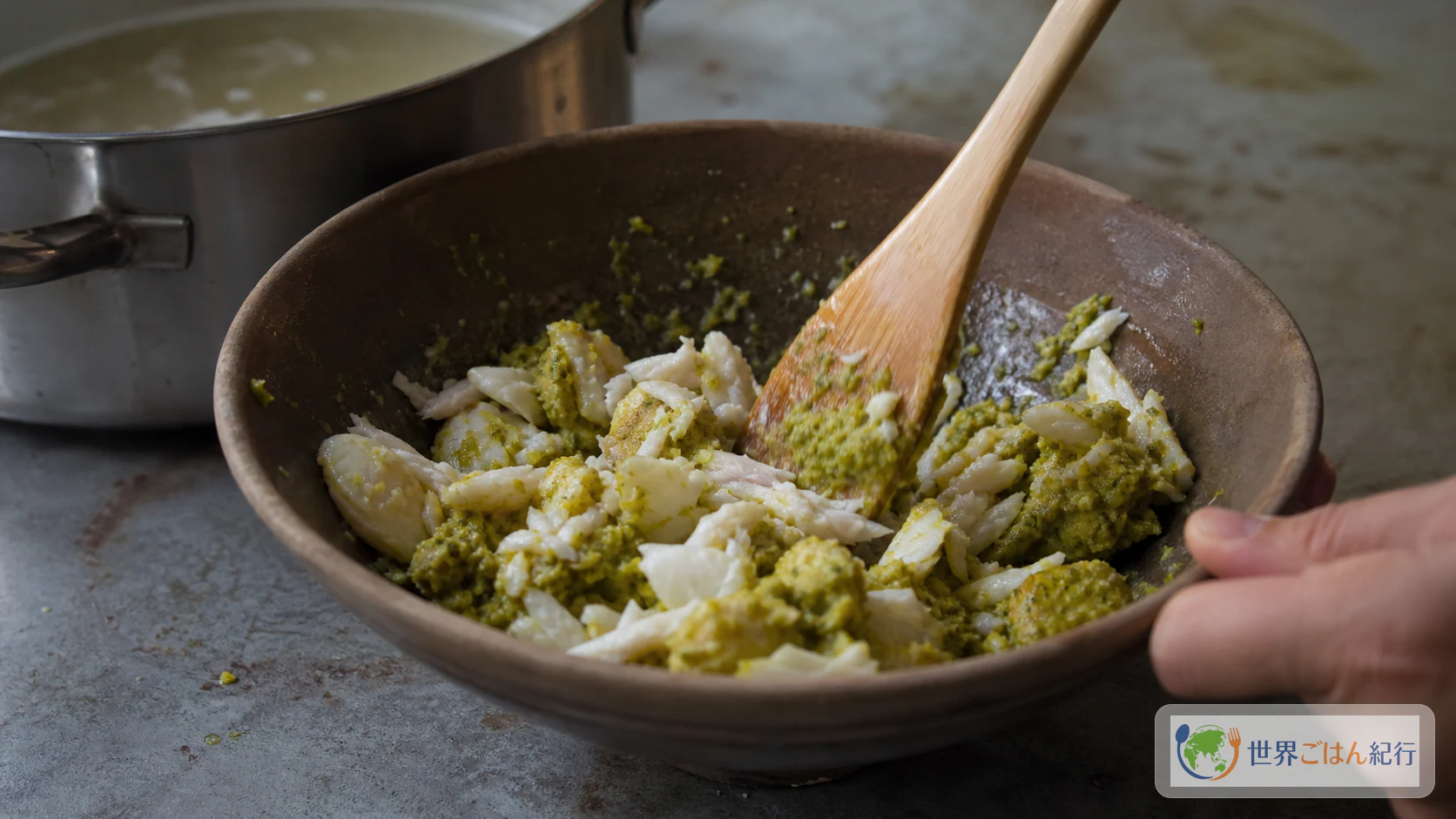
Num banhchok is built in layers. The first is a paste of finely chopped lemongrass, galangal, turmeric, and kaffir lime leaves. Then come a fish broth, the savory depth of fermented fish close to prahok, and a heap of raw vegetables. Prahok is the fermented fish that gives Cambodian cooking much of its savoriness and aroma. The aromatic paste is called kroeung, and it's the part cooks most often worry about.
It helps to set the dish beside its neighbors. Vietnam's phở gà has a clear chicken broth, and Myanmar's mohinga is another breakfast soup of fish and rice noodles. What sets num banhchok apart is the pile of raw vegetables and the strongly aromatic fish soup poured over it.
Ingredients (serves 4)
This recipe uses fish and fish sauce, and some seasonings contain wheat, so check labels. Cook the fish through to the center and remove the bones before flaking. For pregnant women, small children, older people, or anyone with health concerns, make sure the center of the fish reaches 145°F (63°C) or higher.
Choosing Ingredients for Num Banhchok
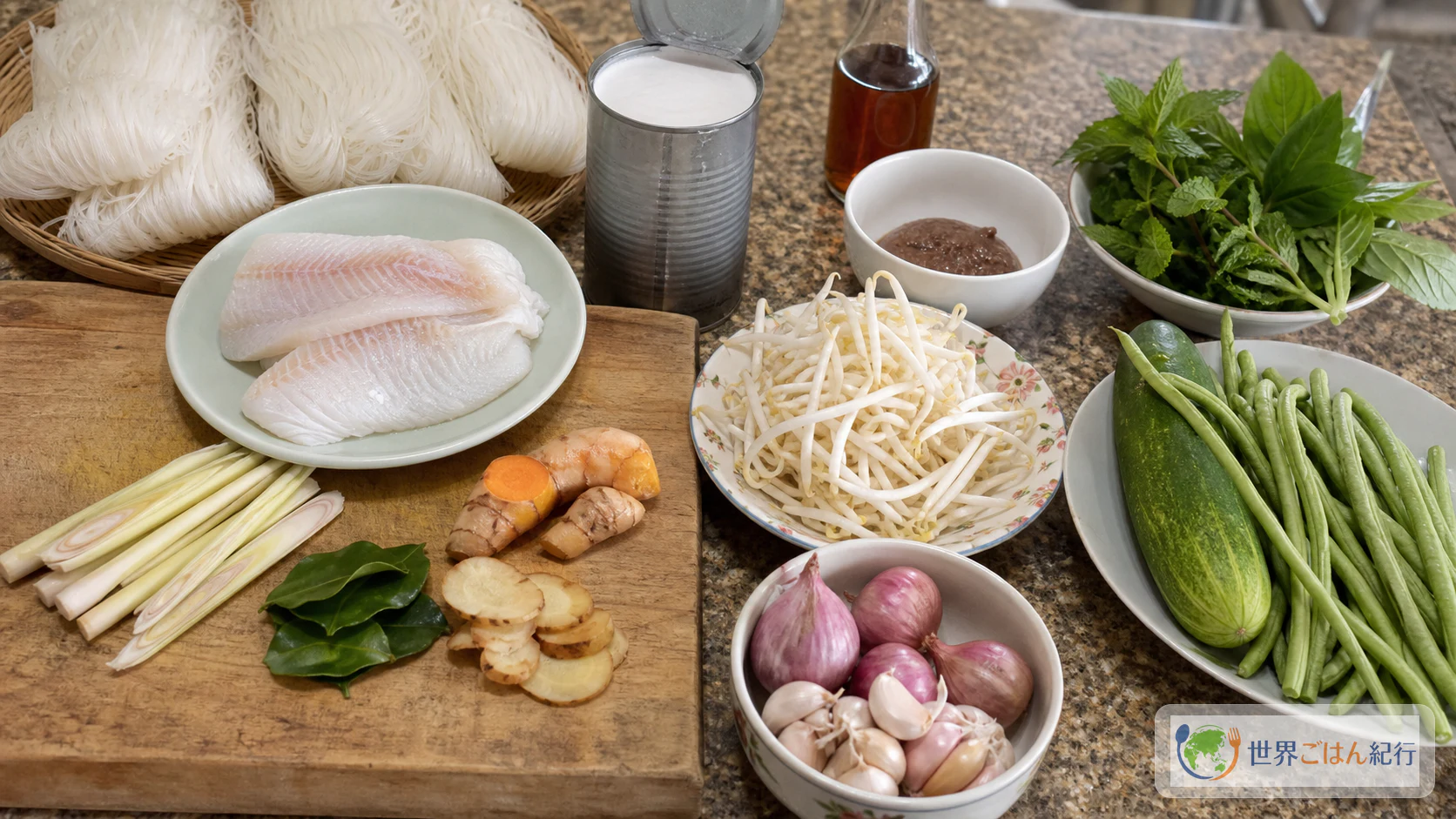
Fresh rice noodles and prahok are hard to find outside Cambodia, so this home version uses dried rice noodles, white fish, fish sauce, and a little anchovy. Three things matter most: keep the aromatic paste strong, stir some of the fish back into the soup for body, and add the vegetables last, cold.
| Element | Local character | How to scale it for a home kitchen |
|---|---|---|
| Rice noodles | Soft fresh rice noodles are often used | Soften fine dried rice noodles, then rinse in cold water after boiling |
| Fish | A light fish broth and flaked flesh | Boneless white fish fillets such as cod, sea bass, or sea bream |
| Fermented fish | The strong savoriness of prahok | Make up for it modestly with 1 tbsp fish sauce and 1 anchovy fillet |
| Kroeung | Lemongrass, galangal, kaffir lime leaves, turmeric | Use fresh or frozen, not curry powder alone |
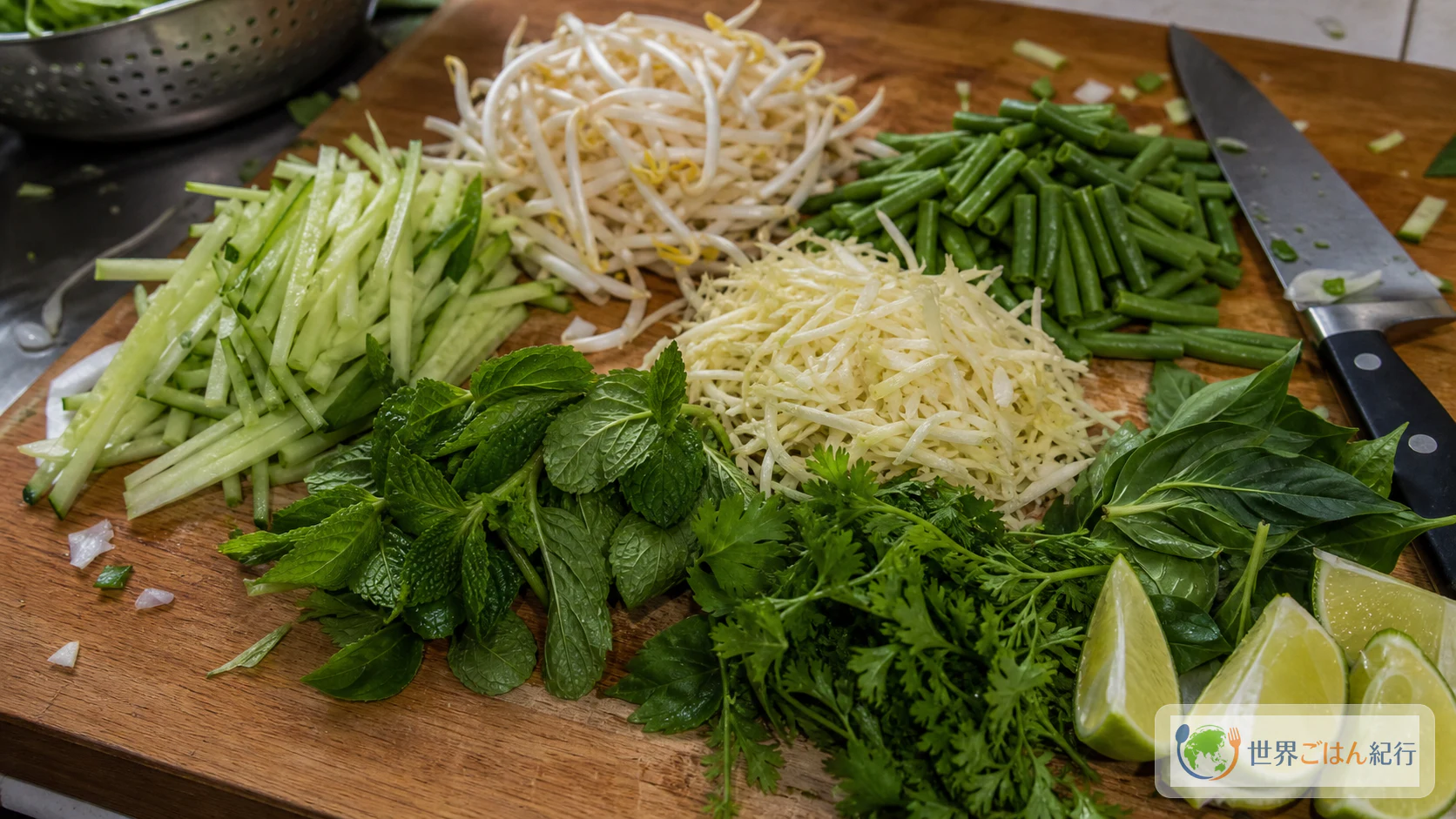
| Vegetables | Raw vegetables heaped on | Prepare cucumber, bean sprouts, green beans, cabbage, and herbs |
The Aromatics for Kroeung
For kroeung, lemongrass, galangal, turmeric, kaffir lime leaves, garlic, and shallots are chopped fine and go into the fish soup. Rice noodles, fish, cucumber, and bean sprouts are easy to find at an ordinary supermarket. The aromatics at the core of the paste are worth a trip to an Asian grocery or an online order. If you use ginger, lemon zest, and curry powder instead, you'll get a perfectly edible noodle dish, but it won't have the green, earthy aroma of Khmer cooking. Turning the soup yellow with curry powder alone gives you a different aroma altogether.
Frozen lemongrass works fine if you can't find fresh. Slice the white base thinly and it breaks down easily into a paste in a mortar or food processor. Galangal is woodier than ginger, with a faint camphor-like scent. Ginger can stand in for it, but if you want the soup to taste like a Southeast Asian fish soup, buy the galangal.
Kaffir lime leaves give the aroma its edges, even in small amounts. The rib is tough, so either remove it and slice the leaf fine, or let the whole leaf scent the soup and pull it out at the end. If there's no fresh turmeric, turmeric powder gives you the color and the earthy note. Use plain turmeric, not curry powder, so the soup keeps its character.
Lemongrass and galangal together are the one part you really can't replace. Without them, you're eating rice noodles in a coconut fish soup. Even without prahok, keep the aromatic paste as true as you can.
Replacing Prahok
Prahok is hard to replace completely. Most stand-ins end up all salt or all fermented fish smell. On a first try, skip the strong fermented aroma and use modest amounts of fish sauce for saltiness and anchovy for fish richness. Then put your effort into the fish broth and the kroeung. This version is easy to serve at a family table.
| Ingredient | What it gets close to | Caution |
|---|---|---|
| Fish sauce | Saltiness and the savoriness of fish sauce | Too much gives a saltiness closer to Thai cooking |
| Anchovy | The richness of fermented fish | One is enough. More leans toward a Western salted fish |
| A little miso | Roundness | Weakens the Khmer character. Up to 1/2 tsp |
| Salt alone | Easy to eat | The local depth is much weaker |
Method
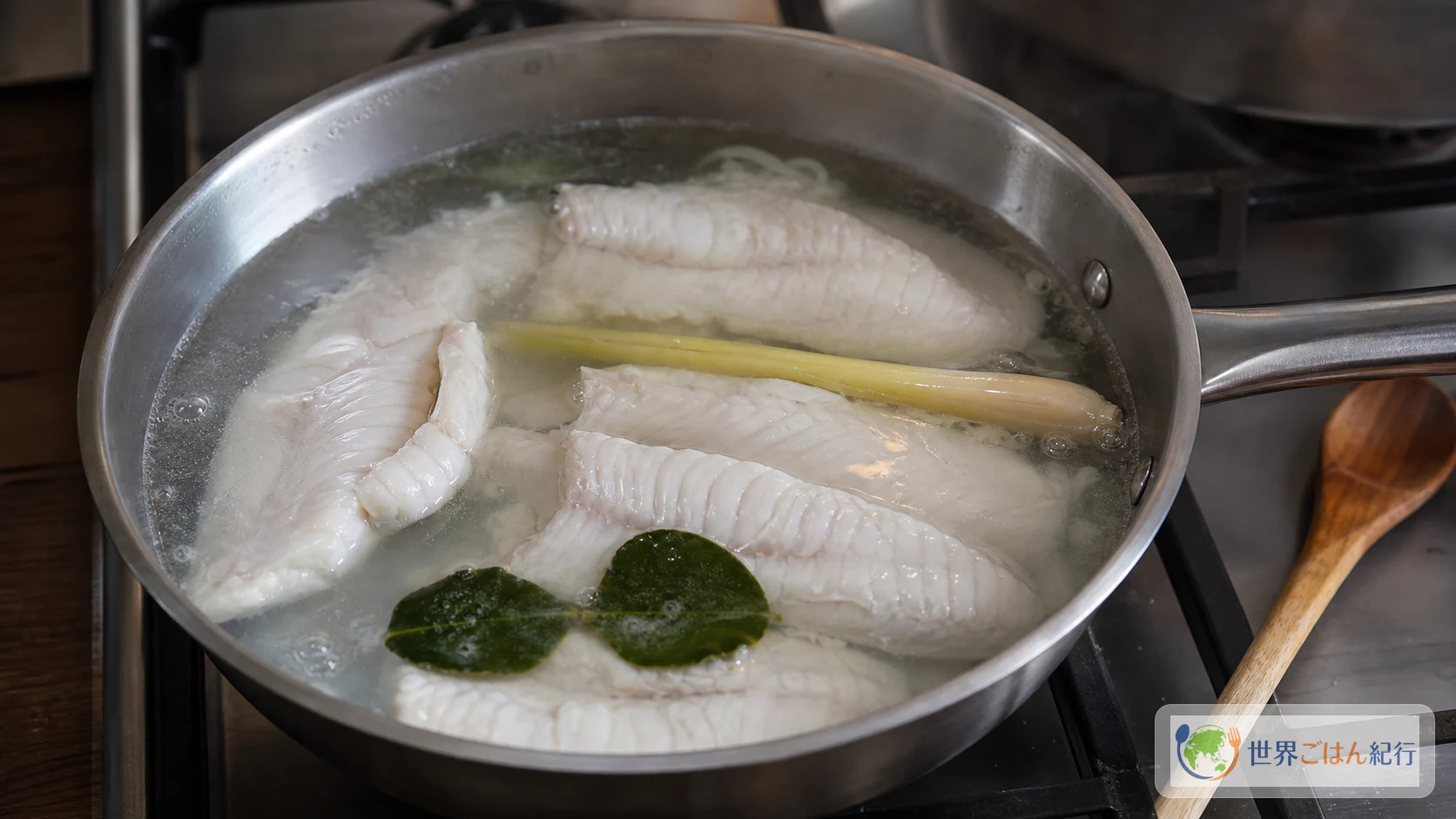
Finish the rice noodles last. Poach the fish first, make the soup from that broth, cut the vegetables, and then soften the noodles, and you can serve them without letting them go limp.
Fixing Common Num Banhchok Problems
| Symptom | Cause | Fix |
|---|---|---|
| The soup smells fishy | The fish was boiled hard, or bones and dark meat remained | Poach over low heat and strain the broth. Add more lemongrass, not ginger |
| The aroma is weak | The paste is too coarse or fried too briefly | Slice the lemongrass thin and fry in oil for 3 minutes to release the aroma |
| It tastes like curry powder | Relying on turmeric and store-bought curry powder | Add galangal, kaffir lime leaves, and lemongrass |
| The noodles break | Overcooked, or rubbed too hard under running water | Boil for less than the package says and rinse just enough to loosen with your fingers |
| The vegetables are watery | They were not drained after cutting | Leave in a colander for 10 minutes and add just before serving |
| It is too salty | Too much fish sauce and anchovy | Add 3.5 tbsp (50 ml) coconut milk and ½ cup (100 ml) broth, and tighten with lemon juice |
If the soup tastes thin, hold off on the fish sauce, or saltiness will be all you taste. Simmer it 5 minutes over low heat, break up the fish a little, then taste again. The soup is meant to go over noodles and vegetables, and the vegetables add water too. So it should taste slightly strong on its own.
Serving and Storing Num Banhchok
Serving Num Banhchok
In Cambodia num banhchok is a light morning noodle dish, but with more vegetables it makes a good lunch. At the table, bring the hot soup in a big pot and set the rice noodles and vegetables out on separate plates so everyone can build their own bowl.
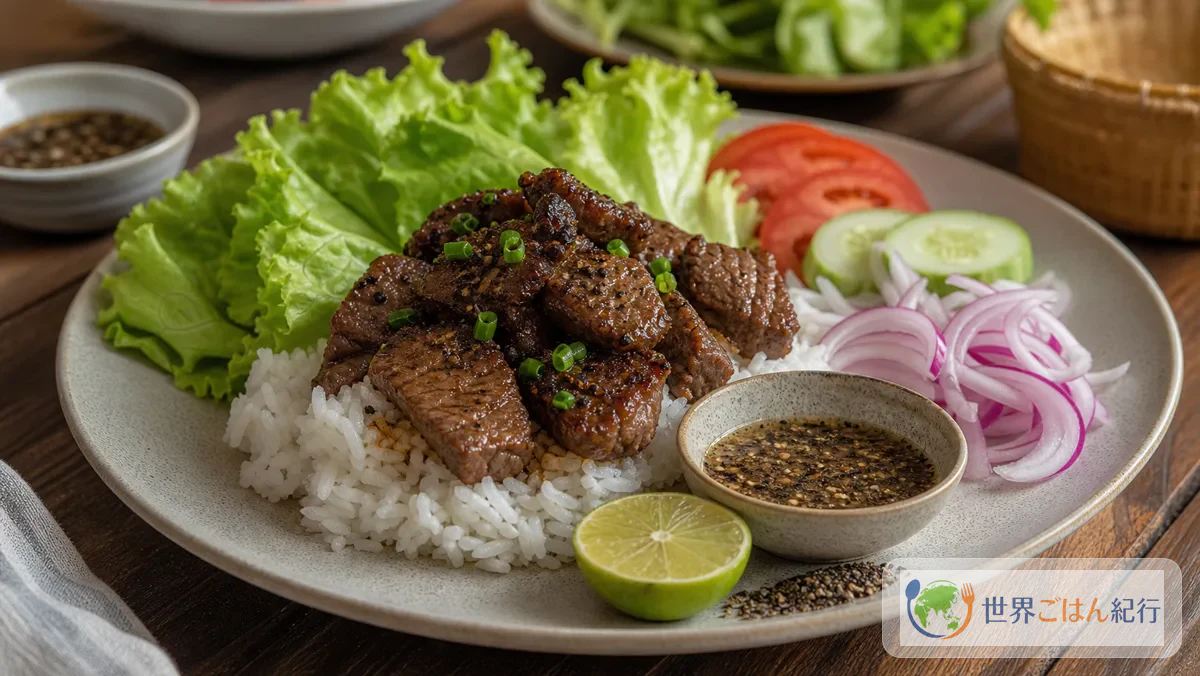
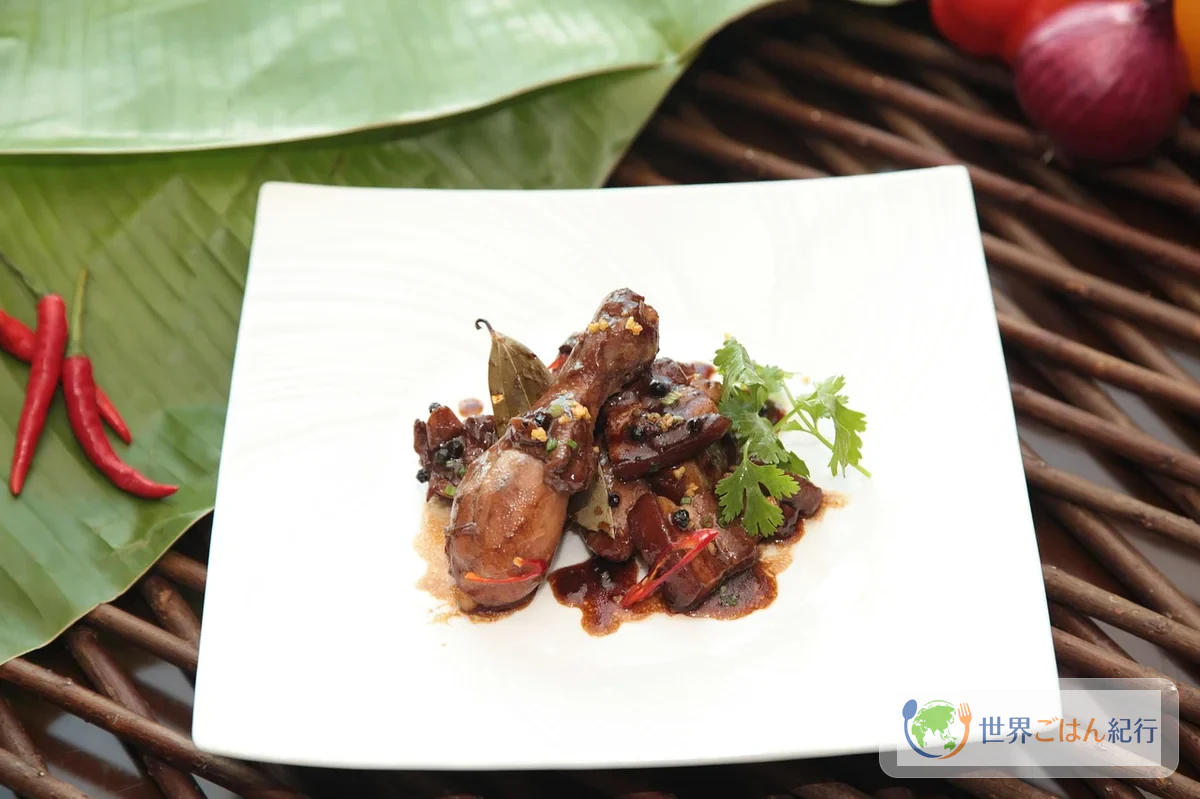
To keep going with Cambodian cooking, amok (in Japanese), a steamed fish with aromatics, uses coconut and aromatic paste in a similar way. lok lak (in Japanese), quickly stir-fried beef, is more of a main dish. aluek trei ngeat (in Japanese), a preserved dish made with dried fish, shows another way Cambodian cooks handle fish and savoriness.
Storage and Making Ahead
Always store the soup, noodles, and vegetables separately. Mixed together, the noodles soak up the soup and the vegetables give off water, and by the next day everything is mushy.
| Item | Time | Point |
|---|---|---|
| Fish soup | 2 days refrigerated | Cool completely before storing. Reheat over low heat to a gentle bubble |
| Boiled rice noodles | 1 day refrigerated | Do not coat in oil; loosen with warm water once stiff |
| Cut vegetables | 1 day refrigerated | Drain, and wrap the herbs separately |
| Freezer | Soup only, 2 weeks | The coconut milk separates slightly, so stir well after reheating |
If you want to get ahead, make the kroeung-style paste the day before. It keeps 2 days in the fridge. Poach the fish and do everything after that on the day you eat, and you'll keep the aroma.
Frequently asked questions
What fish should I use?
Use a mild white fish with bones that are easy to remove, such as cod, sea bream, sea bass, or Spanish mackerel. Oily fish has a strong smell that clashes with the kroeung, so leave it out the first time. Even with fillets, remove the skin and bones before flaking.
Is coconut milk essential?
A little coconut milk helps the fish and the aromatic paste come together. Too much turns it into a rich noodle soup like laksa, so stick to ¾ cup (200 ml) for 4 servings.
Can I substitute somen noodles for the rice noodles?
You can, but it becomes a different dish. Somen carries the aroma of wheat and some salt, and it soaks up the fish soup and goes too soft. If you have to use it, boil it quite firm and rinse it well under running water.
Do I have to make it spicy?
This basic version has no heat. Cambodian cooking is usually not very spicy to begin with, and people add chili or lime at the table to suit themselves. If you want heat, add a little chopped chili at the end.
Can I serve it for meals other than breakfast?
Yes. For lunch, add more vegetables and fish rather than more noodles. For dinner, a small meat dish like lok lak (in Japanese) rounds out the meal.