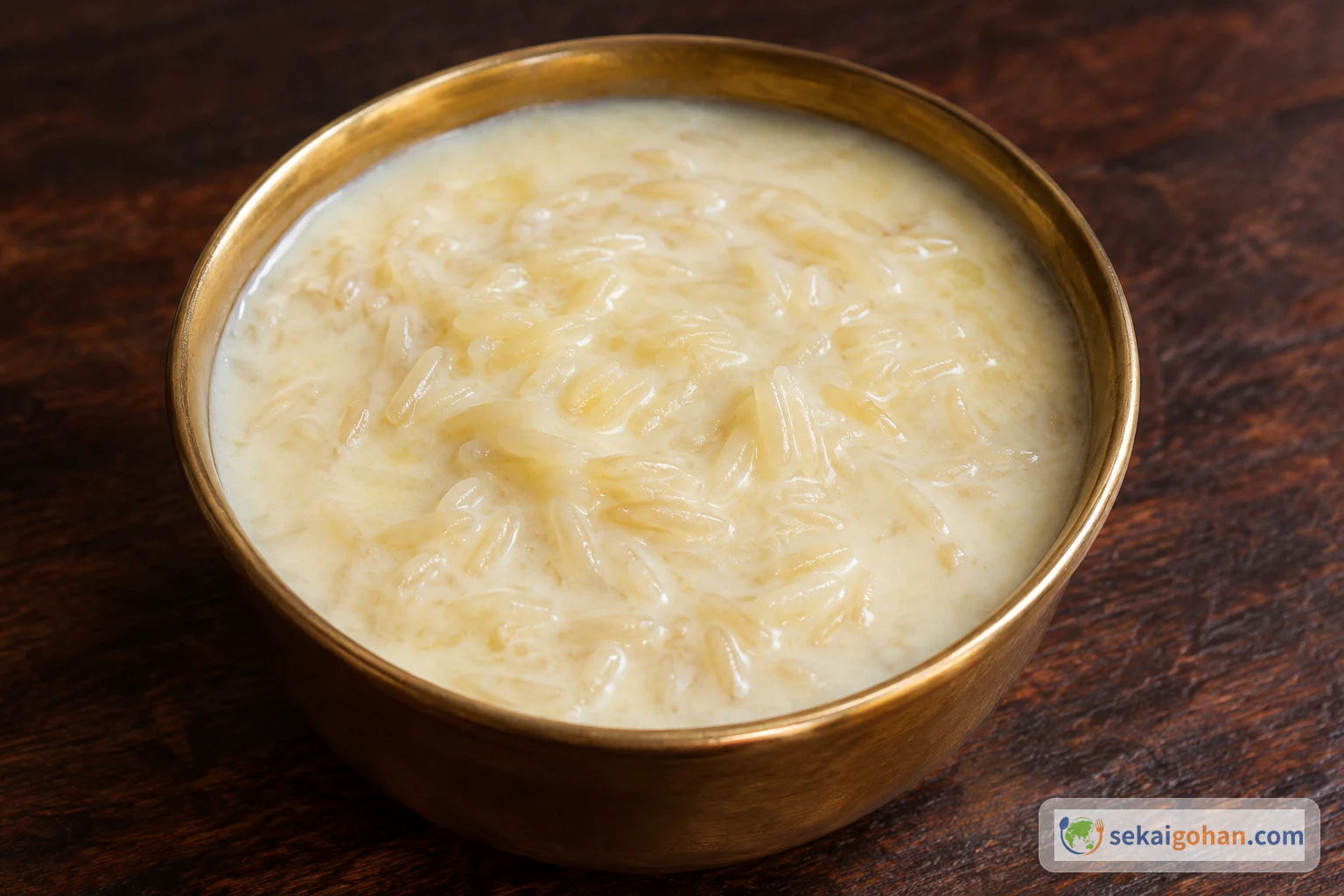
While you scrape the bottom of the pot with a spatula, phirni looks like a plain dish: milk, rice and sugar, all of them white, with only a faint aroma at first. Then the coarsely ground rice starts to hold the milk, the saffron's yellow unfurls, the green scent of cardamom rises, and the kitchen shifts one notch toward the festive. Phirni (also Firni; फिरनी in Hindi) is North India's take on rice and milk. The rice is crushed before it is simmered, and the dessert is eaten chilled. It comes out smoother than kheer and tastes more of rice than of pudding.
Phirni, kheer and doodhpak
Rice pudding usually means whole grains of rice in a sweet porridge. For phirni, the rice is soaked and coarsely ground first. That gives the milk body, and you can still feel fine grains when you eat it. Indian milk sweets have similar names, so the easiest way to tell them apart is by how the rice is treated.
| Dish | How the rice is treated | Texture | Guide in a home kitchen |
|---|---|---|---|
| Phirni | Soaked and coarsely ground | Smooth yet some graininess remains. Eaten chilled | About 2 oz (60 g) rice to 1 quarts (1 L) milk |
| Kheer | Often cooked with the rice grains whole | A homely sweet close to rice porridge | Can be made with short-grain rice but gets sticky |
| Doodhpak | Few rice grains left | Milk is the star, light | More milk, less rice. Also eaten warm |
| Basundi | No rice needed | A rich sweet of reduced milk | Concentrated milk is the star rather than rice |
People mix up phirni with doodhpak (in Japanese) more than with any of the others. Doodhpak leans western Indian. It is a light milk and rice sweet that keeps the grains of rice, and it comes to the table as a sweet course with puri. Phirni leans North Indian and is served in a small bowl after a meal.
You will see both Phirni and Firni in English. It is common in North India and Punjab, in Mughlai restaurants, and at Ramadan and festive tables. Cooks add different amounts of saffron, rose water, kewra water and nuts. Around Kashmir it is also called phirin and made with semolina instead of rice.
Ingredients: little rice, and don't push the aroma too far

Serves 6 small bowls after a meal. If you want the sweet to be the star, serve 4. No clay bowls? Use shallow ceramic bowls, glass pudding cups or teacups.
This uses dairy and nuts. Leave out the nuts if needed, but if you use the same utensils, watch for cross-contact. Milk heated for a long time can scorch, so turn off the heat promptly and refrigerate the phirni in a clean container. If something has been left out at room temperature for a long time, don't keep it for the next day.
Ingredients that are hard to decide on when shopping
Milk, sugar and nuts are easy to find. Look for basmati rice, saffron and cardamom at an Indian grocery or online. They set the aroma of the finished dessert. You use only a little of each at a time, and they also go into samosa, dal tadka (in Japanese) and raita.
For the rice, basmati with its aroma gives a lighter finish. It can be made with short-grain rice, but with the same 2 oz (60 g) it gets sticky, so reduce to 1.75 oz (50 g) and leave the coarse grains slightly larger.
Saffron is for aroma, not color. It sits behind the sweetness of the milk. A lot tastes medicinal, so start with a pinch. Steep it in warmed milk rather than boiling water, so it stays part of the round flavor of phirni instead of floating apart from it.
You can use ground cardamom, but cracking the pods and crushing the seeds gives a cleaner green scent in the milk. If using powder, start with 1/3 tsp. This is a white sweet, so too much cardamom leaves only the aroma in front.
Choosing ingredients and substitutes for phirni
Phirni has so few ingredients that it is easy to see where a substitute will work. Rather than changing everything, decide what you want to protect and what you can swap.
| Ingredient in doubt | To protect | Realistic substitute | Effect on the finish |
|---|---|---|---|
| Rice | Basmati rice | 50 g short-grain rice, crushed a little coarse | Weaker aroma, slightly chewier |
| Milk | Plain whole milk | Avoid low-fat; only when short, add 2 tbsp cream | Low-fat milk alone is thin |
| Saffron | A small amount steeped in milk | Can be omitted. Color is paler | Less aroma, but cardamom can make up for it |
| Rose water | 1/2 tsp | Can be omitted. Better not to use vanilla | Too much leans toward Western pastry |
| Clay bowl | Unglazed small bowl | Shallow ceramic, pudding cups | Deep bowls chill slowly at the center |
| Nuts | Pistachios, almonds | Either one alone is fine | Changes texture and visual brightness |
If all you have is a basic supermarket, rice, cardamom powder and almonds are enough, as long as you still crush the rice coarsely and finish by chilling. Go easy on the saffron and rose water, because too much of either drowns out the quiet flavor of milk and rice.
The bowl matters too. An unglazed clay bowl lets a little moisture escape as the phirni chills, which settles the surface, and it looks good on the table. A shallow ceramic dish, a small gratin dish, a pudding cup or even a teacup works nearly as well. Deep glass is the one to skip, especially when you're in a hurry: the center chills slowly and the bottom stays loose.
Method: coarse rice without scorching, finished by chilling
Phirni is 90% finished in the pot and the remaining 10% in the refrigerator. Stop cooking when the warm phirni feels a little loose. As it chills, the rice absorbs the milk and sets to a thickness you can scoop with a spoon.
Common phirni problems and fixes

When phirni goes wrong, the problem is usually thickness, not seasoning. The rice keeps absorbing liquid as it chills, so phirni that looks right in the warm pot can be a hard lump by the next morning. Work backward from the texture you want once it's cold. Grind the rice slightly coarse rather than to a powder, reduce the milk gently instead of over high heat, and turn off the heat while the phirni is still a little looser than you want.
| Failure | Why it happens | Fix |
|---|---|---|
| Hard after chilling | Too much rice, over-reduced, too heavy when warm | Mix in cold milk 2 tsp at a time. Next time reduce the rice by 5 g |
| Gets lumpy | Coarse rice added to the pot directly | Loosen to a paste with milk and add in a thin stream |
| Scorches on the bottom | High heat, thin pot, not scraping the bottom | Use a heavy pot at medium-low or below. Stroke the bottom once every 2 minutes |
| Aroma too strong | Too much saffron, rose water or cardamom | A pinch of saffron and up to 1/2 tsp rose water |
| Chalky | Rice ground too fine, not cooked enough | Grind coarser next time. For this pot, add milk and cook 5 more minutes over low heat |
| Sweetness is vague | Too little sugar for a chilled dessert, and no salt | Add a pinch of salt. Don't go below 2.75 oz (75 g) sugar if chilling |
After 2 hours in the refrigerator, the surface should have set quietly while the inside still moves smoothly under the spoon. If you cook it toward a firm pudding, you lose the soft texture that makes it phirni.
Serving and storing phirni

A small bowl of chilled phirni after a spicy dish brings your mouth back to calm. It makes an easy sweet finish with chai after tandoori chicken or a strongly spiced bean dish, and after a heavy fried dish a small bowl is plenty.
For a fuller meal, pair it with savory samosa, sour raita and the bean dish dal tadka (in Japanese). Keep the sweet portion small and save the chilled bowl for the end, and the meal won't feel heavy.
Phirni keeps 2 days in the refrigerator. If you store it in the serving bowls, cover them loosely with a small plate or plastic wrap so the surface doesn't dry out. Leave a little space under the wrap, because wrap pressed onto the surface roughens it when you peel it off. If the phirni has firmed up by the next day, loosen it with a little cold milk. It's at its best chilled, but if you want it warm, heat it gently in a 600 W microwave 20 seconds at a time and stop before it gets fully hot so the aroma stays.
FAQ
Can I make it with rice flour?
You can, but the texture changes. Rice flour is usually too fine, so the phirni turns smooth and loses its slight grain. If you use it, dissolve 1.5 oz (40 g) rice flour well in ½ cup (100 ml) milk, then add it to the pot a little at a time. It lumps easily, so keep the heat low.
Is short-grain rice all right?
Yes. It gets sticky, so use 1.75 oz (50 g). After soaking, pulse it briefly so it stays coarse instead of turning to powder. Short-grain rice has a more modest aroma than basmati, so crush the cardamom with a little more care to make up for it.
Is it still phirni without saffron?
Yes. Saffron adds aroma and color but does nothing for thickness. Without it, cardamom and a little rose water bring the phirni together as a white dessert. Skip turmeric for color, since it sends the aroma in a different direction.
Where should I turn off the heat?
Turn off the heat when the warm phirni flows off the spatula in a thin stream. If it falls in a heavy lump when scooped, leaves a long trail on the bottom of the pot, or the rice has soaked up almost all the liquid, it has been reduced too far. It always firms up as it chills, so stop before it looks finished.