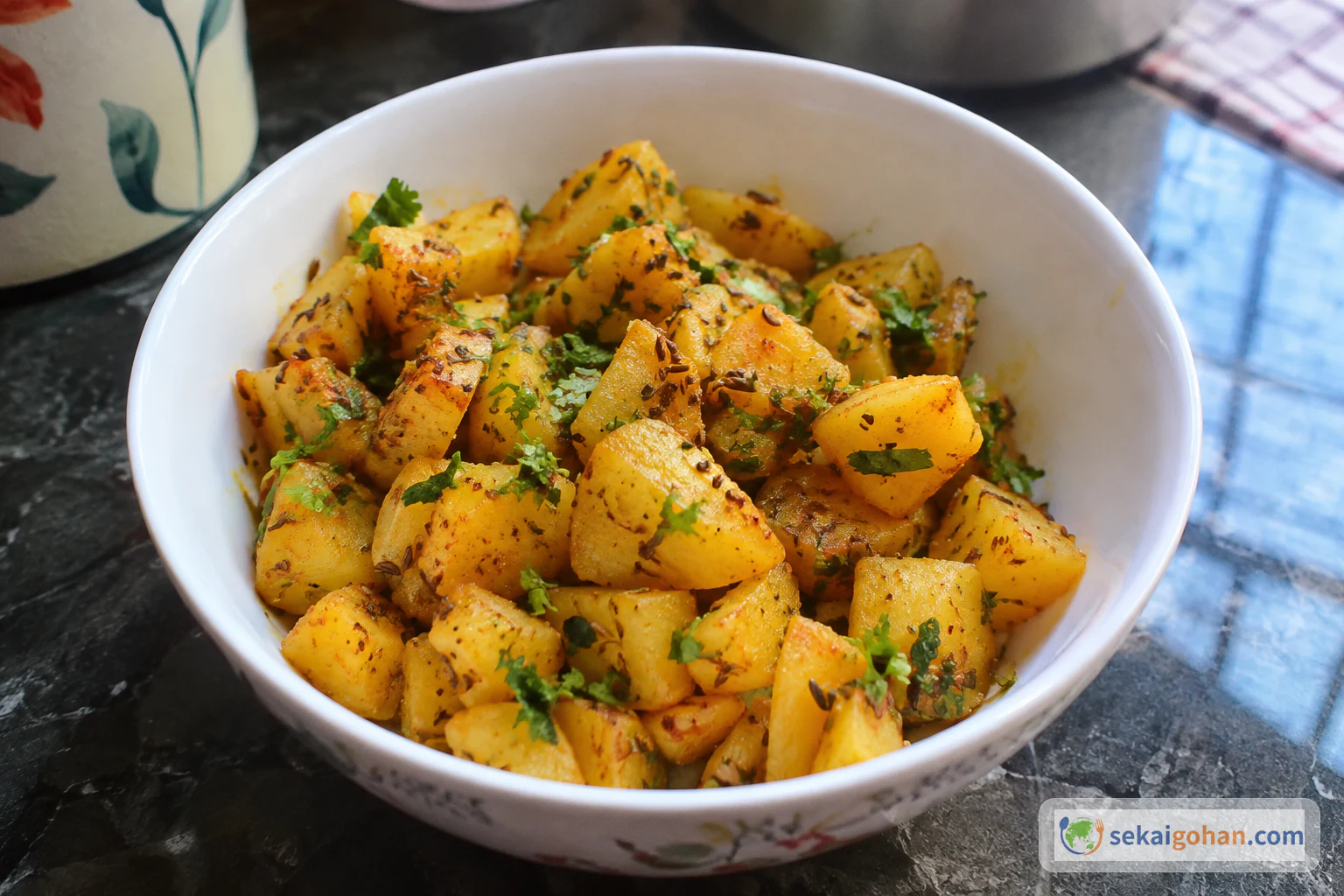
When the cumin hits the hot oil and starts to pop, a pan of plain potatoes starts to smell like somewhere else. Cauliflower is easy to pass by at the evening supermarket. Some days it costs more than broccoli, and a whole head eats up refrigerator space. But put a potato next to it and add a little cumin and turmeric, and an ordinary vegetable stir-fry becomes a North Indian home dish. Aloo gobi (आलू गोभी / Aloo Gobi, Aloo Gobhi) should come out with fluffy potato, cauliflower that holds its shape, and a light coat of cumin, coriander and turmeric on every piece.

About Aloo Gobi, a Punjabi Sabzi

The name is simple: "aloo" means potato and "gobi" means cauliflower, so the Hindi आलू गोभी translates literally as "potato, cauliflower." It is spelled many ways in Latin letters. Aloo gobi is a vegetable sabzi eaten across the Indian subcontinent and is especially linked with North India and the Punjab. Restaurants sometimes serve it as a curry, but at home it is more often a dry stir-fry with the moisture cooked off.
No single version is the right one. Some households add onion and tomato. Others leave them out and finish lightly with only cumin, ginger and turmeric. The traditional form is dry, without sauce, but semi-dry and gravy versions are aloo gobi too. How much liquid it has depends on the household, the region and the meal.
| Style | Character | When it suits a home cook |
|---|---|---|
| Dry sabzi | Little moisture. Goes with roti and lunch boxes | A weekday side dish, make-ahead |
| Semi-dry | A little tomato clings. Also goes with rice | Leans toward a dinner main |
| Gravy | A rich sauce of onion, tomato, cashews, and so on | Guests, days you serve it with naan |
| Oven-assisted | Roast the vegetables first, then toss with spices | Days you want to avoid wateriness |
At home, aloo gobi is usually the vegetable plate next to the roti, not a curry in the middle of the table. It has so little liquid that it packs easily into a lunch box, and the spices still smell good when it's cold. It also cooks much faster than a bean dish like chana masala, with no long simmering. The key fact about cooking it is that potato and cauliflower cook at different speeds, and if they go into the pan together, one of them falls apart. In the Punjabi style, the cumin, ginger, ground spices and potato go in first, and the cauliflower follows.
Ingredients (serves 4): Cauliflower Is the Star, Supported by Potato

Serves 4. For a main dish, add roti or naan, basmati rice, and raita and it becomes dinner. As a side dish, half this amount is enough.
Basic aloo gobi can be made without animal products, wheat, or dairy. However, some store-bought garam masala, curry powder, naan, and frozen roti contain wheat, dairy, or nuts. Check labels when buying.
Ingredients and tools for this dish
Cumin seeds are the first signal that sets the aroma of aloo gobi. You can make it with ground cumin alone, but the aroma of whole cumin popped in oil is a different thing, so if you plan to keep cooking Indian food, it is worth buying first.
Ground coriander builds a rounded aroma that supports the sweetness of the vegetables, not the flashiness of curry powder. It can be reused in aloo gobi, chana masala, and khichdi.
Amchur is the sourness of dried mango. Lemon can substitute, but since a powder adds sourness without adding moisture, it has the advantage of keeping make-ahead aloo gobi from turning watery.
A deep frying pan or wok makes it easier to spread out and sear the cauliflower. Crowded into a small pot, it steams easily and the aloo gobi turns mushy.
For the first time, "cauliflower, potatoes, cumin seeds, coriander, turmeric, and garam masala" are enough. Add amchur and kasuri methi from the second time on if you want to move closer to the real thing.
Choosing Ingredients and Substitutes for Aloo Gobi
With so few ingredients, it's clear which ones to keep and which ones you can swap. At an ordinary supermarket, the two things to watch are how wet the cauliflower is and how the spices are built.
| Ingredient or step in doubt | Closer to the real thing | Realistic home choice | Effect on the dish |
|---|---|---|---|
| Cauliflower | Fresh whole head | Frozen cauliflower | Frozen releases moisture, so sear strongly before covering |
| Potato | A variety that holds its shape | Waxy potato, or floury in larger pieces | Floury collapses easily, but takes on flavor well |
| Acidity | Amchur | Lemon, lime, or a little ume plum vinegar | Without acidity, the potato feels heavy |
| Aroma | Cumin seeds, kasuri methi | Cumin seeds alone are fine | Whole cumin is hard to replace |
| Heat | Green chili, Kashmiri chili | A little chili flakes, paprika plus cayenne | Color and heat can be adjusted separately |
| Moisture | Dry sabzi | Semi-dry with a little tomato | On days you pair it with rice, a little moisture is easier to eat |
The one step with no substitute is warming whole cumin in oil. Curry powder shaken over at the end leaves a floury coating on the vegetables, while cumin popped in oil gives the same vegetables a completely different aroma.
Cauliflower is easiest to work with in season, from winter to early spring. In summer, when it's expensive, frozen works fine, and you can also replace just half of it with frozen. Frozen cauliflower gives off water as it thaws, so put it into the pan still frozen. Cook off the surface moisture over medium-high heat with no lid, then turn the heat down to low. It ends up softer than fresh, so stir it less, and cut the potato smaller and give it a head start.
Lemon is enough the first time you make it. For make-ahead meals or lunch boxes, though, amchur is worth buying. It's a powdered sourness that sharpens the flavor without adding moisture, and you can also use it in chana masala, samosa and chaat-type dishes.
If you have no coriander, cumin, or turmeric, you can make it with 2 tsp curry powder. But curry powder mixes many spices, so it leans toward a Japanese-style curry flavor more than aloo gobi. Adding only cumin seeds separately brings back the Indian feel, and lemon at the end keeps it from getting heavy.
Method: Potato First, and Don't Over-Steam the Cauliflower
The steps for aloo gobi are short, but get the order wrong and it falls apart at once. Potato takes time to cook through, and cauliflower becomes too soft once it releases water. To close that gap, move the potato halfway first and add the cauliflower afterward.
duration: 7 min

Break the cauliflower into 3–4 cm florets and halve any large ones. Washing alone uses no heat. If you are concerned about insects or dirt, dip it for only 2 minutes in boiling water at a full boil, spread it in a colander, and drain well until the steam clears. If the surface stays wet, it steams in the pan and loses toastiness. Keeping the thickness to the core of each floret even makes it easier to match the potato later.
2. Cut the potatoes and soak in water
duration: 6 min

Peel the potatoes and cut into 1 inches (2.5 cm) cubes. No heat is used; soak in water just 5 minutes to rinse off surface starch, drain in a colander, and pat dry with a towel or paper. There is no need to soak long. Drying the surface before cooking over medium heat later keeps the oil from spattering and lets the ground spices coat thinly. A waxy potato keeps its shape, and a floury one has slightly collapsed corners that take on flavor more easily.
3. Pop the cumin in oil
duration: 2 min

Put 3 tbsp oil in a deep frying pan and warm over medium heat for 40–60 seconds. Add 1 tsp cumin seeds, and when fine bubbles appear and the aroma rises, add the ginger, garlic, and green chili and cook 30 seconds. If the cumin starts to turn black, the heat is too high; lower it to low at once. Go on when the moisture from the aromatics touches the oil and spatters lightly, and the smell has changed from green to sweet.
4. Cook the potatoes first
duration: 10 min

Add the potatoes and coat them in the oil over medium heat. Add 1/2 tsp turmeric, 1 tsp coriander, and a pinch of salt; when the floury look disappears and yellow oil has thinly coated everything, cover and cook 8–10 minutes over medium-low heat. Turn from the bottom about twice along the way, and if the bottom dries and threatens to scorch, add only 1 tbsp water. You don't need to cook them through completely here; a skewer that goes in with a little resistance is enough. When the corners start to look slightly translucent, they are ready to receive the cauliflower.
5. Add the cauliflower and sear
duration: 5 min

Add the cauliflower and sprinkle with the remaining 1 tsp coriander, 1/2 tsp ground cumin, and the chili powder. For the first 3 minutes, leave the lid off and sear the surface over medium heat, turning now and then. Mixing too much chips the florets, so lifting and turning with a spatula is enough. When there is a light browning at the edges, the cauliflower is thinly coated in yellow oil, and the floury look is gone and the oil has blended in, the base of the aroma is built.
6. Cover and cook through
duration: 10 min

Cover and steam-cook 8–10 minutes over low heat. Turn from the bottom every 2–3 minutes, and if it threatens to scorch, add 1 tbsp water from the side of the pan. Too much water turns it into a simmered dish, not a sabzi, so add the minimum. Aim for a potato a skewer slides into easily, and cauliflower that breaks softly when bitten but keeps its shape. If water has pooled at the bottom, remove the lid and drive it off over medium heat for 1–2 minutes.
7. Finish with tomato, garam masala, and acidity
duration: 5 min

For the semi-dry version, add the tomato chopped into 0.5 inches (1 cm) pieces and cook only 2–3 minutes over medium heat. When the corners of the tomato have broken down a little and no moisture pools at the bottom, lower to low and add 1 tsp garam masala, 1 tsp kasuri methi, and 1 tsp amchur. Turn off the heat when the aroma of the powder rises. If you have no amchur, turn off the heat and stir in 1 tbsp lemon juice, adjust the salt, and scatter cilantro to finish. It is ready to eat when, on the plate, no water runs out of the vegetables and a thin film of spiced oil is left on the surface.
Common Aloo Gobi Problems and Fixes

Most aloo gobi failures come down to moisture and order. Three habits fix most of them: give the potato a head start, keep the cauliflower from collapsing, and add the acidity last. Don't add much water, don't over-stir, and don't scorch the ground spices.
| Problem | Cause | Fix |
|---|---|---|
| Watery | Moisture in the cauliflower, or the lid stayed on too long | Remove the lid and cook 5–8 minutes over medium heat to drive off the water |
| The potato is hard | Added at the same time as the cauliflower, or cut too large | Add 2 tbsp water, cover, and cook 5 more minutes over low heat |
| The cauliflower collapses | Cut too small, or stirred too much | Next time cut larger and turn it with the spatula fewer times |
| Floury | The ground spices haven't blended into the oil | Add 2 tsp oil and stir-fry 1 minute over low heat |
| Bitter | The ground spices or cumin scorched | Round it out with lemon, a little sugar, or a yogurt side |
| The flavor is dull | Not enough salt and acidity | Add 1/4 tsp salt and 1 tsp lemon juice at a time |
If the pan turns watery, don't reach for more ground spice. The powder soaks up the extra water and goes grainy. Take the lid off instead, spread the vegetables out and let the moisture cook away. When a toasty layer forms on the bottom of the pan, bring it back together with a little oil.
If the potato is still hard, turn the heat down to protect the cauliflower. High heat only breaks up the cauliflower while the potato stays firm. A splash of water and the lid will let the potato catch up on its own.
When the flavor won't come together, add acidity before you add more garam masala. Potato and cauliflower are both sweet vegetables, and amchur or lemon at the end sharpens them. It's the same reason raita and lemon onions are served with the tandoori chicken side dishes.
Serving Aloo Gobi
Aloo gobi with roti, dal and yogurt

Aloo gobi looks like a side dish, but with a staple and some beans it can anchor dinner. For a North Indian table, serve it with roti, dal and yogurt. At home, basmati rice, plain yogurt and a quick cucumber raita are plenty.
On a weekday, aloo gobi, frozen naan and raita make a three-item dinner. The yogurt balances the heaviness of the potato, and the cumin brings out the cauliflower's aroma. For something more filling, add a little chana masala for a meal of beans and vegetables. It also works as the vegetable plate on a samosa day.

For a weekend Indian spread, tandoori chicken, aloo gobi, raita and jeera rice are an easy combination. The red chicken, white raita and yellow aloo gobi side by side brighten the table right away.
| Occasion | Staple | Served alongside | A word |
|---|---|---|---|
| Weekday dinner | Frozen naan, roti | Raita, onion | Few dishes to wash, and you get vegetables |
| Lunch box | Rice, chapati | Boiled egg, cucumber | A dry sabzi with little liquid suits it |
| Weekend Indian menu | Jeera rice | Tandoori chicken, raita | Becomes the vegetable plate beside the meat dish |
| A meatless day | Basmati rice | Chana masala, dal | Beans and vegetables build satisfaction |
Aloo gobi on a South Asian table

In the Indian cuisine overview, aloo gobi is the everyday vegetable plate. It doesn't have the feast feel of biryani or the calm of khichdi. Familiar potato and cauliflower make spice cooking easy enough for a weeknight.
For a fuller South Asian spread, put it next to khichdi, a gentle dish of rice and beans, fragrant biryani, or Nepal's set-meal-style dal bhat. With guests, serve momo as a starter and Pakistan's nihari (in Japanese) in a separate pot for anyone who likes heat. Aloo gobi then becomes the welcome vegetable plate.
Next to its neighbors, aloo gobi is clearly the light one. Bangladesh's ilish bhuna leads with fish and mustard, and Bhutan's ema datshi is all chili and cheese. Sri Lanka's kottu is fun right down to the clatter of the griddle, which shows how differently "stir-frying" works even within South Asia.
Aloo gobi beyond South Asia
Heading toward Southeast Asia, Malaysia's roti canai and nasi lemak link to the food culture of Indian immigrants. Then try Indonesia's mie goreng and sambal substitute, Thailand's tom yum goong, pad thai and gapao, and Laos's laab. They're all hot and aromatic, but each uses acidity, fermentation and herbs in its own way.
Middle Eastern vegetable plates are an interesting comparison too. Hummus, falafel and tabbouleh get their lightness from beans and herbs, and shawarma pairs meat with acidity. If you'd like to compare kinds of heat, China's mapo tofu and Korea's bibimbap handle oil, fermented seasonings and vegetables differently. Aloo gobi is far plainer than any of them, which is exactly why it makes such an easy weekday side.
Storing Aloo Gobi and Using Leftovers

Aloo gobi keeps in the refrigerator for about 2–3 days. Let it cool slightly, spread it in a shallow container and refrigerate. The potato firms up a little in the cold, so reheat it in a frying pan with a little oil rather than a lot of water, and the aroma comes back.
You can freeze it, but the cauliflower turns somewhat softer. If you plan to freeze it, cook it a little firmer to begin with and freeze it flat in single portions. It releases water as it thaws, so don't stop at the microwave. Finish it in a frying pan to cook off the moisture.
My favorite use for leftovers is an aloo gobi sandwich. Lightly mash the warmed aloo gobi, tuck it into sliced bread or pita, and add yogurt, lemon and thinly sliced onion. The fluffy potato becomes the filling, and you can still taste the cauliflower. For fried rice, stir-fry a little oil, a little cumin, the leftovers and warm rice in a frying pan, then finish with lemon and cilantro for an easy aloo gobi–flavored pulao. It makes a good next-day lunch.
Potato dishes take a long time for the center to cool. Don't leave them at room temperature for long; refrigerate promptly once they have cooled slightly. When reheating, heat thoroughly to the center, and don't eat it if there is an odor or sliminess.
Aloo Gobi Variations

Make the basic dry sabzi the first time, then adjust it to the meal. For stuffing into roti, cut back the liquid. To serve over rice, let a little tomato coat the vegetables. For guests and naan, use more onion and tomato for a richer dish. Decide beforehand whether it's for a lunch box, a side for meat or the main dish, and you'll know how much moisture to leave.
| The table you are finishing for | Suitable variation | What to adjust |
|---|---|---|
| Lunch box, make-ahead | Dry sabzi without tomato | Don't add water; tighten with amchur at the end |
| Dinner over rice | Semi-dry with tomato | Add a little tomato and let a thin sauce cling |
| A weekend eaten with naan | A rich version with more onion | Strengthen the ginger, garlic, and garam masala a little |
| A day children also eat | With green peas | Leave out chili and serve lemon on the side |
| A day you want less oil | Oven-assisted | Roast the vegetables first and reduce the oil in the pan |
Dry aloo gobi without tomato
Leave out the tomato and finish with only ginger, cumin, turmeric, coriander and garam masala. This is the driest form and the best one for roti and lunch boxes. It puts the cauliflower first, so make it when you have a good in-season head.
Semi-dry aloo gobi with tomato
Stir in a little chopped tomato at the end so it coats the potato and cauliflower thinly. This version goes well with rice and with frozen naan. If you use canned tomatoes, start with about 3 tbsp, because too much turns it into a vegetable curry.
Aloo gobi matar with green peas
A handful of frozen green peas added at the end brings it close to aloo gobi matar. Matar means peas, and they add sweetness and color. It's an easy version for days when you tone down the heat for children.
Oven-assisted roasted aloo gobi
Toss the potato and cauliflower with oil and salt, roast 20–25 minutes in a 425°F (220°C) oven, then combine with the spices in the frying pan. Roasting first keeps the dish from turning watery or oily. It's a good weekend option when the oven is free, and handy for making ahead before guests arrive.
Jain-style aloo gobi without onion or garlic
This light version uses cumin, ginger, turmeric, coriander and green chili, with no onion or garlic. The aroma is simpler and the vegetables come through more. Next to a meat dish at dinner, some days this lighter version suits better.
FAQ

Q1. Should I parboil the cauliflower?
It isn't essential. If you're worried about insects or dirt, dip it in boiling water for only 2 minutes and drain. Longer boiling makes it too soft, and it falls apart in the pan. Draining it well matters more than parboiling.
Q2. Can I make it without heat?
Yes. Leave out the green chili and chili powder and use a little paprika just for color. Cumin, coriander, turmeric, garam masala and lemon still make it taste like aloo gobi.
Q3. Can I microwave the potato first?
On a rushed day, yes. Put the cut potato in a heatproof dish, cover loosely with plastic wrap and microwave 3–4 minutes at 600 W. Stop when it's half-cooked, because softer potato falls apart in the pan. Let the surface moisture cook off before you stir-fry.
Sources
For the names of aloo gobi, the difference between dry sabzi and gravy, the order of adding potato and cauliflower, how to add acidity, and ways to avoid wateriness, we consulted English-language and Indian cooking media and reorganized the material for home cooking.
- Swasthi's Recipes, "Aloo Gobi Recipe" https://www.indianhealthyrecipes.com/aloo-gobi-recipe/
- BBC Good Food, "Punjabi cauliflower with potatoes (aloo gobi)" https://www.bbcgoodfood.com/recipes/punjabi-cauliflower-with-potatoes-aloo-gobi
- Dassana's Veg Recipes, "Aloo Gobi Recipe (Restaurant Style Curry)" https://www.vegrecipesofindia.com/aloo-gobi-recipe-punjabialoo-gobi/
- Bon Appetit / Priya Krishna, "The Sneaky, Easy Trick to My Mom's Perfect Aloo Gobi" https://www.bonappetit.com/story/roasted-aloo-gobi
- Wikibooks, "Cookbook: Potato and Cauliflower Curry (Aloo Gobi)" https://en.wikibooks.org/wiki/Cookbook:Potato_and_Cauliflower_Curry_%28Aloo_Gobi%29
- Wikimedia Commons, "Category:Aloo gobi" https://commons.wikimedia.org/wiki/Category:Aloo_gobi
- Sekai Gohan Kikō, "Indian cuisine overview" /en/recipes/south-asia/overview/indian-cuisine