Winter on the Mongolian plateau, minus 30 degrees. Inside the ger (the portable home), the whole family sits around a low round table, biting into steamed dumplings held in their hands, and the moment a wrapper tears, hot juices gush out and white steam rises. These are buuz (Buuz / Бууз), Mongolia's national steamed dumpling: lamb or mutton and onion wrapped in wheat dough and steamed. They look a lot like xiaolongbao or a steamed pork bun, but they are made with 100% lamb. The meat of sheep grazed on the Mongolian steppe has a flavor on a different level from lamb or mutton sold elsewhere.
About buuz, Mongolia's steamed lamb dumplings
The name means "something steamed" and is etymologically connected to the Tibetan "momo" and the Chinese "baozi." Buuz belong to the steamed-dumpling culture that stretches from Central Asia to East Asia. In English you'll see them called "Mongolian Steamed Dumplings" or simply "Buuz." Their signature shape is wrapped with a small hole at the top, and the steam from the juices rises through it as they cook.
Lamb and life on the steppe
For thousands of years the nomads of the Mongolian plateau have raised the five animals (horses, cattle, sheep, goats and camels) and lived mainly on their milk and meat. High-calorie lamb was an important source of energy for getting through the bitter winters, so it was natural for meat-heavy dishes like buuz to develop.

The climate shaped buuz in a practical way, too. In winter temperatures of minus 30 to 40 degrees, buuz keep just by being laid out outdoors, a natural freezer, and need only to be steamed again before eating. That convenience as a preserved food is one of the important reasons buuz became Mongolia's national dish.
Where buuz came from
There are two main theories about the direct origin of buuz. The first runs through Tibet: the method of making the Tibetan steamed dumpling momo likely traveled with monks and merchants in the 16th to 17th centuries, when Tibetan Buddhism spread in Mongolia, and merged with Mongolia's lamb culture. Some linguists also link the word "buuz" to the Tibetan "mog mog."
The second theory runs through China. It holds that the Chinese baozi was brought to Mongolia in the Yuan dynasty (1271–1368), when many Chinese cooks worked at Kublai Khan's court and Chinese steaming techniques likely entered Mongolian cooking. The similar sound of "Buuz" and "Baozi" supports this view. Dishes often spread this way, through rule and trade routes, as with feijoada.
Buuz in Ulaanbaatar today
Around the capital Ulaanbaatar you'll find "buuz shops" (Buuzny Gazar / Буузны Газар), a part of everyday casual eating out. Many people also buy frozen buuz to take home and steam. Just as koshari is Egypt's national fast food, buuz are the flavor of everyday Mongolian life.
Buuz at Tsagaan Sar
Buuz are eaten all year, but they matter most at Tsagaan Sar (Tsagaan Sar / Цагаан Сар), the Mongolian Lunar New Year. The name means "White Moon," and "white" symbolizes dairy, standing for abundance and purity. Like China's Spring Festival and Korea's Seollal, it is a lunisolar new year, so the date changes every year, falling from late January into February.
Before the holiday, each household prepares hundreds to over a thousand buuz. The whole family gathers in the kitchen to roll wrappers, fill them and steam them, and this "buuz prep" is itself an important family event at the end of the year. The more buuz there are, the deeper the hospitality.
On the first day, homes receive visitors. Guests are first served milk tea (suutei tsai / Сүүтэй Цай), then buuz, steaming hot, alongside aaruul (dried curd) and ul boov (a stacked pastry). By custom the family elder takes the first buuz, and it is polite for a guest to finish at least one, since leaving buuz uneaten would mean refusing the hospitality.
Buuz and their neighbors
Buuz are one of many steamed and boiled dumplings found from East Asia to Central Asia and beyond.
| Dish | Country or region | Wrapper | Filling | Cooking |
|---|---|---|---|---|
| Buuz | Mongolia | Thick, hole at top | Lamb | Steamed |
| Momo | Tibet, Nepal | Somewhat thin | Water buffalo, yak | Steamed, fried |
| Manti | Uzbekistan, Turkey | Thick, large | Lamb + pumpkin | Steamed |
| Baozi | China | Leavened dough | Pork | Steamed |
| Xiaolongbao | China (Shanghai) | Very thin | Pork + gelatin soup | Steamed |
| Khinkali | Georgia | Thick, twist on top | Beef and pork, lamb | Boiled |
| Pierogi | Poland | Thick | Potato, cheese | Boiled, then fried |
Ingredients (serves 4, about 24 dumplings)

Lamb is becoming easier to find in many places, but ground lamb can be hard to come by. It is best to buy lamb shoulder or leg and chop it coarsely with a knife or grind it in a food processor. Mutton (meat from adult sheep) has a stronger flavor and is closer to the authentic taste, but if the gaminess bothers you, choose lamb. Halal butchers and well-stocked international grocers often carry ground lamb, and frozen ground lamb can also be bought online.
Choosing the meat and liquid for buuz
Lamb gives Mongolian buuz their distinctive flavor, so use it if you possibly can. Beef, pork, or a mix of ground beef and pork also work. Beef has little fat, so adding 1 tbsp neutral oil to the filling keeps it juicy. For the water in the filling, beef bone broth or chicken stock gives an even richer juice.
Instructions
Make the dough
First, prepare the wrapper dough. Buuz wrappers are thicker than Chinese dumpling wrappers and need a firm springiness. This thickness serves as the "vessel" that keeps the juices in when steamed.
Put the flour and salt in a bowl, and stir around with chopsticks while adding the boiling water a little at a time. When the dough starts to come together in crumbs, add the oil and bring it together by hand. Turn it out onto a work surface and knead for about 10 minutes until the surface is smooth. Wrap the kneaded dough in plastic wrap and rest it at room temperature for at least 30 minutes.
Using boiling water breaks down the flour's gluten just enough to make a stretchy, supple dough. Made with cold water, the dough turns stiff and tears easily when you wrap. But if you pour in water straight off the boil all at once, the dough lumps, so pour it in a little at a time as you mix.

Make the filling
Add minced onion, garlic, salt, black pepper and cumin to the ground lamb. The important thing here is to add "water." Mixing 2–3 tbsp of water into the filling lets soup collect inside when steamed, so the juices burst out the moment you bite in.
With chopsticks or your hand, mix in one direction until sticky. This "mixing in one direction" technique makes the meat's proteins tangle and bind, so the juices are less likely to escape when steamed. Overmixing makes the filling hard, so stop once it turns sticky.
Rest the mixed filling in the refrigerator for at least 30 minutes. Cold filling is easier to wrap and holds more juice when steamed.

Mongolian nomads use fresh lamb, so they do little to remove gaminess, but frozen lamb or mutton bought elsewhere can carry some. You can lessen it as follows: (1) use more onion (up to 1.5 is fine), (2) raise the cumin to 1 tsp, (3) add 1 tsp grated ginger, (4) add 1 tbsp of cooking wine. None of these changes takes the dish far from its authentic taste.
Wrap the buuz
The way to wrap buuz is distinctive. It resembles Chinese xiaolongbao or Georgian khinkali, but the Mongolian style is characterized by leaving a small hole at the top. Steam escapes through this hole and the steaming is more even.
How to eat: by hand, sipping the juice
The right way to eat buuz is a manner nurtured over years at the Mongolian table.
First, once you've taken a buuz to your plate, let it cool a little before picking it up by hand. If you bite in while it is hot, the juices can burn your mouth. Put your lips to the hole at the top and first sip the juice inside. This juice is the essence of buuz: a thick, hot soup concentrating the savor and fat of lamb. Then bite into the whole thing, wrapper included.
In Mongolia it is most common to eat them as they are, without soy sauce or dip, but at a table elsewhere, a dip of soy sauce and vinegar, or a touch of chili oil, is also delicious. More Mongolians are also eating them with ketchup.
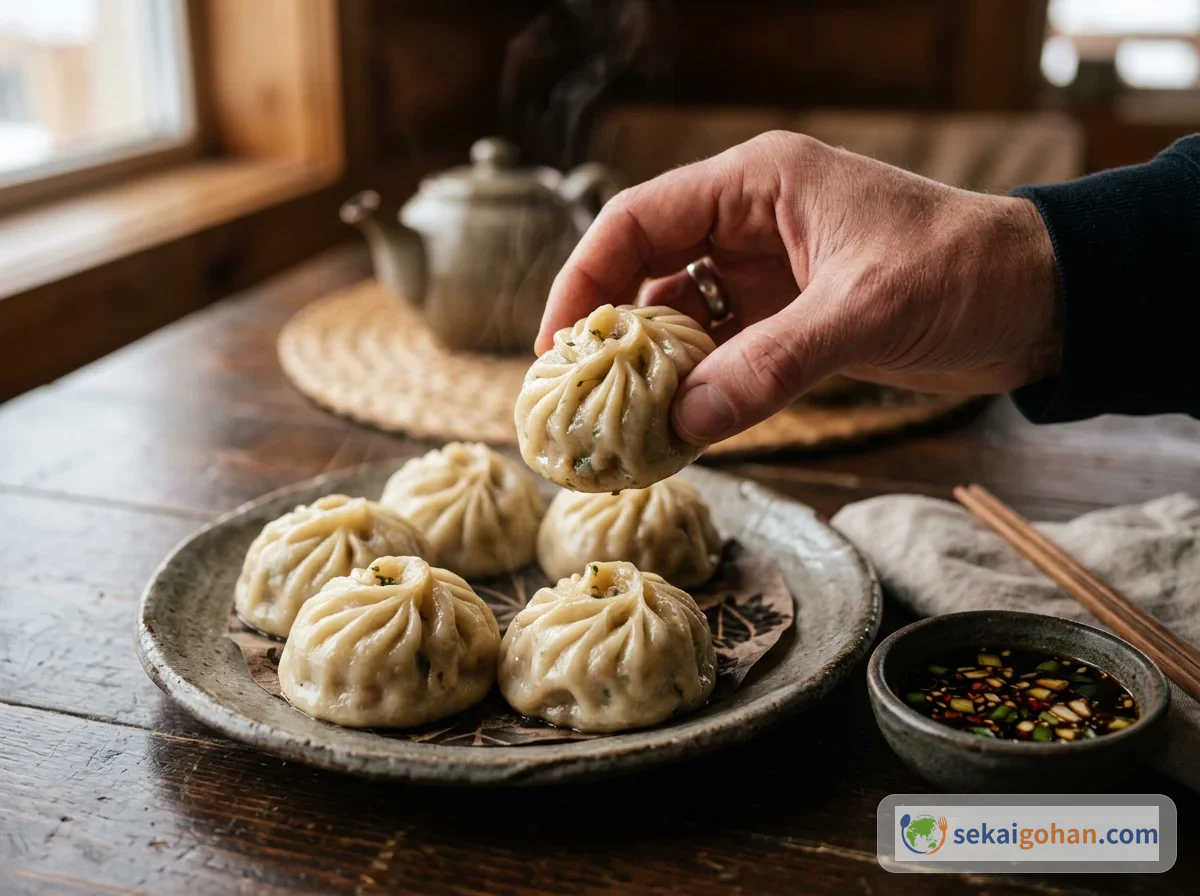
Freshly steamed buuz holds juices of nearly 212°F (100°C). As with Chinese xiaolongbao, on the first bite always sip just a little juice from the hole, check the heat, and then eat. When serving children, widen the hole with chopsticks to let the steam out and hand it over after cooling about 3 minutes.
Tips and fixes for juicy buuz
Water in the filling
The greatest pleasure of buuz is the juice that floods out the moment you bite in, and it comes from the 2–3 tbsp of water mixed into the filling. With too little water, the inside turns dry even after steaming and you end up with an ordinary steamed dumpling.
Wrapper thickness

Buuz wrappers are thicker than dumpling wrappers, but not evenly so. Roll them thicker in the center (the part that becomes the base) and thinner at the edge (the part that is pleated). A thin base tears under the weight of the juice and the soup leaks out. The easy trick: keep the pin off the center and roll only the edge, and the center ends up thicker on its own.
Pleats
Skilled Mongolian cooks gather 33 pleats in one buuz, but at home 8–12 are enough. With too few, the wrapping is loose and opens in the steamer. Aim for eight at first and add more as you get the hang of it.
Your first few won't wrap neatly, but they taste the same however awkward the shape. Even in Mongolian homes, lopsided buuz wrapped by helping children are an everyday sight on the table.
Steam and timing
Put the buuz in only when steam is billowing out through the gap in the lid. If the steam is weak, the dough turns sticky, clings to the steamer and tears when you lift the buuz out.
Steam for 15–18 minutes. When clear juice shows through the top hole, they're done; if it's still reddish, give them another 2–3 minutes. Don't go much longer than that, though, because oversteamed wrappers turn soggy and tear easily.
Buuz variations and storage
Mongolia has several siblings of buuz, all built on the same idea of wrapping lamb in wheat dough.
Khuushuur, fried buuz
Khuushuur uses nearly the same filling but is folded into a half-moon and fried, so you get a crisp outside and a juicy inside. At the Naadam festival (the national summer sports festival), khuushuur stalls line the grounds. For Mongolians, khuushuur is the "taste of summer" and buuz the "taste of winter."

Bansh, small boiled dumplings
Bansh are miniature buuz, about the size of a thumb tip, eaten in soup. They are an everyday food alongside tsuivan (Tsuivan / Цуйван) (stir-fried noodles), and a bowl of bansh is a kind of "Mongolian porridge" for when you have a cold or an upset stomach.
Freezing buuz

Buuz freeze very well, and a tray in your freezer does the job of the Mongolian winter outdoors.
Freezing steps:
- Arrange unsteamed buuz on a tray lined with parchment paper
- Leave space so the buuz don't touch each other
- Put in the freezer; the surface firms in 2–3 hours
- Once firm, move them to a freezer bag
- About 1 month in the freezer
To steam again: Put them in the steamer still frozen and steam 18–22 minutes. Skip thawing, and skip the microwave too, which turns the wrappers rubbery and sticky and the bottoms soggy.
Wrapping takes the most time. If your family wraps 50–60 on the weekend and freezes them, you can have authentic Mongolian food on a weekday in 20 minutes, the same idea as Mongolian households preparing great quantities before Tsagaan Sar.
Frequently asked questions
Q1. What if I don't have a steamer?
A frying pan can stand in. Line the pan with parchment paper, arrange the buuz, pour in about 0.5 inches (1 cm) of water, cover, and steam-fry over medium heat for 15 minutes. You get "pan-fried buuz" with a crisp bottom, close to Chinese pan-fried xiaolongbao (shengjianbao) and tasty in its own way. This also works for frozen buuz.
Q2. Is it okay to close the hole at the top?
You can, but without the hole you can't judge when they're done, and the inside may end up undercooked. The hole also lets steam circulate evenly and improves the wrapper's texture, so try the open wrapping first.
Q3. Can children eat it?
Yes. Halve the cumin and black pepper and the flavor is easy for children. The juice inside is very hot, though, so for small children widen the hole to let the steam out and let it cool 3–5 minutes before handing it over.
Sources
Books:
- Buell, P. D. & Anderson, E. N. (2010). A Soup for the Qan: Chinese Dietary Medicine of the Mongol Era. Brill Academic.
Reports and articles:
- Taste Atlas (2024). "Buuz - Traditional Mongolian Dumplings." Taste Atlas Encyclopedia.