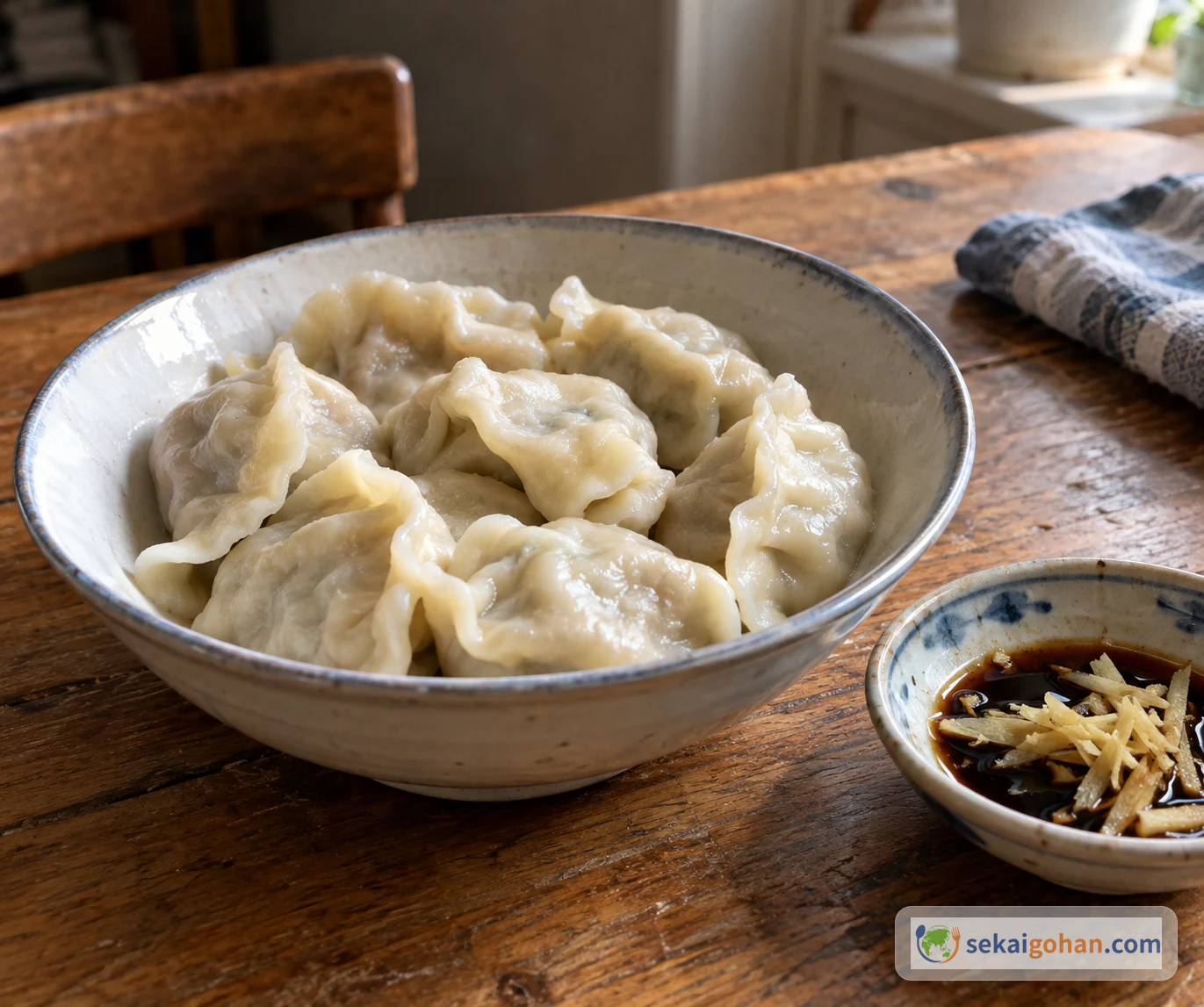
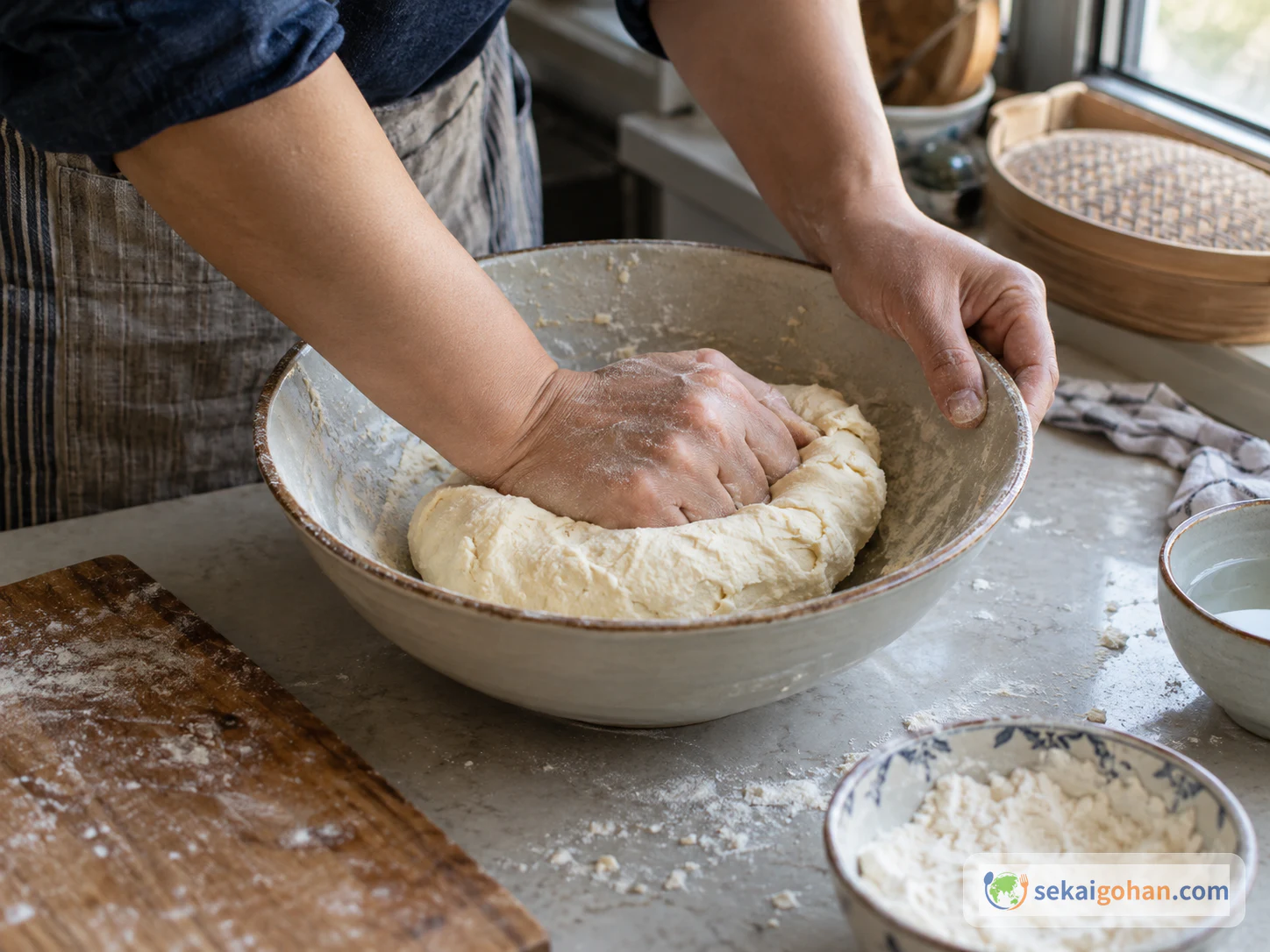
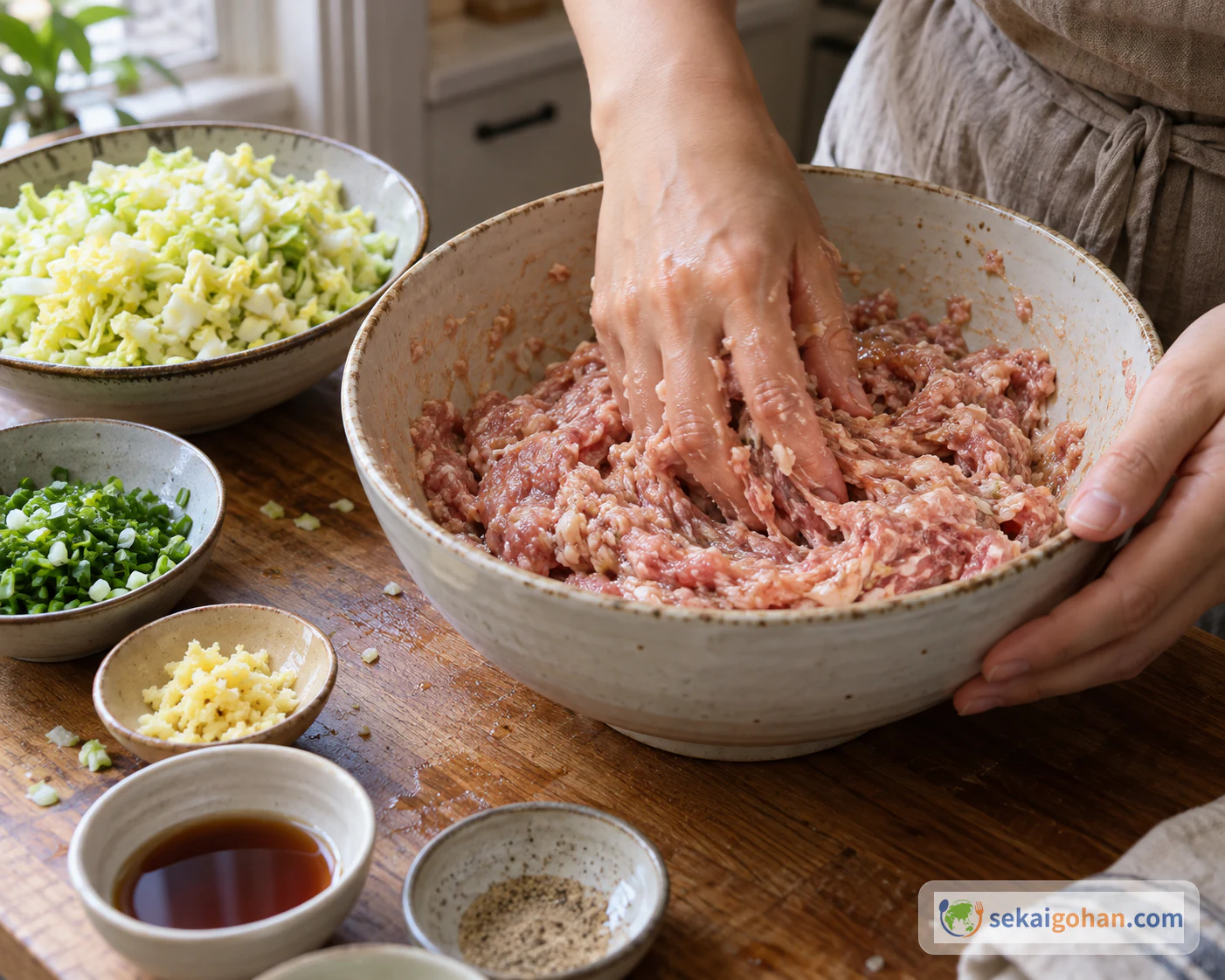
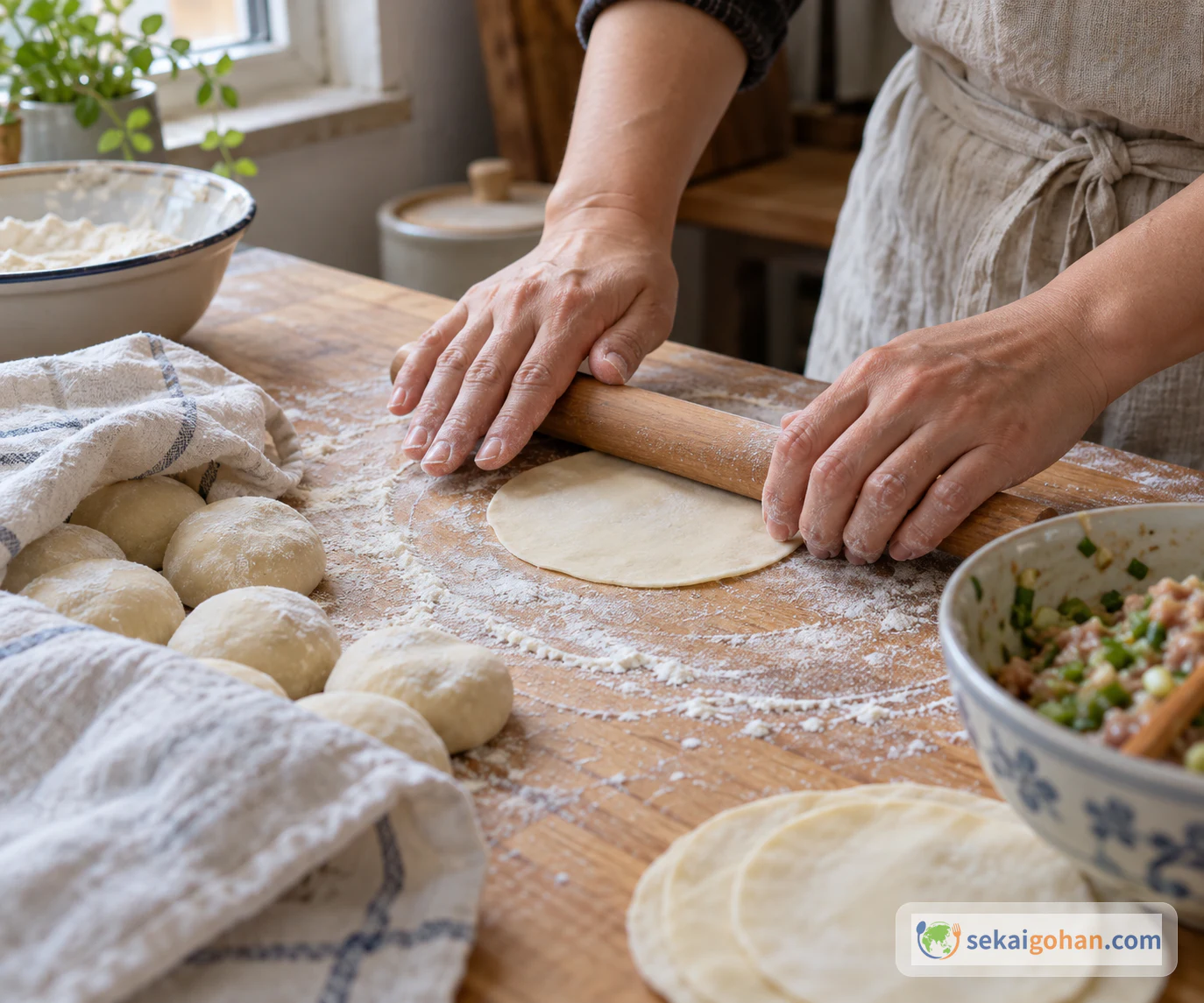
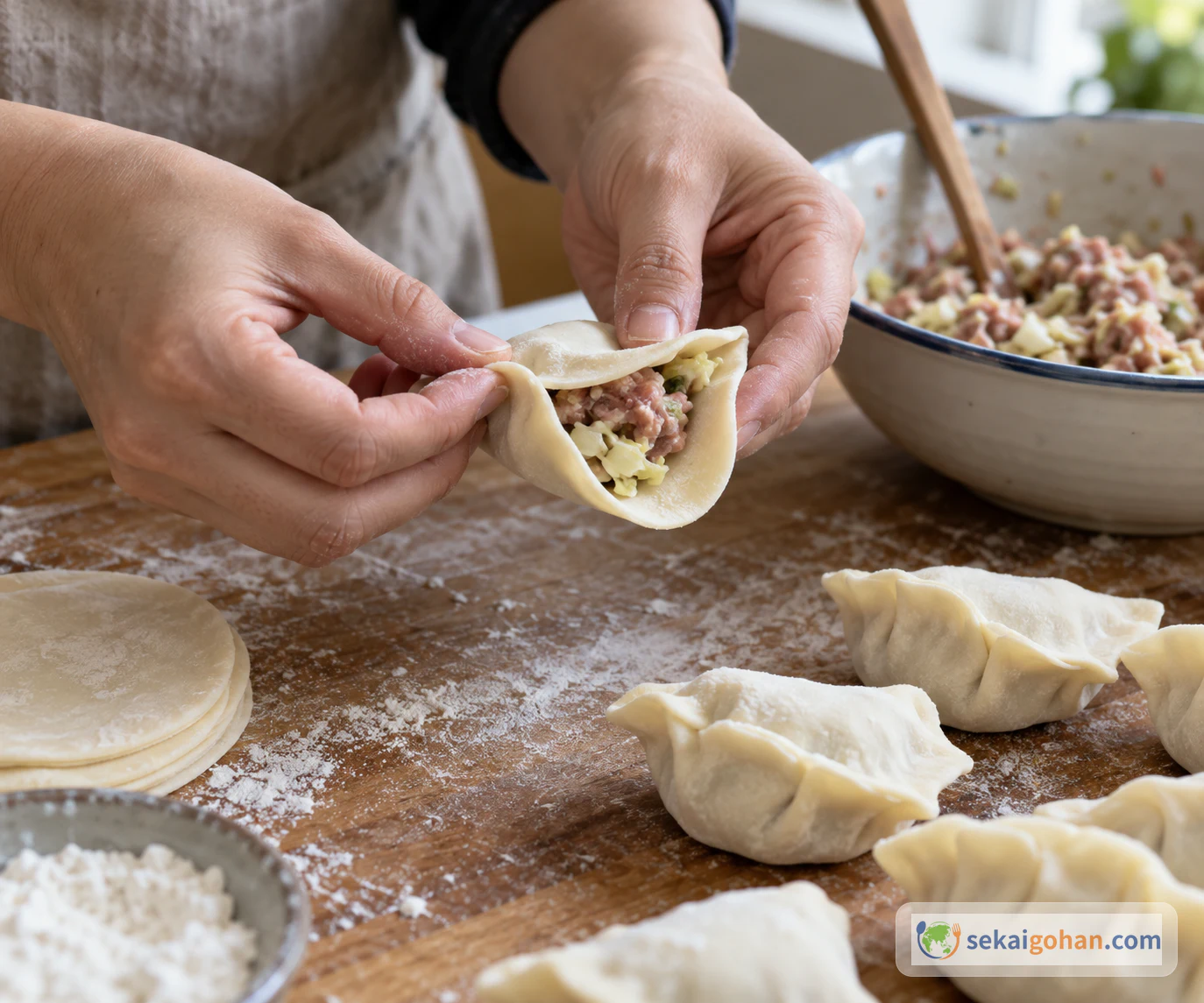
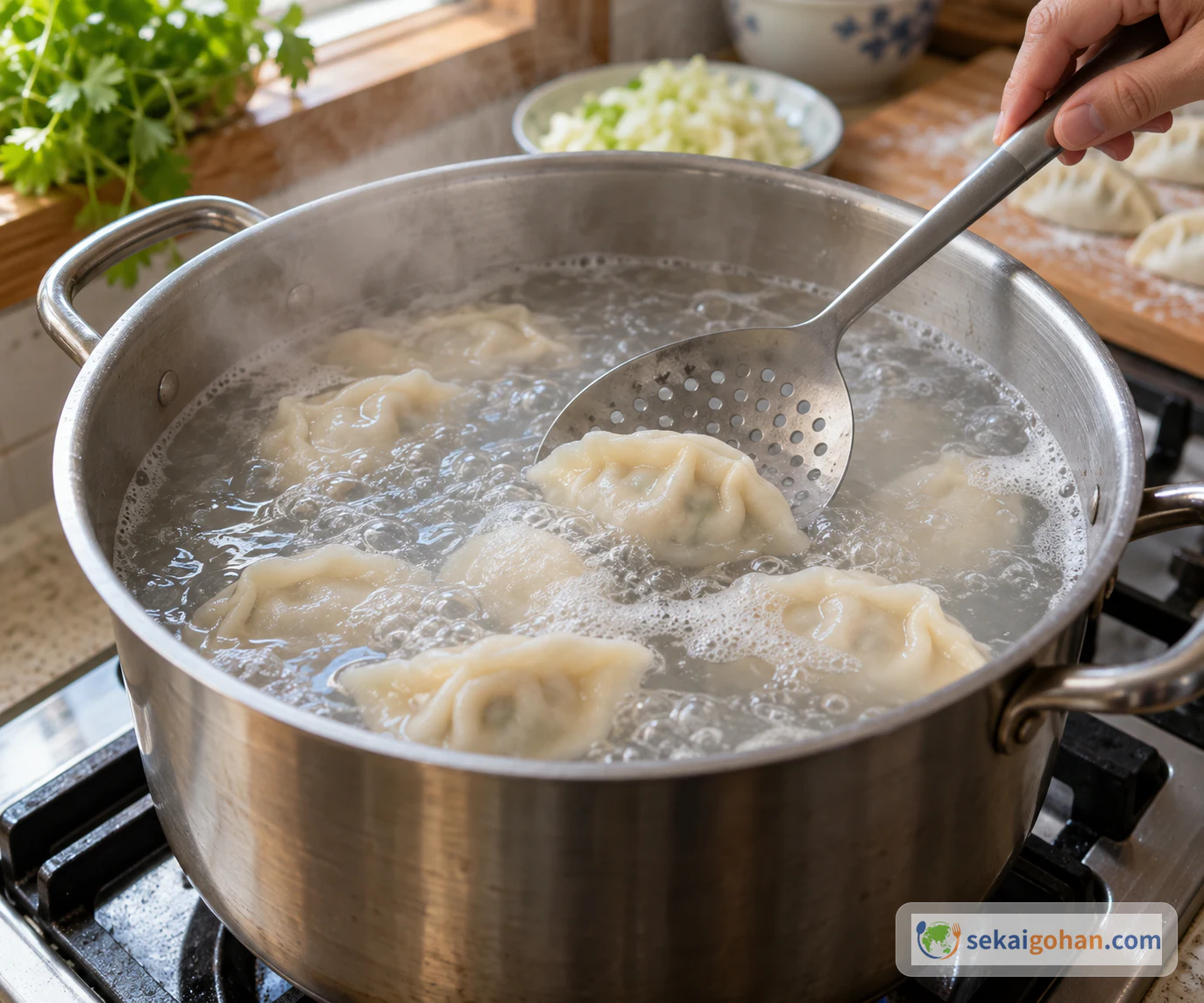
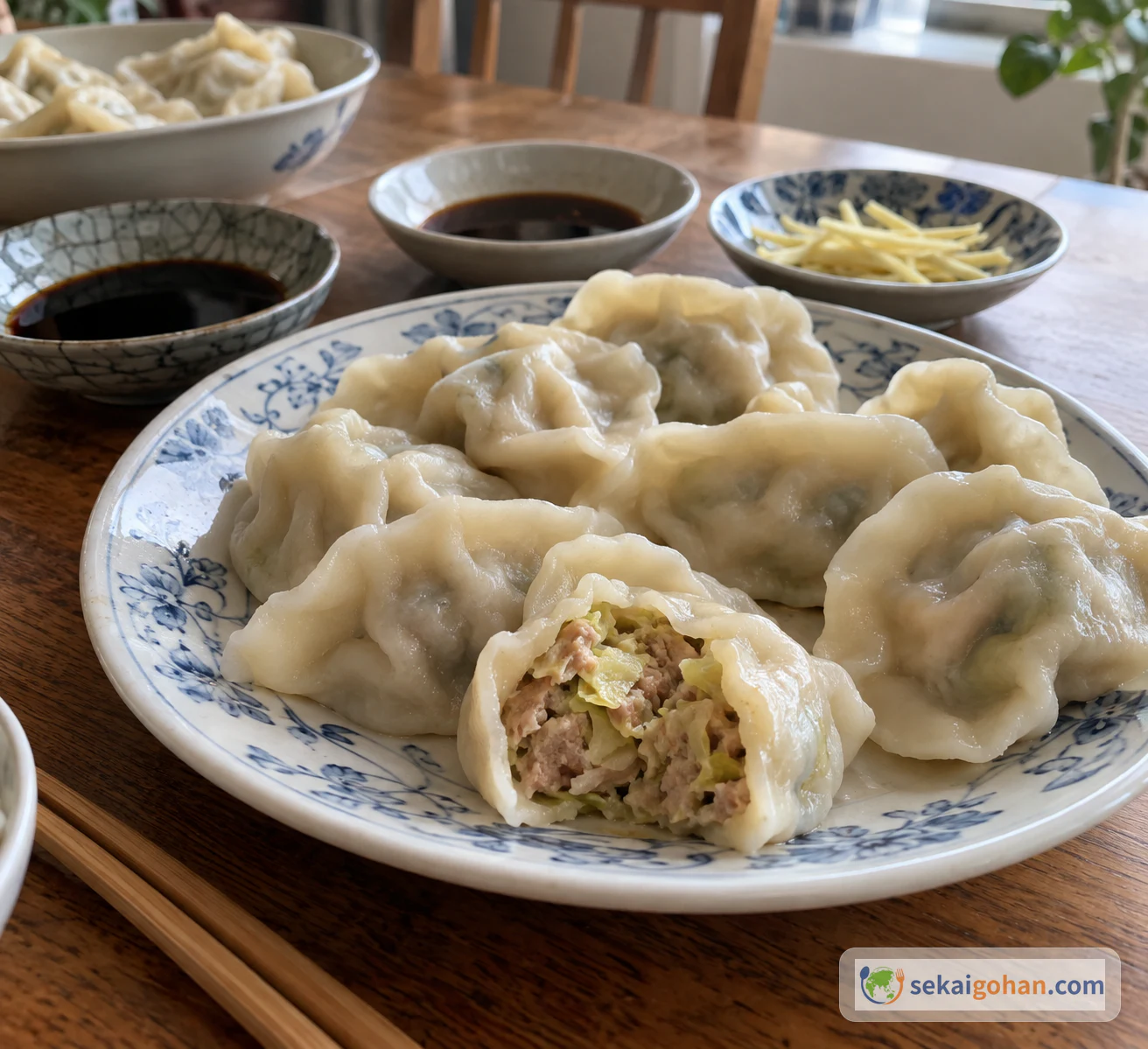
Around a big pot of boiling water, the dumplings go in a batch at a time and come out pale, soft and steaming. Before that comes the wrapping: a ball of rested dough is rolled into a log and cut into small pieces, and each piece is pressed flat, rolled into a round, filled with a spoonful of pork and cabbage, and pinched shut. These are northern-style boiled jiaozi (饺子, jiǎozi), known as shuijiao (水饺, shuǐjiǎo), from China. You want a soft, springy wheat wrapper around a juicy pork filling, with the gentle sweetness of napa cabbage and the scent of ginger and green onion, dipped lightly in black vinegar and soy sauce. A batch makes about 36 dumplings, enough for 4 people, and you can roll your own wrappers or use store-bought ones.
Northern Boiled Jiaozi
Jiaozi and Similar Dumplings
Jiaozi are dumplings made by wrapping a filling in a wheat dough wrapper, and cooks across China fill, wrap and cook them in their own ways. In the northern boiled style, the wrapper is rolled from a simple flour-and-water dough and the dumplings are cooked in plenty of boiling water. The Shanghai style differs in both wrapper and fold, with thinner wrappers gathered into pleats.
The same dumplings can be cooked three ways:
| Style | How it is cooked | Texture |
|---|---|---|
| Shuijiao (水饺) | Boiled in plenty of water | Soft, slippery wrapper all around. This recipe |
| Zhengjiao (蒸饺) | Steamed | Wrapper set by steam rather than water |
| Jianjiao (煎饺) / Guotie (锅贴) | Pan-fried | A browned, crisp surface on one side |
Boiled jiaozi have pale wrappers with no browned surface, which sets them apart from the pan-fried dumplings common in Japan.
A few neighboring dishes are easy to confuse with jiaozi. Xiaolongbao (小笼包) are steamed dumplings; the well-known Nanxiang version from Shanghai wraps pork and a jellied stock made from pork skin in a thin wrapper. Baozi (包子) are filled buns, and wontons (馄饨, húntun) and tangyuan (汤圆) are separate foods again. To compare the soup-filled steamed style, see xiaolongbao, and for a dumpling from another part of Asia, look at the wrapping and cooking of Nepal's momo.
Jiaozi at Spring Festival
Jiaozi belong to celebration and everyday cooking at once. They are a festive food for Spring Festival (Chinese New Year), and they are also something families make in a big batch and keep on hand for ordinary meals.
Several Spring Festival customs involve jiaozi:
- Timing. Families wrap jiaozi on New Year's Eve and eat them at zishi, the hour around midnight.
- The name. Jiaozi is connected with 交子 (jiāozǐ), as in the phrase 更岁交子 for the changeover of the year at that hour.
- The shape. Dumplings shaped like a yuanbao ingot are read as a sign of good fortune.
Local ways of eating them differ from place to place, and these are New Year customs and explanations rather than settled history of the dish.
Ingredients for About 36 Dumplings (About 4 Servings)
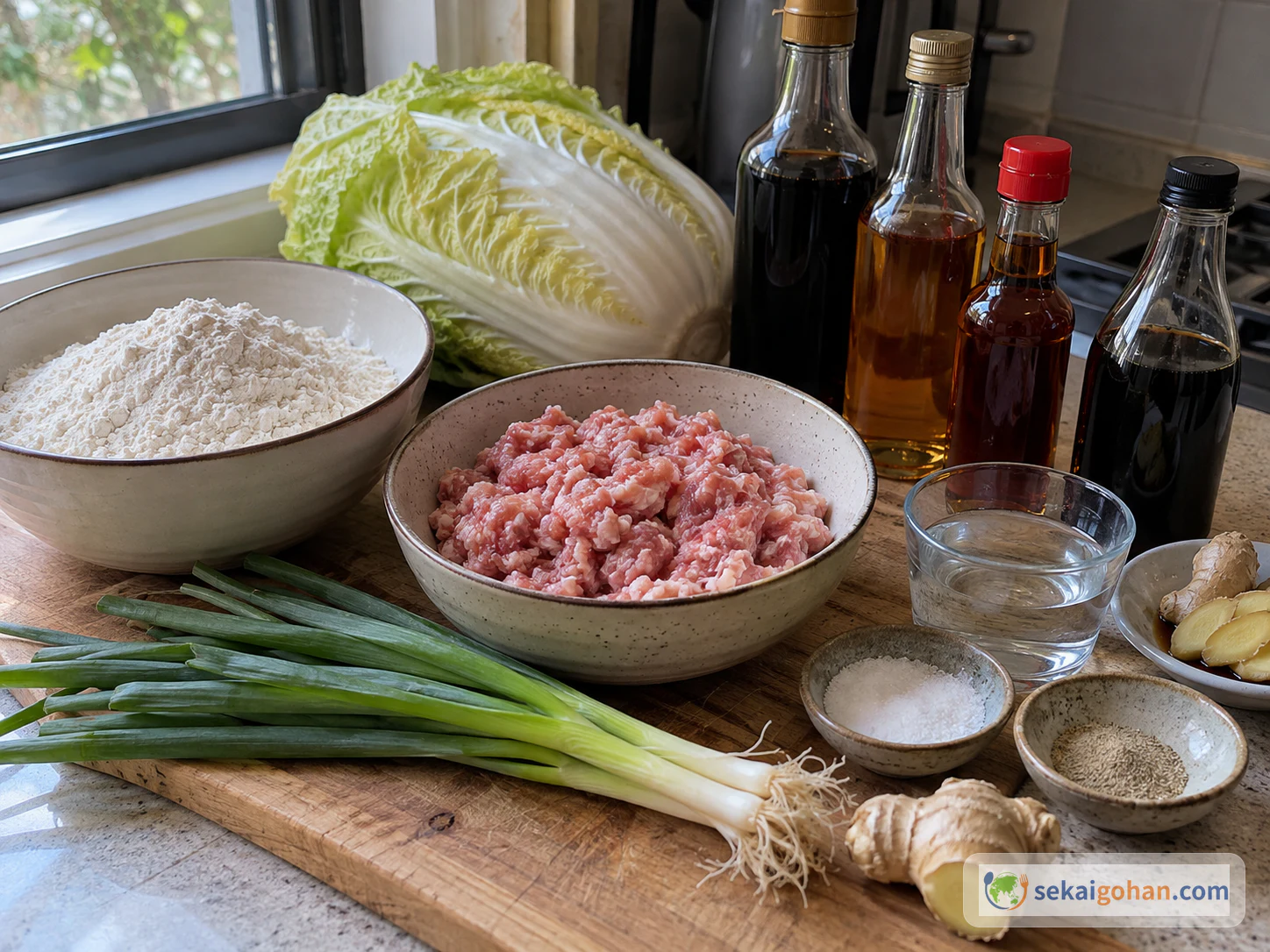
The count is about 36 dumplings. How thinly you roll the wrappers and how much filling you use changes the number. Use the water and salt amounts as starting points and adjust within the ranges given.
This recipe contains wheat, soy (soy sauce) and sesame. Also check the labels on Shaoxing wine and dipping-sauce ingredients. The filling contains raw pork. Use separate cutting boards and utensils for raw meat and for food that will not be cooked. Never taste the raw filling.
Choosing Jiaozi Ingredients
Flour. All-purpose flour is the base. Equal amounts of bread flour and cake flour also work, though the dough turns out more elastic. Brand and humidity change how much water flour takes, so judge the dough by feel rather than pouring in a fixed amount.
Napa cabbage. Napa cabbage is also sold as Chinese cabbage, and any from an ordinary supermarket works. For the rest of the filling, keep in mind that very lean pork makes a drier filling, and that Chinese green onions and long onions such as Japanese negi differ in thickness, so adjust the amount by taste.
Soy sauce. Chinese light soy sauce (生抽, shēngchōu) differs from both Japanese dark (koikuchi) and Japanese light-colored (usukuchi) soy sauce. With Japanese-style dark soy sauce, the color and saltiness come out stronger, so start with 2 tsp (10 ml). To check the seasoning, cook a small piece of filling all the way through to the center and taste that. Never taste the filling raw.
Shaoxing wine, sesame oil and black vinegar. Shaoxing wine is optional; dry sherry can stand in, though its aroma is different. Any toasted sesame oil will do, but it's strong, so stay within the listed amount. Chinese black vinegar is the one item worth seeking out at an Asian grocer. Rice vinegar works for the dip, with a different aroma and color.
Equipment
- Rolling pin, for rolling wrappers evenly
- Round cutter about 3 inches (8 cm) across (optional, for perfectly even wrappers)
- Damp cloth or plastic wrap, to keep dough and wrappers from drying out
- Tray dusted with flour, for the wrapped dumplings
- Large pot
- Slotted spoon, for lifting dumplings out without breaking them
- Food thermometer, for checking the center of the filling
Method: Pork and Napa Cabbage Boiled Jiaozi
Floating dumplings and translucent wrappers are signs that cooking is progressing. They do not prove the pork is done. The filling should reach 167°F (75°C) at the center and stay there for at least 1 minute.
Jiaozi Troubleshooting
| Problem | Likely cause | What to do |
|---|---|---|
| Wrapper edges dry out and crack | Dough left uncovered | Roll out small batches and keep the rest under a damp cloth or plastic wrap |
| Seams open | Flour, filling or moisture on the edge; too much filling; trapped air | Keep the rim clean, use less filling, press out the air and pinch firmly |
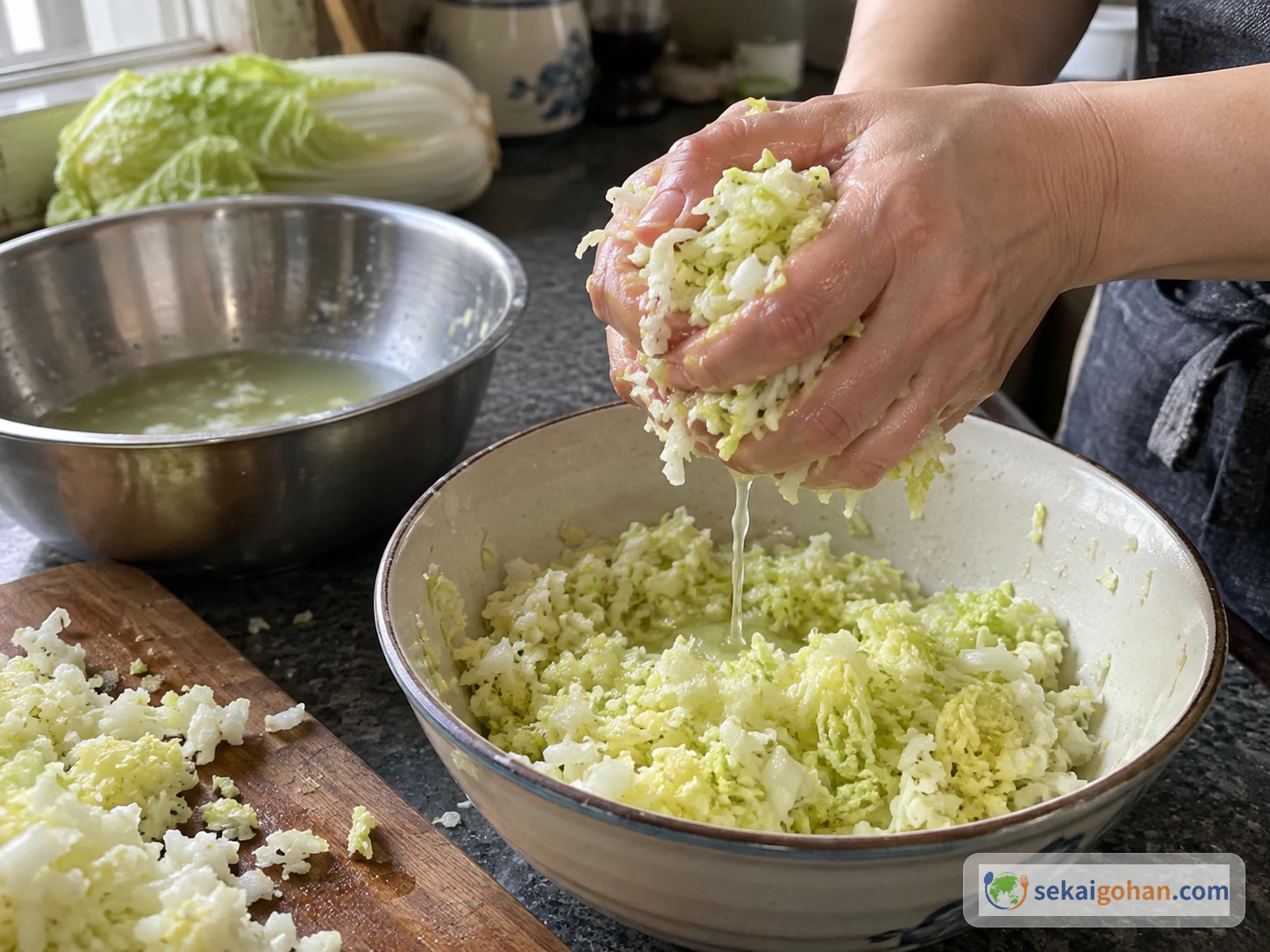
| Filling is watery | Cabbage not squeezed enough; wrapped dumplings left standing | Squeeze the salted cabbage well. Boil wrapped dumplings soon or freeze them in portions rather than leaving them at room temperature |
| Wrappers tear in the pot | Pot overcrowded; dumplings stuck to the bottom | Boil in smaller batches and give one gentle stir right after adding them |
| Too salty | Strong soy sauce | Start Japanese-style dark soy sauce lower next time, and taste only a fully cooked sample |
Jiaozi Storage and Variations
Cool cooked dumplings quickly in shallow containers, then refrigerate or freeze them. When reheating, heat until the center of the filling reaches 167°F (75°C) for at least 1 minute.
Jiaozi fillings include pork, chicken, beef, fish, celery and vegetables, and where pork isn't eaten, beef or lamb take its place. Each one changes the moisture and seasoning of the filling, so expect to readjust:
- Garlic chives instead of napa cabbage. Chives bring a stronger aroma and a different amount of moisture, so rethink the aromatics and squeezing.
- Beef or lamb instead of pork. Balance the flavor with the aromatics rather than adding more salt.
- A meatless filling of egg and vegetables. Build the proportions yourself.
- Pan-fried jianjiao or guotie. Set aside some of the same dumplings to pan-fry in oil and water for a browned bottom.
Frequently Asked Questions
Can I use store-bought wrappers?
Yes. They save time, but their thickness and size differ from handmade wrappers. Use less filling than in step 6 and make a secure seal your priority.
Why can't I just wait until they float?
Floating and translucent wrappers show that cooking is under way, but they don't confirm that raw pork is cooked through. Check that the center of the filling reaches 167°F (75°C) for at least 1 minute.