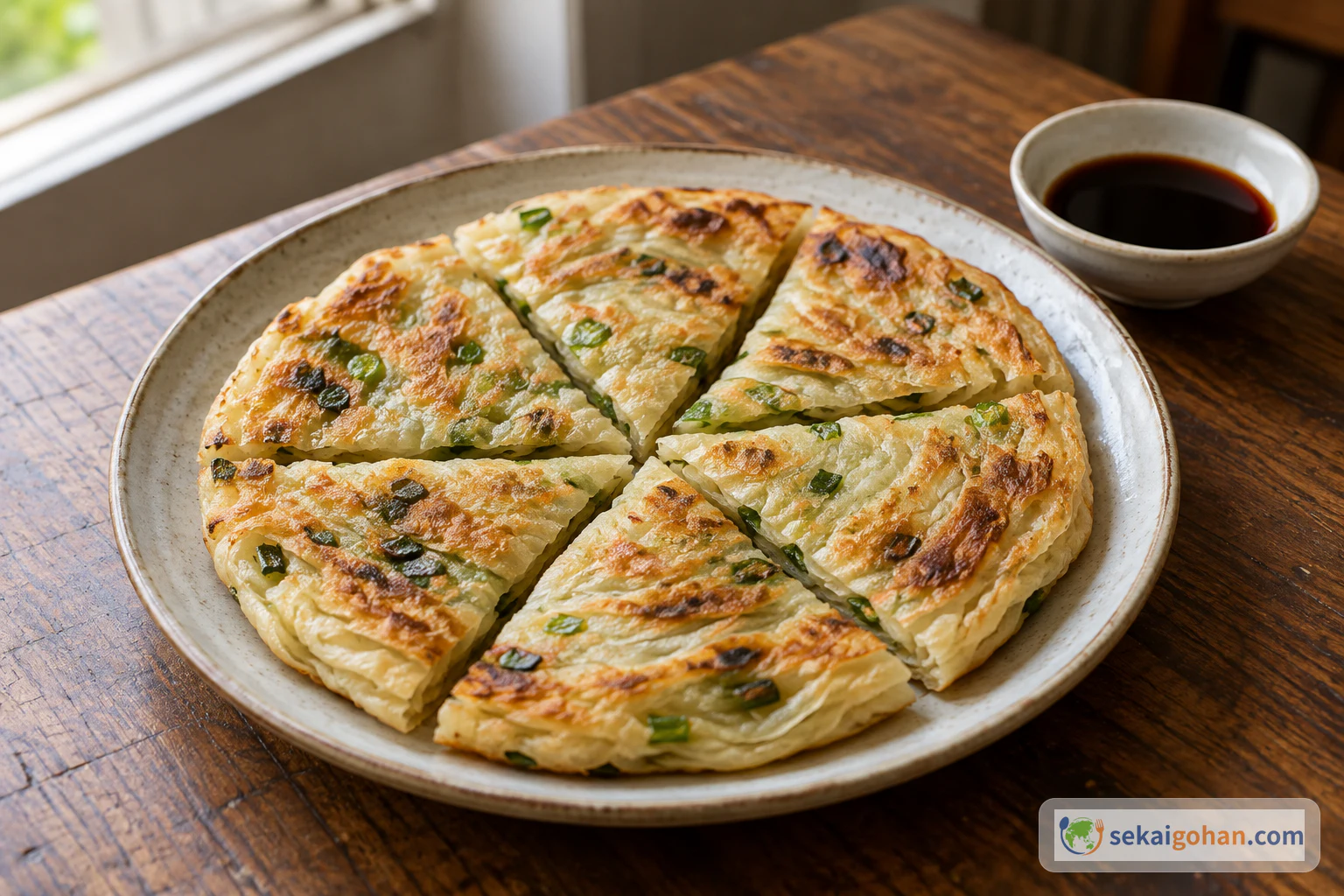
One cong you bing cut into six wedges, plated with a small dish of dipping sauce
Prep10 min
Cook30 min
Serves12 servings (6 pancakes)
CuisineChinese

Cong You Bing: Chinese Scallion Pancakes (葱油饼)

How to make cong you bing, Chinese scallion pancakes (葱油饼), following Maggie Zhu's Omnivore's Cookbook version: a hand-kneaded dough mixed with boiling water and then cool water, a flour-and-peanut-oil paste, scallions laid in an L, a tube-and-coil shape, and a covered-then-uncovered pan-fry. Makes 6 pancakes (12 servings), with an optional soy and Chinkiang vinegar dip.

Total: 1 hr

Cooking flow

Cooking steps

STEP 11 / 11

Add the boiling water, then the cool water

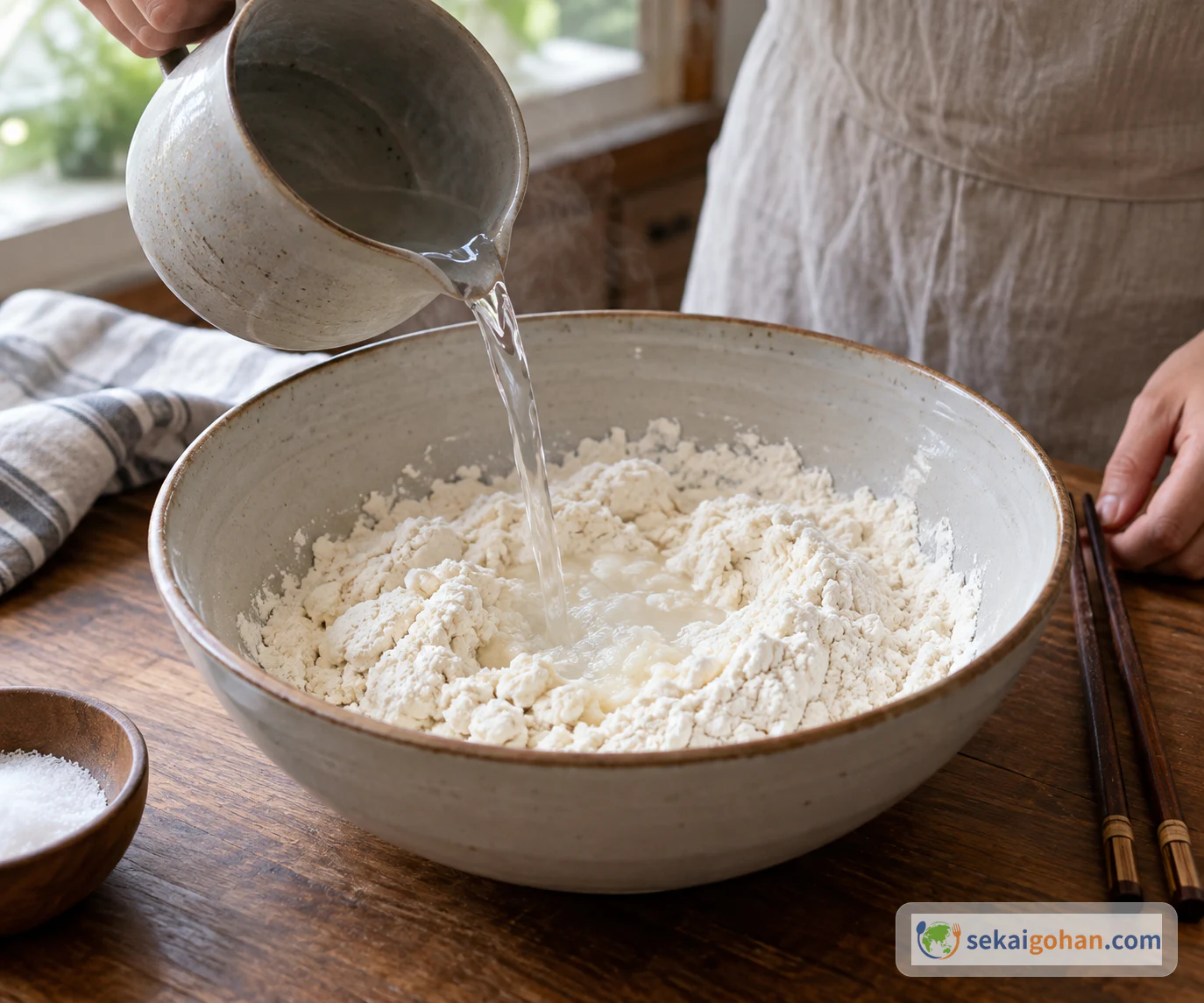
Boiling water being poured into a bowl of flour and salt
The boiling water goes in first, while you keep mixing

In a large bowl, combine 2 cups all-purpose flour and 1/2 teaspoon salt. While mixing, slowly pour in 1/2 cup boiling water.

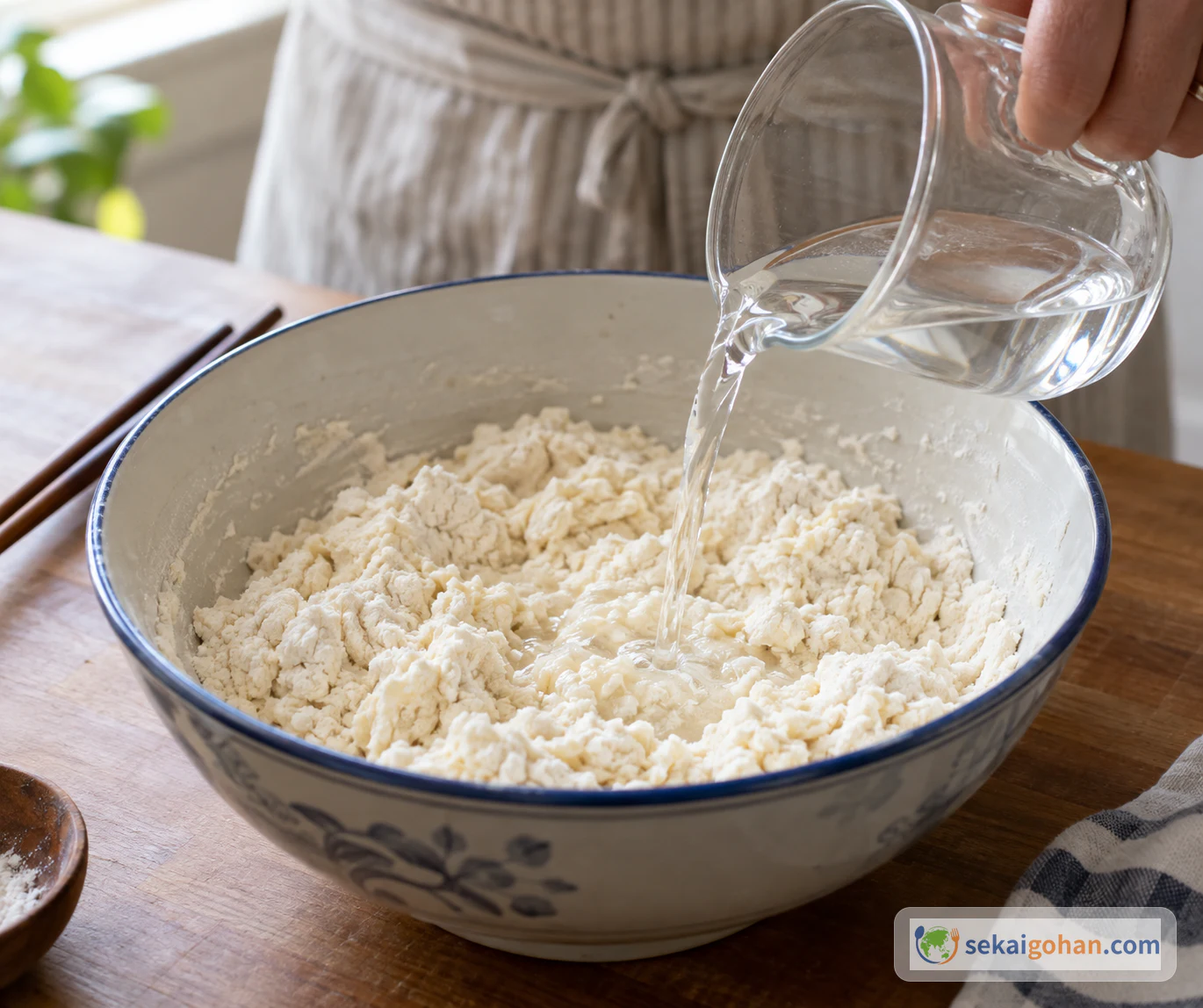
Once the boiling water is absorbed, keep mixing while you add 1/4 cup cool water. Stop when the dough forms flakes. If dry flour still remains, add only enough extra water to pick up the dry flour.

Cool water being poured into the flour after the boiling water has been absorbed
The cool water follows once the boiling water is absorbed
STEP 22 / 11

Knead, cover and rest

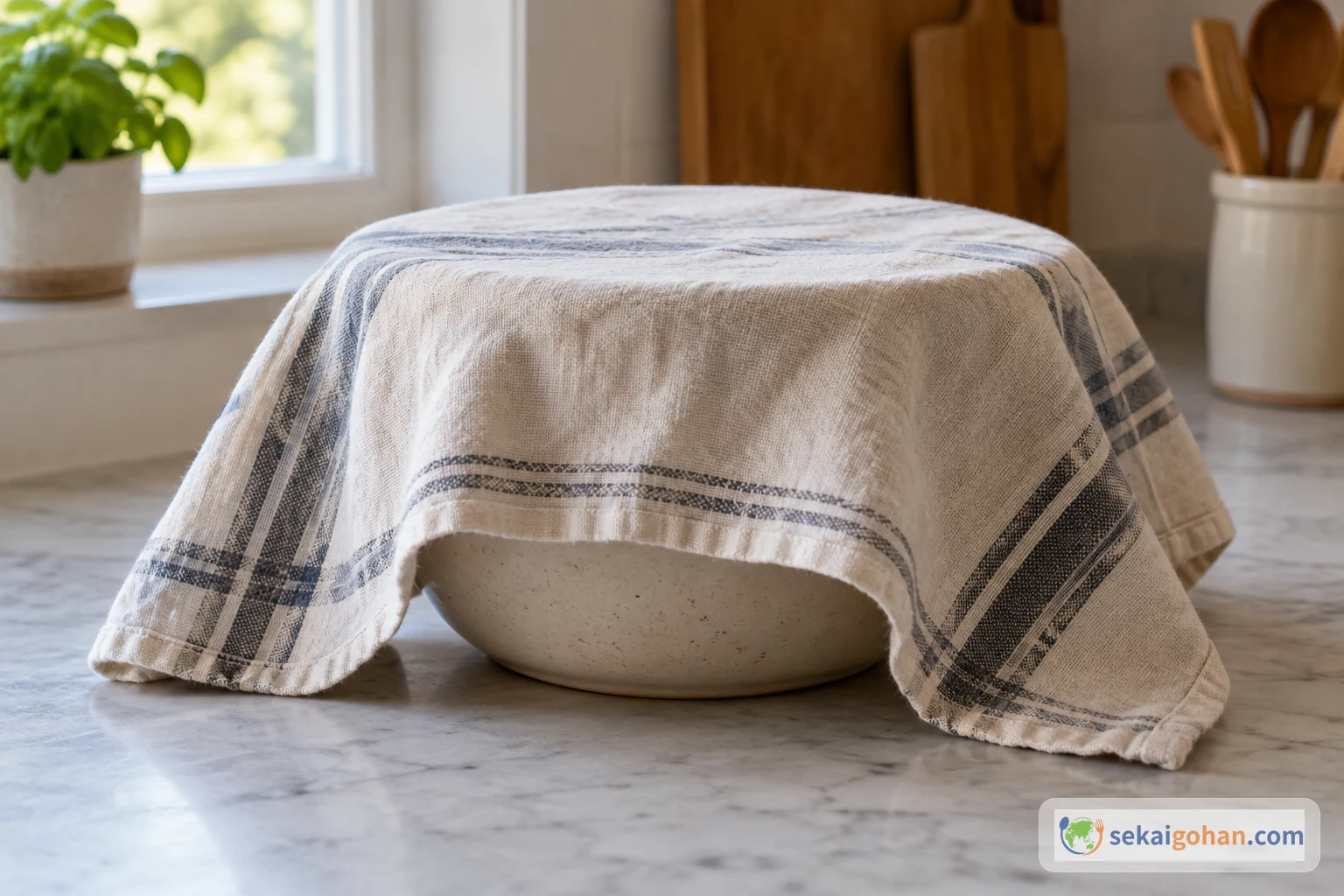
A mixing bowl fully covered with a towel while the dough rests
Cover the dough and let it rest for 20 minutes

Gather the moist dough and any dry bits together. Knead for about 5 minutes into a firm ball. Cover it and let it rest for 20 minutes, then knead for about another minute.

STEP 33 / 11

Make the paste and the dip

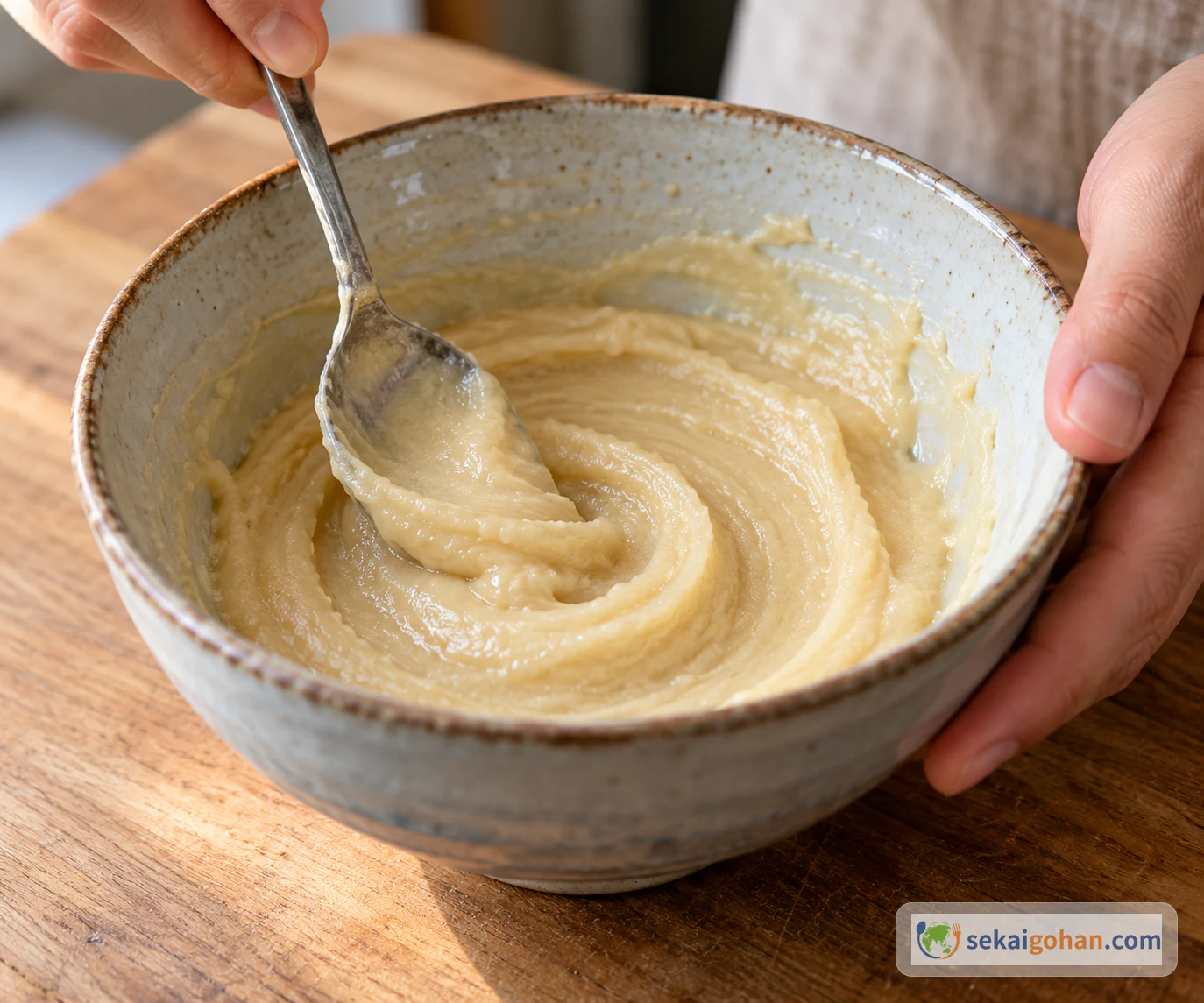
Flour, peanut oil and salt being mixed into a smooth paste in a small bowl
The paste is flour, peanut oil and salt only

While the dough rests, stir 1/3 cup all-purpose flour, 1/4 cup peanut oil and 3/4 teaspoon salt together in a small bowl until smooth.

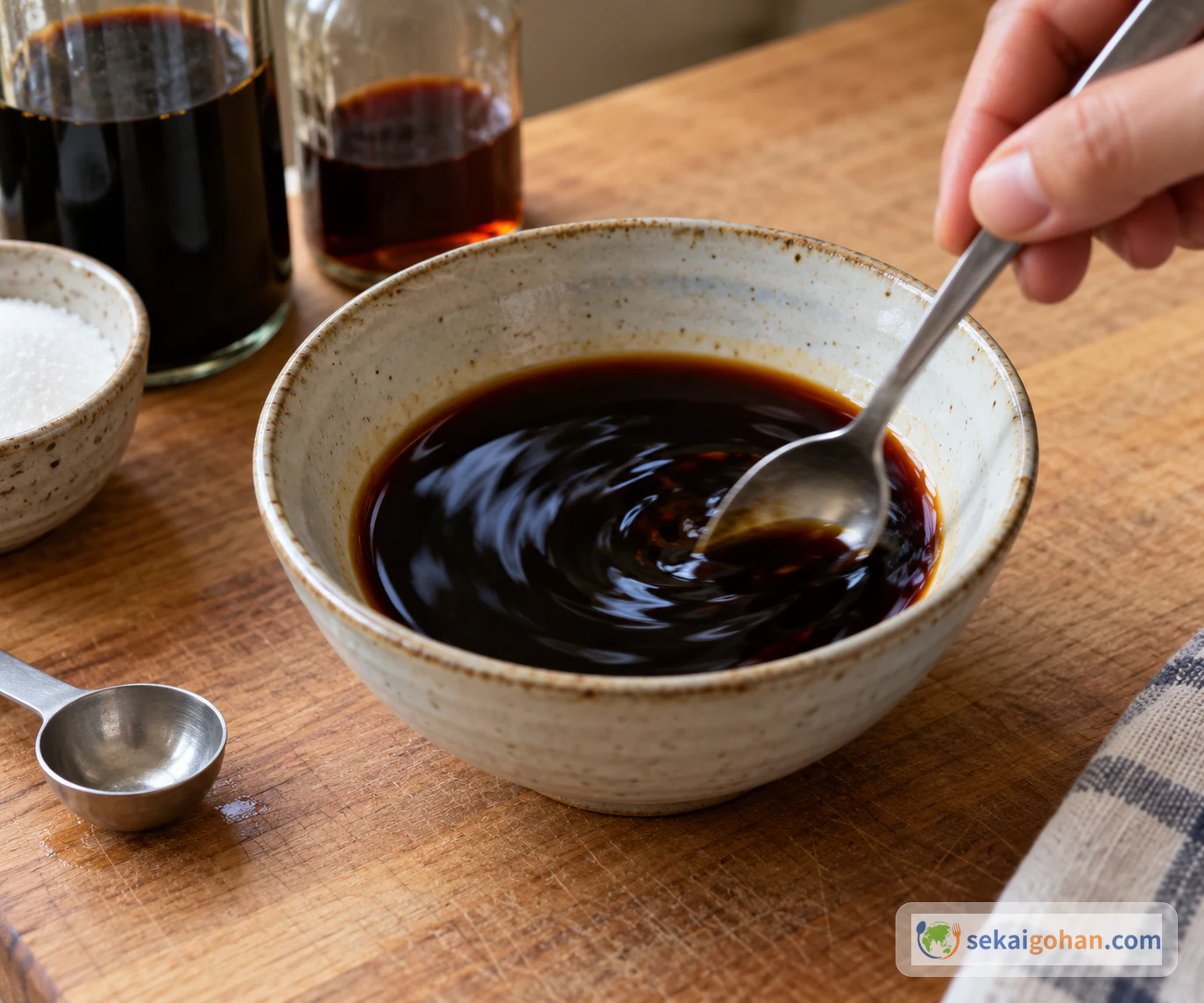
If you are serving the optional dip, stir 1 1/2 tablespoons soy sauce, 1 tablespoon Chinkiang vinegar and 1/4 teaspoon sugar together with 1 tablespoon water until the sugar dissolves.

The optional dip of soy sauce, Chinkiang vinegar, sugar and 1 tablespoon water being stirred
Stir until the sugar dissolves
STEP 44 / 11

Chop the green onions

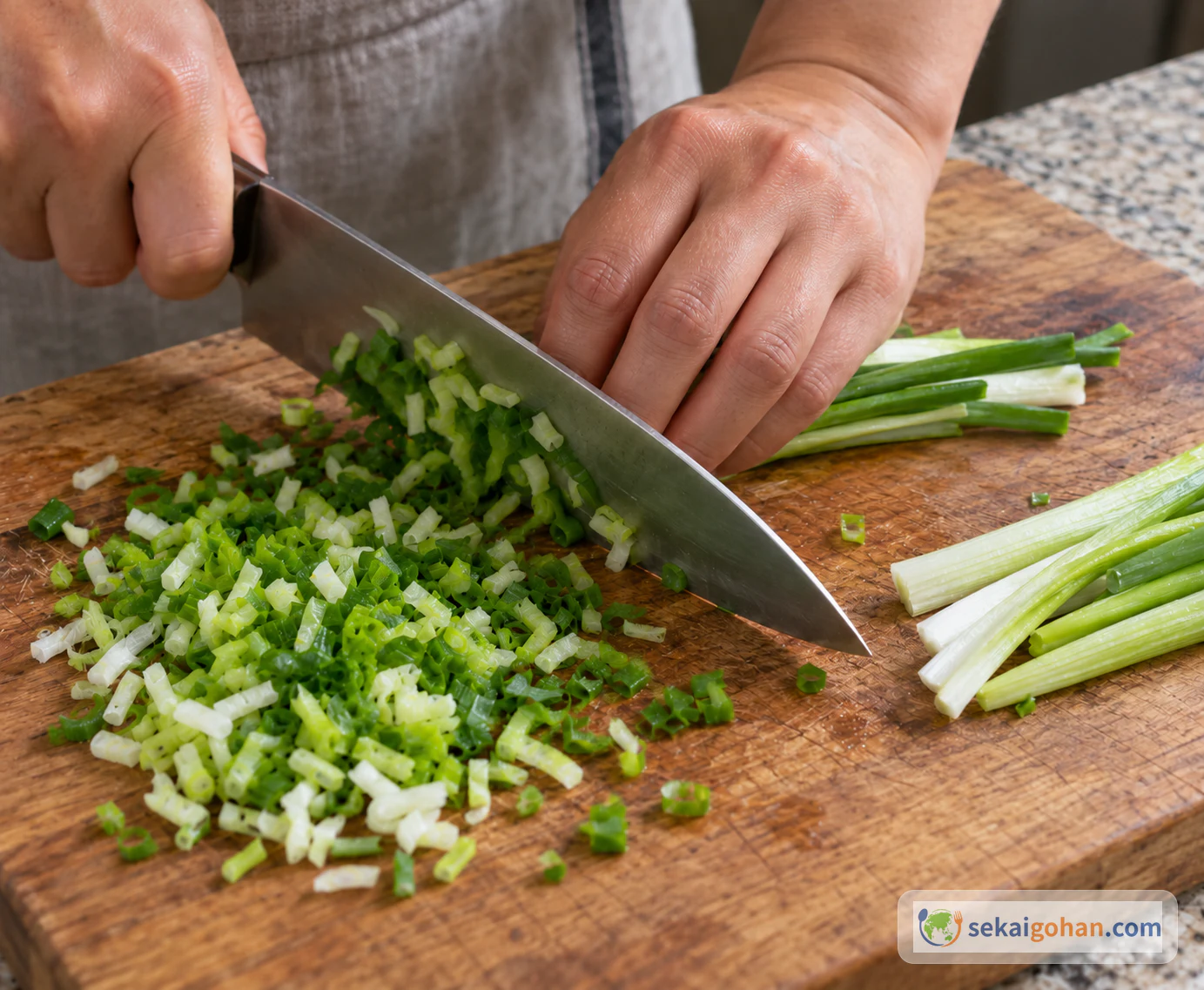
Eight lengthwise-split green onions being chopped finely; the source gives the chopped yield as 1 cup
Split lengthwise first, then chop finely

Split 8 green onions lengthwise down the middle, then chop them finely, to about 1 cup. Finely chopped scallions are easier to roll up and less likely to leave large air pockets.

STEP 55 / 11

Divide the dough into six

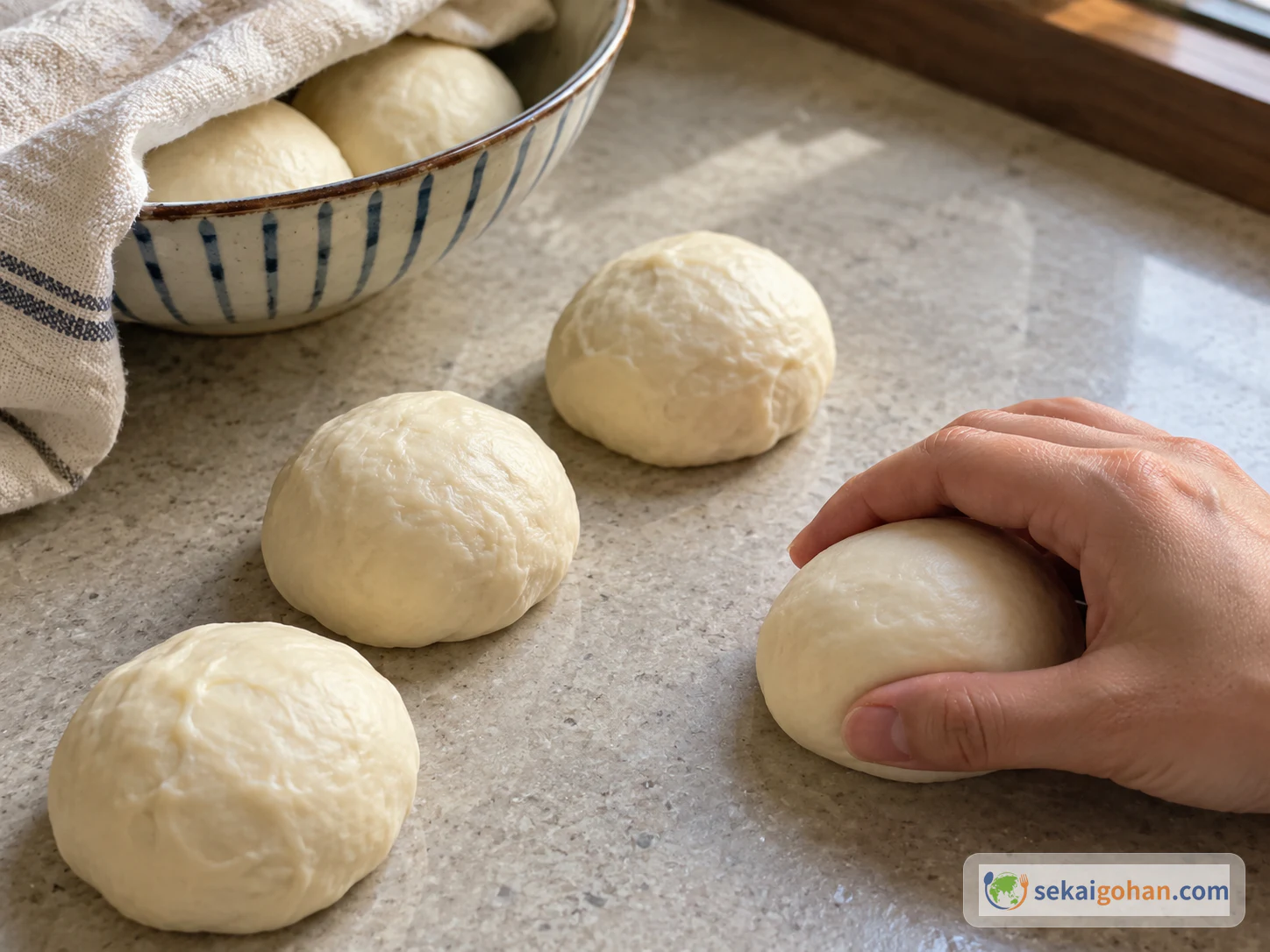
Hand-kneaded dough divided into six equal pieces, with the pieces not in use kept covered
Six portions, kept covered while you work

Divide the dough into 6 equal pieces, about 76 grams each. Keep the pieces you are not working on covered so they don't dry out.

STEP 66 / 11

Roll a thin rectangle and spread the paste

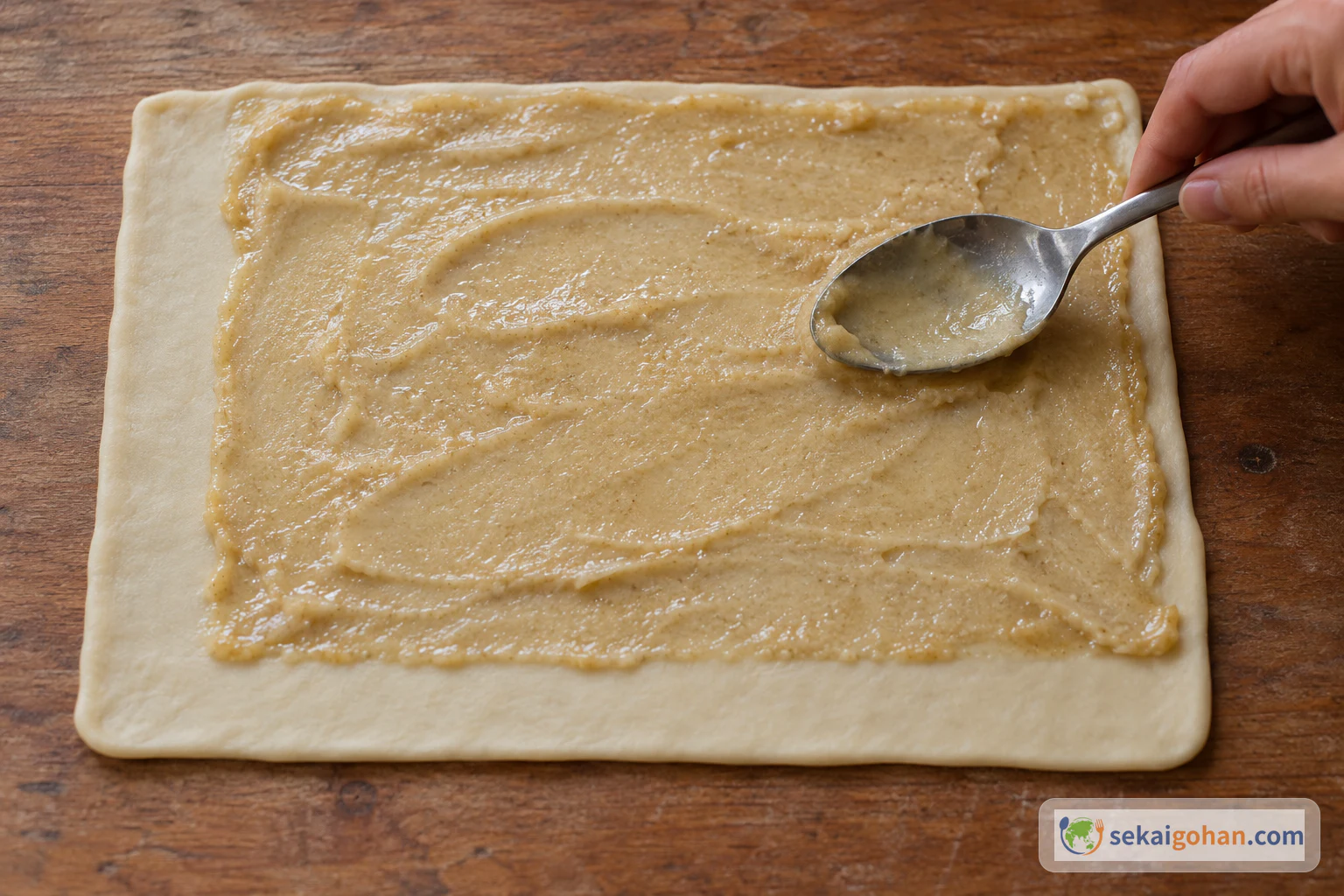
A thinly rolled dough sheet spread with paste, with narrow clear margins along two adjacent edges
Leave two adjacent edges free of paste

Roll one piece into a thin rectangle about 6x10 inches (15x25 cm). Spread about 1 tablespoon of paste over it, leaving about 1 inch (2.5 cm) clear on the top and left edges. What matters is that the two clear edges are next to each other.

STEP 77 / 11

Lay the scallions in an L

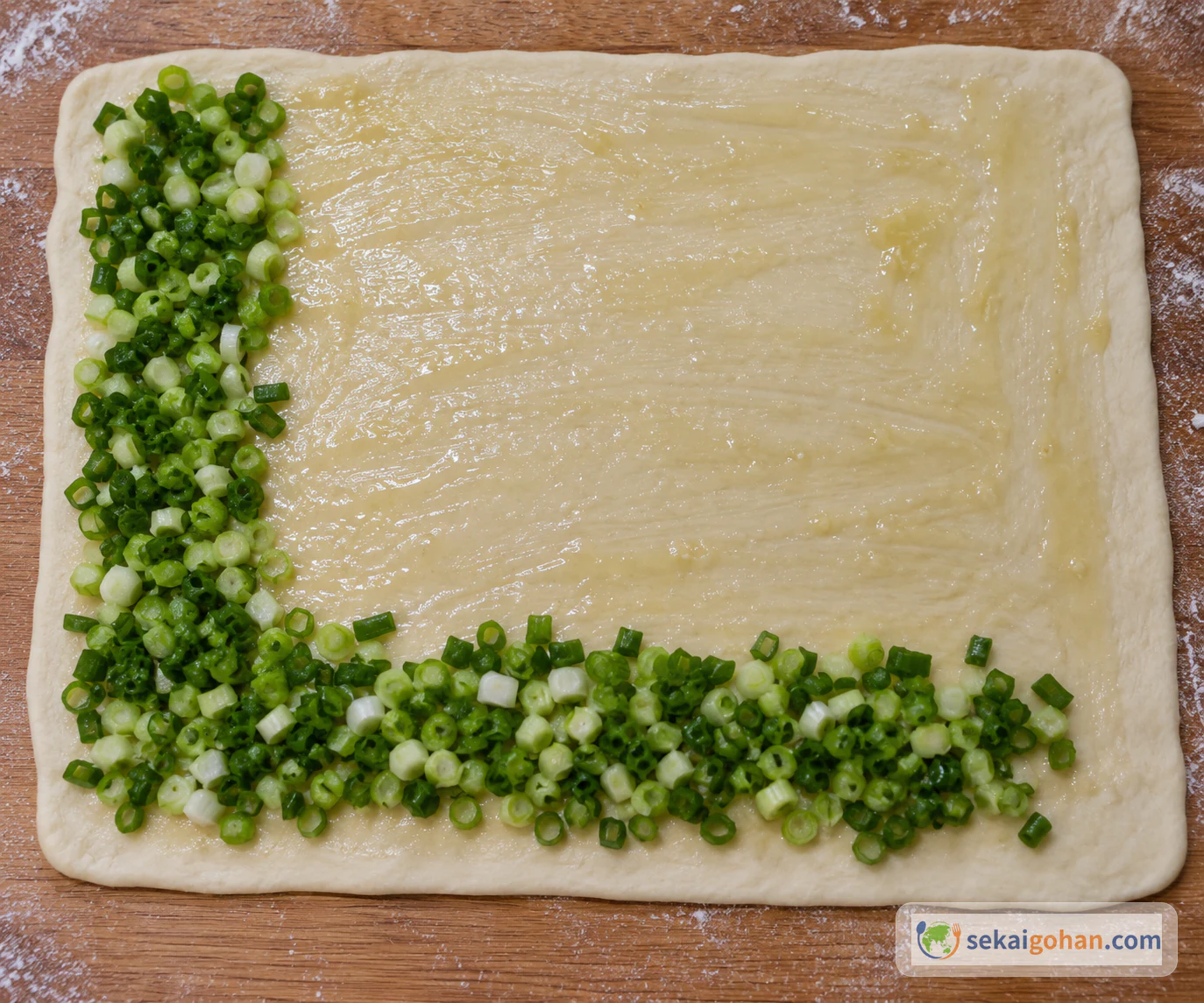
Scallions laid in an L along the two adjacent edges opposite the clear margins
The scallions run along the other two adjacent edges

Place 2 heaping tablespoons of chopped scallions in a loose L along the other two adjacent edges, one long edge and one short edge.

STEP 88 / 11

Roll into a tube, seal, and coil

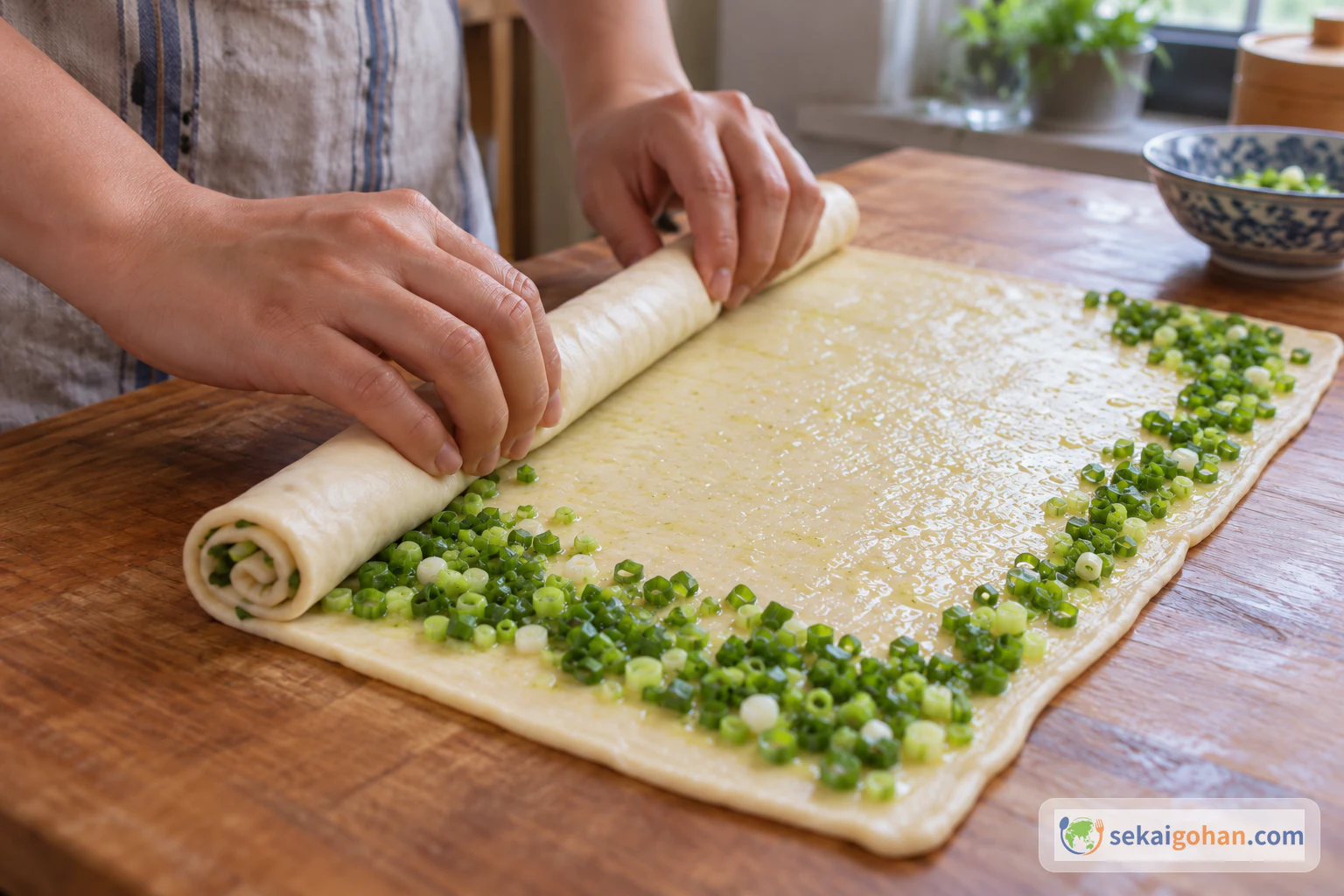
Dough being rolled into a long tube from the scallion-rich long edge
Roll from the long edge with the most scallions

Starting from the scallion-rich long edge, roll the sheet into a tube.

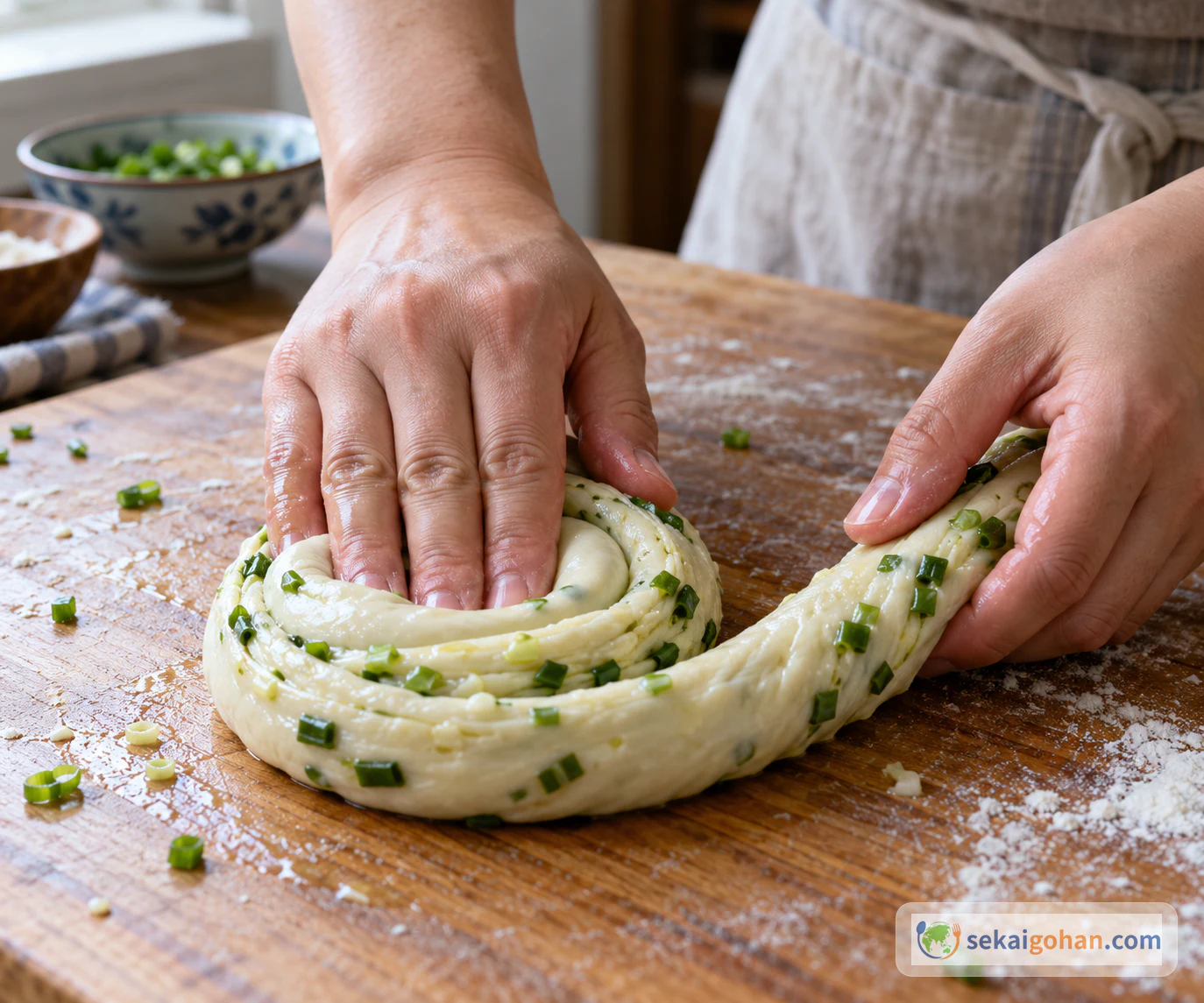
Flatten the tube lightly with your hands and pinch the scallion-rich end closed. Coil the tube from that sealed end toward the unsealed end. As the coil forms, press out any large air bubbles. Once the coil is complete, tuck the loose end underneath and gently press the coil into a disk. Let it rest, covered, while you shape the remaining pieces.

A coil being wound from the sealed scallion-rich end toward the open end while large air bubbles are pressed out
Coil from the sealed end, pressing out air as you go
STEP 99 / 11

Roll each coil into a circle

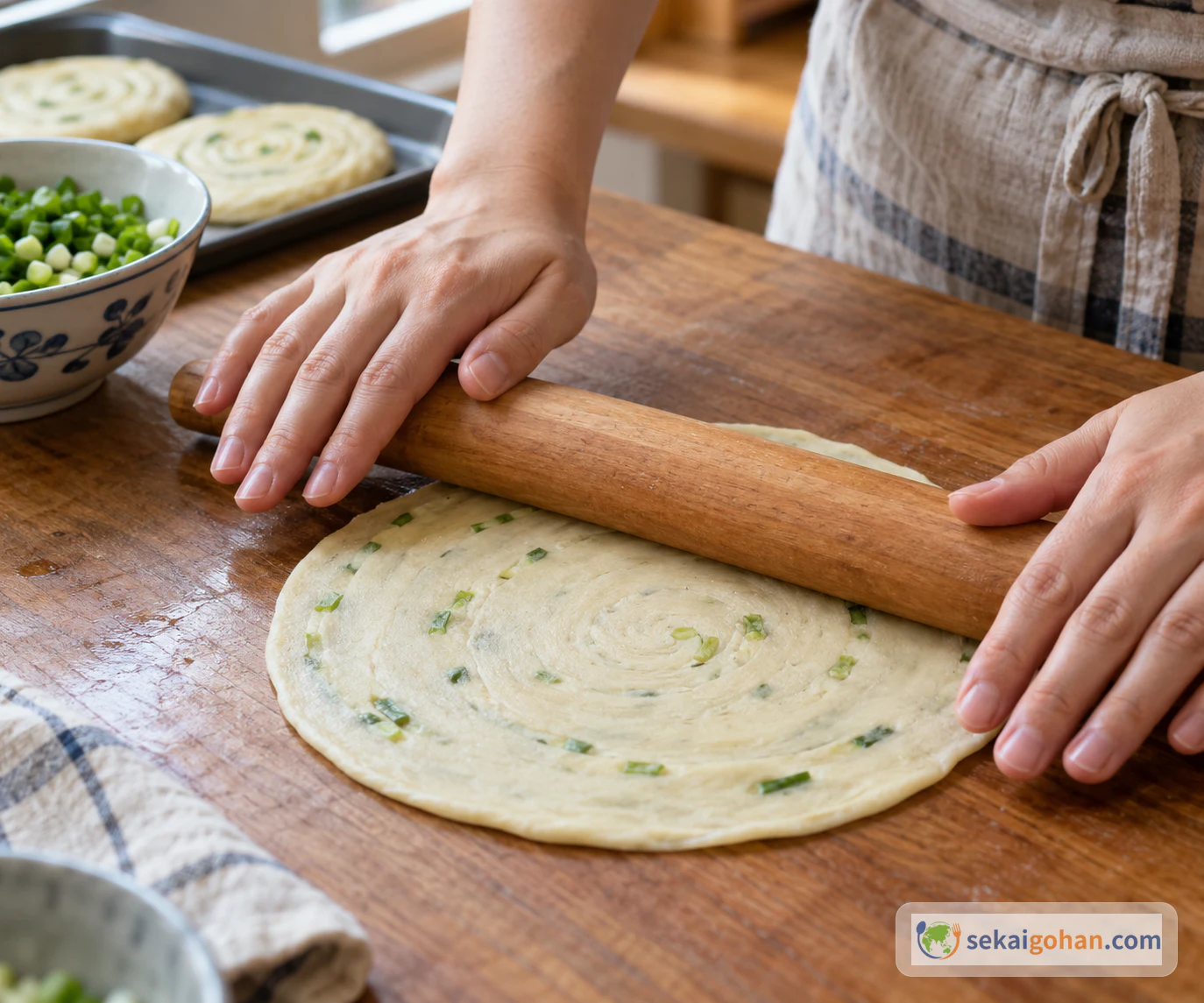
A coiled dough disk being rolled into a round about 7 to 8 inches across
A few scallions peeking through is fine

Roll each disk into a circle about 7–8 inches (17–20 cm) across. It is fine if an air pocket bursts or a few scallions poke through.

STEP 1010 / 11

Cook covered, one minute per side

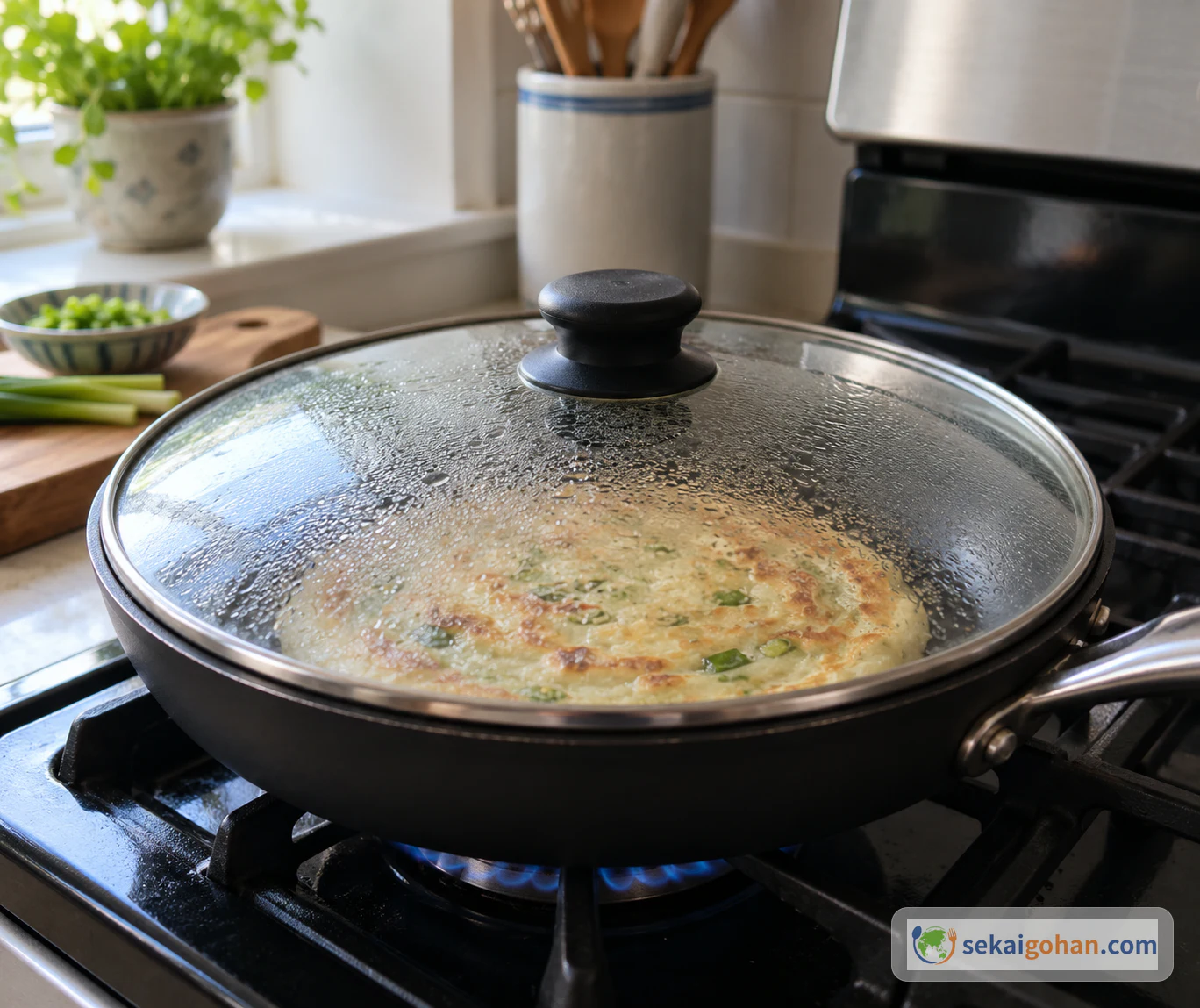
A cong you bing cooking under a lid in a 9-inch nonstick skillet coated with vegetable oil
One covered minute on each side

Heat a 9-inch (23 cm) nonstick skillet over medium-high. Add enough vegetable oil to coat the bottom. When the oil is hot, add one pancake and swirl it for a few seconds to spread the oil underneath. Reduce the heat to medium, cover, and cook for 1 minute. Flip, cover again, and cook for another minute.

STEP 1111 / 11

Uncover, press and brown

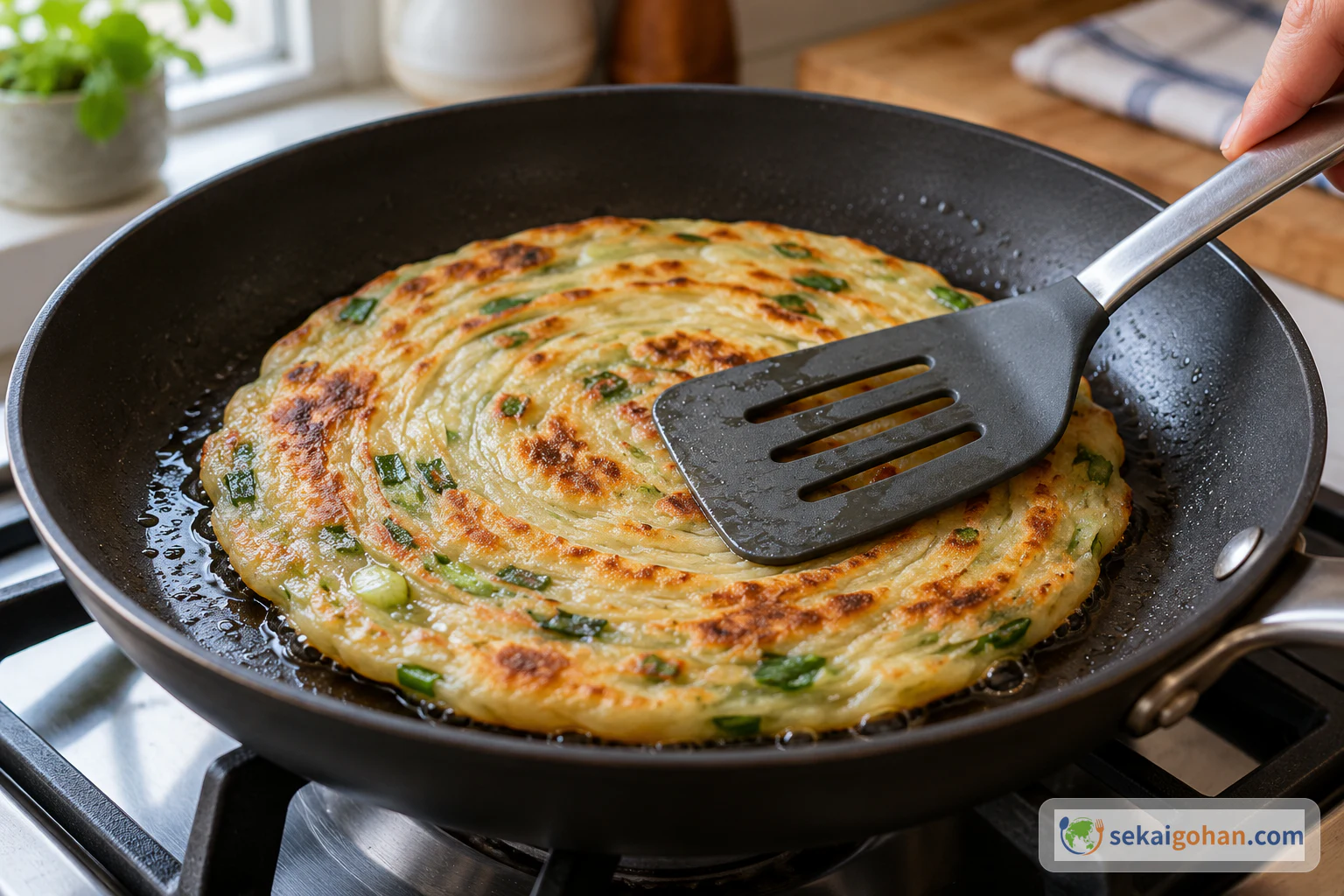
An uncovered cong you bing being pressed with a spatula to even out the browning
Press and turn until crisp and browned on both sides

Remove the lid. Press the pancake with a spatula and turn it frequently for about 3 minutes, until both sides are crisp and browned. If the pan gets too hot, lower the heat to medium-low. Let the pancake cool until you can handle it, then cut it into 6 wedges. Serve with the dip on the side if you like.

0 / 0
Ingredients

Ingredients

1 / 1

Ingredients

Ingredient Amount Role
All-purpose flour 2 cups Dough
Salt 1/2 teaspoon Dough
Boiling water 1/2 cup Dough; added first, while mixing
Cool water 1/4 cup Dough; added after the boiling water is absorbed
Extra water A little Dough; only if dry flour remains
All-purpose flour 1/3 cup Paste
Peanut oil 1/4 cup Paste; not the frying oil
Salt 3/4 teaspoon Paste
Green onions 8, split lengthwise and chopped (about 1 cup) Filling; about 2 heaping tablespoons per pancake
Vegetable oil Enough to coat the bottom of the skillet Pan-frying only
Soy sauce 1 1/2 tablespoons Optional dip
Chinkiang vinegar 1 tablespoon Optional dip
Sugar 1/4 teaspoon Optional dip
Water 1 tablespoon Optional dip
0 / 0

A thin, round pancake flecked with green onion slides into a 9-inch nonstick skillet, gets a quick swirl in the hot oil, and disappears under a lid. A minute later it's flipped and covered again. Only then does the lid come off, and the pancake is pressed and turned until both sides are crisp and browned. That's cong you bing (葱油饼), the Chinese scallion pancake: crisp and flaky outside, slightly chewy inside, with layers of scallion running all through it.

About Cong You Bing

The layers come from the shaping. A hand-kneaded flour dough is rolled thin and spread with a paste of flour, peanut oil and salt. Chopped green onions are scattered over it, and the sheet is rolled into a tube. The tube is coiled into a disk and rolled flat again, which stacks the oiled layers on top of one another.

The name gets used loosely, so it helps to know what this pancake isn't. The Peking Duck Pancake is a thin, plain wrapper for Peking duck and shredded fillings, a different kind of pancake from this scallion-filled, coiled one. For more dishes from the same country, see our China page.

Ingredients for 6 Pancakes (12 Servings)
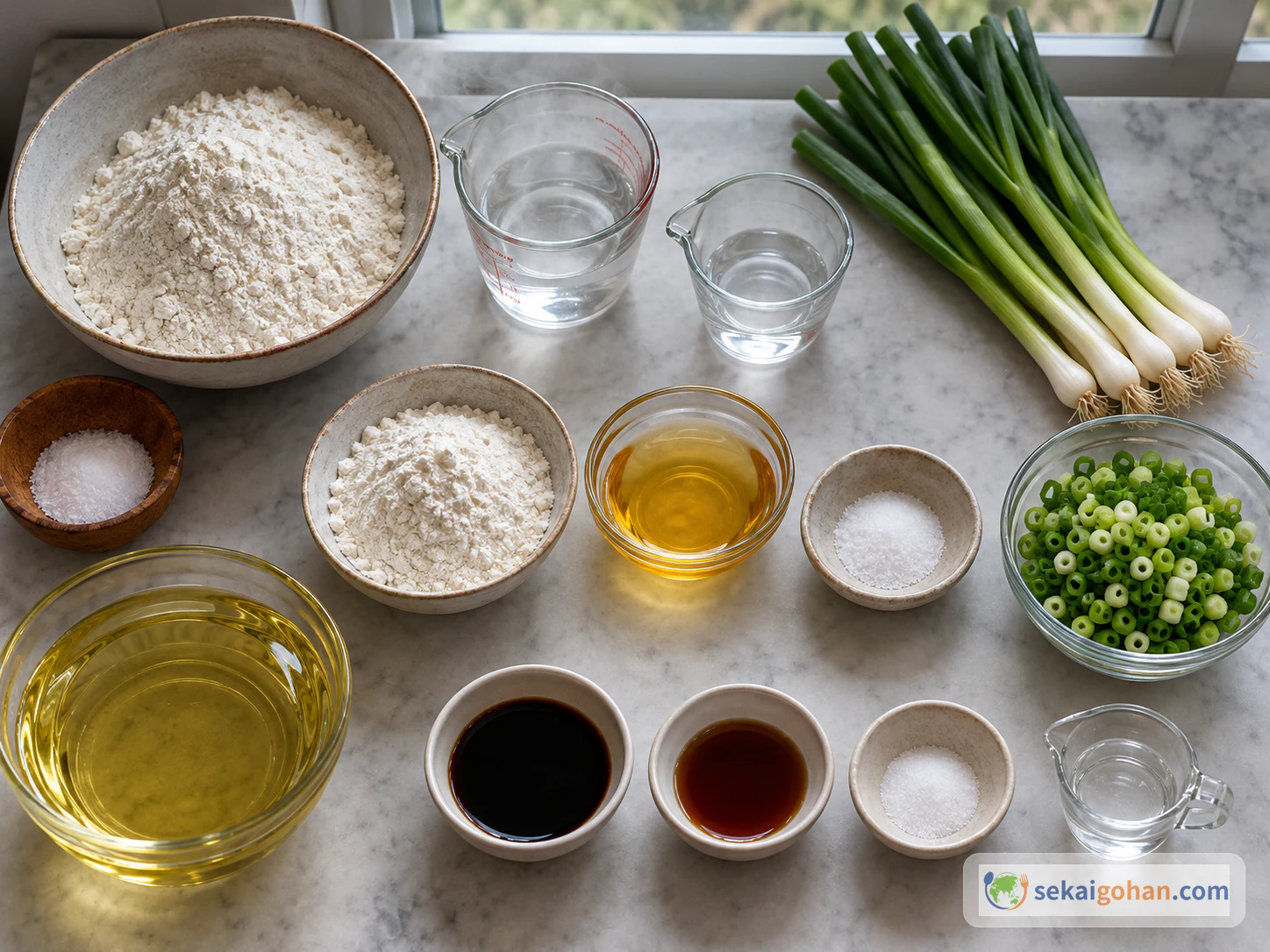
Ingredients for cong you bing grouped by use: dough flour and salt, boiling and cool water, paste flour, salt and peanut oil, eight green onions, separate vegetable oil for frying, and the dip ingredients with a small measure of water
Dough, paste, scallions, frying oil and dip, kept as separate groups

The paste's peanut oil and the frying vegetable oil are separate ingredients with separate jobs.

Equipment

  • Large mixing bowl
  • Small bowls for the paste and the dip
  • Clean cover or towel for resting the dough
  • Cutting board and knife
  • Rolling pin
  • 9-inch (23 cm) nonstick skillet with a lid
  • Spatula

Choosing Ingredients for Cong You Bing

Two oils, two jobs. Peanut oil goes into the flour paste spread inside the layers. Vegetable oil goes only in the skillet, coating the bottom for frying.

About 76 grams per portion. When you divide the dough into six, aim for about 76 grams each so the pancakes cook evenly.

Leftover paste and scallions are fine. Each pancake takes about 1 tablespoon of paste and 2 heaping tablespoons of chopped scallions. If some is left once all six are filled, that's normal. Leave it rather than piling it onto the last pancakes.

The dip uses Chinkiang vinegar. It's mixed with soy sauce and sugar. Rice vinegar is another option.

How to Make Cong You Bing

Follow the order

Water goes in hot first, then cool. The scallions go along two adjacent edges. The coil starts from the sealed, scallion-rich end. The pan is covered before it is uncovered.

Common Problems With the Dough and Shaping

What you see What to expect What to do
Dry flour won't come together A little extra water Add a small splash, just until the dry flour is picked up
The dough is very sticky A little extra flour Use a little to fix the dough, not for routine dusting of the work surface
You're unsure which edges stay clear Top and left edges Keep the two clear edges adjacent and put the scallions along the other two
An air pocket bursts or scallions poke through when rolling That's fine Keep rolling to 7–8 inches
The pan seems too hot during the uncovered stage Lower to medium-low Reduce the heat only if needed
Paste or scallions are left after six pancakes Leftovers are normal Leave them rather than overloading the last pancakes

Frequently Asked Questions

Does 12 servings mean 12 pancakes?

No. Six pancakes make 12 servings. Cut each pancake into 6 wedges.

The dip's water isn't on the recipe card. Should I add it?

Yes. Add 1 tablespoon water to the dip. It helps the sugar dissolve.
Sources