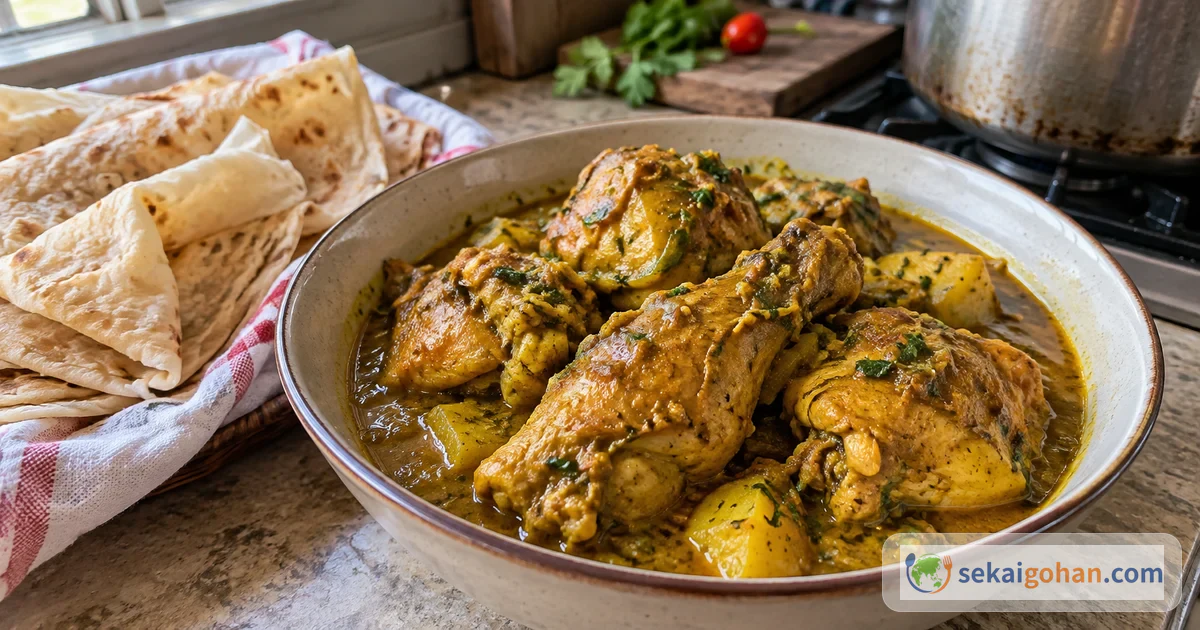
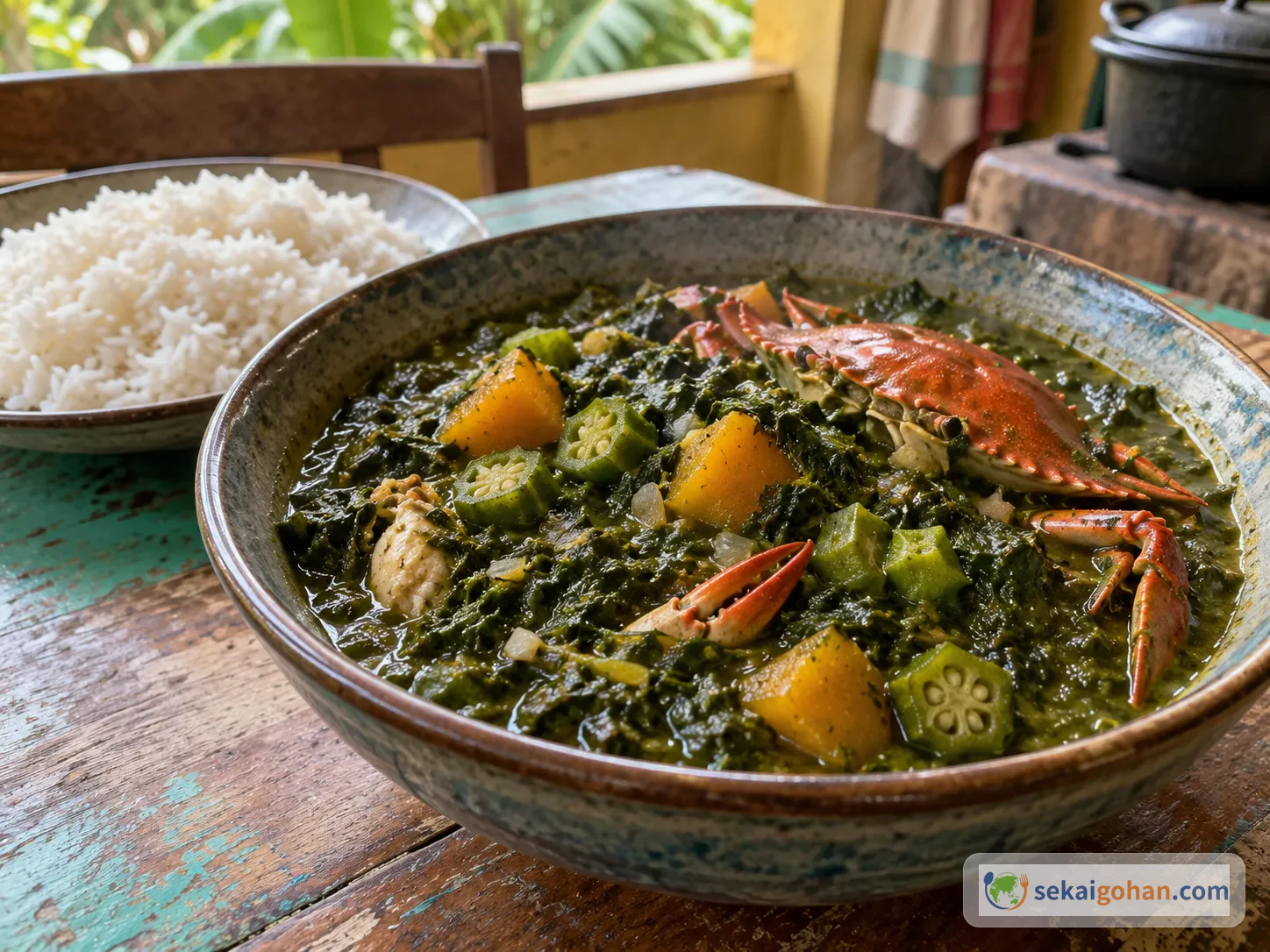
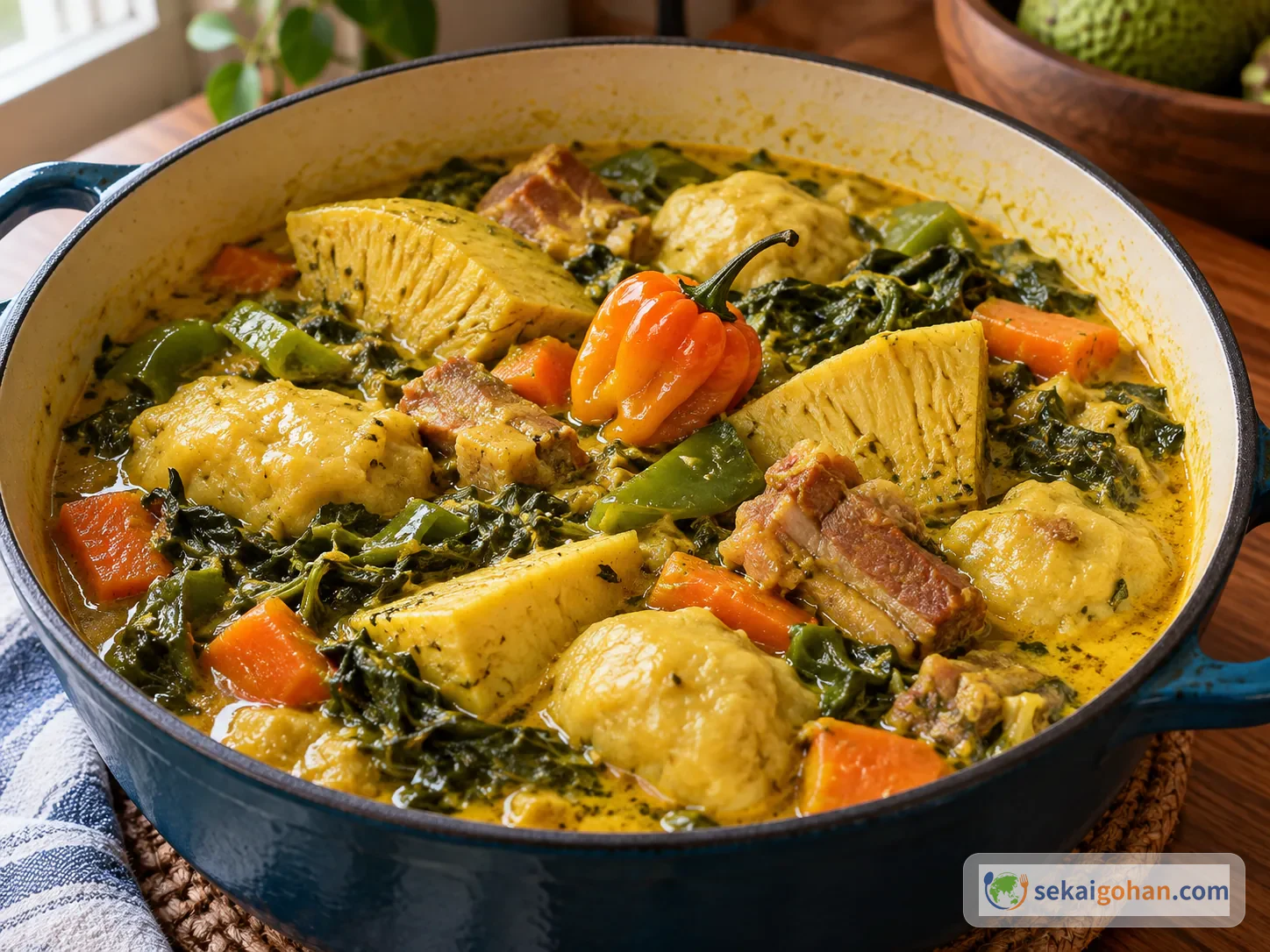
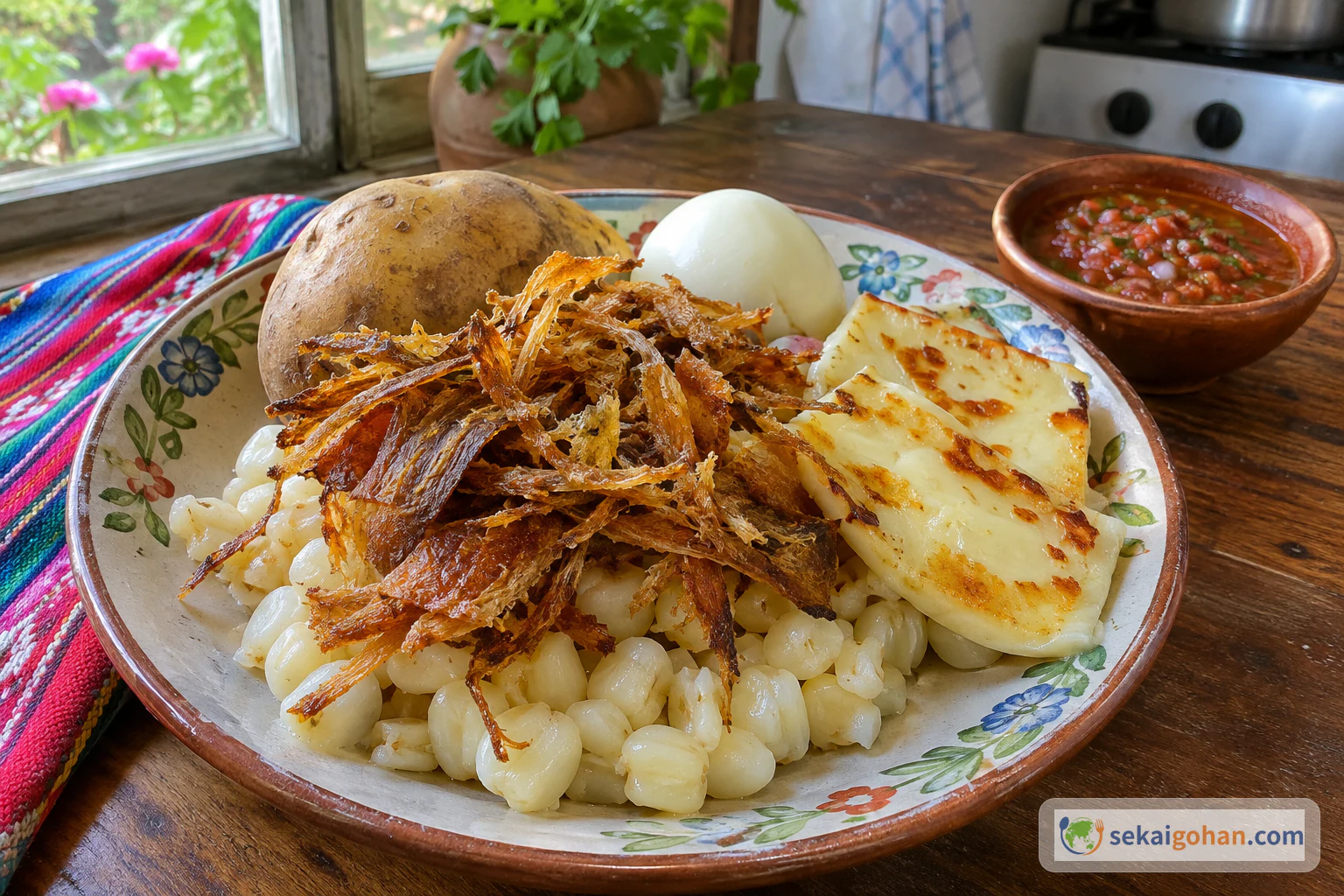
Once brown sugar hits the oil in the pot, it melts, the bubbles grow larger, and the color deepens from pale amber to deep brown. Add the chicken at that point, and the kitchen fills with the smell of caramel and meat. That is how pelau starts: Trinidad and Tobago's one-pot chicken and rice, which gets its color and aroma from burnt sugar the way a Japanese takikomi gohan gets its color from soy sauce. Rice, pigeon peas, coconut milk, pumpkin, carrots and aromatics then cook with the chicken. The finished rice is rounded and savory, with the faint bitterness that marks a real pelau.

About Trinidad Pelau
Where pelau comes from
The food of Trinidad and Tobago draws on Indian, African, Indigenous, European, Chinese and Middle Eastern cooking, and pelau puts several of those into one pot. The Indian pilaf idea of cooking rice in an aromatic liquid meets the African technique of coloring meat with sugar, and the Caribbean adds beans and coconut. Pelau is known as the unofficial national dish of Trinidad and Tobago.
Among Trinidadian dishes, doubles is the morning street-stall food, made from Indian fried bread and chickpea curry. Pelau belongs to home cooking. You'll find it at weekends, picnics and potlucks, and packed as lunch for the beach.
In English it is written pelau. Locally it sounds close to "pelau" or "pilau", and related names such as pileau and cook-up rice appear in different Caribbean countries and households.
The burnt-sugar step

Burnt sugar, beans and coconut milk are the heart of pelau, so keep those three as far as you can. The step that matters most is the order: check the color of the sugar before the chicken goes in. If you're used to takikomi gohan, burning sugar on purpose can feel a little frightening. Skip it and color the rice with soy sauce alone, though, and you lose the faintly bitter aroma that makes pelau what it is.
There's a narrow window. Burn the sugar too far and the whole pot turns bitter, so add the chicken when the bubbles are fine and the color looks like dark barley tea. Those few dozen seconds decide the dish.
| Element | What it means locally | What to keep at home |
|---|---|---|
| Burnt sugar | Color, toasty flavor, the outline of bitterness | Stop at deep amber, and add the chicken before black smoke appears |
| Pigeon peas | Bean aroma and substance | If unavailable, substitute black-eyed peas, cooked soybeans or chickpeas |
| Coconut milk | The rounded aroma and fat of the rice | Too much makes it heavy |
| Scotch bonnet | Aromatic heat | Adding it whole and removing it makes the heat easier to control |
| Chadon beni | Green aroma | Approximate with cilantro stems, scallions and thyme |
Ingredients (serves 4): Decide the Color and the Beans Before the Rice

This serves four as a main dish. It is also good the next day. For a small household, making the full amount and refrigerating the rest gives more of the true pelau pot aroma than halving it. Long-grain rice is the easiest to handle, but short-grain rice also works. In that case, use a little less liquid and rest it longer.
Read the labels on all-purpose seasoning, chicken stock and ketchup. Brands differ, and some contain wheat, soy or dairy. Scotch bonnet is a very hot chile. Add it whole without breaking it, and remove it when the rice is done to keep the heat down. If you chop it, wear gloves and keep your hands away from your eyes and mucous membranes.
Choosing Pelau Ingredients and Substitutes

Any supermarket will have the chicken, rice, onion, carrots and pumpkin. The harder items are pigeon peas, coconut milk, thyme, Scotch bonnet and chadon beni. Look for pigeon peas at a Caribbean or import grocery, but don't wear yourself out hunting for them. Beans are easy to substitute, so get the coconut milk and thyme first.
For the closest aroma, choose unsweetened canned coconut milk made for cooking. Coconut drinks in cartons vary in sweetness and water content. Thyme changes the aroma of the whole pot even in small amounts, and dried thyme from a small supermarket jar will do.
The aromatic heat of Scotch bonnet is harder to replace. If you can't get it fresh, keep the pot mild and add a little hot sauce at the table. All-purpose seasoning is optional and handy when you want salt, garlic, pepper and cumin in one step. If you use it, reduce the salt as the ingredient table shows so the saltiness doesn't double up.

| Ingredient in doubt | Closer to local | A realistic solution elsewhere | Verdict |
|---|---|---|---|
| Rice | Parboiled rice, long-grain rice | Jasmine rice, short-grain rice | Reduce the water by about 2.5 tbsp (40 ml) for short-grain rice |
| Beans | Pigeon peas | Black-eyed peas, cooked soybeans, chickpeas | The aroma changes but the texture comes through |
| Pumpkin | Sweet calabaza-type pumpkin | Ordinary pumpkin | It breaks down easily, so cut it into 1 inch (2 cm) cubes and leave it alone until the end |
| Chadon beni | Culantro, bandhania | Cilantro stems, scallions, thyme | The direction of the aroma differs, but a green outline comes through |
| Scotch bonnet | Add whole | Habanero, a hot hot sauce | Add it whole the first time and remove it without breaking it |
| Burnt sugar | Brown sugar | Raw cane sugar, light brown sugar | White sugar colors quickly and scorches easily |
The type of rice alone makes a big difference. Long-grain rice separates easily and suits pelau. Short-grain rice holds together sweetly, which is delicious but a step away from the local lightness. On days you use it, drain the washed rice in a sieve for just 10 minutes, reduce the water, and stir as little as possible after resting. Those three steps keep the stickiness down.
Method: Don't Fear the Burnt Sugar, and Don't Fuss with the Rice
Pelau is a one-pot dish, but it isn't just a matter of putting everything in and cooking. The order matters: marinade, burnt sugar, coating the rice in oil, low-heat cooking and resting decide the result. Stir too much and the rice breaks; stir too little and only the bottom scorches. Keep your touch light, and run a wooden spoon along the bottom of the pot just once.
Do the burnt sugar and the searing of the chicken in a pot, then transfer to the rice cooker together with the rice, beans, vegetables and liquid. With short-grain rice, start the liquid at ¾ cup (200 ml) coconut milk and 1¼ cups (280 ml) water. After the normal cooking cycle, rest for 10 minutes and check that the chicken is cooked. Burning the sugar in the rice cooker alone risks scorching and damage to the appliance, so avoid it.
Common Pelau Problems and Fixes

The most common mistake is being afraid of the sugar and adding the chicken while the color is still pale. The result is dull, like a mixed rice dish made without soy sauce. The next most common is too much coconut milk and water, which pushes the rice toward porridge. Pelau can be moist, but once the grains are completely crushed it turns heavy.
| Failure | Cause | How to recover |
|---|---|---|
| Bitter | The sugar turned black and smoked | Discard that sugar, wash the pot and start over |
| Pale color | The sugar wasn't burnt enough | Compensate with 1 tsp ketchup and 1/2 tsp soy sauce. Next time, burn the sugar darker |
| Sticky rice | Too much liquid, too much stirring | Remove the lid and cook over low heat for 3 minutes to drive off moisture, then rest 10 minutes |
| Rice with a hard core | The heat was too low or the water too little | Add 3 tbsp boiling water and cook 5 more minutes over low heat |
| Chicken still red | Bone-in pieces too large | Take out only the chicken, cover, and cook 5–8 more minutes over low heat |
| Scorched bottom | The heat was too high or the pot too thin | Move only the top and don't stir in the scorched bottom |
A light brown crust is part of the pleasure of pelau, but a black, bitter layer can't be undone once it's mixed through. If the bottom smells doubtful, leave the wooden spoon out of it and lift only the rice on top onto another plate. Sacrificing the black layer in the pot saves the rest of the dish.
Serving, Variations and Storing Pelau
Serving

Pelau is a meal on its own, but something tart beside it makes it much easier to eat. A simple chow of thinly sliced cucumber dressed with lime, salt and chile works well, and so do cabbage coleslaw or an avocado and tomato salad. For anyone who likes heat, put a few drops of Scotch bonnet hot sauce on the edge of the plate.
To build out a Caribbean table, start with doubles, then try Jamaican jerk chicken or Haitian griot to see how the same chile and thyme get used in different ways. Puerto Rico's pernil and mofongo are good next dishes for the Caribbean pairing of rice, beans and meat.
Variations
Chicken is the easiest version, but there are also versions with pork, beef or salted meat, as well as vegetarian ones. For a vegetarian pelau, replace the chicken with more firm fried tofu and pumpkin, and build the color by cooking onion in the burnt sugar. You lose the chicken's umami, so use vegetable bouillon and a little soaking liquid from dried shiitake instead of chicken stock to give the rice more depth.
Storage

Chicken and rice are stored together here, so cool pelau quickly. Within 2 hours of cooking, move it to shallow containers, and refrigerate once the steam has gone. It keeps 2 days refrigerated or 2 weeks frozen. To reheat, microwave each serving at 600 W for 2 to 2 minutes 30 seconds. If it looks dry, sprinkle on 2 tsp water and cover loosely with plastic wrap. Bone-in meat heats slowly, so keep going until steam rises from the center.
Frequently Asked Questions
Can I make it without pigeon peas?
Yes. Black-eyed peas are the closest match. Cooked soybeans taste slightly Japanese, but they hold their texture well. Chickpeas have a strong aroma, close to the channa in doubles. Whichever you use, rinse canned beans once and adjust the salt at the end.
Is Scotch bonnet essential?
No. It adds aroma and heat, but it isn't one of the core three. If your family dislikes spice, leave it out and add a little hot sauce at the table. Even a whole pepper can suddenly make the pot much hotter if it breaks, so remove it when the rice is done.
How do I change the liquid when using short-grain rice?
For 2 rice cups of long-grain rice, use 200 ml coconut milk and 360 ml water. For short-grain rice, start with 320 ml water and avoid stirring while it cooks, or the rice turns sticky and the pumpkin breaks down. If it still comes out too soft, cut another 2 tbsp of water next time.
Can I use boneless chicken?
Yes. With boneless thighs, 1.5 lb (650 g) is enough. Cut them into 3–4 cm cubes and shorten the searing to about 6 minutes in total. The broth is weaker than with bone-in chicken, so replace half the water with chicken stock to keep the rice from tasting thin. Breast meat dries out easily, so stick with thighs the first time.
Is it good made the day before?
Yes, and the flavors meld overnight. Because it's rice, keep it out of room temperature and refrigerate it as described above. When reheating, add a little water and heat until the rice plumps up again. For a lunch box, reheat it thoroughly in the morning, then let it cool.