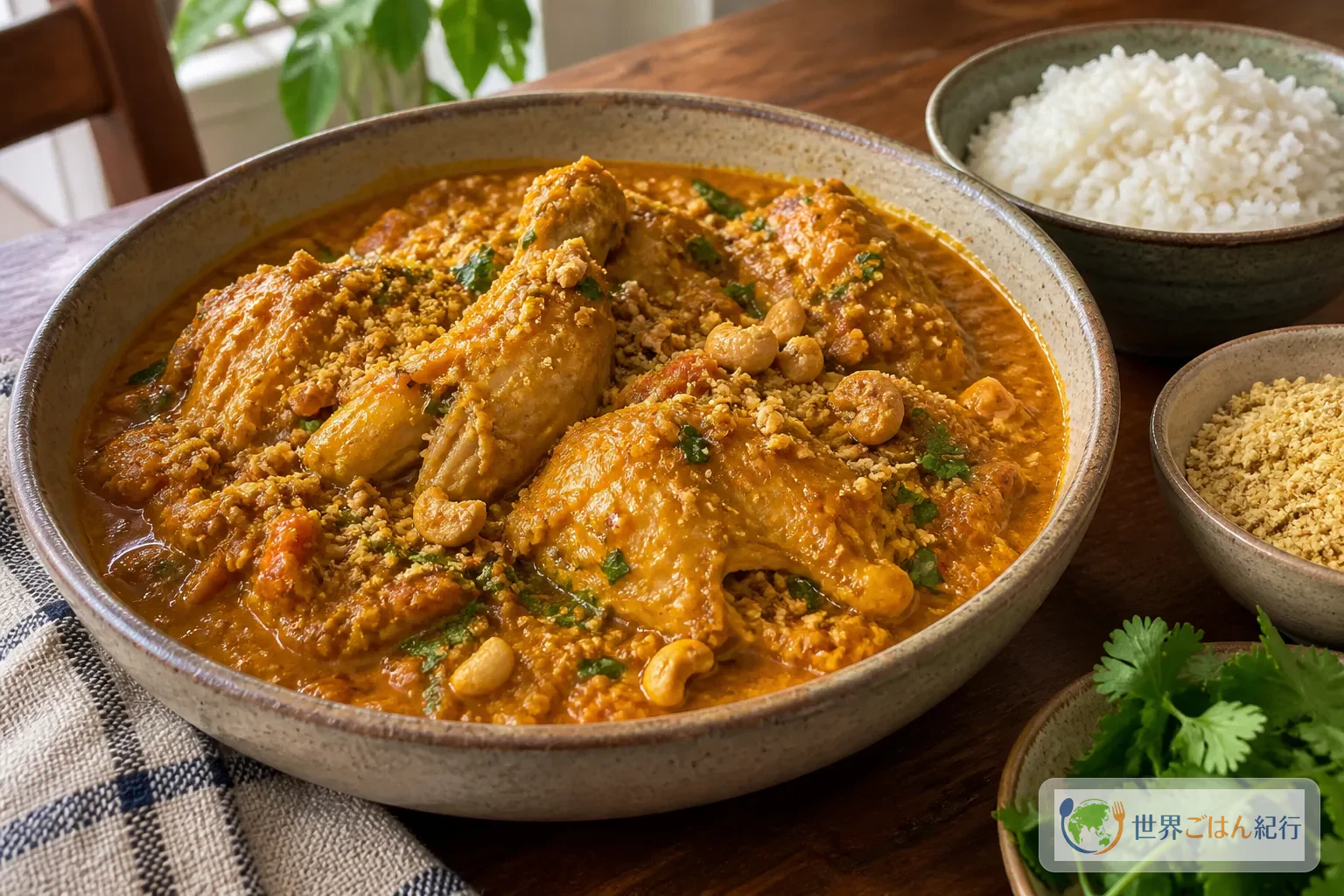
Lift the lid of the pot and the first thing you notice is the color of the sauce, even before the shrimp: an orange with a tinge of yellow. Put a spoon in and the sauce doesn't run. It parts slowly and closes back over, and red, curled shrimp drift in and out of view. Bobó de camarão is a shrimp dish loved in Bahia, in northeastern Brazil, and camarão is Portuguese for shrimp. Its flavor rests on boiled, mashed cassava, coconut milk, and dendê oil, which brings its own aroma and that color. The first time you make it, two questions come up: how much dendê oil makes it taste local, and how smooth should the cassava be? Guess at either one and the oil takes over, or the dish turns into heavy mashed potatoes.
Bobó de camarão and the Bahian table
In Portuguese, it is written bobó de camarão. The word bobó comes from the Fon language of West Africa.

Origins of bobó
Bahian food culture has no single origin. African, Indigenous, and European traditions blend in it, and so do the ingredients that arrived and the ways people learned to use them on the land. Cassava is native to South America and holds up the Brazilian table. Dendê oil came from the food culture of West Africa and gives Bahian dishes their color and aroma. Add coconut milk, chili, and dried shrimp, and you have what is now called Afro-Bahian cuisine.
Some accounts name ipetê, yam simmered with dendê oil and dried shrimp, as an ancestor of bobó. It is best read as one theory among several possible influences, not as a single fixed line of descent.
Bahian dishes also change between homes, ritual occasions, and restaurants, and Candomblé food is distinct from general Bahian cooking. When you make bobó, keep that background in mind and avoid treating a dish of faith as just a commodity.
Regional differences
Even within Brazil, some versions use yam instead of cassava, add dried shrimp, or use less coconut milk. Ingredients and presentation also shift from region to region and household to household.
How bobó tastes

The local character of this dish isn't strong heat. Dendê oil, coconut milk, chili, and shrimp all layer into the Bahian flavor, and bobó is less a sharp, spicy sauce than one where cassava carries the aroma of the oil and the roundness of the coconut. Taste in this order and you won't lose track:
- Is there the sweet, earthy quality of cassava?
- Is there the roundness of coconut milk?
- Does the dendê oil scent come from behind?
- Does the sweetness of the shrimp remain at the end?
Keep that order and the dish still tastes clearly like bobó, even if you swap some ingredients.
Ingredients (serves 4)

Do not eat shrimp raw; cook until the center of the flesh is white and opaque. Use separate knives and cutting boards for raw shrimp and vegetables, or wash them with detergent before use. If you have an allergy to shrimp, coconut, or palm oil, check the ingredient labels and do not force substitutes. Peel cassava and always boil it before use.
Choosing ingredients and equipment for bobó

Dendê oil
Buy dendê oil if you want to taste the Bahian aroma and orange color at least once. A bottle also works for finishing other dishes, such as acarajé and moqueca. Check that the label says edible red palm oil. It usually comes in about 1 lb (500 g) sizes, and cosmetic or non-food palm oil cannot be substituted.
Don't add it all at the start. Fry 1 tbsp (15 ml) with the aromatics and add the remaining 1 tbsp (15 ml) after turning off the heat, which keeps the color and aroma bright. If you're not used to strongly scented oil, cut it to 2 tsp (10 ml) for frying and 1 tsp (5 ml) for finishing. The color will be paler and the aroma milder. If that seems too little, add a few drops at a time over the plate. Oil that's already in the pot is hard to take out.
You can skip it, too. If you dislike the aroma or won't use it elsewhere, cook with 1 tbsp (15 ml) of rice bran oil and a little paprika for the color, and learn the cassava thickness and shrimp timing first. Just know it becomes a different dish: easier to eat, but without the aroma.
Cassava, shrimp, and stock
With 14 oz (400 g) of peeled shrimp you can't make shell stock, so use 2½ cups (600 ml) of unsalted seafood stock instead, divided between boiling the cassava and thinning the sauce. The flavor is lighter than with shell-on shrimp, but the prep is shorter. Frozen cassava works as well (see the FAQ).
Make substitutions one at a time so you can see what each change did. Whatever you swap, keep two things: a smooth cassava cream, and a brief cook for the shrimp at the end.
A food processor
If you already have a blender that handles a small batch, that's enough, and you can also chop the cassava finely and push it through a sieve. A food processor is worth buying if you want an even cassava cream, will use it for aromatics too, and have the storage space. Check the capacity, whether it handles hot ingredients, and how the feed opening and bowl work. Never run hot cassava in a sealed container, and always follow the product manual.
Steps
Preparation and making the sauce
How to tell when it is ready to plate
The sauce on the plate should not set like a mound but spread slowly beside the rice. If it all runs off the tilted spoon at once, there is a lot of stock. If instead a lump does not move, mix in the reserved stock 1 tbsp (15 ml) at a time.
The shrimp is best when the center is white, the surface red-orange, and the tail tip not fully shriveled. When the green cilantro, orange dendê oil, white rice, and pale farofa sit side by side, the one-color pot becomes a full table.
Fixing bobó texture and tough shrimp

If the hard fiber in the center is left in, a stringy texture shows up even after blending. When you split the cassava after boiling, remove any white, hard streak running through the center. Frozen cassava breaks easily, so check with your fingers before it crumbles completely.
If watery, remove the lid and simmer over low heat for only 2 to 3 minutes. If too heavy, add hot shrimp stock 1 tbsp (15 ml) at a time. Avoid cold water, which lowers the temperature and gives the shrimp extra cooking.
Don't boil hard once the shrimp is in. When the center is white and opaque, lower to low heat as you add the cassava cream. If the shrimp finishes first, lift it out with a skimmer, adjust the sauce, and return it for the last 30 to 60 seconds. Shrimp that has already toughened won't fully recover, so next time cook the aromatics down first and cook the shrimp briefly right before the sauce goes in.
Serving bobó de camarão, with variations

At the table, bobó is eaten with white rice and farofa. Scoop the sauce over the rice, mix in a little farofa, and after the shrimp are gone, go back for the sauce alone once more. The dish comes together on the plate with the rice, not ingredient by ingredient. Farofa's light grit balances the rich sauce. You can leave it out, but the plate will feel different. If you have no cassava flour, dry-toasted fine breadcrumbs can stand in, and the rice can be cooked with a little coconut milk.
On days when bobó is the center, keep the sides to rice and farofa so the flavor stays focused. To stay with the same Bahian aroma, try the bean-based acarajé (in Japanese) or the seafood and coconut moqueca baiana. For the big-pot Brazilian table of beans and meat, go on to the black bean stew feijoada, where the same farofa takes on a different role.
Variations

White fish. Cut 14 oz (400 g) of boneless white fish into 1 inch (3 cm) cubes. Add it to the aromatics, cook 2 minutes per side, and add the cream when the flesh is white and flaking. Without shrimp, it's a bobó-style seafood stew rather than bobó de camarão.
Mushrooms and hearts of palm. Switch the shrimp stock to vegetable stock and add 5.5 oz (150 g) of shimeji and 3.5 oz (100 g) of hearts of palm for a plant-based version. The coconut milk and dendê aromas stay, though it won't taste like the shrimp dish. Rinse jarred hearts of palm before use, since they're salted.
Dried shrimp. For a deeper Bahian flavor, fry 10 g of rehydrated dried shrimp with the aromatics. Because the shrimp flavor gets stronger, reduce the salt for the raw shrimp and the overall salt by 2 g each, then taste. Not suitable for anyone with a shellfish allergy.
Storage and frequently asked questions

How should I refrigerate it?
Once it has cooled, move it to a shallow container and refrigerate the sauce and rice separately. Because it contains shrimp, finish it within 2 days. Reheat over low heat, stirring, until hot to the center. Repeated reheating toughens the shrimp, so portion out only what you'll eat.
Can I freeze it?
You can, but the cassava and coconut milk may separate and the shrimp's texture changes. Take the shrimp out a little early and freeze only the sauce, in portions. After thawing, return the shrimp and warm over low heat to the center. Freeze the rice separately.
Can I use frozen cassava?
Yes. Boiling times differ by product, so check with a fork rather than relying only on the package time. If fibers remain in the center, remove them while warm. For a watery frozen product, reduce the stock added to the cream by 3.5 tbsp (50 ml) from the start.
Sources
These are the materials used to check the dish's history, regional character, and cooking steps. Accessed 17 July 2026.
English sources
- Instituto Brasil a Gosto, "Shrimp Bobó"
- Google Arts & Culture / Instituto Brasil a Gosto, "Shrimp Bobó"
- Food.com, "Shrimp Bobo"
- FoodSafety.gov, "Safe Minimum Internal Temperatures"
- Instituto do Patrimônio Histórico e Artístico Nacional (IPHAN), intangible heritage of Bahia
- Conselho Nacional de Segurança Alimentar e Nutricional, "No tabuleiro da baiana tem..."
- Companhia de Desenvolvimento e Ação Regional da Bahia, dialogue on dishes of African origin
- Fundação Joaquim Nabuco, "Cozinha Baiana"
- Globo Receitas, "Bobó de camarão com farofa de dendê"
- UOL Nossa, "Bobó de camarão e mais: prato com tempero baiano esquenta de Norte a Sul"