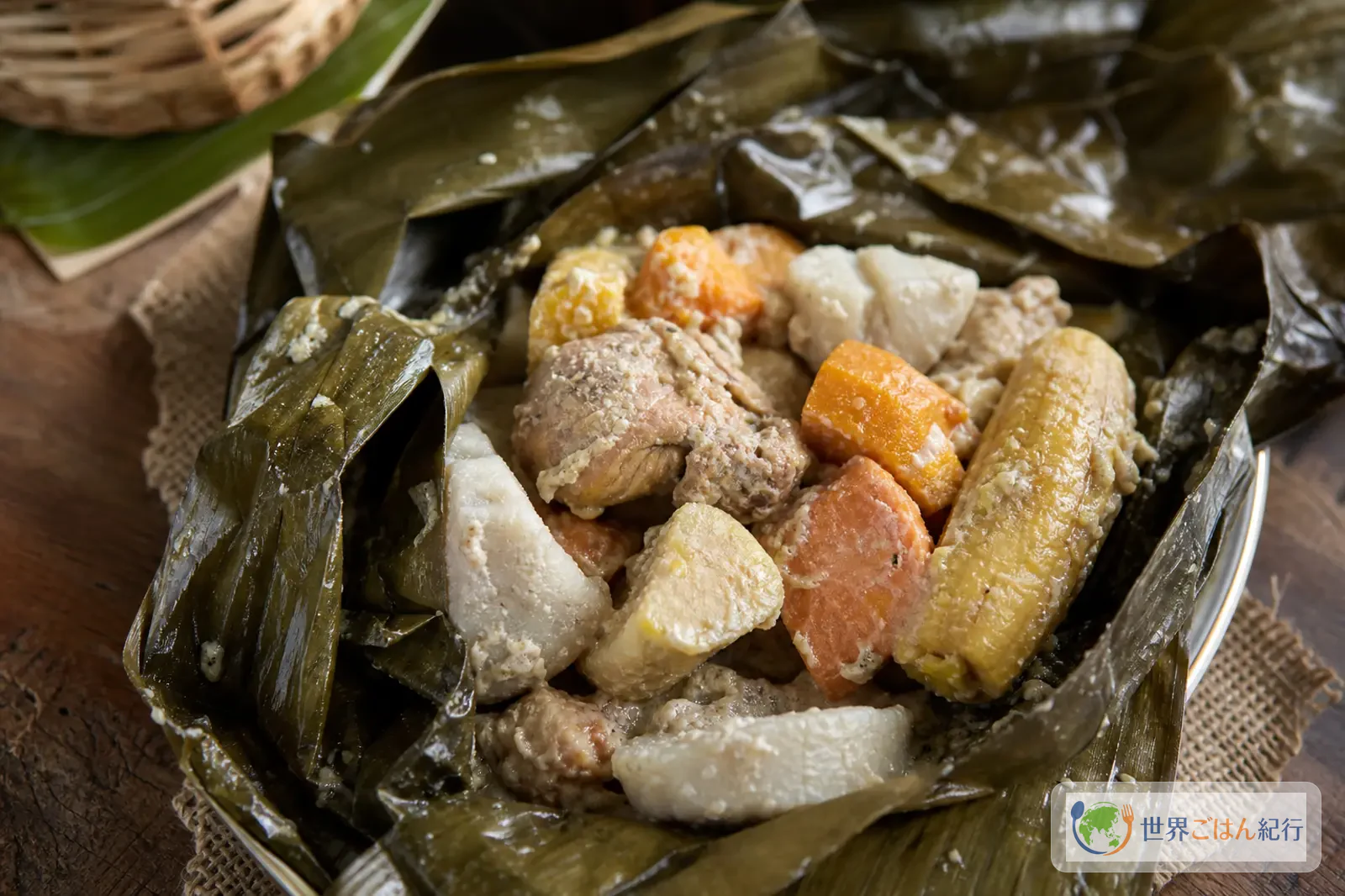
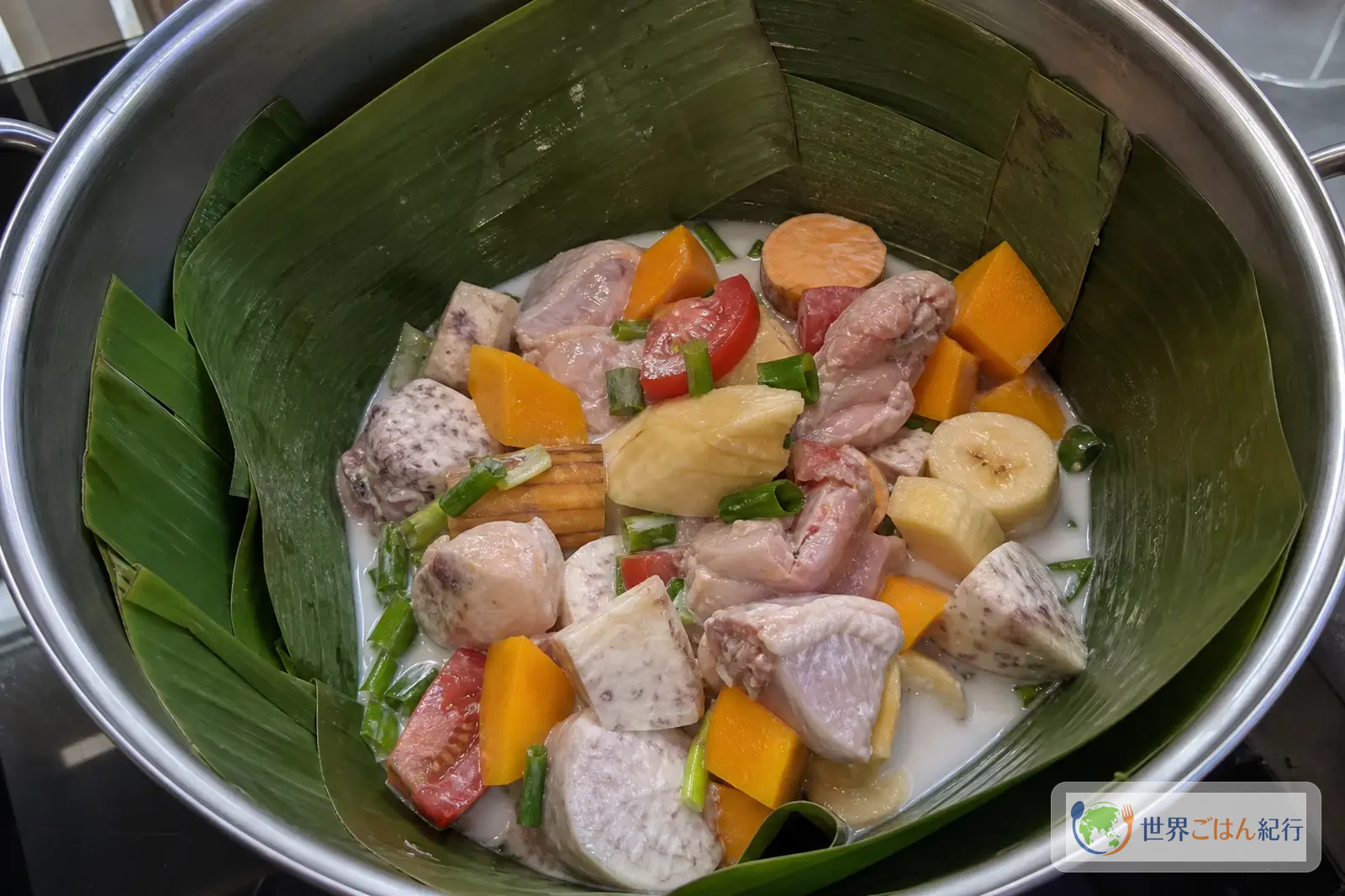
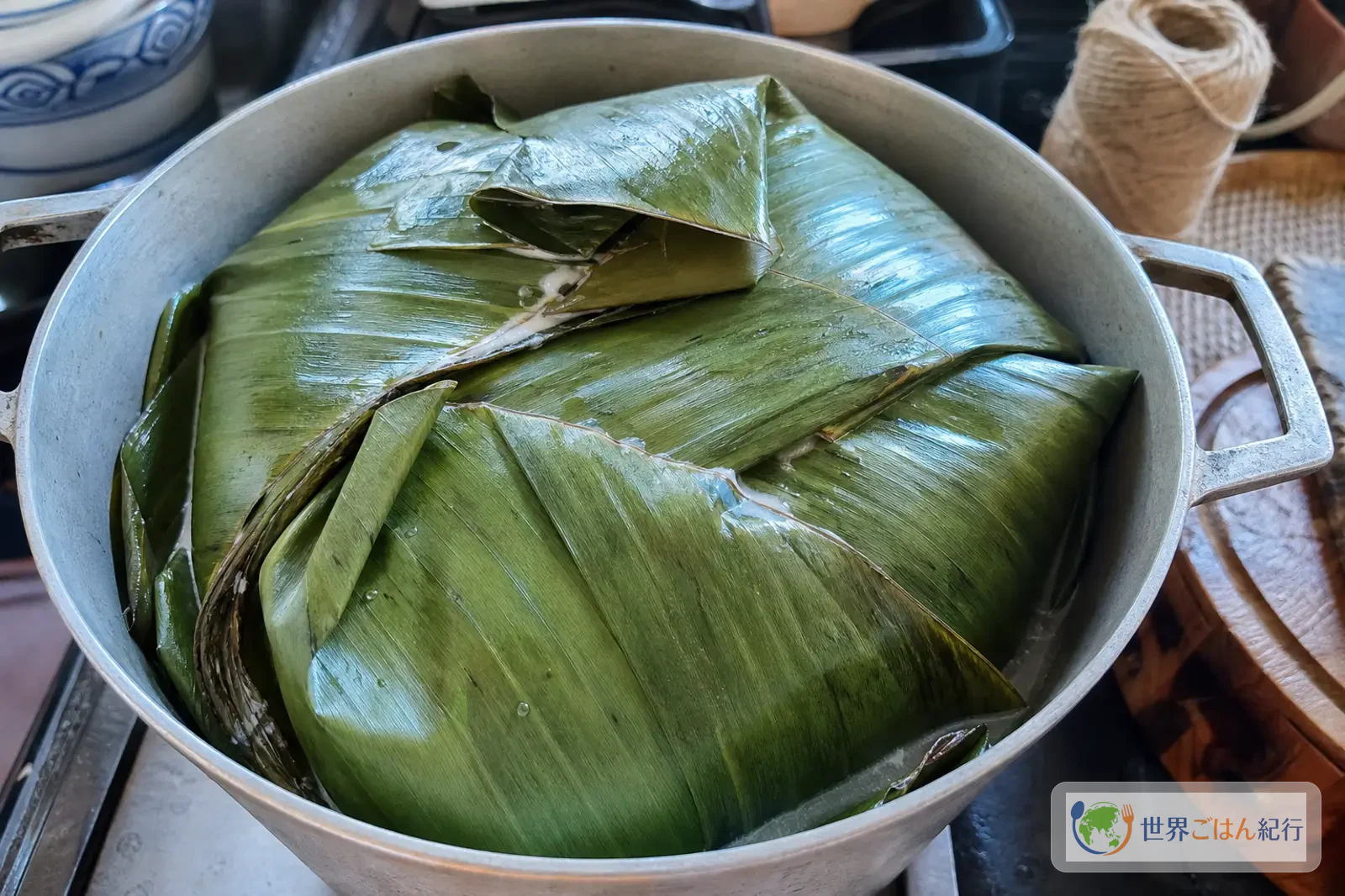
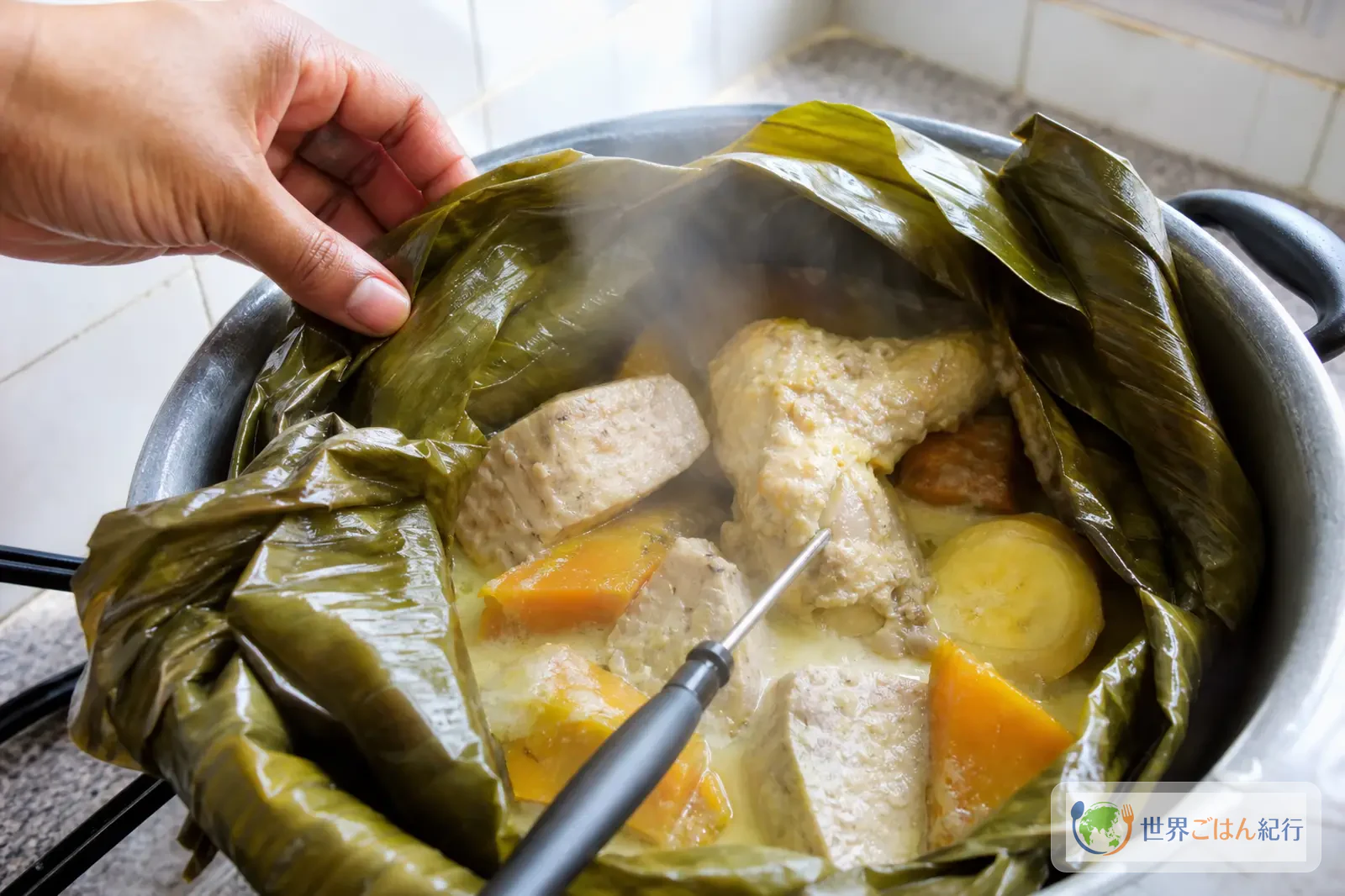
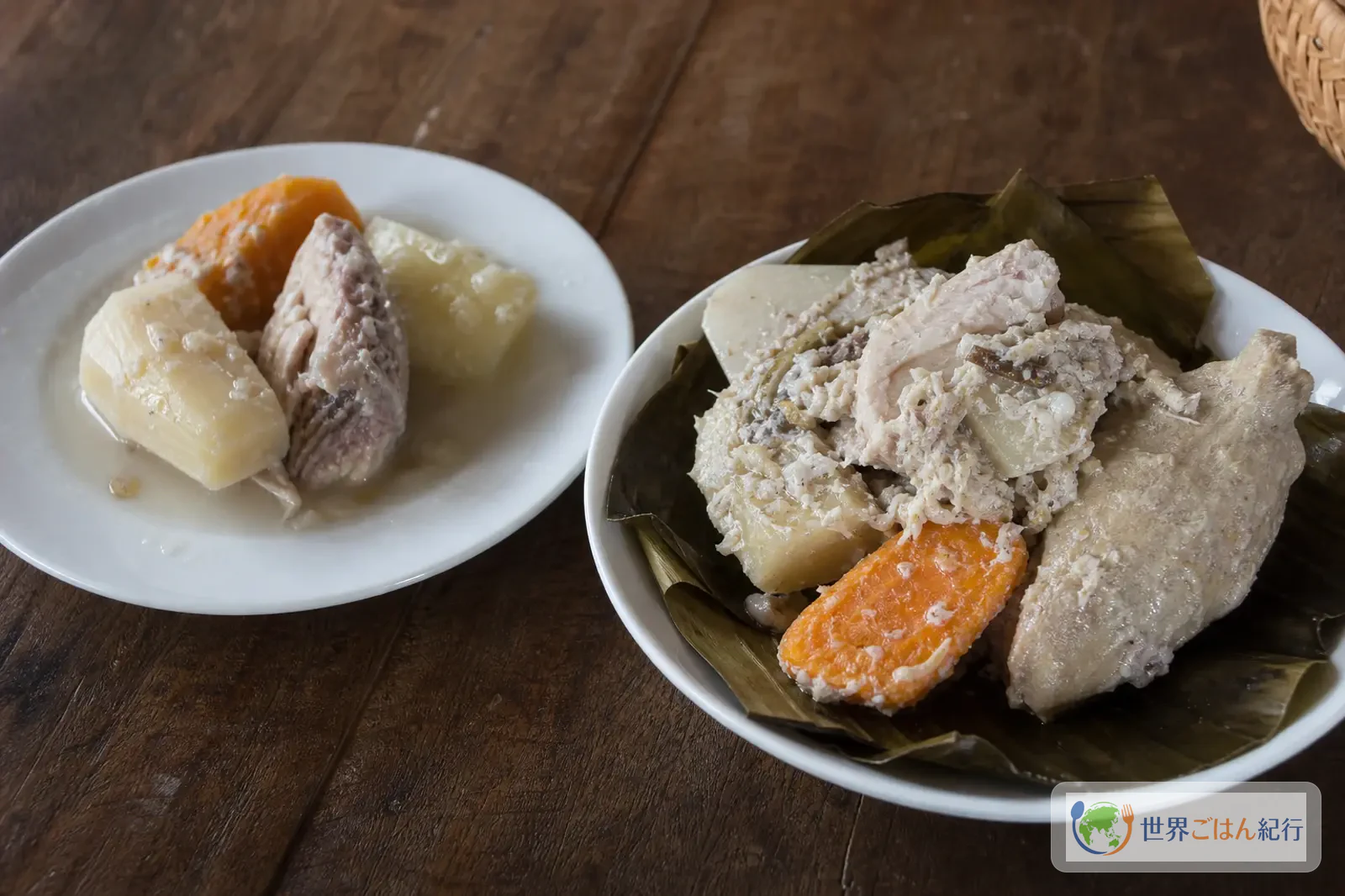
Peel back the banana leaf and the steam comes first, carrying coconut and that green, grassy scent the leaf gives off as it warms. Underneath, chicken, taro, sweet potato, squash and slightly green banana have softened together in coconut milk. This is bougna, the leaf-wrapped feast of the Kanak people of New Caledonia: rich, gently sweet from the roots and the coconut, and made for sharing. You don't need an earth oven to make it. A deep home pot with a steaming rack will do, as long as you keep the leaf's aroma, the heft of the roots, the coconut milk's moisture and a slow, steady steam.
What bougna is
Bougna is the signature dish of Kanak cooking. Fish, chicken or shellfish go in with taro, yam, sweet potato and banana, all moistened with coconut milk and wrapped in banana leaf. Traditionally the parcel cooks slowly in an earth oven heated with hot stones, though it can also be made in a pot.
| What to look at | Local version | Home kitchen version |
|---|---|---|
| Meat or fish | Chicken, fish, shellfish; in some places other meats too | Start with bone-in chicken thighs. For fish, shorten the cooking time |
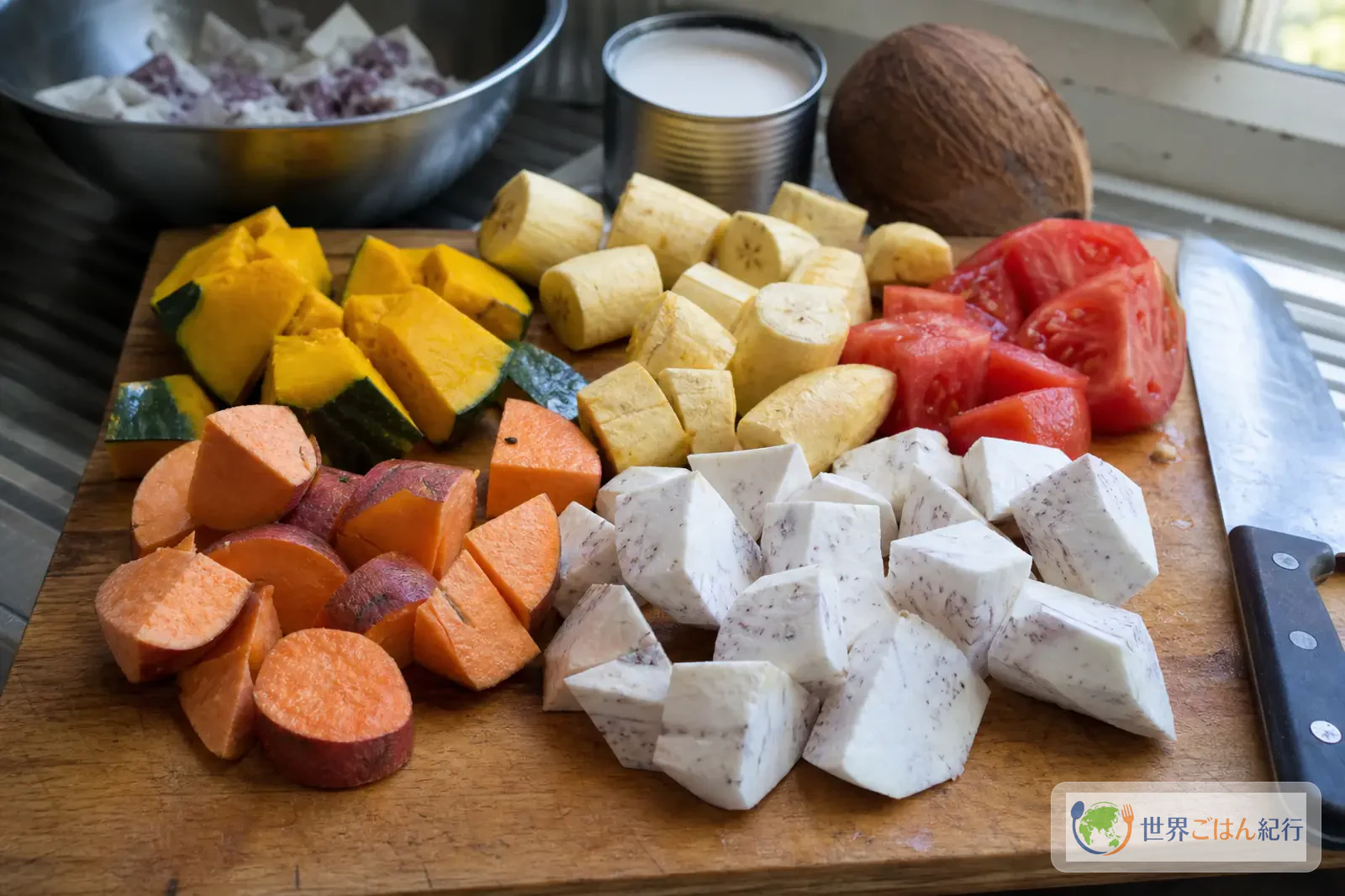
| Starch | Taro, yam, sweet potato, banana | Build thickness with taro, sweet potato, squash and greenish banana |
| Aroma | Banana leaf, coconut milk | Use frozen banana leaf and canned unsweetened coconut milk |
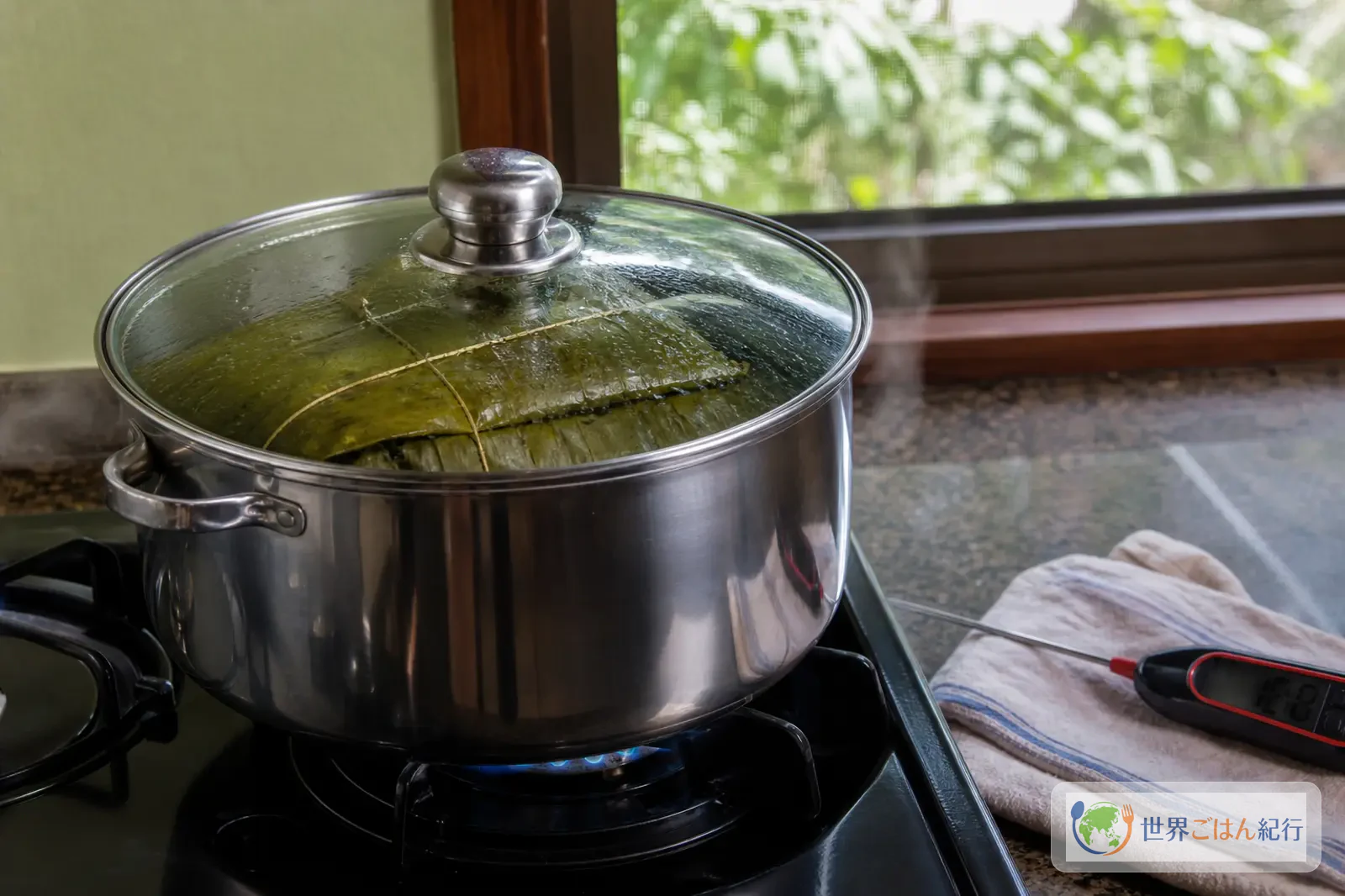
| Heat | Earth oven, hot stones, long steam-roasting | Keep steam with a deep pot and rack, without soaking in water |
| How to eat | Open the leaf and share from the platter | Lay the leaf on a plate and add white rice or greens to make it easy to eat |
The key thing to understand is that bougna is a wrapped steam, not a stew. Simmer the ingredients in water and the roots turn watery while the coconut thins out. The juices stay sealed inside the leaf, and the water at the bottom of the pot is there only to make steam.
If you like leaf-wrapped cooking, Papua New Guinea's mumu, the Central African Republic's maboke and Nicaragua's vaho are close relatives. For banana as a staple food, Uganda's matooke is worth a look.
Ingredients (serves 4)
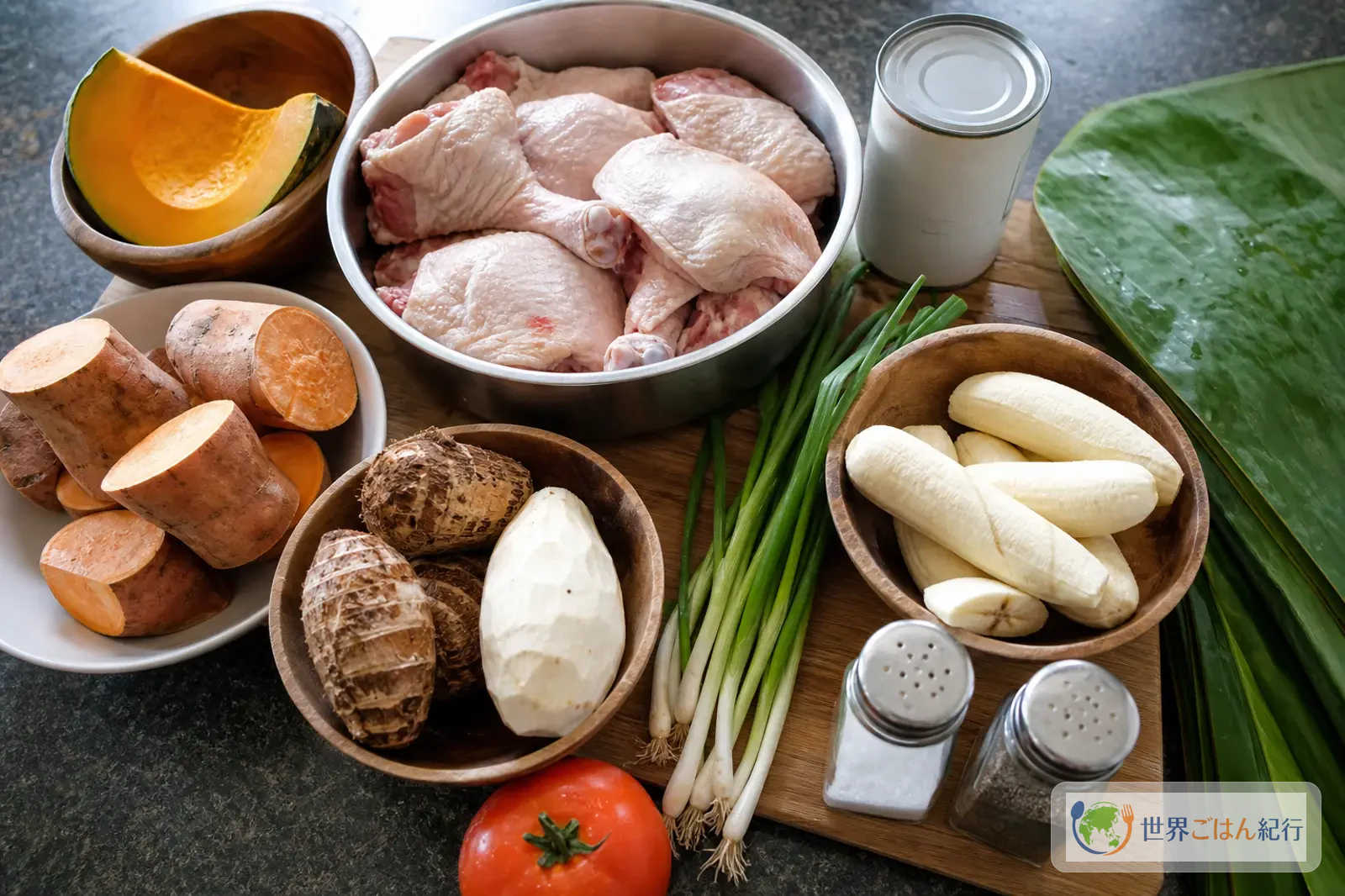
This amount is for 4 servings that fit in a deep home pot. As a big local wrapped dish it is modest, but with the roots and coconut stacked it is plenty if you serve white rice alongside.
If using chicken, cook it through to the center. Insert a thermometer into the thick part and check for 167°F (75°C) or higher before serving. For fish, cook until the center is white and the flesh flakes with chopsticks. Before you cook, ask everyone eating about allergies to coconut, fish or chicken.
Choosing ingredients and substitutes for bougna
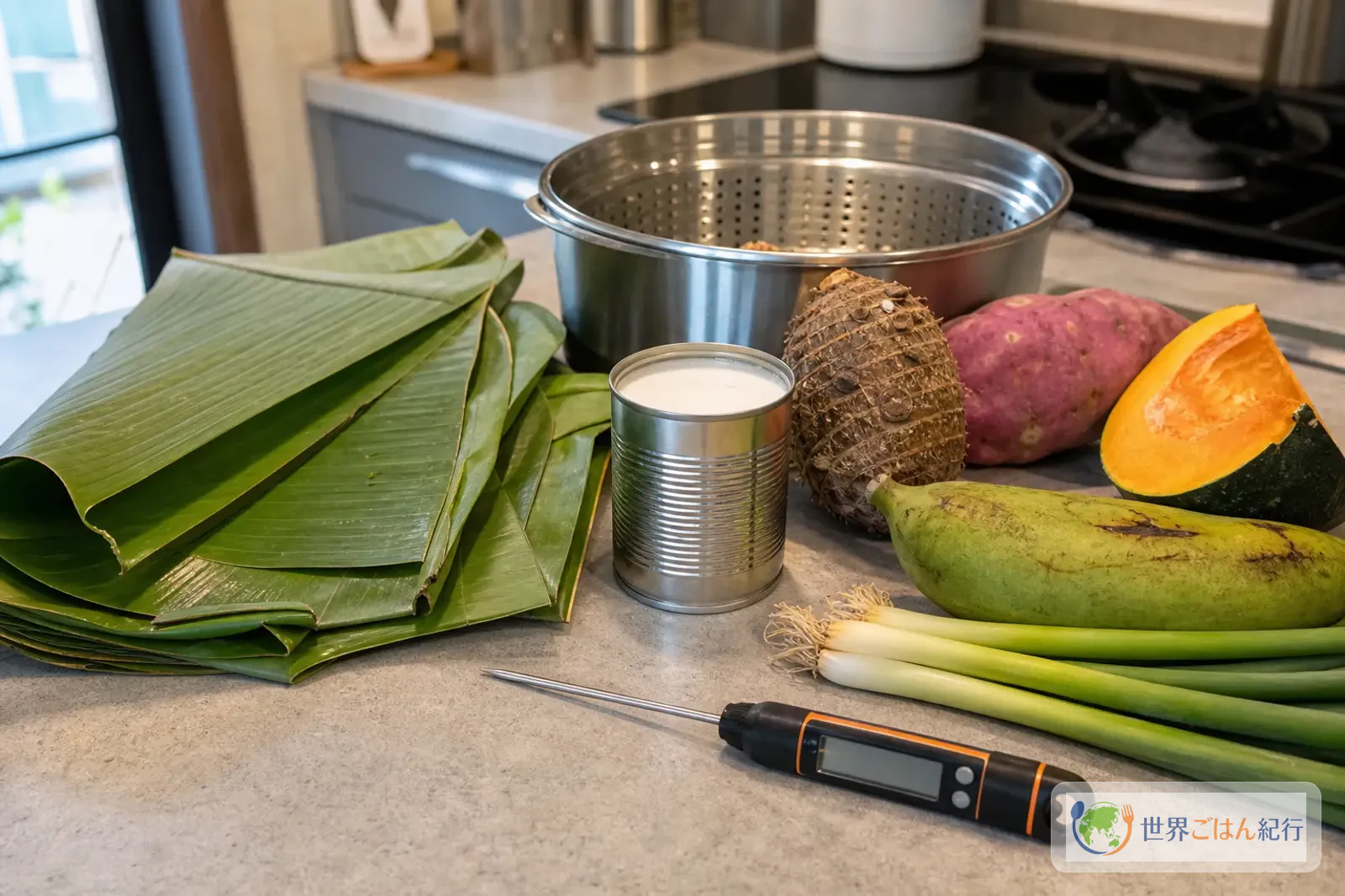
Chicken, sweet potato, squash, onion and tomato are easy to find anywhere. Banana leaf carries the aroma of the dish, and you'll usually find it frozen at Asian, Filipino, Thai or Vietnamese grocery stores. For coconut milk, buy unsweetened cans meant for cooking rather than a drink. Light versions are too thin to coat the roots and taste watery after the long steam.
The equipment matters as much as the shopping. A two-tier steamer or a tall rack keeps the parcel clear of the water. On a low rack the roots soak it up like a simmered dish. A probe thermometer is worth having too, because with bone-in chicken steamed this long, looks won't tell you whether it's cooked through safely or needs more time.
Taro, yam, poingo banana and an earth oven are hard to come by outside the Pacific, so it helps to know what can be swapped and what defines the dish.
| Local-leaning ingredient | Practical alternative | Difference in the result |
|---|---|---|
| Taro (local varieties) | Satoimo (Japanese taro) or frozen satoimo | Gives stickiness. Too small and it crumbles |
| Yam | Sweet potato, some squash | Japanese nagaimo has too much water and sliminess to stand in for steamed roots |
| Poingo banana | Greenish banana, plantain | Fully ripe banana alone turns sweet, so use a little |
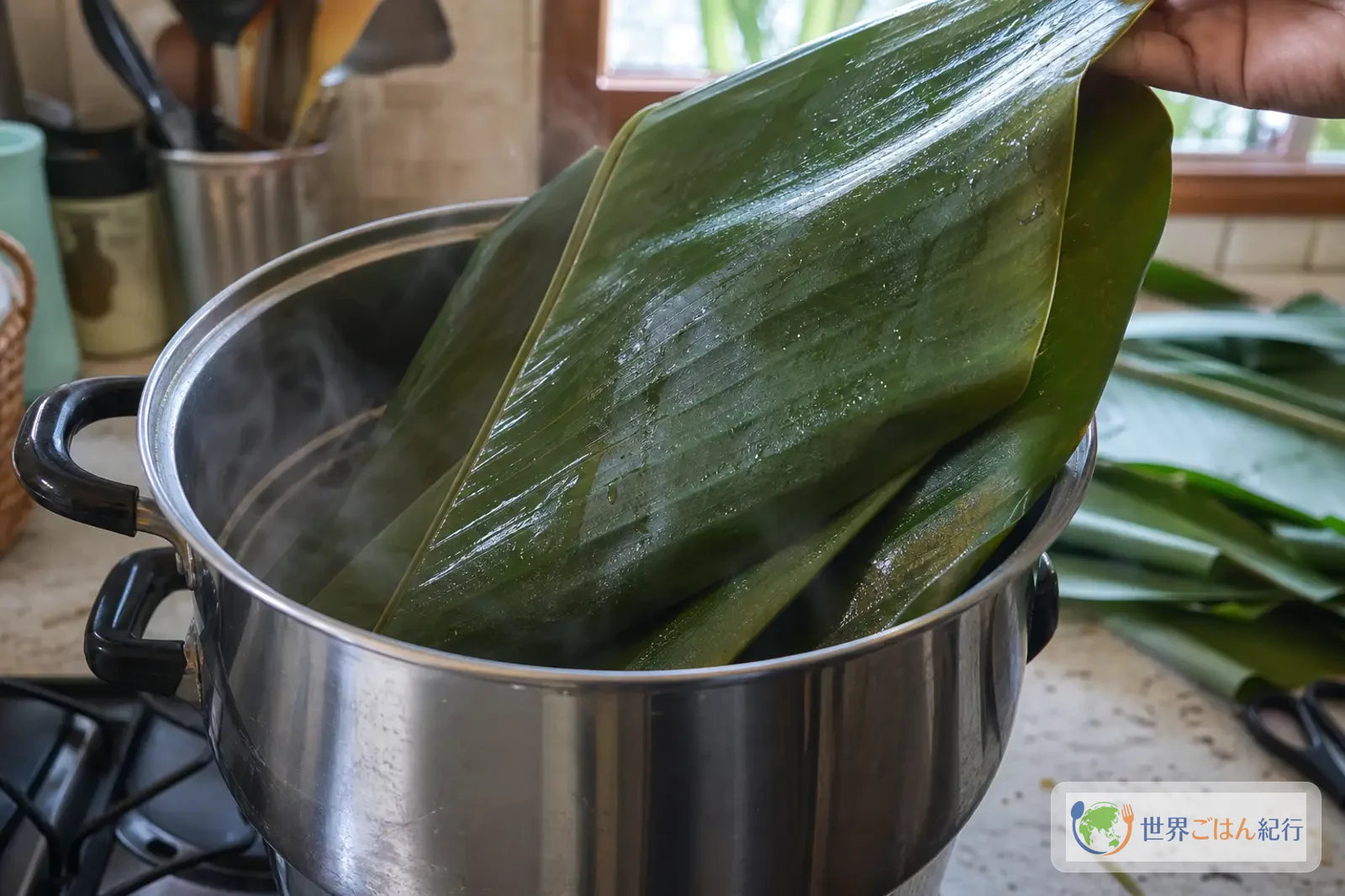
| Banana leaf | Frozen banana leaf | If none, you can steam with parchment and aluminum foil, but the leaf aroma is weaker |
| Coconut milk | Unsweetened canned for cooking | Replacing with milk or cream moves the dish away from its outline |
| Earth oven | Deep pot, rack, heavy lid | No smoky aroma, but the moisture and structure of the parcel are easy to reproduce |
Coconut milk is the one ingredient to keep. Swap in milk or cream and you end up with creamy steamed roots rather than a South Pacific leaf-wrapped dish. Parchment works fine the first time if you have no leaf, but track down frozen banana leaf for your second try. The difference in aroma is worth it.
Method: soften the leaf and steam the roots without breaking them
Bougna is not a dish that builds its flavor from browning. You make steam from the water at the bottom of the pot and let the meat and roots loosen slowly inside the leaf. If you keep the heat high, the water at the bottom runs low and the leaf scorches and turns bitter. Keep up the steam, and do not let the parcel soak in water.
Common bougna problems and fixes
| Problem | Cause | How to recover |
|---|---|---|
| Roots are hard | Steam too weak; pieces cut too large | Add ½ cup (100 ml) boiling water and steam 15 more minutes on medium-low |
| Watery | The parcel sat in water; the leaf tore | Move to a plate, drain off some liquid, and add only a little warmed coconut milk |
| Chicken is dry | Steamed too long; the parcel came open | Spoon coconut sauce over it when serving, and don't open it partway next time |
| Coconut separates | Kept on high heat; the bottom got too hot | Lower the heat, and adjust on the plate with a sauce made with 2 tbsp water |
| Leaf tears | Folded cold; the rib was hard | Soften it with steam, and lay another leaf or parchment over the tear |
| Flavor is blurry | Salt did not reach the roots | Add a pinch of salt and 1 tsp lemon juice to the finishing sauce |
Hard roots are the easiest fix, since a little more steaming rescues them. A parcel that has soaked in water or a scorched leaf is much harder to save. Keep the water below the rack and away from the food, and most of these problems never happen.
Serving and storing bougna
At the table
Bougna is meant to be opened and shared at the table rather than plated for each person. Lay fresh leaves on a platter, set out the chicken and roots in big pieces, and spoon over a little of the white coconut sauce just before eating. Pour on all the liquid and the roots turn heavy.
White rice, salt-boiled greens, and cucumber and onion dressed with lemon all go well alongside. Put lime or lemon at the edge of the plate so everyone can squeeze a few drops over the coconut to cut its sweetness. If you want heat, serve a little chili sauce at the table instead of adding it to the pot.
For more leaf and coconut cooking, try Indonesia's lemper, a leaf-wrapped rice, or ayam betutu, where the chicken is wrapped in spices and takes on a completely different aroma. On days you want coconut with rice, Malaysia's nasi lemak makes a light base.
Storage and reheating
Bougna is best eaten soon after the leaf is opened. Don't leave leftovers at room temperature in the leaf. Move the chicken and roots to a shallow container and keep the coconut sauce separately so nothing turns watery overnight.
| Method | Time | Reheating |
|---|---|---|
| Room temperature | Within 2 hours | Shorter in summer or on humid days |
| Refrigerator | 2 days | Move to a plate, spoon on 2 tbsp sauce, and microwave at 600 W for 2 to 3 minutes |
| Freezer | 2 weeks | Remove the leaf and portion only the chicken and roots. Thaw in the refrigerator, then steam again |
To reheat in a steamer, set the plate inside and steam 8 to 10 minutes over medium-low heat. If the coconut sauce has set, warm it in a small pot over low heat with 1 tbsp water and stop as soon as it simmers. A hard boil makes the fat float.
Frequently asked questions
How do I change it for fish?
Steam the roots alone for 30 minutes first, then add the white fish partway through and finish in 45 to 55 minutes. Steaming fish for 90 minutes from the start makes the flesh tight. Cut the salt a little and add more lemon at the end.
Can a home steamer version be called bougna?
Think of it as a bougna-style dish, since heat moves differently than in a local earth oven. Keep the structure of roots and meat or fish wrapped in leaf and steamed slowly in coconut milk, and you stay close to the real thing.
Is it a failure if the coconut milk separates?
A little floating fat is fine. A sustained hard boil makes separation obvious. If that happens, move everything to a plate and spoon on a sauce of 2 tbsp separately warmed coconut milk mixed with 1 tbsp water to bring back the look and mouthfeel.
Can I make it lighter for children?
Leave out the heat and let everyone add lemon at the table. If the coconut feels heavy, go easy on the sauce and serve a fresh side of cucumber or greens.
What to cook next
To continue with leaf-wrapped dishes, first look at mumu for the idea of a big wrapped steam, and on days you lean toward fish move to maboke; even with the same banana leaf, the way the aroma is used changes. To go deeper into roots and banana as a staple, matooke is the closest next read.