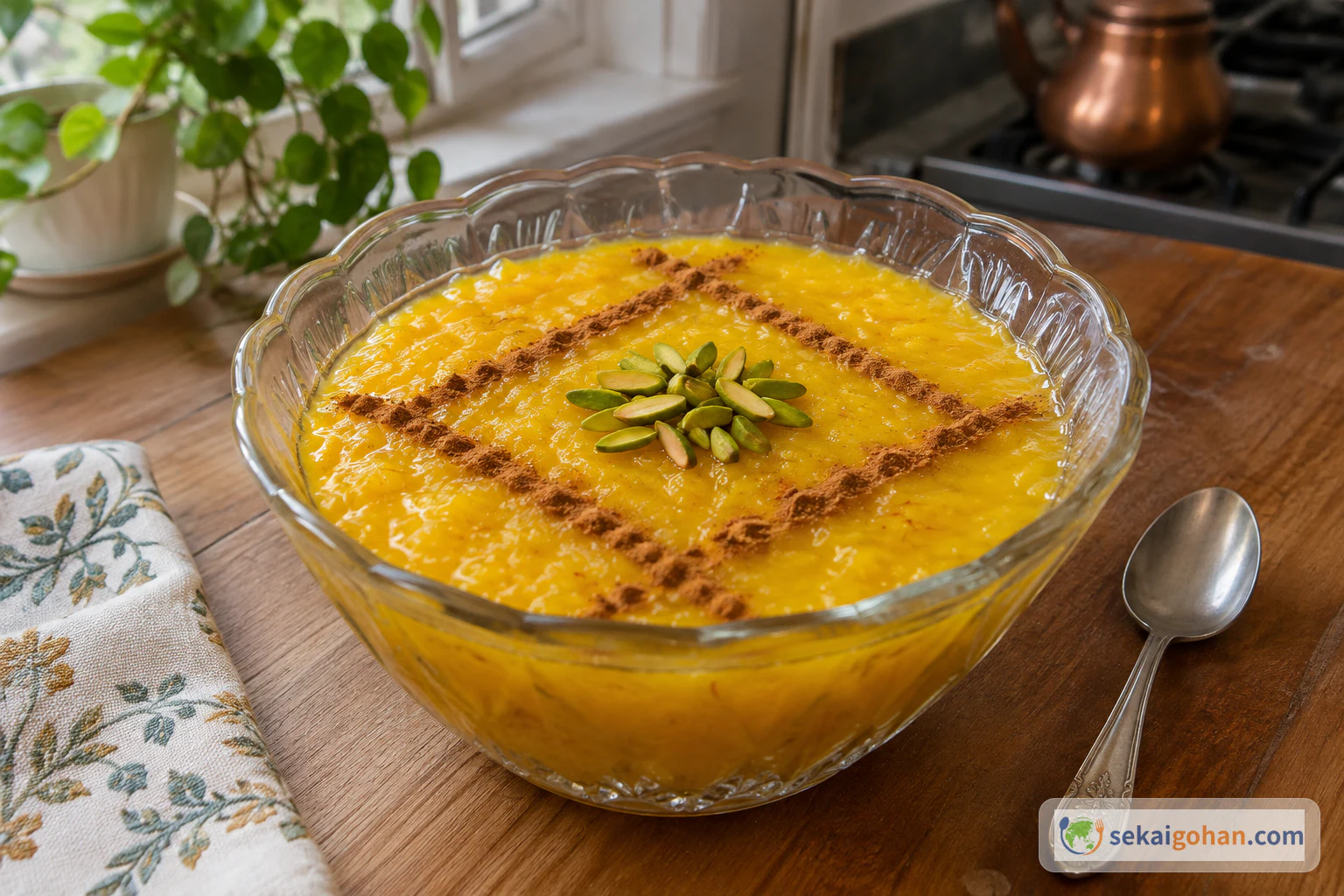
Trace the bottom of the pot with a wooden spoon and the grains slowly close back in behind it. Aşure is a Turkish sweet grain pudding: wheat, beans, dried apricots, figs, raisins, and nuts cooked together in one pot until they loosen into each other, then scattered with pomegranate and cinnamon. It is eaten warm or chilled, and its sweetness is soft and fruity, never sticky. In Turkey it is made in the month of Muharram and shared with neighbors, so the pot always holds more than one household will eat.
About Aşure, Turkey's Noah's Pudding
In English aşure is written Ashure, or called Noah's pudding, and it is often told together with the legend of Noah's Ark. Unlike a flan, it is not set smooth. It is a spoonable pot of grains, beans, and fruit, and what sets it apart from other Middle Eastern sweets is the custom of making a large amount at home and handing it out to neighbors and relatives.
It is much more homey than syrup sweets like baklava and knafeh. It works as a small bowl after a meal or as a sweet porridge in the morning. If you have made Armenia's harissa or Bangladesh's haleem, the long, patient cooking of wheat will feel familiar.
Regional Versions of Aşure
Aşure changes from region to region. Fava beans, black-eyed peas, corn, pomegranate, and sesame all turn up. Some regions use rice with or in place of wheat, some sweeten with pekmez instead of sugar, and some add a little meat. For a first batch, stick to the sweet version with wheat, beans, fruit, and nuts; it is easier to shop for, and the taste is easier to get right. For another celebration porridge built on grain, see Kazakhstan's nauryz kozhe.
Ingredients

This serves 6, or 8 in smaller bowls. If using dried beans, soak them the night before. Using canned beans greatly shortens the soaking and parboiling time.
Ingredients That Cause Hesitation When Shopping
With aşure, the result changes not with sugar or ordinary nuts but with wheat, dried beans, and the flower water. Treat as online candidates only what you can't gather at your local supermarket; easy-to-find fruit and sugar are fine from ordinary shopping.
If you cannot find wheat berries, using coarse bulgur makes it come together more easily as a home version. It softens faster than traditional wheat berries, so rather than cooking it from the start, it is easier to handle if you add it after building the wheat's thickness. Bulgur can be found at Middle Eastern or international grocers or from online sellers.
Chickpeas can be made from canned too, but reconstituting dried ones keeps the skins from breaking easily even in sweet wheat, and leaves aroma. They also go into hummus and falafel, so if you will keep cooking Middle Eastern food, a bag of dried chickpeas is worth having.
Orange blossom water is not required. But just 1 tsp switches it from "sweet bean porridge" to the aroma of a Middle Eastern sweet. It also goes into knafeh and baklava, so if you will keep making sweet Middle Eastern desserts, a bottle goes quickly.
Choosing Ingredients for Aşure
The base is hulled wheat, white beans, chickpeas, dried fruit, and sugar. Walnuts, hazelnuts, pomegranate, cinnamon, cloves, orange peel, and orange blossom water are layered on top, and the full list can run to more than 15 ingredients. On a first try, that many ingredients make the work harder than the taste is worth. Start with wheat, beans, dried fruit, nuts, and a citrus aroma.
It helps to know the role each one plays. Wheat brings "grains and thickness," beans bring "chew," dried fruit brings "sweet-sourness," and nuts bring "the final toastiness." Keep those four, and even with just a regular supermarket and online shopping you get the outline of aşure.
| What to protect | What can be substituted | What is hard to substitute |
|---|---|---|
| The grain feel of the wheat | Coarse bulgur if there are no wheat berries | Rice alone weakens the aşure-like chew |
| Softness of the beans | Rinsed canned beans if dried beans are hard to find | Hard beans are difficult to fix afterward |
| Sweet-sourness of the fruit | Ordinary supermarket dried apricots, figs, and raisins are fine | Sugar alone makes the flavor flat |
| Aroma of the finish | Cinnamon, walnuts, and pomegranate are enough | Even a little orange blossom water changes the character |
Fixing Aşure Thickness and Sweetness

The most common failure is aşure that looks right while hot, then firms up too much in the refrigerator. Wheat and beans keep absorbing liquid as they cool. Stop cooking when it is a little thicker than drinking yogurt, and once chilled it will be easy to scoop with a spoon.
| Condition | Cause | Fix |
|---|---|---|
| Runny, and the ingredients sink in the bowl | Wheat undercooked, or too much water | Add 5 minutes at a time over low heat. Stir the bottom and add sugar after thickness appears |
| Hard like rice cake after refrigeration | Reduced too much while hot | Stir in 2 tbsp of boiling water at a time. If the aroma is faint, add a little cinnamon |
| Only the beans are hard | Not parboiled enough | They hardly soften after sugar goes in. Next time, cook the beans first until they can be crushed with a finger |
| Sweetness is blurry | Not enough salt or fruit acidity | Add a pinch of salt, and increase the orange zest or pomegranate |
| Aroma is too strong | Too much flower water | Divide into bowls while warm and add more cinnamon and nuts to disperse the aroma |
If you want it less sweet, resist cutting the sugar in half. The wheat and beans come forward too much, and it starts to taste like a sweet staple rather than a dessert. Make it with 4.5 oz (130 g) the first time and bring lightness with pomegranate and cinnamon at the finish.
Serving, Storing, and Varying Aşure
Serving Aşure
Warm aşure eats like a sweet breakfast porridge; chilled, it makes a small dessert after a meal. After a salty mercimek çorbası or a strongly herbal tabbouleh, a bowl of beans and wheat fits right in. It sits well beside other festive grain dishes, such as Kazakhstan's nauryz kozhe.
Storing Aşure

Aşure can be eaten the day you make it, but after half a day in the refrigerator the sweetness of the fruit moves into the wheat and the flavor rounds out. Divide it into small bowls before chilling, and the surface sets neatly and the bowls go straight to the table.
| Storage method | Guide | How to bring it back when eating |
|---|---|---|
| Refrigerated | 3 days | As is, as a cold dessert. If hard, stir in 1 tbsp of boiling water |
| Reheating | Until the next day | Over low heat in a small pot. It scorches easily, so add a little water |
| Freezing | Not recommended | The texture of the wheat and beans tends to turn crumbly |
| Taking to a gathering | Same day | Add the nuts and pomegranate just before eating |
Regional Variations at Home
| Variation seen there | How to include it at home | Caution |
|---|---|---|
| Mixing rice into the wheat | Add 2 tbsp of rice only when you have few wheat berries | If rice becomes the star it drifts toward porridge |
| Sweetening with pekmez | Mix in a little grape concentrate or dark brown sugar | All dark brown sugar makes the color and aroma too strong |
| Adding corn | Add just 3 tbsp of canned corn | The sweetness drifts Western, so keep it small |
| Topping with pomegranate or sesame | Prioritize pomegranate if you have it. Sesame up to 1 tsp | Too much topping hides the flavor of the wheat |
Frequently Asked Questions
I have no wheat berries. Can I make it with rice only?
Rice alone makes a sweet porridge, but it loses the chew of the wheat at the core of aşure. Coarse bulgur is closer. Bulgur breaks down quickly, so instead of cooking it for 45 minutes from the start, add it before step 4 and cook for 15 to 20 minutes.
Is it okay with canned chickpeas and white beans?
Yes. Drain them, rinse lightly, and add them in step 3. Canned beans are already soft and their skins tear with long cooking, so shorten step 3 to 10 minutes and stir gently.
Is orange blossom water required?
Orange zest alone gives enough aroma. Adding 1 tsp of orange blossom water brings the floral aftertaste of a Middle Eastern sweet, but too much tastes like perfume, so keep it to 1 tsp the first time.
Is it eaten warm or chilled?
Either way. Freshly made, the wheat aroma stands out; chilled, the sweetness of the dried fruit blends in. Eat it warm on the day and cold in a small bowl the next day, and you'll taste the difference.
I can't get pomegranate.
You can make it without. For acidity, add a little more orange zest at the finish, or use fewer raisins and more dried apricots. Strawberries and blueberries look festive but pull away from the grain character of aşure.
It's a dish made in large amounts. Is 6 servings okay?
In Turkey it is often made in a big pot and shared, but a large first batch makes the thickness hard to adjust. Learn the wheat thickness and bean softness with 6 servings, then double the ingredients the second time. Even doubled, use a heavy pot, because the bottom scorches easily.