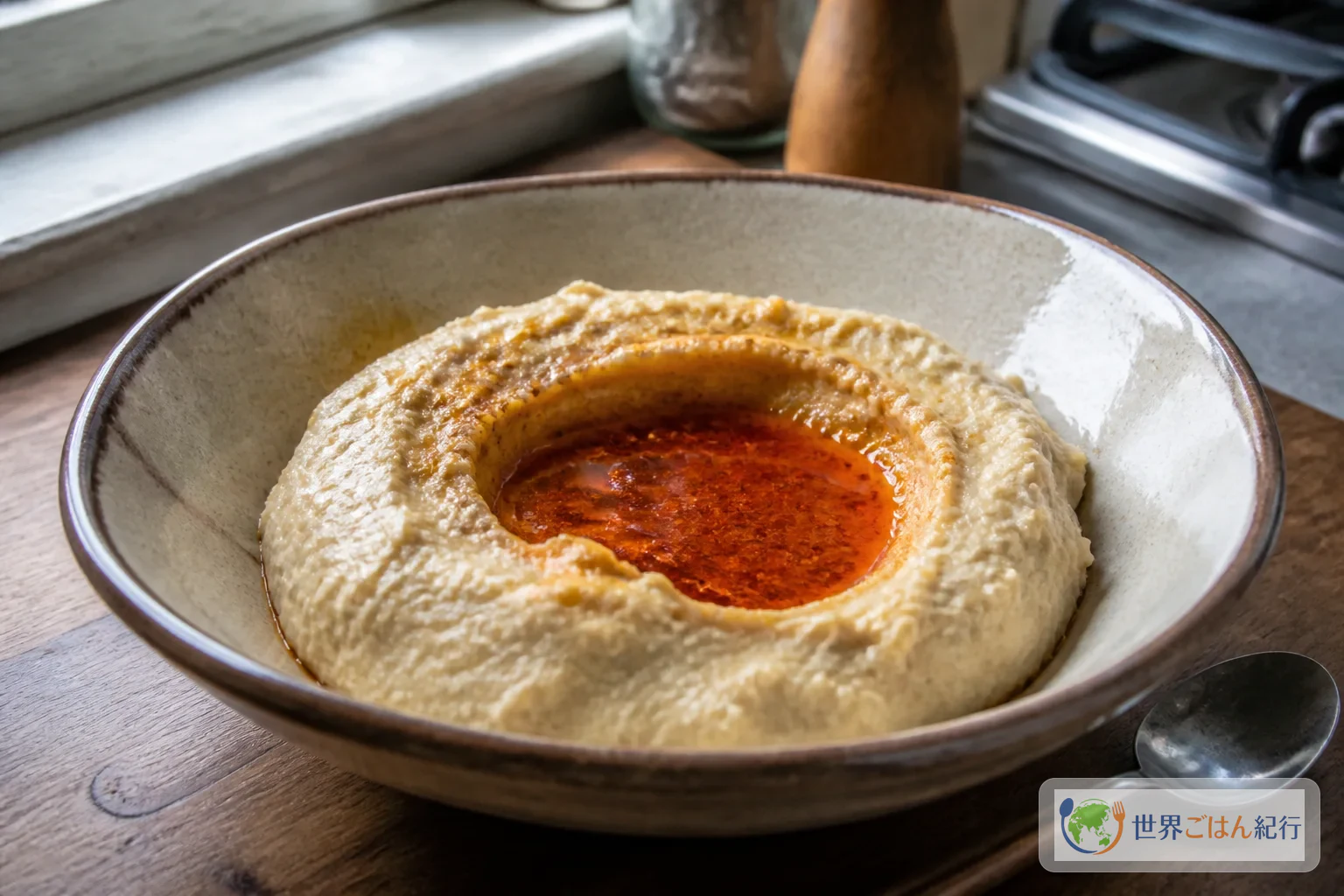
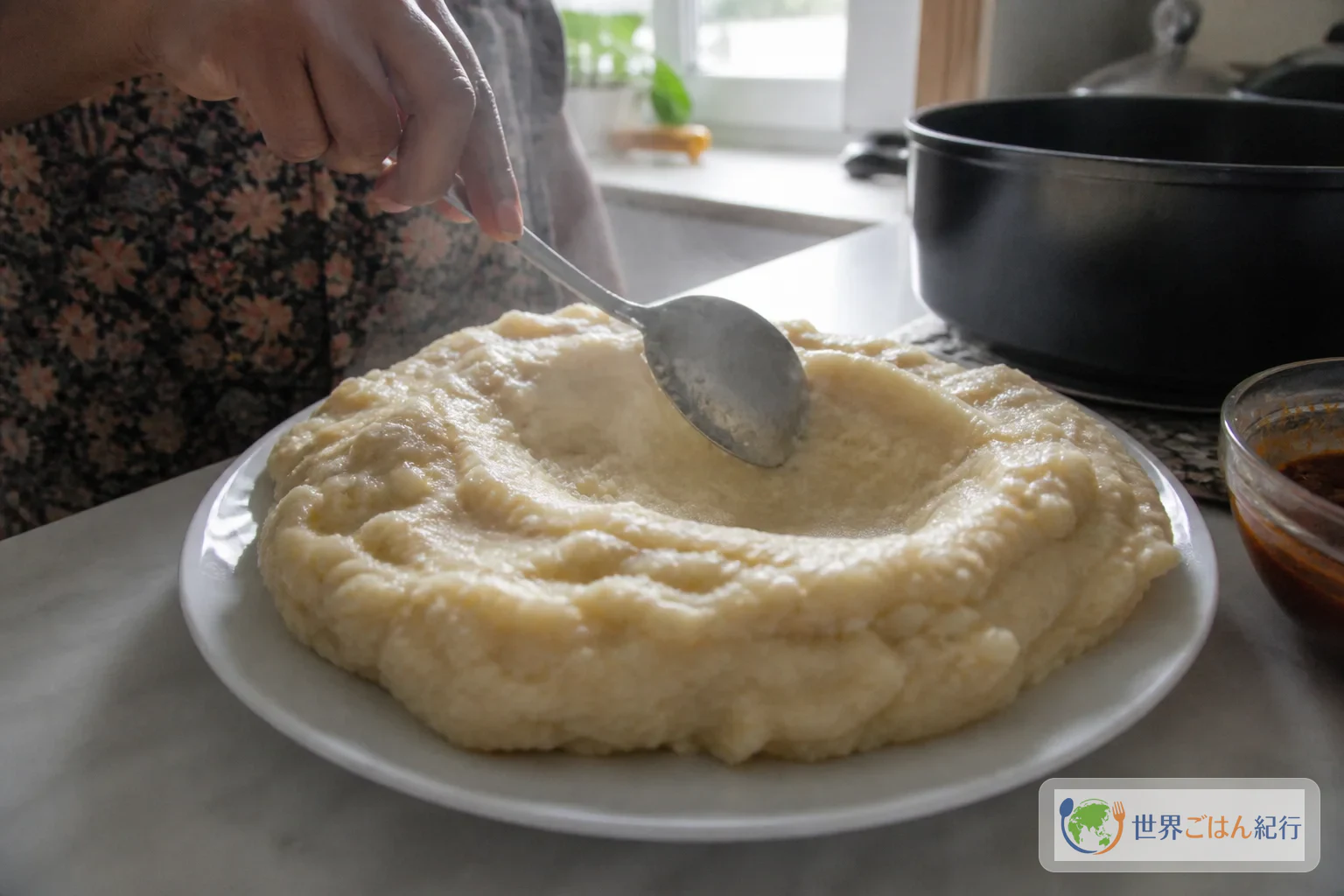
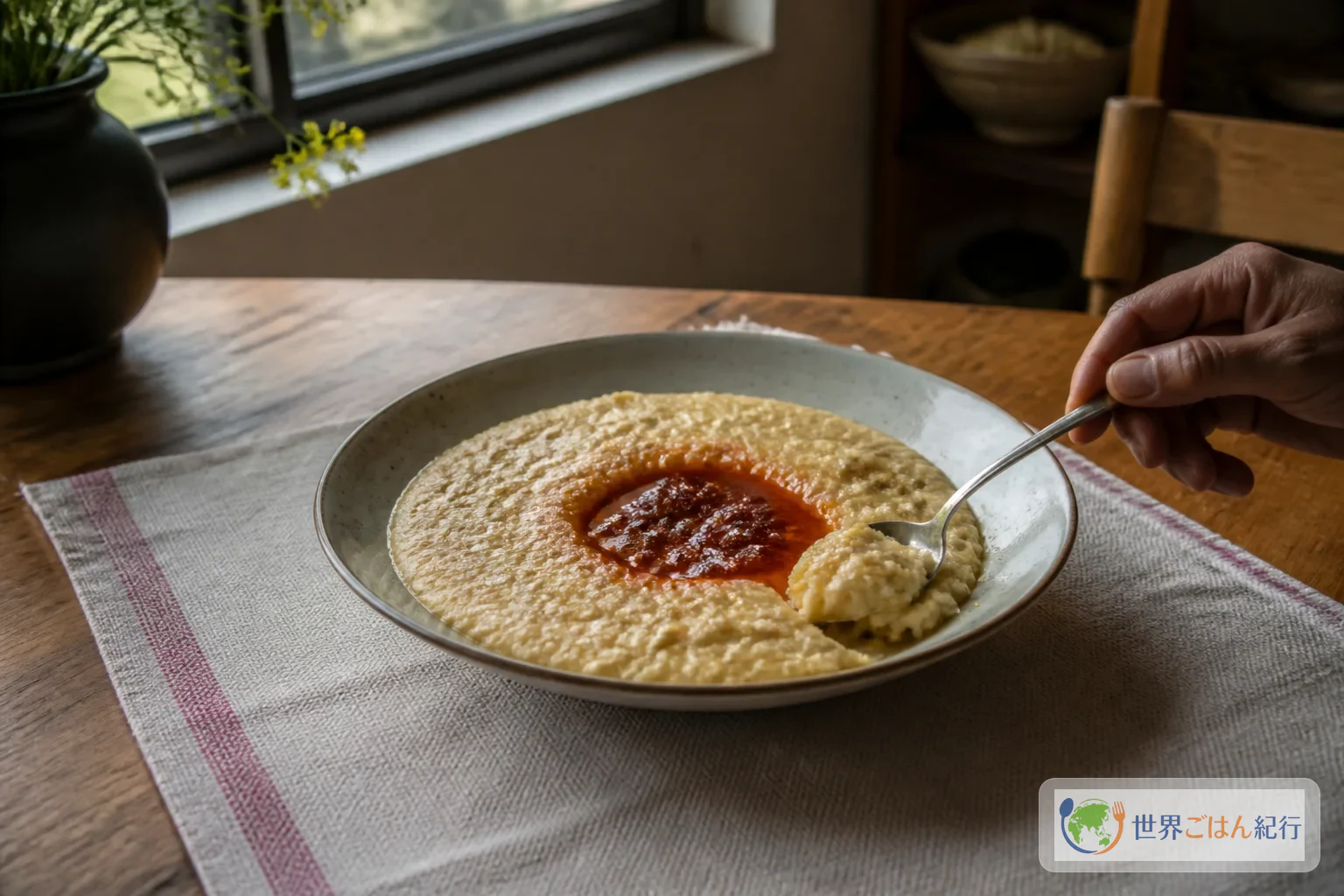
Break into the steaming, pale mound with a spoon, starting from the outside. In the well at the center, butter spiced red with berbere pools, and with each spoonful the heat and the richness shift a little. This is genfo, an Ethiopian breakfast of grain flour worked with water. It is much firmer than the loose bowl the word "porridge" might bring to mind, firm enough to hold its shape on the plate, and here it is made with easy-to-find wheat flour.
Genfo in Ethiopia
The Well at the Center
The dent in the middle has a job. It holds the niter kibbeh and berbere, and each time you take porridge from the outside, you decide how close to that aromatic center you go. The flavor builds in order: pale flour first, then butter, and last the heat of chili. Even people who don't care for spice can choose where they eat.
Genfo is a dish where you break the outside of the mound a little at a time and take the aroma at the center. Once you understand that structure, you have a breakfast whose flavor changes as you eat.
Grains, Regions and Occasions
Genfo is made almost everywhere in the country, with wheat, barley, corn and other grains. In regions such as Bale, Gambela and Borena it is a staple, and the type of flour depends on the climate and the grains available. Traditionally the grain is washed, dried, roasted and ground, and how far it is roasted changes its savoriness.
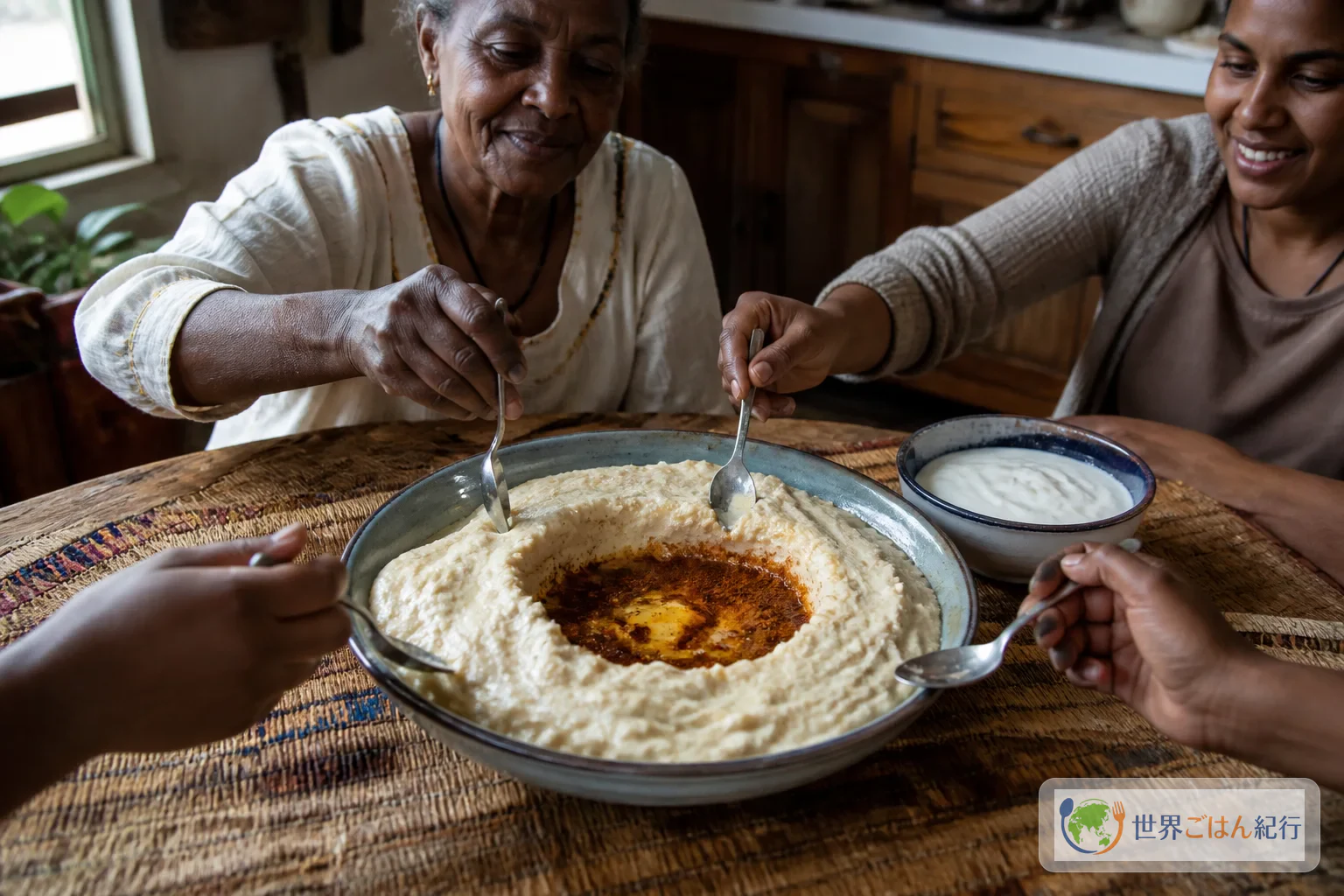
Genfo is eaten as a breakfast, and it is also served to women after childbirth. Occasions and accompaniments vary by region. In parts of the north, people gather around a large dish at weddings, share it among several people and eat it with yogurt; in other households, each person gets a single portion for breakfast.
How Genfo Differs from Other Ethiopian Dishes
Genfo doesn't wait on fermentation like injera, and it isn't a long simmer like doro wat. It goes from flour and water to finished in one pot. The skill lies in judging the moment when the flour has absorbed the water and the trail of the wooden spatula stays, which is why you can make it well at home without the local ingredients.
Ingredients: Shape with Wheat Flour, Build the Aroma in a Separate Pot
The ingredients are for 4. Make one mound in a large shallow dish and serve from it, or divide among 4 bowls and dent the center of each. The first time, use a single dish, because it makes the flavor change from the outside to the center easier to notice.
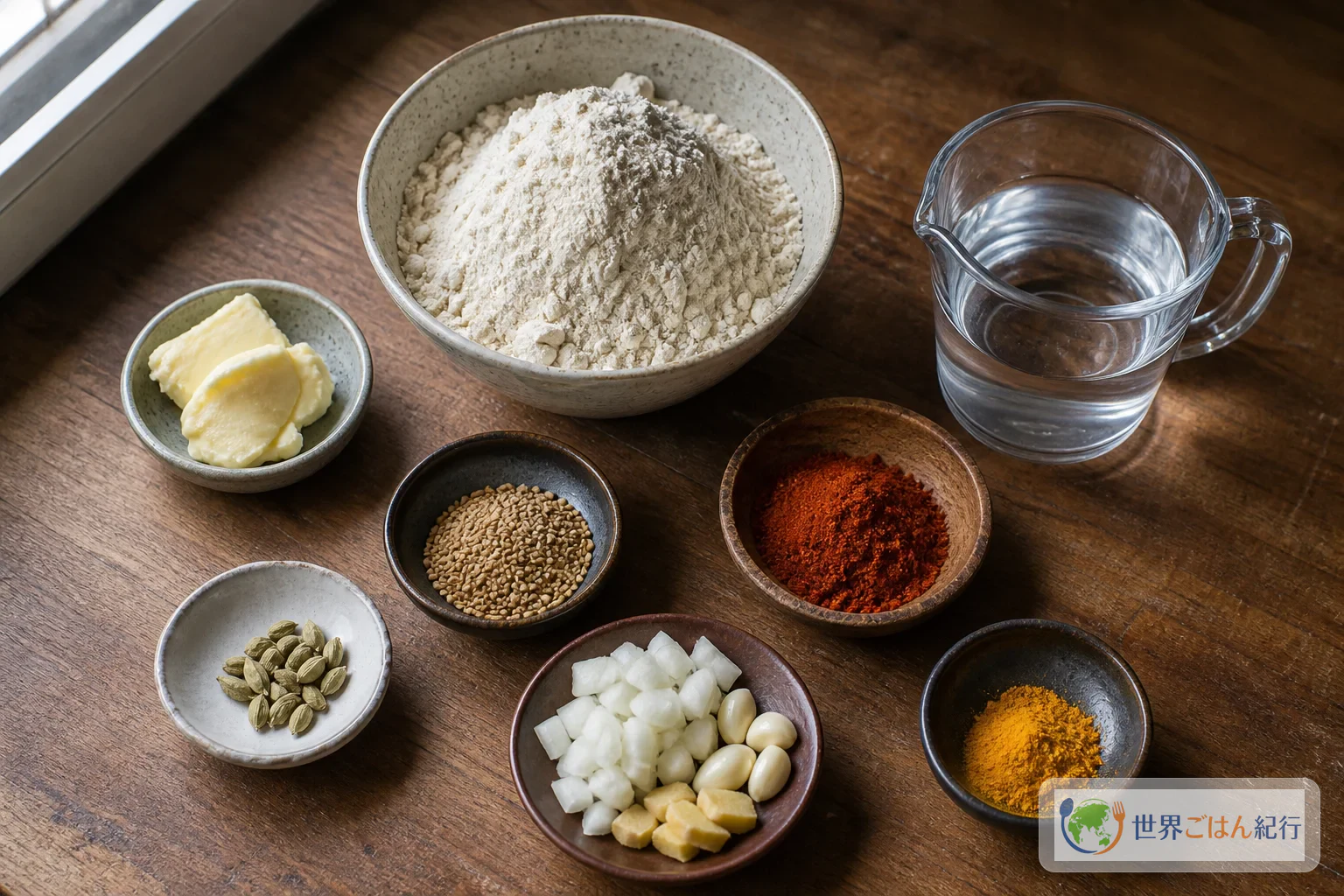
Cake flour (low-protein flour) is fine. This recipe focuses on working the hot flour smooth rather than on the exact type of flour. When using barley flour, do not add all the water from the start; match the viscosity with the last 3.5 tbsp (50 ml).
Fenugreek is a seed that gives a pleasant bitterness and a maple-like scent even in small amounts. Warmed together when you make niter kibbeh, its outline comes out from under the sweet scent of butter. If you already have berbere or spiced butter, you do not need to buy a 1 lb (500 g) bag of whole seeds. If you plan to make doro wat and berbere as well, check on the product page whether you are choosing whole seeds or already-ground powder.
For genfo alone you use only a small amount of fenugreek seeds. For a one-off, 1/2 tsp curry powder works as a stopgap, and buy the whole seeds only if you also plan to use them for berbere or doro wat. Store-bought berbere also works, but check the heat and saltiness on the label, and start with less than 15 g while tasting.
This recipe uses wheat and dairy, so if you have a wheat or dairy allergy, do not use these ingredients as they are. Switching to vegetable oil does not remove the wheat. Store-bought berbere and curry powder differ in ingredients by product, so check the label before buying.
Do not eat wheat flour raw; cook it thoroughly to the center. Do not increase the onion or ginger in the spiced butter to make it keep longer. Refrigerate leftover genfo and do not leave it at room temperature for long.
Choosing Flour and Spices for Genfo
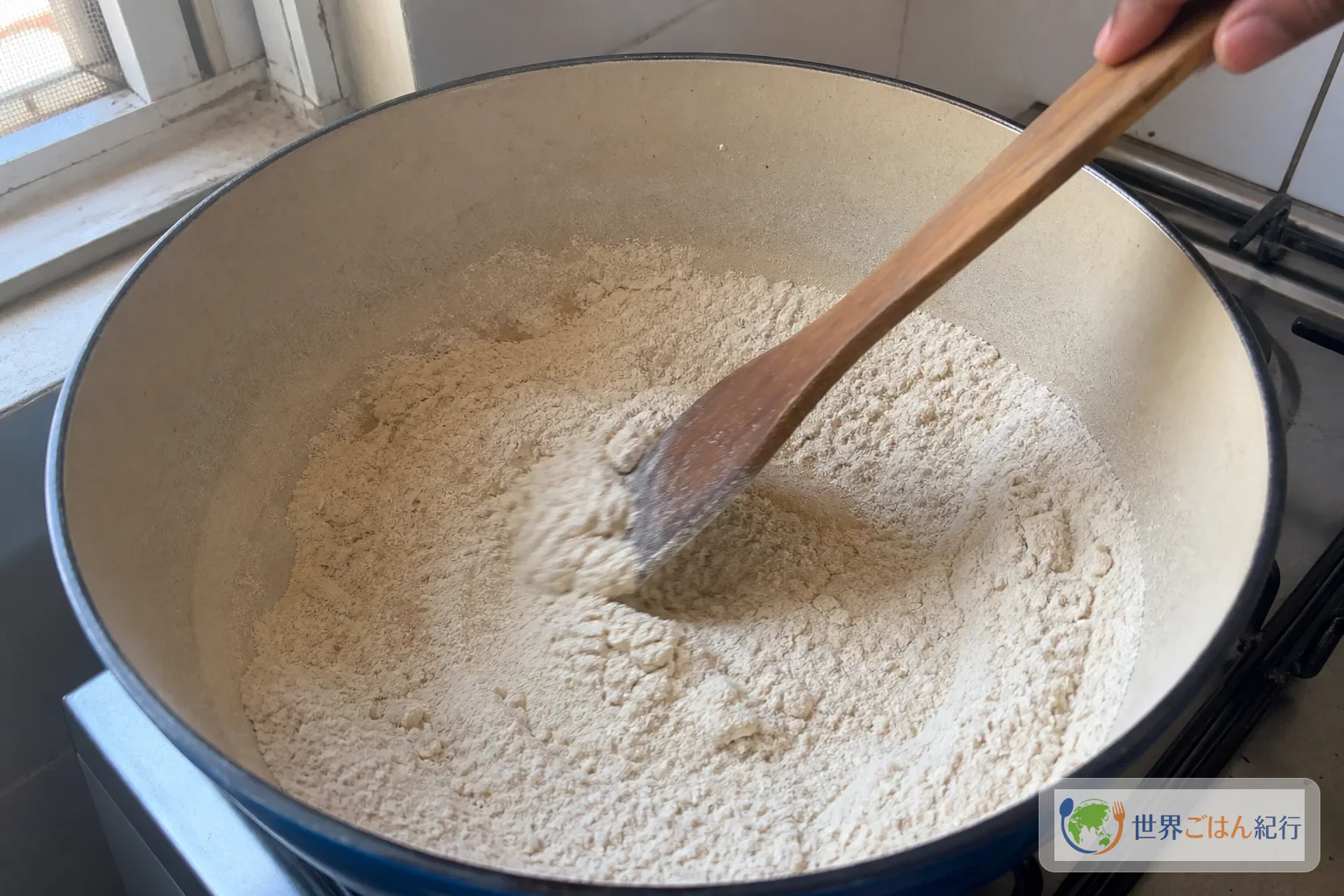
This recipe dry-toasts cake flour. That step stands in for the traditional roasting and brings out the aroma in a short time.
Changing the grain changes the shape of genfo, and the same amount of water won't give the same firmness. Barley flour has a stronger savoriness and makes a slightly rough mound, so start with only 3¼ cups (800 ml) of water and add the rest a little at a time while you work it. For corn flour, choose a fine one for baking or polenta, use about 3.5 tbsp (50 ml) more water, and if grains remain, extend the low-heat time by 5 minutes. Coarse cornmeal is hard to make smooth even when worked, so for a first batch, stick with cake flour or a finely ground flour. Whatever you use, adjust the water while you watch the texture.
If you buy whole fenugreek and cardamom, crush them slightly first to release the aroma. The mortar you have at home is enough for this amount. If you plan to make your own berbere or use whole spices in other dishes, a mortar that can crush grains coarsely is worth having, so check its material and what comes with it before you buy.
Method
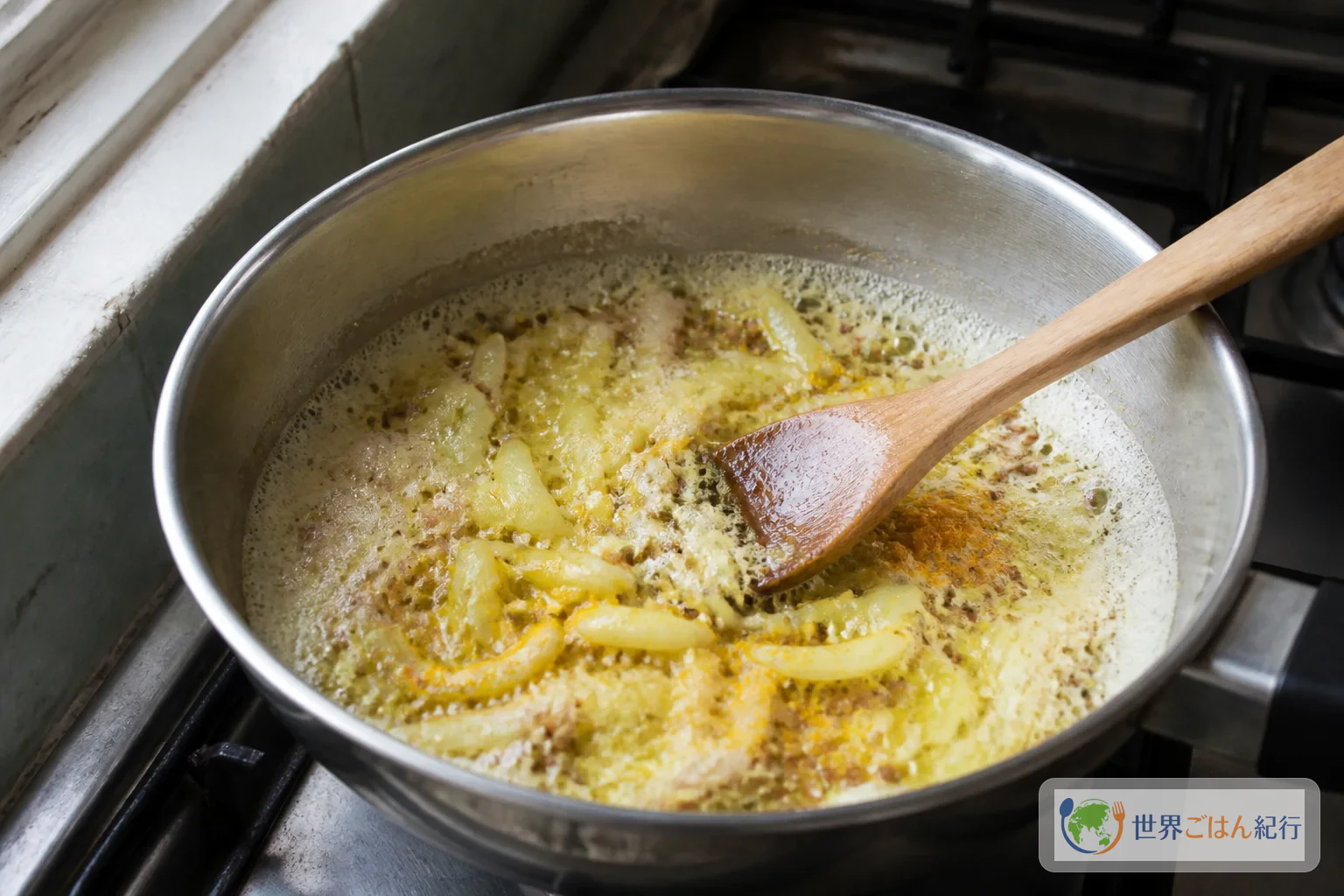
Use a heavy-bottomed pot. Choose a wooden spatula whose handle is not too short, so that you can keep pushing with steady force even after the flour gets heavy. Make the spiced butter first, then toast the flour dry, and finally return it gradually to the boiling water; the order of work is then hard to break.
It is important to shape it while the heat of the flour remains. If you try to dent it after it cools, the surface cracks and the oil in the center easily runs outward. When 4 people gather around one dish, do not share one spoon; preparing a serving spoon is easier to manage.
Common Genfo Problems and Fixes
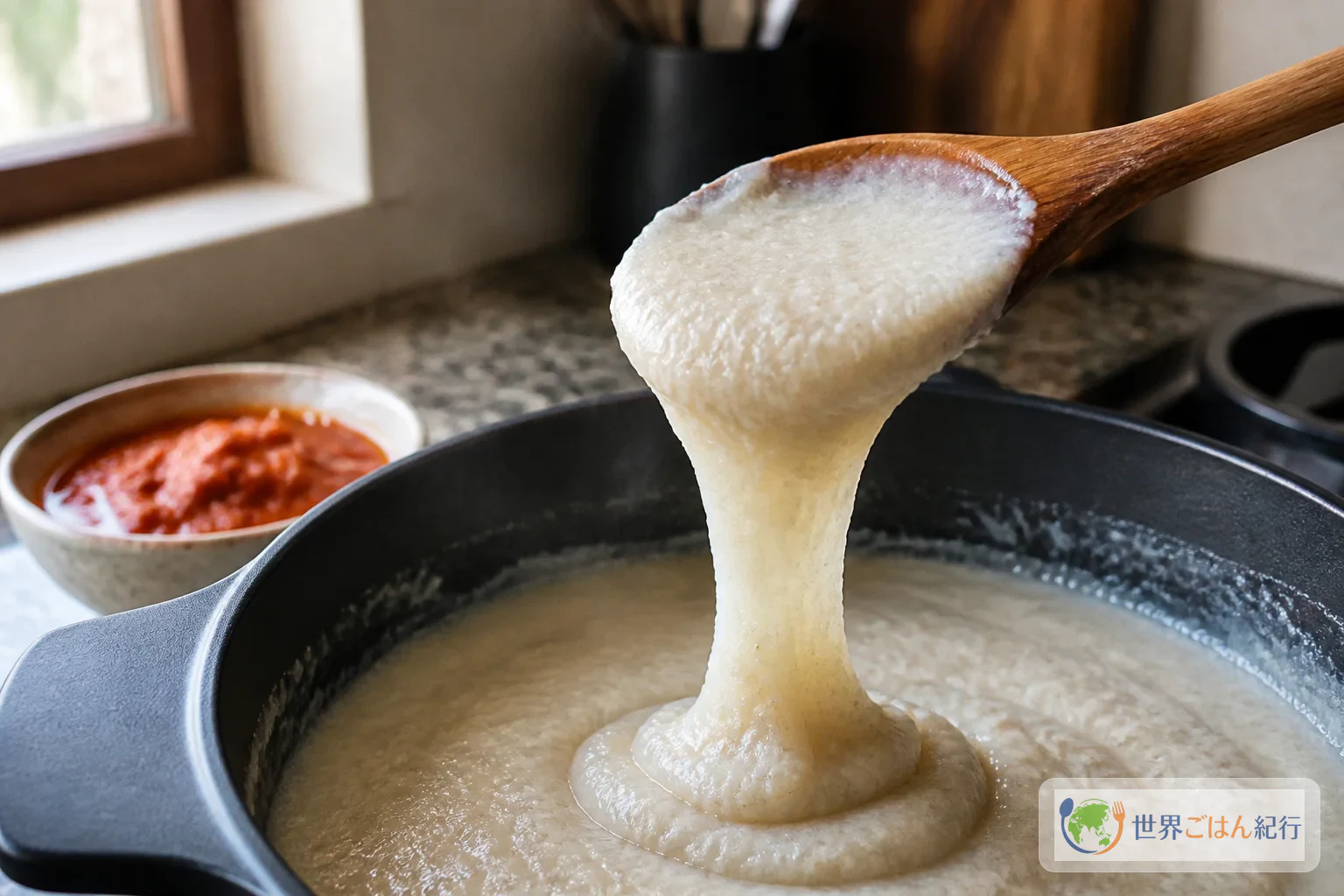
Success with genfo comes down to the final viscosity. Make it loose with extra water and the berbere butter won't stay in the center; it drifts toward ordinary porridge. Make it too stiff and the wooden spatula stops, and you can't smooth the surface.
The two classic mistakes happen early. Add the flour all at once and it lumps; cook over heat that's too high and only the bottom of the pot sets.
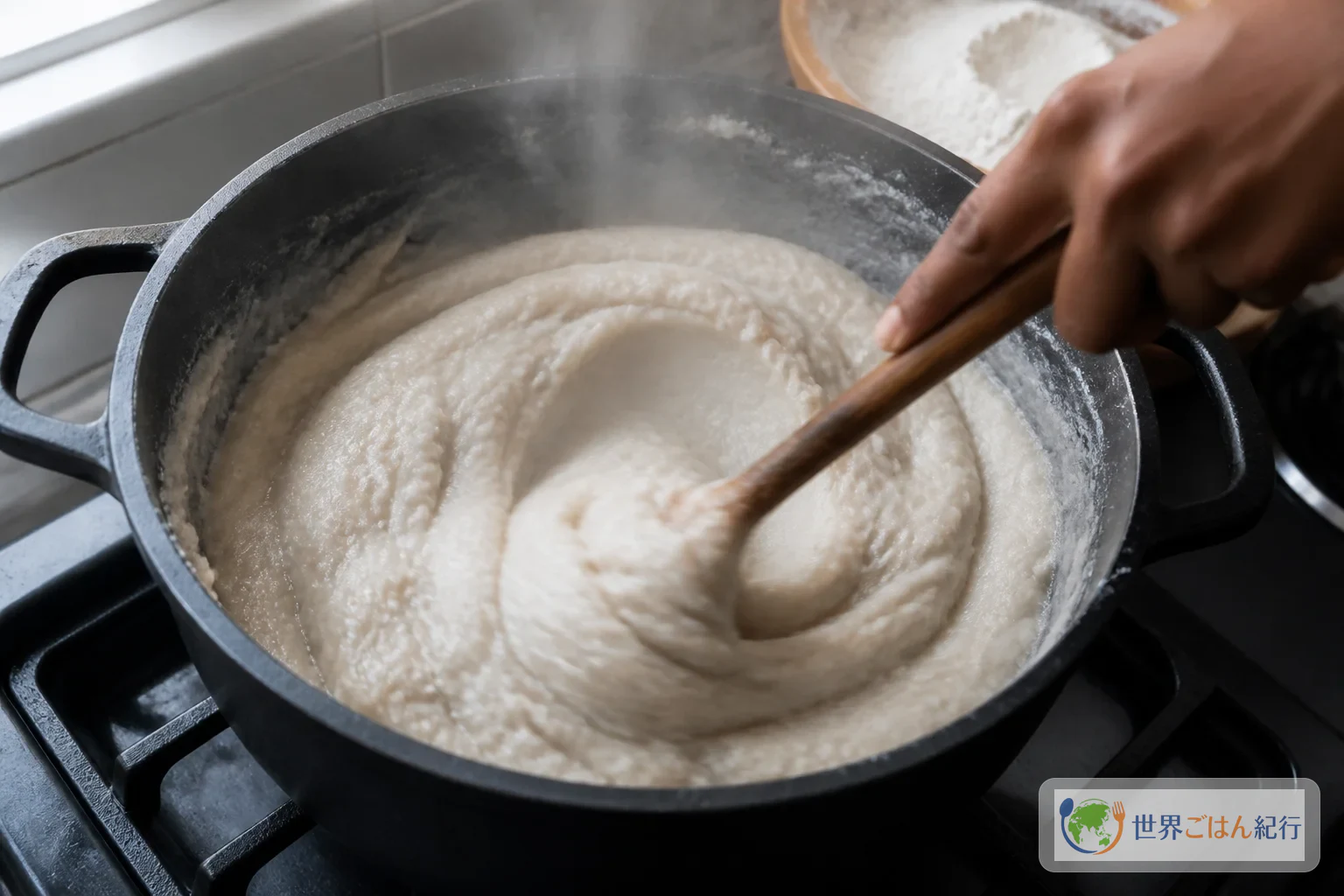
When you drop flour into boiling water, at first there is the sound of small bubbles. As the flour increases, the sound dulls and the feel of the wooden spatula against the bottom of the pot gets heavy. When you feel this change, do not add flour all at once; work it for about 20 seconds before adding the next 3 tablespoons.
If you draw the wooden spatula across the bottom of the pot and the trail stays for 2 seconds, you can move to shaping. If the trail fills in right away, cook 3 minutes over low heat; if the surface cracks and cannot be pushed, add the reserved water 2 tsp at a time. Decide not by time alone but by the line on the bottom of the pot and the stickiness.
1–2 minutes is enough to warm the spiced butter and berbere. If you use high heat to deepen the red, the chili scorches and turns bitter. Turn off the heat when red oil floats on the surface and the heat reaches your nose.
Serving Genfo and Variations
You can make the well in individual bowls or bring one large dish to the table to share.
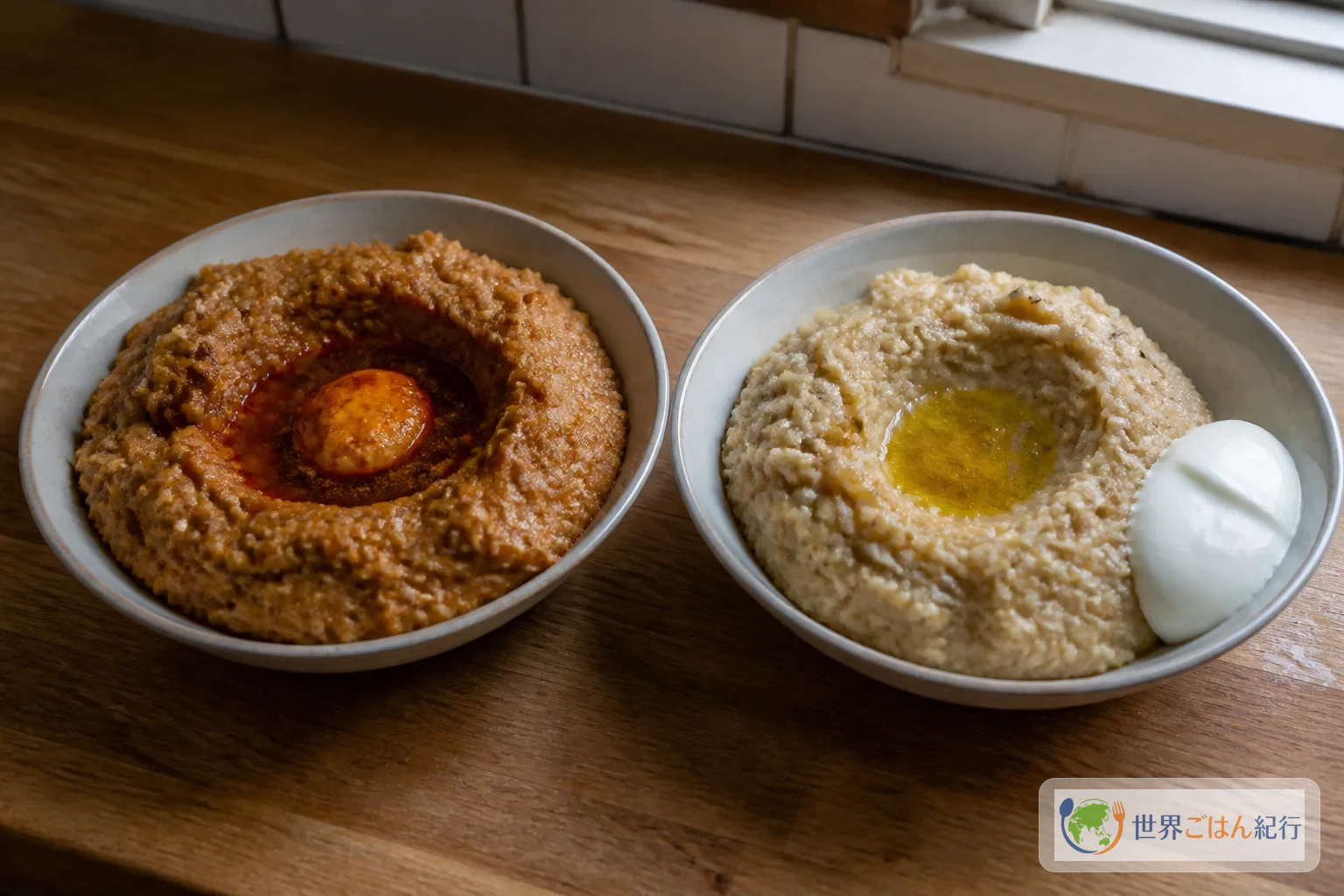
To keep the heat down, make the berbere 8 g and add 7 g paprika powder. The red color stays, but the chili's heat softens. Serving it with 4 oz (120 g) yogurt rounds off the oil and heat; rather than mixing it into the center, pair a little with each spoonful from the outside so you can follow how the flavor changes.
For a plant-based version, replace the spiced butter with 3.5 tbsp (50 ml) vegetable oil. You'll lose the milky aroma of the butter, and the way to hold on to aroma is to keep the full time for warming the berbere rather than adding more fenugreek. The flour is unchanged, so this version still contains gluten.
Frequently Asked Questions
Q1. Can I make genfo ahead?
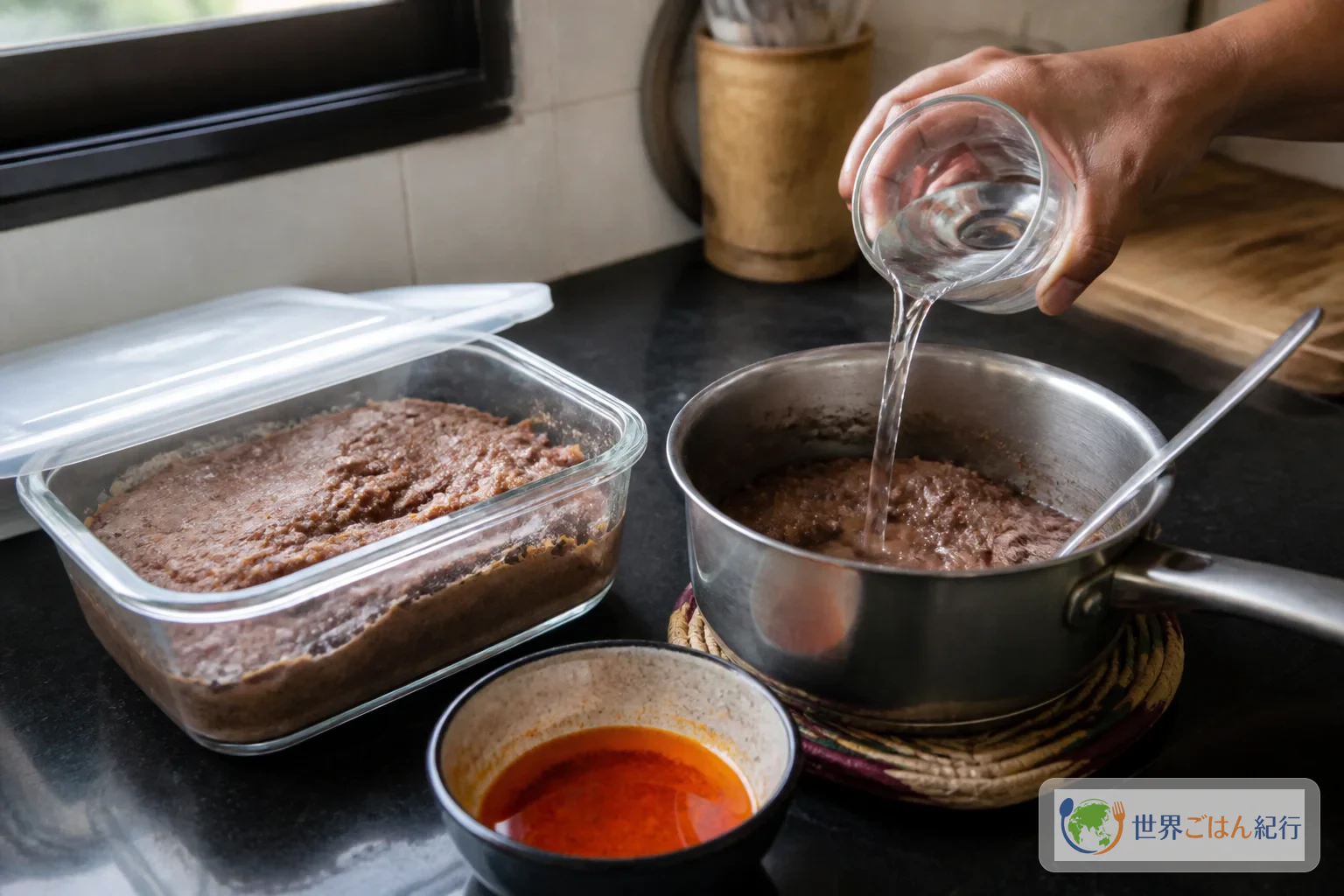
It is best eaten the day it is made. Cool the leftovers a little, move them to a shallow airtight container, refrigerate, and finish within 2 days. To reheat, put it in a small pot with 1 to 2 tbsp water and warm over low heat. When it turns smooth as you press it with the wooden spatula, return it to a bowl and remake the well. A microwave alone dries out and hardens the surface.
Q2. The flour lumped. Can I fix it?
If there is still moisture left, lower the heat and crush the lumps against the bottom of the pot with the tip of the wooden spatula. If the lumps are big, turn off the heat, add a little boiling water, stir broadly with a whisk, then go back to the spatula. Large lumps won't fully disappear once cooked, so break them up finely before plating to even out the texture. Next time, add the flour in small amounts from the start; it's the surest prevention.
Q3. Can I make it without fenugreek?
Yes, though the spiced butter loses its pleasant bitterness and sweet aroma. If you're making it just once, leave the fenugreek out and don't add extra berbere to compensate. If you want a substitute, add just 1/2 tsp curry powder, and if the cumin comes forward too much, skip it next time.
Q4. How do I avoid wheat or dairy?
To avoid wheat, use finely ground barley or corn flour, but note that barley contains gluten. To avoid dairy, replace the unsalted butter with vegetable oil. Check the labels of the berbere and any substitute flour for wheat, dairy and other allergens. If you have a food allergy, do not make this on your own judgment.
Sources
The type of flour, the well in the center, the spiced butter, how it is eaten, regional differences and storage time in this recipe were checked against the sources below. Quantities and substitutions are the editors' reconstruction based on the cooking principles in the sources, and are not the only formula common to every region.
- Springer Nature, Discover Food, review of Ethiopian cereal foods, "Genfo's grains, regional differences and place at the table" https://link.springer.com/article/10.1007/s44187-025-00593-2 (accessed and checked 5 August 2026)
- Ethiopian Food, "Genfo Recipe" https://ethiopian-food.org/genfo-recipe/ (accessed and checked 5 August 2026)
- Ethiopian Roots, "Niter Kibbeh Recipe" https://ethiopianroots.com/niter-kibbeh-recipe/ (accessed and checked 5 August 2026)
- MECS / EnDev Ethiopia, "eCooking Market Assessment presentation" https://mecs.org.uk/wp-content/uploads/2022/02/MECS-EnDev-Ethiopia-eCooking-Market-Assessment-presentation.pdf (accessed and checked 5 August 2026)